 Tajweed Resources
| Key Takeaways |
| The Noorani Qaida is a structured Tajweed foundational book authored by Sheikh Noor Muhammad Al-Haqqani, born in 1865 in Punjab, India. |
| The book teaches Arabic letter recognition, Makharij (articulation points), Sifat (letter attributes), and vowel marks before progressing to full Quranic recitation. |
| Noorani Qaida contains 17 progressive lessons moving from individual letters through Shaddah, Sukoon, Madd, and complex consonant combinations. |
| Non-Arabic speakers using the Noorani Qaida method develop correct Hafs ‘an ‘Asim pronunciation habits before ingraining recitation errors. |
| Tajweed rules including Ghunnah, Madd, and Sukoon are embedded within Noorani Qaida lessons, making it an applied Tajweed entry point. |
Every certified Tajweed instructor has sat with students who arrived confident in their Arabic reading — only to discover their foundational letter pronunciation was built on guesswork. The Noorani Qaida Tajweed book exists precisely to prevent this. It isn’t merely an alphabet primer; it’s a systematic applied Tajweed methodology that embeds correct Makharij and Sifat habits from the very first lesson.
Developed by Sheikh Noor Muhammad Al-Haqqani and refined over generations of classroom application, the Noorani Qaida serves non-Arabic speakers as a phonetic and Tajweed entry point simultaneously.
Students who complete its 17 lessons correctly arrive at Quranic recitation with pronunciation architecture already in place — rather than unlearning bad habits later.
What Is the Noorani Qaida Tajweed Book?
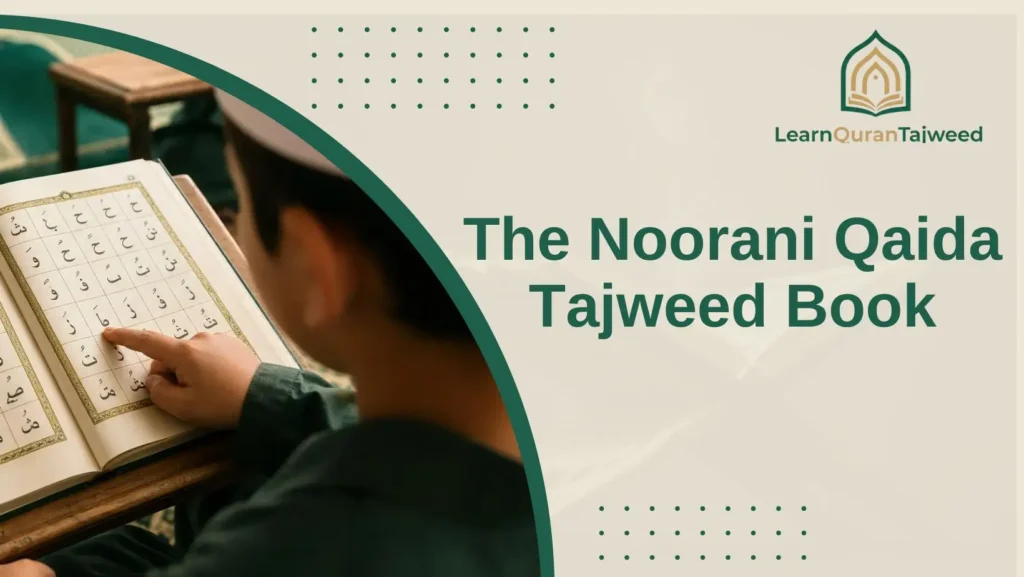
The Noorani Qaida Tajweed book is a structured foundational reading method that teaches Arabic letter recognition, correct articulation points (Makharij), and essential Tajweed rules simultaneously — before a student opens the Mus’haf.
It is named after its author, Sheikh Noor Muhammad Al-Haqqani, who was born in 1865 in Punjab, India, completed advanced Hadith studies under the scholar Ahmad Ali Al-Sahanpuri, and passed away in 1925.
What separates the Noorani Qaida from generic alphabet books is its deliberate integration of recitation accuracy. Students don’t just learn letter shapes — they learn how each letter is produced, where in the mouth or throat it originates, and how vowel markers (Harakat) change its sound. This is applied Tajweed from lesson one.
At Learn Quran Tajweed Academy, our Tajweed course for Kids uses Noorani Qaida as the primary entry framework for young non-Arabic speakers, precisely because its sequential structure prevents the pronunciation fossilization that is so difficult to correct later.
Enroll your kid in our Tajweed classes for kids with a FREE trial

What Is Tajweed Qaida and How Does It Differ from Standard Arabic Primers?
Tajweed Qaida — often used interchangeably with Noorani Qaida — refers specifically to a foundational Arabic reading book designed around Quranic pronunciation standards, not Modern Standard Arabic. Standard Arabic primers teach letters for general literacy. A Tajweed Qaida teaches letters for Quranic recitation accuracy.
The distinction is significant in practice. The letter ض (Dhad), for instance, is pronounced differently in Modern Standard Arabic versus its Quranic Makhraj. A Tajweed Qaida trains the ear and tongue toward the Uthmani Rasm standard from the beginning.
This is why the Noorani Qaida specifically references the recitations of authenticated Qaris such as Al-Hussary and Abdul Basit — as phonetic models for students to internalize correct recitation sound.
How the Noorani Qaida Embeds Tajweed Rules from the Beginning
The Noorani Qaida doesn’t delay Tajweed until a separate course. Rules like Ghunnah (nasal resonance), Madd (prolongation), and Qalqalah (echo sound) appear organically within lessons as students encounter the letters and vowel conditions that trigger them.
This is pedagogically sound. Students encounter Ghunnah rules first through the Noon and Meem letters in context — before they ever need to memorize abstract rule definitions.
Shots Videos from Our Courses
Perfect Your Quran Recitation Today
Join expert-led Tajweed classes, and recite the Quran with confidence and clarity.
Start Your Free TrialRead Also: Best Tajweed Books
What Are the Lessons in Noorani Qaida with Tajweed?
The Noorani Qaida contains 17 sequential lessons, each building on the previous. Every lesson introduces a phonetic or Tajweed concept through Quranic vocabulary and controlled practice segments.
| Lesson | Topic | Core Tajweed Element Introduced |
| 1 | Individual Arabic Letters (Mufradah) | Letter recognition and basic Makhraj |
| 2 | Compound Letter Forms (Murakkabah) | Letter joining and shape variation |
| 3 | Disconnected Letters (Al-Huruf Al-Muqatta’ah) | Quranic letter pronunciation (e.g., Alif-Lam-Mim) |
| 4 | Letters with Vowel Marks (Mutaharrikah) | Fathah, Kasrah, Dhammah application |
| 5 | Tanween (Nunation) | Double vowel sounds and their Tajweed implications |
| 6 | Practice on Harakat and Tanween | Applied recitation review |
| 7 | Small Alif, Yaa, and Waw | Uthmani script conventions |
| 8 | Letters of Madd and Leen | Foundational Madd rules — Alif, Waw, Yaa elongation |
| 9 | Combined practice: Tanween, Madd, Leen | Integrated recitation application |
| 10 | Sukoon (vowelless letters) | Correct stopping without vowel sound |
| 11 | Sukoon practice | Applied Sukoon in Quranic words |
| 12 | Shaddah (gemination) | Double consonant production with full weight |
| 13 | Shaddah practice | Applied gemination in context |
| 14 | Combined Shaddah and Sukoon | Complex consonant clusters |
| 15 | Double Shaddah within a word | Advanced gemination patterns |
| 16 | Shaddah, Sukoon, and Madd combined | Full Tajweed rule interaction |
| 17 | Cumulative review of all prior lessons | Integrated recitation assessment |
Each lesson uses Quranic words as practice material — not invented Arabic. This means students are simultaneously building Quranic vocabulary recognition alongside their recitation skills.
Read Also: How to Recite Quran With Tajweed?
How Does Noorani Qaida Teach Makharij and Sifat Before Full Quranic Reading?
The most technically demanding aspect of the Noorani Qaida is its Makhraj (articulation point) framework. Before students can read flowing Quranic text, they must be able to produce each Arabic letter from its correct anatomical position.
Classical Tajweed scholarship, following the methodology of Imam Ibn Al-Jazari, identifies 17 primary Makharij grouped across five regions: the chest, throat, tongue, lips, and nasal passage. The Noorani Qaida introduces these organically — not as a memorized list, but as a felt physical experience as students practice each letter individually.
Read Also: How to Improve Tajweed?
Why Non-Arabic Speakers Struggle Most with Throat Letters
In my experience working with non-Arabic speakers, the letters ع (Ain), غ (Ghain), ح (Ha), and خ (Kha) cause the most persistent errors. These sounds have no phonetic equivalent in English, French, Urdu, or most Western languages.
Students often substitute ع with a plain vowel sound, or produce ح as a simple ‘h’ rather than from the middle of the throat (Wasat Al-Halq).
The Noorani Qaida addresses this by isolating these letters early and providing structured repetition before they appear in complex words.
Students at Learn Quran Tajweed Academy who work through our Beginner Tajweed Course often describe the throat-letter correction as the single most transformative moment in their recitation development.
Begin your Tajweed journey with a free lesson

Read Also: Tajweed Made Easy Book
Noorani Qaida Tajweed Reading
Noorani Qaida Tajweed reading means applying Tajweed rules actively during every practice session — not reading first and correcting later.
The methodology requires students to pause at each letter, confirm its Makhraj, check the vowel marker, and produce the sound with the correct Sifat before moving forward.
This slow, deliberate approach is called Tarteel — measured, unhurried recitation. The Prophet ﷺ recited in this manner, and the Quran itself instructs:
وَرَتِّلِ ٱلْقُرْءَانَ تَرْتِيلًا
Wa rattil il-Qur’āna tartīlā
“And recite the Quran with measured recitation.” (Al-Muzzammil 73:4)
This verse is the foundational justification for the Noorani Qaida’s pace-first methodology. Speed is never the goal. Precision is.
For students working toward full Tarteel recitation after completing the Qaida, Learn Quran Tajweed Academy’s Quran Tarteel Course provides structured progression from foundational reading speed to melodious, measured full recitation.
Join our Quran Tarteel Course and get a free trial

Read Also: The Jazariyyah Tajweed Poem
The Core Tajweed Rules Embedded Within the Noorani Qaida Lessons
The Noorani Qaida doesn’t just prepare students for Tajweed — it actively teaches several of its most important rules within the lesson sequence itself.
Madd (Prolongation) Rules in Lessons 8 and 16
Madd Al-Tabee’i (natural prolongation of two counts) is introduced in Lesson 8 through the three Madd letters: Alif, Waw, and Yaa. Students learn to sustain these letters for exactly two counts before encountering the extended Madd types in later Quranic study.
Read Also: Best Tajweed Book for Kids
Perfect Your Quran Recitation Today
Join expert-led Tajweed classes, and recite the Quran with confidence and clarity.
Start Your Free TrialRead Also: Fun Tajweed Activities for Kids
Sukoon and Its Interaction with Noon Sakinah
Lesson 10 introduces Sukoon — the vowelless state of a letter. This is the prerequisite for understanding Noon Sakinah rules including Ikhfa, Idgham, Iqlab, and Izhar — which students encounter in the Intermediate Tajweed phase.
Read Also: Tajweed Practice Worksheets
Shaddah and the Ghunnah Connection
Lessons 12–16 build Shaddah mastery. When a Shaddah appears on Noon (نّ) or Meem (مّ), it triggers Ghunnah Mushadd-dadah — the strongest level of nasal resonance in Tajweed, lasting two full counts. This rule is embedded in the Noorani Qaida before students ever encounter a formal Tajweed rules chart.
| Tajweed Rule | Noorani Qaida Lesson | Rule Detail |
| Madd Al-Tabee’i | Lesson 8 | Two-count prolongation on Alif, Waw, Yaa |
| Sukoon application | Lesson 10–11 | Vowelless letter articulation |
| Ghunnah Mushadddadah | Lesson 12–13 | Nasal resonance on Shaddah Noon/Meem |
| Combined rule interactions | Lesson 16–17 | Madd + Sukoon + Shaddah in Quranic text |
For deeper study of these rules after completing the Qaida, students can explore Ikhfa rules, Idgham in Tajweed, and Iqlab rules as natural next steps.
Read Also: Tajweed Worksheets for Kids
Our Students Reviews
Perfect Your Quran Recitation Today
Join expert-led Tajweed classes, and recite the Quran with confidence and clarity.
Start Your Free TrialBegin Your Quranic Recitation Foundation at Learn Quran Tajweed Academy
The Noorani Qaida Tajweed book is only as effective as the instruction guiding it. Reading it alone builds partial habits; working through it with an Ijazah-certified instructor builds correct ones.
Learn Quran Tajweed Academy offers:
- Ijazah-certified instructors specializing in Hafs ‘an ‘Asim recitation
- Personalized 1-on-1 sessions tailored to each student’s current level
- Flexible scheduling available 24/7 for students worldwide
- Structured progression from Qaida foundations to full Ijazah certification
- Specialized Tajweed focus — not a generalist academy
Book your FREE trial lesson today and begin building the recitation foundation that Insha’Allah serves you for life.
Check out the best tajweed course for your needs:
- Practical Tajweed Course
- Beginner Tajweed Course
- Intermediate Tajweed Course
- Advanced Tajweed Course
- Quran Tarteel Course
- Tajweed Ijazah Program
- Tajweed Course for Sisters
- Tajweed course for Kids
Book your free trial Tajweed lesson today

Conclusion
The Noorani Qaida Tajweed book earns its place as the most trusted Quranic reading foundation for non-Arabic speakers because it refuses to separate reading from recitation accuracy. Every lesson is an applied Tajweed session — not a linguistic exercise.
Students who invest the time to complete all 17 lessons correctly — under qualified instruction, at proper Tarteel pace — arrive at the Quran not as beginners, but as readers with embedded correct habits. That foundation, Alhamdulillah, is what makes every subsequent Tajweed rule easier to apply and internalize.
Read Also: Tajweed Rules with Examples for Kids
Frequently Asked Questions About the Noorani Qaida Tajweed Book
Is the Noorani Qaida Suitable for Adult Beginners or Only for Children?
The Noorani Qaida is fully suitable for adult beginners. While originally designed with children in mind, its structured phonetic progression makes it equally effective for adult non-Arabic speakers starting Quranic recitation. Most adults complete the 17 lessons more quickly than children, typically within 8–12 weeks of consistent daily practice with a qualified instructor.
Can Someone Learn Noorani Qaida Tajweed Reading Without a Teacher?
Self-study is possible but significantly limited. Without a qualified instructor correcting Makhraj errors in real time, students frequently ingrain incorrect pronunciation — particularly for throat letters like ع, ح, and غ. These errors become progressively harder to correct. A certified instructor provides the live phonetic feedback that no book or recording can fully replace.
How Many Lessons Are in the Noorani Qaida and How Long Does Each Take to Master?
The Noorani Qaida contains 17 lessons, progressing from individual letter recognition through complex Tajweed rule combinations. Mastery time per lesson varies by student. Most non-Arabic speaking adults spend 1–3 sessions per lesson when working with an instructor, meaning full Qaida completion typically requires 3–5 months of regular study.
Which Tajweed Rules Does the Noorani Qaida Cover Directly?
The Noorani Qaida directly covers Madd Al-Tabee’i (natural prolongation), Sukoon (vowelless letter articulation), Shaddah (gemination), Ghunnah Mushadddadah (nasal resonance on Shaddah Noon and Meem), and Leen letters. It establishes the prerequisites for Noon Sakinah rules, Tanween rules, and all four Nun Sakinah categories studied in the Intermediate Tajweed phase.