 Tajweed Resources
| Key Takeaways |
| Tajweed games transform abstract pronunciation rules into memorable, hands-on experiences children naturally retain longer than passive memorization. |
| Color-coded flashcard systems help kids visually distinguish Noon sakinah rules — Ikhfa, Idgham, Iqlab, and Izhar — without cognitive overload. |
| Recitation relay games build both accuracy and confidence by introducing healthy peer accountability in a low-pressure group format. |
| Physical movement activities, like letter articulation exercises, reinforce makharij (articulation points) through muscle memory rather than rote repetition. |
| Consistent short sessions of 10–15 minutes using varied Tajweed activities outperform long passive study for children under twelve. |
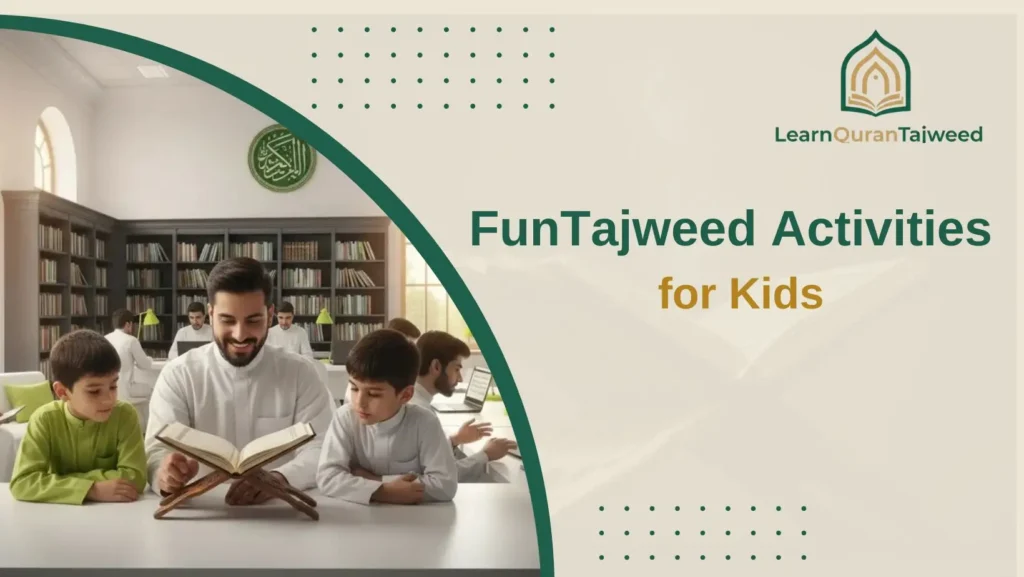
Fun Tajweed activities make the difference between a child who dreads recitation practice and one who asks for more. When kids engage with Tajweed through games, movement, and creative challenges, abstract rules like Noon sakinah orMadd stop feeling like memorization tasks and start feeling like skills they genuinely own.
At Learn Quran Tajweed Academy, our Tajweed Course for Kids is built on this exact principle — that children learn best through structured play. The activities below are drawn from real classroom experience with young non-Arabic speaking students, tested across hundreds of sessions.
Enroll your kid in our Tajweed classes for kids with a FREE trial

1. Tajweed Color-Coding Flashcard Game
Color-coded flashcard games teach kids to visually categorize Tajweed rules before they can apply them verbally. Assign each Noon sakinah rule a distinct color — green for Izhar, blue for Idgham, yellow for Ikhfa, and red for Iqlab. Children match Quranic word cards to the correct color category, reinforcing rule identification through visual pattern recognition.
How to set it up:
- Write short Quranic phrases containing Noon sakinah on index cards
- Color the border of each card to indicate the correct rule
- Shuffle the deck and time how quickly the child sorts them correctly
- Increase difficulty by removing color hints once they achieve mastery
This activity works especially well for ages seven to twelve and builds the foundational sorting skill needed before moving into full recitation application.
2. Ghunnah Clapping and Rhythm Activity
The Ghunnah duration — held for two counts — is one of the most commonly misjudged elements in children’s recitation. A clapping rhythm game gives children a physical anchor for that timing, something a verbal explanation simply cannot replicate.
The child recites a phrase containing a Ghunnah letter (Meem or Noon with shaddah) and claps once on the Ghunnah onset, then again at its release.
The parent or instructor confirms whether both claps fall within the correct window. Over time, the muscle-memory association between the physical beat and the nasal resonance becomes automatic.
How the Ghunnah Timer Challenge Works
Once the child is comfortable with standard clapping, introduce a challenge: recite ten consecutive phrases with correct Ghunnah timing while a parent counts silently.
Every correct Ghunnah earns a point. This transforms an isolated rule into a scoring system children instinctively want to master.
Shots Videos from Our Courses
Perfect Your Quran Recitation Today
Join expert-led Tajweed classes, and recite the Quran with confidence and clarity.
Start Your Free Trial3. Tajweed Games for Kids Using Letter Sorting Boards
Letter sorting boards are among the most versatile tajweed games for kids across multiple rule categories. A physical or printed board divides into sections — one per rule — and children place letter tiles or written cards into the correct section based on their Tajweed properties.
| Board Section | Rule / Property | Age Group |
| Sun Letters / Moon Letters | Lam assimilation | 6–8 years |
| Qalqalah Letters | Echo bounce | 8–10 years |
| Noon sakinah categories | Izhar, Idgham, Ikhfa, Iqlab | 9–12 years |
| Meem sakinah categories | Ikhfa Shafawi, Idgham Shafawi, Izhar Shafawi | 10–13 years |
Start children on the Sun/Moon letter board before advancing to Noon sakinah categories. The sorting logic is the same, but the phonetic complexity increases gradually — exactly the progression our Beginner Tajweed Course follows for young learners.
Begin your Tajweed journey with a free lesson

4. Recitation Relay Race for Sibling or Group Practice
A recitation relay teaches children to maintain Tajweed accuracy under mild time pressure — a skill they need for Quran competitions, classroom recitation, and eventually Ijazah assessment.
Two or more children take turns reciting consecutive verses from a short Surah, each picking up exactly where the previous child stopped.
The rule: if a Tajweed error occurs — mispronounced makharij, dropped Ghunnah, incorrect Madd length — the team loses one point. Correct, uninterrupted handoffs earn two points.
Children quickly realize that their individual accuracy affects the group, which creates genuine motivation to self-correct without an instructor needing to intervene.
5. Makharij Mouth Mirror Activity
Makharij errors are the most persistent problem I encounter with non-Arabic speaking children — and the hardest to correct through audio instruction alone. A small handheld mirror transforms articulation practice into a visible, self-correcting activity.
The child holds the mirror while attempting the Ain (ع), Ha (ح), or Ghayn (غ) sounds and watches their own jaw and lip position. The instructor demonstrates the target position, and the child adjusts until the visual matches.
Children find this surprisingly engaging — seeing their own articulation in real time builds a level of self-awareness that listening alone never achieves.
Pairing the Mirror Activity with the Qalqalah Letters
Once children are comfortable with the mirror, apply it specifically to the five Qalqalah letters — Qaaf, Taa, Baa, Jiim, Daal — in sukoon position.
The visible “pop” of the lips on Baa or the back-of-throat echo on Qaaf becomes immediately apparent in the mirror, giving children visual confirmation that their articulation is producing the correct bounce effect.
6. Tajweed Treasure Hunt with Rule Clue Cards
A Tajweed treasure hunt embeds rule review into a physical game that children ask to repeat. Write five to eight Tajweed rule clues on cards — each clue contains a Quranic word and asks the child to identify the rule applied. Correct answers reveal the next clue’s hiding location, leading toward a small prize.
Sample clue format:
“Find the word where Noon sakinah meets a Waw. What rule applies? Name it to find your next clue.”
This activity reinforces Noon sakinah rules and Meem rules in a retrieval-practice format — one of the most effective memorization strategies supported by cognitive science.
7. Tajweed Bingo for Classroom or Home Groups
Tajweed Bingo replaces standard Bingo numbers with Tajweed rule names, letter names, or Quranic terms. The caller recites a short phrase or description — the players mark the matching term on their board. First to complete a row calls “Tajweed!”
| Bingo Card Example |
| Idgham with Ghunnah |
| Madd Tabee’i |
| Qalqalah Kubra |
| Ikhfa |
| Izhar Halqi |
This game works well for groups of three or more and covers multiple rule categories simultaneously.
For online classes at Learn Quran Tajweed Academy, our instructors use digital Bingo boards in group sessions — children between ages eight and fourteen respond exceptionally well to this format.
Meet One of our Certified Teachers to Correct Your Kid’s Pronunciation

8. Madd Duration Stretching Game
Madd rules require children to hold vowel extensions for precise counts — two, four, or six harakaat — which most young learners find genuinely difficult without a physical anchor. The stretching game pairs each Madd type with a corresponding physical stretch.
- Madd Tabee’i (2 counts) — hands at shoulder width
- Madd Muttasil or Munfasil (4 counts) — arms extended to sides
- Madd Lazim (6 counts) — arms fully overhead
The child recites while holding each stretch for the correct duration. When the Madd ends, the stretch releases.
After ten to fifteen repetitions, the physical memory of the duration transfers into recitation without the movement — exactly the way motor learning is supposed to work.
9. Tajweed Rule Identification Buzzer Game
A buzzer game — even a simple hand-clap substitute — trains children to identify Tajweed rules at recitation speed rather than only during slow, deliberate study.
The instructor recites aloud; when a child hears a specific target rule, they buzz in and name it.
Start with a single rule target per round — Iqlab only, for example. Gradually increase to two or three simultaneous targets as the child’s identification speed improves.
The competitive element is self-directed: children naturally push themselves to respond faster in subsequent rounds.
10. Recitation Recording and Self-Review Challenge
Recording a child’s recitation and playing it back for self-review is one of the highest-impact activities available — and one of the most underused. Most children have never heard their own recitation objectively, and the gap between what they think they sound like and what they actually produce is often a turning point in motivation to improve.
Guide the child to listen for one specific element per review — Ghunnah presence, Qalqalah clarity, or Madd length — rather than everything at once. This focused self-review builds the metacognitive awareness that separates good reciters from excellent ones. At Learn Quran Tajweed Academy, our Practical Tajweed Course incorporates instructor-guided recording review as a core methodology.
Join our Practical Tajweed Course and get a free trial

Read Also: The Noorani Qaida Tajweed Book
11. Tajweed Story Map Activity
A story map connects Tajweed rules to a visual narrative children create themselves. Each rule becomes a “character” with a name, a color, and a role in a simple illustrated story the child draws. Ikhfa might be “the whispering character,” Qalqalah the “bouncing one,” Idgham the one who “merges” with others.
This activity is particularly effective for ages six to ten, where abstract rule taxonomy is developmentally difficult but narrative memory is strong.
Parents report that children who complete story maps can recall rule names and functions weeks later without re-studying.
Read Also: Best Tajweed Book for Kids
12. Compete Your Way Through a Surah Challenge
The Surah challenge introduces gentle competition between the child’s current recitation and their own previous recording.
The goal: recite the same Surah with fewer Tajweed errors than last week. No external competitor — just personal progress tracking.
Parents mark errors on a simple tally sheet covering three categories: makharij accuracy, rule application, and Madd duration. Week-on-week improvement is visible, concrete, and motivating. Children who respond poorly to group competition often thrive in this self-referential format.
Read Also: Tajweed Practice Worksheets
Our Students Reviews
Perfect Your Quran Recitation Today
Join expert-led Tajweed classes, and recite the Quran with confidence and clarity.
Start Your Free TrialRead Also: Tajweed Worksheets for Kids
Start Your Child’s Tajweed Journey with Certified Instruction at Learn Quran Tajweed Academy
Activities work best when backed by expert guidance. Fun games reinforce what certified instruction introduces correctly from the start.
At Learn Quran Tajweed Academy:
- Ijazah-certified instructors specializing in Hafs ‘an ‘Asim
- Personalized 1-on-1 sessions tailored to each child’s level
- Flexible scheduling available 24/7 globally
- Structured progression from beginner rules to full Ijazah certification
- Specialized Tajweed focus — not a generalist academy
Book your child’s FREE trial lesson today and let your child experience the difference structured, expert Tajweed instruction makes.
Check out the best tajweed course for your needs:
- Practical Tajweed Course
- Beginner Tajweed Course
- Intermediate Tajweed Course
- Advanced Tajweed Course
- Quran Tarteel Course
- Tajweed Ijazah Program
- Tajweed Course for Sisters
- Tajweed course for Kids
Book your free trial Tajweed lesson today

Conclusion
Fun Tajweed activities succeed because they meet children where learning actually happens — in movement, play, and repetition that doesn’t feel like repetition. The activities above are not supplements to real Tajweed study; they are real Tajweed study, applied through methods children’s minds are built to absorb.
Insha’Allah, every child who grows up with these tools will carry accurate, beautiful recitation into adulthood — not as a memorized checklist, but as an embodied skill. That is the goal every instructor at Learn Quran Tajweed Academy works toward, one session at a time.
Perfect Your Quran Recitation Today
Join expert-led Tajweed classes, and recite the Quran with confidence and clarity.
Start Your Free TrialRead Also: Tajweed Rules with Examples for Kids
Frequently Asked Questions About Fun Tajweed Activities for Kids
At What Age Can Children Start Tajweed Activities and Games?
Children can begin simple Tajweed activities from age five or six, starting with Sun/Moon letter sorting and color-coded flashcards. More complex games involving Noon sakinah rules or Madd durations are appropriate from age eight onward, once foundational Arabic letter recognition is established.
Are Tajweed Games Effective for Kids Who Struggle with Standard Lessons?
Yes — in most cases, children who disengage from traditional recitation instruction respond strongly to game-based Tajweed learning. The competitive or creative element reduces performance anxiety and replaces it with genuine motivation. Activities like the buzzer game and treasure hunt are especially effective for kinesthetic learners.
How Long Should a Tajweed Activity Session Be for Young Children?
Sessions of ten to fifteen minutes per activity produce better retention than single long sessions. Two short activity sessions per day — one in the morning and one in the evening — outperform one thirty-minute block for children under twelve, based on consistent instructional observation across hundreds of students.
Can Parents Without Tajweed Knowledge Run These Activities at Home?
Most of the activities above require only basic familiarity with rule names and categories — not recitation expertise. Parents can learn the rule names from their child’s course materials and serve as game facilitators. For pronunciation accuracy verification, pairing home activities with certified instructor sessions at Learn Quran Tajweed Academy ensures errors are caught early.
Do These Activities Work for Online Tajweed Classes?
Yes — activities like Bingo, recording review, matching card games, and progress charts adapt directly to online formats. At Learn Quran Tajweed Academy, several of these are already embedded in our Tajweed Course for Kids curriculum, delivered through live 1-on-1 sessions with screen-sharing and interactive digital tools.
Related Articles
Tajweed Resources