 Tajweed Rules
| Key Takeaways |
| Tajweed is the set of precise phonetic rules governing correct Quranic recitation, obligatory for every Muslim reciting aloud. |
| Makharij al-huruf — the 17 articulation points of Arabic letters — form the foundation every student must master before applying any Tajweed rule. |
| Noon sakinah and tanween have four distinct rules: Izhar, Idgham, Ikhfa, and Iqlab — each determined by the letter that follows. |
| Madd (elongation) rules require holding vowel sounds for precisely 2, 4, or 6 counts depending on the type of Madd encountered. |
| Consistent recitation under a certified instructor remains the only reliable method to correct makharij errors that self-study cannot identify. |
Reciting the Quran with Tajweed is not a skill reserved for scholars or professional Qaris — it is an obligation for every Muslim who recites aloud, as affirmed by classical Tajweed scholarship. Most non-Arabic speakers already know that Tajweed exists; what they lack is a clear, sequential path to actually apply it.
Proper Tajweed combines three interconnected disciplines: correct articulation (makharij), letter attributes (sifat al-huruf), and applied recitation rules governing pausing, elongation, and nasalization. Master these in the right order, and your recitation transforms from approximate to accurate — Insha’Allah.
1. Understand What Tajweed Actually Requires Before You Begin
To recite the Quran with Tajweed correctly, you must apply a defined set of phonetic rules that govern articulation, letter attributes, elongation, and nasalization — simultaneously, in real time, during recitation.
Tajweed is not cosmetic beautification; it is precision phonetics applied to the words of Allah.
The Prophet ﷺ himself received the Quran with these rules embedded in the recitation. As recorded in Sahih Bukhari 5023, the Prophet ﷺ was instructed:
“Recite the Quran in a pleasant tone.” This points to both accuracy and beauty — two dimensions Tajweed addresses together.
Many students at Learn Quran Tajweed Academy arrive believing Tajweed means “reading slowly with a nice voice.” The actual requirement is much more specific: every letter must exit from its precise articulation point, carry its correct attributes, and interact with neighboring letters according to established rules.
What Does “Reciting Properly” Actually Mean in Practice?
Reciting properly means zero substitution of one letter for another, correct vowel lengths, proper application of nasalization rules, and accurate stops and pauses. A single mispronounced letter can alter meaning — making Tajweed a matter of both worship validity and linguistic integrity.
Our Beginner Tajweed Course at Learn Quran Tajweed Academy is specifically designed for students at this stage — building the foundational framework before any rules are introduced, through live 1-on-1 sessions with Ijazah-certified instructors.
Begin your Tajweed journey with a free lesson

2. Master Makharij al-Huruf Before Memorizing Any Rule
Makharij al-huruf — the 17 articulation points of the Arabic alphabet — is where correct Tajweed begins. Every rule you learn later depends entirely on producing each letter from its precise exit point in the mouth, throat, or nasal passage.
Arabic has 28 letters distributed across five primary articulation regions: Al-Jawf (the oral/throat cavity), Al-Halq (the throat), Al-Lisan (the tongue), Al-Shafatan (the lips), and Al-Khayshum (the nasal passage). Each region produces specific letters — and confusing them produces meaning errors.
The most consistent pattern I observe among non-Arabic speaking students is the substitution of ح (Ha) with ه (Ha), and ع (Ain) with a plain glottal vowel. Both errors occur because these letters share surface similarity in English perception but exit from entirely different throat positions. ح exits from the middle of the throat with friction; ع exits from the deepest throat position with constriction.
The Three Throat Letters That Challenge Non-Arabic Speakers Most
The halqi (throat) letters — ء، ه، ع، ح، غ، خ — require the most deliberate practice for non-Arabic speakers. No equivalent sounds exist in English, French, or most European languages. Isolate each one, find its articulation point through physical throat awareness, and drill it daily before incorporating it into full recitation.
3. Learn the Sifat al-Huruf to Distinguish Similar Letters
Sifat al-huruf (letter attributes) are the inherent qualities that distinguish letters sharing the same or nearby articulation point. Without sifat mastery, makharij knowledge alone is insufficient — two letters can exit from the same point yet differ entirely in sound quality.
Letters carry two categories of attributes: Sifat Lazimah (permanent attributes that never change) and Sifat ‘Aridah (temporary attributes that appear in certain contexts). Among the Sifat Lazimah, seven paired opposites govern all 28 letters: Jahr/Hams (sonority/whisper), Shiddah/Rakhawah/Tawassut (constriction/openness/middle), Isti’la/Istifal (elevation/lowering), Itbaq/Infitah (closing/opening), Izlaq/Ishmat (fluency/laboriousness).
Tafkhim (heaviness) and Tarqiq (lightness) are among the most practically impactful Sifat ‘Aridah. The letters of Isti’la — خ، ص، ض، غ، ط، ق، ظ — are always recited with tafkhim. The letter ر alternates between tafkhim and tarqiq based on surrounding vowels. Misapplying these transforms the sound and meaning of Quranic words.
4. Apply the Rules of Noon Sakinah and Tanween Correctly
The rules of Noon sakinah and tanween govern one of the most frequently occurring interactions in Quranic recitation. Whenever a نْ (Noon sakinah) or tanween (ً ٍ ٌ) appears before another letter, one of four rules applies — determined entirely by the letter that follows.
| Rule | Arabic Term | Trigger Letters | Application |
| Izhar | الإظهار | ء ه ع ح غ خ | Noon pronounced clearly, no ghunnah |
| Idgham | الإدغام | ي ر م ل و ن | Noon merged into following letter |
| Iqlab | الإقلاب | ب only | Noon converted to Meem sound with ghunnah |
| Ikhfa | الإخفاء | Remaining 15 letters | Noon concealed with nasal resonance |
Idgham divides into two sub-types: Idgham with Ghunnah (before ي، و، م، ن) and Idgham without Ghunnah (before ل، ر). This distinction matters — adding ghunnah to ل or ر is a Tajweed error. For a detailed breakdown of Ikhfa rules and Iqlab rules, our dedicated guides cover each with Quranic examples.
Consider this example of Ikhfa from Surah Al-Baqarah:
مِنْ ثَمَرَةٍ
Min thamaratin
“Of fruit” (Al-Baqarah 2:25)
Noon sakinah before ث — Ikhfa applies: Noon is concealed with nasal resonance held for two counts.
Shots Videos from Our Courses
Perfect Your Quran Recitation Today
Join expert-led Tajweed classes, and recite the Quran with confidence and clarity.
Start Your Free Trial5. Master Ghunnah and the Rules of Meem Sakinah
Ghunnah is the nasal resonance produced through the nasal passage — not the nose, and not the mouth, but specifically from the khayshum (nasal cavity). It is an essential quality of the letters Noon and Meem in specific conditions and must be held for precisely two counts (harakat).
Ghunnah appears in six key situations: with Noon and Meem mushaddad, during Idgham with Ghunnah, during Ikhfa, during Iqlab, and with Ikhfa Shafawi (a Meem rule).
Many students produce a nasal sound but place it incorrectly in the throat rather than the nasal passage — this produces a distorted sound rather than a clean ghunnah.
The rules of Meem sakinah parallel the Noon rules in structure. When مْ (Meem sakinah) appears, three rules apply: Ikhfa Shafawi (before ب), Idgham Shafawi (before م), and Izhar Shafawi (before all other letters).
The lip closure for Meem must be complete and intentional — students who leave lips slightly parted lose the Meem sound entirely and produce an undefined nasal blur.
6. Learn the Madd Rules and Apply Correct Elongation Counts
Tajweed Madd rules govern the elongation of the three Madd letters — ا، و، ي — when specific conditions are met. Every Madd type has a defined count measured in harakat (vowel counts), and holding a Madd for the wrong length is a recitation error.
| Madd Type | Count | Condition |
| Madd Tabee’i (Natural) | 2 counts | Madd letter with no following hamzah or sukoon |
| Madd Muttasil (Connected) | 4–5 counts | Madd letter + hamzah in same word |
| Madd Munfasil (Separated) | 2–4–5 counts | Madd letter at word-end + hamzah starting next word |
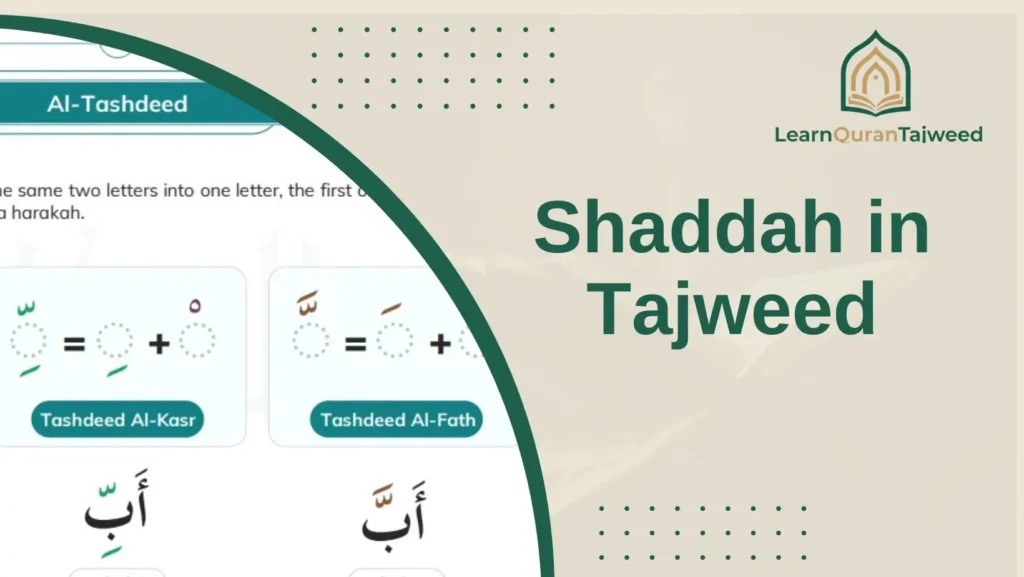
| Madd Lazim (Necessary) | 6 counts | Madd letter followed by permanent sukoon or shaddah |
| Madd ‘Arid lil-Sukoon | 2, 4, or 6 counts | Madd letter before a letter stopped upon |
The most common error in non-Arabic speakers is treating all Madd as equal — elongating everything to two counts. Madd Lazim in particular must reach six counts with no shortening; shortening it is impermissible according to all scholars of Hafs ‘an ‘Asim.
Working with Ijazah-certified instructors at Learn Quran Tajweed Academy through our Advanced Tajweed Course provides the individualized attention needed to internalize Madd counts through live correction — because counting silently while reciting requires practice that only real-time feedback develops.
Reserve your free trial lesson for Advanced Tajweed Course

7. Understand Qalqalah and Apply It at the Right Level
Qalqalah is the echoing, bouncing sound produced when one of the five Qalqalah letters — ق، ط، ب، ج، د — carries a sukoon (either original or when stopping). The sound is a controlled, brief echo produced at the articulation point of the letter itself — not a general vibration.
Qalqalah has three levels of intensity. Minor (Sughra) applies when the letter carries an original sukoon in the middle of a word.
Medium (Wusta) applies when stopping on a letter with original sukoon.
Major (Kubra) applies when stopping on a letter carrying a shaddah — this produces the strongest echo and is the most commonly under-applied level among students.
Read Also: Best Tajweed Books
8. Practice Waqf and Ibtida to Recite With Proper Pausing
Waqf (pausing) and Ibtida (resuming) determine where you stop and where you restart during recitation — and incorrect pausing can alter the meaning of an ayah. Tajweed scholarship defines multiple categories of pause, but four are practically essential for every reciter.
Waqf Tam (complete stop) occurs at the end of a complete meaning unit — the reciter may stop here.
Waqf Kafi (sufficient stop) occurs where meaning is complete but connected to what follows — stopping is permitted.
Waqf Hasan (good stop) occurs mid-sentence where stopping without restarting from the beginning of the phrase is problematic.
Waqf Qabih (ugly stop) occurs where stopping distorts or contradicts meaning — this is impermissible.
Mushaf al-Madinah uses standard symbols: ج (Waqf Jaiz — permissible stop), م (Waqf Lazim — mandatory stop), لا (no stopping). Familiarizing yourself with these symbols transforms your recitation from guesswork into structured delivery.
Learn Quran Tajweed Academy’s Quran Tarteel Course specializes in developing proper pacing, breath control, and waqf application that reflects the measured, contemplative recitation style the Quran itself commands.
Join our Quran Tarteel Course and get a free trial

Read Also: How to Improve Tajweed?
9. Develop Tarteel Through Consistent Measured Recitation Practice
Tarteel is the measured, deliberate recitation style commanded in the Quran. Allah ﷻ says in Surah Al-Muzzammil:
وَرَتِّلِ ٱلْقُرْءَانَ تَرْتِيلًا
Wa rattilil-Qur’aana tarteelan
“And recite the Quran with measured recitation.” (Al-Muzzammil 73:4)
Tarteel is not slowness for its own sake — it is the pace at which every Tajweed rule can be applied consciously and correctly. Most students rush because slowness feels uncomfortable.
In most students’ experience at Learn Quran Tajweed Academy, the shift from rushed recitation to true tarteel takes 4–6 weeks of deliberate daily practice before it begins to feel natural rather than forced.
The practical method: begin each session reciting at 50% of your natural speed. Record yourself. Listen for makharij errors, dropped ghunnah, and inconsistent Madd lengths. Gradually increase pace only when the slow-speed recitation is fully accurate. Speed without accuracy is not tarteel — it is hurrying through the words of Allah.
Read Also: The Noorani Qaida Tajweed Book
10. Recite Regularly Under a Certified Teacher for Live Correction
No rule book, video lecture, or app can replicate what a certified teacher provides: real-time identification of errors you cannot hear in yourself. This is not a commercial observation — it is a phonetic reality.
The human ear is calibrated by its mother tongue. Non-Arabic speakers genuinely cannot perceive certain makharij errors because the sounds don’t exist in their phonetic reference system.
At Learn Quran Tajweed Academy, our Practical Tajweed Course addresses exactly this gap. Students recite directly to Ijazah-certified Qaris who provide immediate, specific correction — not general feedback, but targeted identification of which letter, which attribute, which rule is being misapplied and precisely why.
Join our Practical Tajweed Course and get a free trial

This is how centuries of Quranic transmission have been preserved: teacher to student, mouth to ear, correction by correction.
For students pursuing the highest level of Quranic recitation mastery, our Tajweed Ijazah Program provides structured, rigorous training under qualified Ijazah-holding scholars, connecting you to the unbroken chain of transmission back to the Prophet ﷺ himself.
Our Students Reviews
Perfect Your Quran Recitation Today
Join expert-led Tajweed classes, and recite the Quran with confidence and clarity.
Start Your Free TrialRead Also: Tajweed Made Easy Book
Begin Your Tajweed Mastery With Certified Instruction at Learn Quran Tajweed Academy
Tajweed rules are learnable. What you need is the right structure and a qualified teacher.
Learn Quran Tajweed Academy offers:
- Ijazah-certified instructors specializing in Hafs ‘an ‘Asim
- Personalized 1-on-1 sessions tailored to your exact recitation level
- Structured progression from beginner rules to full Tajweed Ijazah Program
- Flexible scheduling available 24/7 for students worldwide
- Specialized Tajweed focus — not a generalist academy
Book your FREE trial lesson today and recite with confidence, Insha’Allah.
Check out the best tajweed course for your needs:
- Practical Tajweed Course
- Beginner Tajweed Course
- Intermediate Tajweed Course
- Advanced Tajweed Course
- Quran Tarteel Course
- Tajweed Ijazah Program
- Tajweed Course for Sisters
- Tajweed course for Kids
Book your free trial Tajweed lesson today

Conclusion
Reciting the Quran with Tajweed is a skill built in sequence — makharij first, then sifat, then applied rules, then measured tarteel under live correction. There are no shortcuts, but there is a clear path.
The ten steps above represent exactly how certified instruction progresses in practice: from foundational articulation to advanced rule interactions to the waqf and pacing that give recitation its dignity. Each stage builds the next.
Alhamdulillah, the knowledge of Tajweed has been preserved with remarkable precision across generations. You are not starting from zero — you are connecting to a tradition. Take it one step at a time, recite under a qualified teacher, and trust the process.
Perfect Your Quran Recitation Today
Join expert-led Tajweed classes, and recite the Quran with confidence and clarity.
Start Your Free TrialRead Also: The Jazariyyah Tajweed Poem
Frequently Asked Questions About Reciting the Quran With Tajweed
How long does it take to learn to recite the Quran with Tajweed properly?
Most non-Arabic speaking adults who study consistently under a certified teacher reach functional Tajweed application — correct makharij, Noon/Meem rules, and Madd lengths — within six to twelve months. Full mastery sufficient for Ijazah pursuit typically requires two to four years of structured study, depending on prior Arabic familiarity.
What is the difference between Tajweed and Tarteel?
Tajweed refers to the complete system of phonetic rules governing correct Quranic pronunciation. Tarteel refers specifically to measured, deliberate recitation pace — the speed at which Tajweed rules can be applied consciously. Tarteel is one dimension of applying Tajweed correctly; Tajweed is the broader rule system that tarteel enables.
Can I learn to recite the Quran with Tajweed through apps or videos alone?
Apps and videos can introduce rules and provide exposure to correct recitation, but they cannot identify your specific articulation errors. Since most makharij mistakes are imperceptible to the reciter’s own ear — particularly for non-Arabic speakers — live correction from a certified instructor is functionally irreplaceable for achieving genuine accuracy.
Where can I find more detail on specific Tajweed rules like Izhar and Ikhfa?
Related Articles
Tajweed Rules