 Tajweed Resources

Choosing the right Tajweed book for kids can feel overwhelming when you are standing in an Islamic bookstore or scrolling through endless product pages. The truth is, a good Tajweed book for children serves one specific purpose: it builds recognizable rule awareness so that a teacher’s correction can stick.
The books listed below have been used, reviewed, and recommended by educators across Western Muslim communities. Each title has been selected based on its pedagogical clarity, age-appropriateness, alignment with the Hafs ‘an Asim recitation tradition, and proven use in classroom or home settings. Pair any of them with qualified live instruction for the best results, Insha’Allah.
1. Tajweed Untangled Book for Kids
Tajweed Untangled is a full-color, A4-sized guide designed for children and adults at beginner and intermediate levels. Each chapter opens with real Quranic examples of a rule in action, then invites the reader to reflect and identify the rule before it is formally explained — a discovery-based method that deepens retention. Written tasks and practice lines follow each rule explanation to reinforce application.
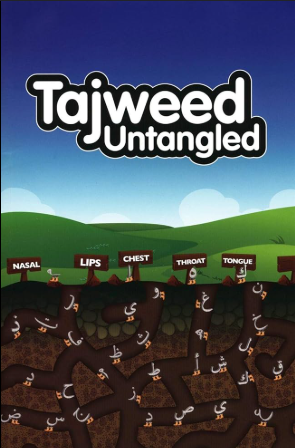
What makes this book particularly effective for classroom use is its layout. The rules are rendered in a clean, salient format that children can return to independently for revision.
The book emphasizes proper pronunciation (Makharij) and the melodic features of Quranic recitation, instructing learners not just on Tajweed’s technical components but also on the artistry of beautiful, measured recitation.
Suitable for: Children aged 8 and above, Islamic weekend schools, home learning alongside a teacher.
At Learn Quran Tajweed Academy, students who come having used Tajweed Untangled at home are noticeably quicker to internalize rule corrections.
They recognize the rule name and can visualize the concept — which means our instructors in the Tajweed Course for Kids can immediately move into applied recitation practice rather than spending the first sessions on terminology alone.
Enroll your kid in our Tajweed classes for kids with a FREE trial

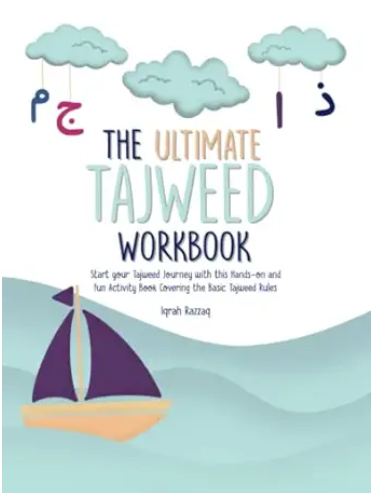
2. The Ultimate Tajweed Workbook by Iqrah Razzaq
The Ultimate Tajweed Workbook by Iqrah Razzaq of Al Qasas Learning takes a distinctly hands-on approach that sets it apart from standard rule-explanation books.
Each Tajweed rule is explained visually with a clear and simple explanation, followed immediately by a hands-on activity and a quiz — the bitesize, colourful worksheets help children learn without feeling overwhelmed.
The rule coverage is genuinely thorough. The workbook covers Madd letters, Leen letters, the five main makharij, Ghunnah, Qalqalah, heavy letters, Ra rules, Noon Sakinah and Tanween rules, Idgham and Ikhfa rules for Meem, sun and moon letters, Waqf, a full range of Madd types including Madd Muttasil, Madd Munfasil, and Madd al-Lazim, and Huroof al-Muqattat — all following the Hafs ‘an Asim tradition in Uthmani script.
To help children apply these rules in context, the workbook includes Tajweed packs for five Surahs from Juz Amma: Surah an-Nas, al-Falaq, al-Ikhlas, al-Kafirun, and an-Naba’ — all examples drawn directly from the Quran.
One recurring observation from teachers who use this workbook: children who complete the coloring and matching activities genuinely retain rule names better than those who only read explanations. There is something about physical engagement with Quranic words that anchors the learning in a way passive reading rarely does.
Suitable for: Children who can already read basic Arabic, ages 7 and above, home use by parents.
Shots Videos from Our Courses
Perfect Your Quran Recitation Today
Join expert-led Tajweed classes, and recite the Quran with confidence and clarity.
Start Your Free Trial3. Noorani Qaida (Color-Coded Edition)
The Noorani Qaida is one of the most widely used foundational Quranic reading books for children across the Muslim world. It is the appropriate starting point for any child who is still developing their basic Arabic letter recognition and needs an organized pathway into Tajweed.
Noorani Qaida begins with the Arabic alphabet and introduces Tajweed rules step by step, following a structured and progressive approach — starting with basic letters and gradually advancing to words and then short sentences. It introduces essential Tajweed rules including three short vowels (harakat), prolongation rules, and other recitation techniques.
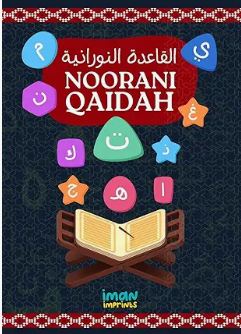
The color-coded editions available today are particularly effective. Each Arabic letter and Tajweed rule is color-coded to help learners easily identify pronunciation patterns — step-by-step guidance ensures a gradual learning process so children build confidence as they progress.
An important reminder for parents: Noorani Qaida is a reading foundation tool, not a substitute for live articulation feedback.
The makharij of letters like Ain (ع), Ghain (غ), and Qaf (ق) cannot be self-corrected from a book. A child may read the pages perfectly and still mispronounce these letters for years. This is precisely why our Beginner Tajweed Course at Learn Quran Tajweed Academy pairs book learning with live instructor correction from the first session.
Begin your Tajweed journey with a free lesson

4. Essential Tajweed Rules (Children) by Shaykha Dina Essam
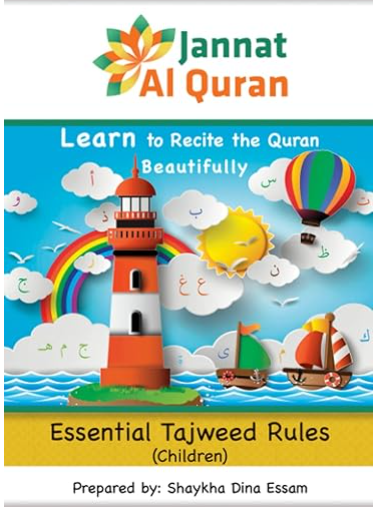
Essential Tajweed Rules (Children) from the Jannat Al Quran Children Series is authored by Shaykha Dina Essam — a Hafizah of the Quran and Al-Azhar graduate who holds an Ijazah in ten Qira’at. That scholarly authority behind the authorship genuinely matters when selecting a child’s Tajweed book.
The book builds upon foundational Arabic and Tajweed knowledge, guiding children toward competency in Tajweed rules such as Al-Madd, Noon Sakinah, and Tanween. It is also suitable for children who already know basic Arabic rules and are ready to recite the Quran with applied Tajweed.
The book’s design was created with non-Arabic speaking children specifically in mind. This is a meaningful distinction — many Tajweed books were originally written for Arab students and then translated, which means examples and explanations often assume an Arabic linguistic intuition that non-Arab children simply do not have. Shaykha Dina’s approach starts from where Western-raised children actually are.
Perfect Your Quran Recitation Today
Join expert-led Tajweed classes, and recite the Quran with confidence and clarity.
Start Your Free Trial5. Colorful Tajweed for Kids by Yusuf Elnady
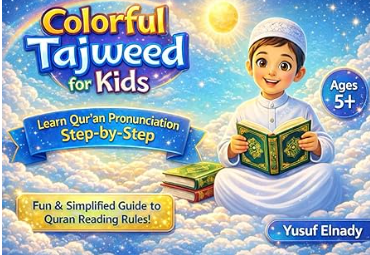
Colorful Tajweed for Kids by Yusuf Elnady is a newer addition to the children’s Tajweed book space and one of the more structured options available.
Children advance through sixteen structured levels, each focusing on a single Tajweed concept — as they progress, a virtual turtle character grows, reinforcing motivation and a sense of achievement.
Content covers essential rules such as Harakat, Sukoon, Qalqalah, Noon Sakinah and Tanween, Madd, and more, all based on the Qira’ah of Hafs ‘an Asim.
The gamified progression element makes this book particularly effective for younger children who benefit from visible markers of accomplishment.
In my experience working with students at Learn Quran Tajweed Academy, children between the ages of 5 and 8 respond significantly better to visual reward systems than to traditional rule memorization alone.
When a child sees their progress represented visually, they become internally motivated — and that motivation carries over into actual recitation sessions.
Visual aids, practice verses, and chapter-end challenges support rule consolidation at each level. The book is suitable for both classroom and home environments, and parents with no Tajweed background can follow along using the clear English explanations without feeling lost.
Suitable for: Children aged 5 and above, Islamic school classrooms, motivated home-learning environments.
Read Also: The Noorani Qaida Tajweed Book
6. Safar Tajweed Practice Book
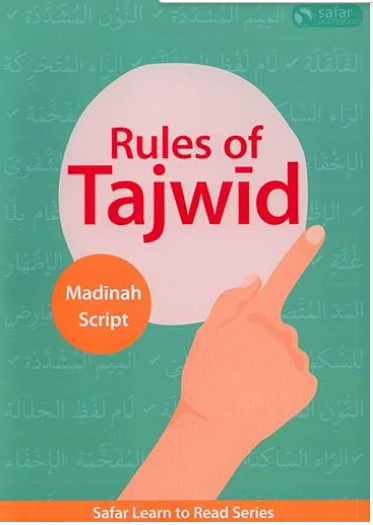
The Safar Tajweed Practice Book follows on from the widely used Safar Qaidah, making it a natural next step for children who have completed that foundational reading series. There are seven levels in this book, each beginning with an explanation and requiring the student to memorise the rule — followed by multiple pages of spotting and practising the rule with ample opportunity for reinforcement.
The graded level structure is one of its most valuable features. Children do not move forward until a rule is consolidated, which prevents the common problem of a child who can recite the rule definition but cannot identify it in actual Quranic text.
Read Also: Fun Tajweed Activities for Kids
This distinction — between knowing a rule and recognizing it — is one of the most persistent challenges I see in students who come to Learn Quran Tajweed Academy after years of partial Tajweed study.
The book also includes guidance on how to teach and use the book in the opening pages, along with adab of reading the Quran — a thoughtful inclusion that situates the learning within its proper spiritual context.
For children pursuing structured advancement toward applied Tajweed proficiency, pairing this book with our Amali (Practical) Tajweed Course provides the ideal combination of rule reinforcement and live recitation application.
Join our Practical Tajweed Course and get a free trial

Read Also: Tajweed Practice Worksheets
What Makes a Good Tajweed Book for Kids?
Not every colorful Tajweed book is genuinely useful. Before purchasing, parents and educators should evaluate any tajweed book for kids against these criteria:
| Criterion | What to Look For |
| Recitation tradition | Explicitly states Hafs ‘an Asim |
| Script | Uthmani rasm for all Quranic examples |
| Language | Clear English explanations, not just Arabic instruction |
| Age alignment | Designed for the child’s actual reading level |
| Rule coverage | Includes Noon Sakinah rules, Madd rules, Qalqalah, and Ghunnah |
| Practice activities | Written tasks, not just reading explanations |
| Makharij coverage | Visual articulation point guidance included |
One principle worth repeating for every parent on this list: a book teaches rules — a teacher corrects pronunciation. The rules of Tajweed form an interconnected system of rules that govern letters, elongations, nasalization, and stopping points.
A child reading about Ikhfa will understand the concept — but whether their tongue and nasal passage are actually producing the correct sound requires a trained ear to evaluate. Books and live instruction work together; neither replaces the other.
Read Also: Tajweed Worksheets for Kids
Our Students Reviews
Perfect Your Quran Recitation Today
Join expert-led Tajweed classes, and recite the Quran with confidence and clarity.
Start Your Free TrialStarting Your Child’s Tajweed Learning with Certified Instruction at Learn Quran Tajweed Academy
A solid Tajweed book is a powerful tool — but your child deserves qualified guidance alongside it. Learn Quran Tajweed Academy offers specialized Tajweed instruction for children through structured, 1-on-1 sessions with Ijazah-certified instructors.
- Ijazah-certified Qaris specializing in Hafs ‘an Asim recitation
- Personalized instruction tailored to each child’s level and age
- Flexible scheduling available 24/7 for families worldwide
- Structured progression from foundational rules to full recitation proficiency
- Specialized focus: Tajweed only — not a generalist platform
Book a FREE Trial Lesson Today
Check out the best tajweed course for your needs:
- Practical Tajweed Course
- Beginner Tajweed Course
- Intermediate Tajweed Course
- Advanced Tajweed Course
- Quran Tarteel Course
- Tajweed Ijazah Program
- Tajweed Course for Sisters
- Tajweed course for Kids
Book your free trial Tajweed lesson today

Conclusion
The right tajweed book for kids is the one that matches where your child actually is — not where you hope they are. A child still mastering Arabic letter recognition needs a Qaida. A child ready to learn rule categories needs a structured workbook. A child preparing for consistent Quran recitation needs applied practice with Quranic text.
Every book on this list has genuine value when matched to the right student. Alhamdulillah, the past several years have seen a meaningful expansion in quality Tajweed resources specifically designed for non-Arabic speaking children — a development that makes building a home learning environment far more achievable for Western Muslim families.
What matters most is not which book you choose — it is that the book is paired with regular, qualified live correction. Tajweed is an oral tradition. It was transmitted through voices, corrected through listening, and perfected through recitation. Let the book build awareness — and let a certified teacher build the sound.
Read Also: Tajweed Rules with Examples for Kids
Frequently Asked Questions About Tajweed Books for Kids
At What Age Can a Child Start Using a Tajweed Book?
Children can begin with a foundational Qaida, such as the Noorani Qaida, from around age 4 to 5. Structured Tajweed rule books like Tajweed Untangled or The Ultimate Tajweed Workbook are appropriate from age 7 onward, once basic Arabic reading is established. Starting earlier with a Qaida builds the letter recognition needed for meaningful Tajweed rule study.
Can a Child Learn Tajweed from a Book Without a Teacher?
A Tajweed book helps a child understand rule concepts, but correct pronunciation — particularly for makharij of letters like Ain, Ha, and Qaf — cannot be self-corrected through reading. A certified instructor must hear the child recite and provide specific corrections. Books and teachers serve different functions; neither fully replaces the other for proper Tajweed development.
Which Tajweed Book Is Best for Non-Arabic Speaking Children?
Tajweed Untangled by Learning Roots and Essential Tajweed Rules (Children) by Shaykha Dina Essam are both specifically designed for non-Arabic speakers. They explain rules in clear English, use Uthmani script examples, and follow the Hafs ‘an Asim tradition. The Ultimate Tajweed Workbook is also excellent for this audience due to its visual, activity-based format that does not require Arabic language intuition.
Do Tajweed Books for Kids Cover Rules Like Idgham and Ikhfa?
Should a Child Memorize the Tajweed Rules Before Applying Them?
Memorization of rule definitions is useful, but application in actual Quranic text is the real goal. Books like the Safar Tajweed Practice Book and Tajweed Untangled both require students to identify and apply rules within Quranic verses — not just recite definitions. In most students’ experience, rule application within familiar short Surahs from Juz Amma typically begins solidifying after consistent weekly practice over four to six weeks.