 Tajweed Resources

| Key Takeaways |
| Tajweed practice worksheets organize rule-specific drills that isolate one recitation error at a time for targeted correction. |
| Noon sakinah has four rules — Ikhfa, Idgham, Iqlab, and Izhar — each requiring a dedicated identification and application drill. |
| Qalqalah letters (ق ط ب ج د) must be practiced in both mid-word and end-of-word positions, as echo intensity differs by position. |
| Madd rules require timing drills measured in harakah counts, not musical feel, to build consistent vowel elongation precision. |
| Ghunnah nasal resonance must be held for exactly two harakah counts in Ikhfa and Idgham with Ghunnah — never approximated. |
Tajweed practice worksheets are one of the most underused tools in Quran recitation training — and one of the most effective.
Students who read Surah after Surah without isolating specific rules often plateau without understanding why. The answer is almost always the same: they need structured, rule-specific drilling.
Worksheet 1: Noon Sakinah and Tanween Rule Identification Drill
Noon sakinah and tanween produce four distinct Tajweed outcomes depending entirely on the following letter. This worksheet trains students to identify which rule applies before they recite — a skill that eliminates mid-recitation hesitation.
📄 Download Worksheet 1 — Noon Sakinah & Tanween PDF
How to use this worksheet:
Write out the following Quranic fragments. For each, identify the following letter and write which rule applies: Izhar, Idgham, Iqlab, or Ikhfa.
After completing the identification column, recite each fragment aloud and record whether your application matched your written answer. This gap between identification and production is where most students at Learn Quran Tajweed Academy discover their real weak points.
For a full breakdown of each rule, review our guides on Iqlab rules,Izhar,Idgham, andIkhfa.
Our Beginner Tajweed Course covers all four noon sakinah rules with live error correction from Ijazah-certified instructors in dedicated 1-on-1 sessions.
Begin your Tajweed journey with a free lesson

Shots Videos from Our Courses
Perfect Your Quran Recitation Today
Join expert-led Tajweed classes, and recite the Quran with confidence and clarity.
Start Your Free TrialWorksheet 2: Ghunnah Timing and Resonance Practice Drill
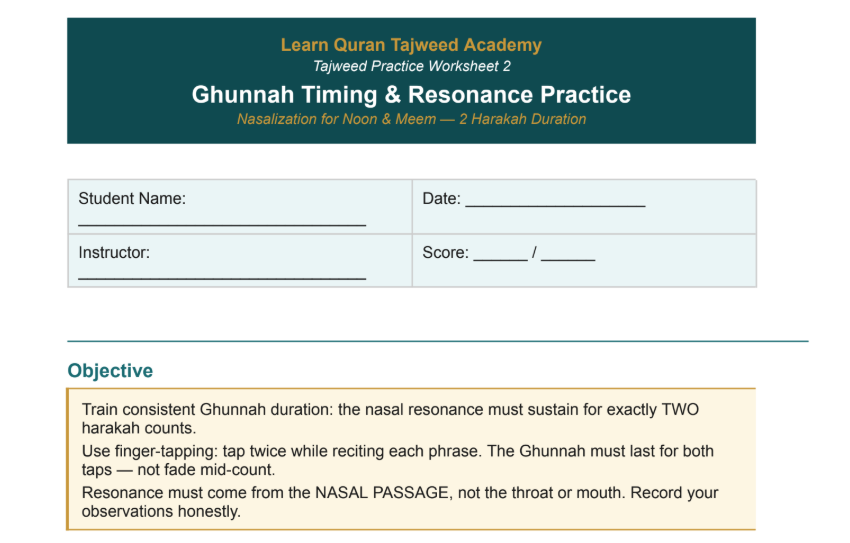
Ghunnah is a nasal resonance produced from the nasal passage — not the throat or mouth — and must be held for exactly two harakah counts. This worksheet trains consistent ghunnah duration, which is the most common timing error I observe in non-Arabic speaking students.
Drill instructions:
Recite each phrase below while tapping your finger twice to mark two harakah counts. The ghunnah must sustain for both taps — not fade mid-count.
أَنَّ — Shaddah on Noon (ghunnah mandatory) إِنَّا — Shaddah on Noon (ghunnah mandatory) مِمَّا — Shaddah on Meem (ghunnah mandatory) يَوْمَئِذٍ نَّاعِمَةٌ — Tanween + Noon (Idgham with Ghunnah)
The ghunnah rules govern not just duration but resonance quality. Students who produce ghunnah from the mouth rather than the nasal passage will always sound slightly off, regardless of timing accuracy.
📄 Download Worksheet 2 — Ghunnah Timing and Resonance Practice PDF
Worksheet 3: Qalqalah Echo Intensity Levels Practice
Qalqalah is a vibrating echo produced on the five letters ق ط ب ج د when they carry sukoon. The echo is not uniform — it has three levels of intensity, and most students apply the same flat echo regardless of position.
The three levels, from weakest to strongest, are:
- Qalqalah Sughra — mid-word sukoon
- Qalqalah Kubra — end-of-word stop (waqf)
- Qalqalah Akbar — end-of-word with shaddah at waqf
📄 Download Worksheet 3 — Qalqalah Echo Intensity Levels Practice PDF
Recite each example aloud after completing the table. The Akbar level should produce a noticeably stronger, fuller echo than the Sughra. For a detailed breakdown of all levels, visit our guide on Qalqalah in Tajweed.
At Learn Quran Tajweed Academy, our Practical Tajweed Course is built around exactly this principle — targeted practice, one rule at a time, until application becomes instinctive. The worksheets below are drawn directly from our live instruction methodology, refined through years of teaching non-Arabic speakers.
Join our Practical Tajweed Course and get a free trial

Read Also: Best Tajweed Book for Kids
Worksheet 4: Madd Elongation Timing Drill
Madd rules require precise elongation measured in harakah counts — not personal taste or melodic instinct. This drill builds consistent madd timing, which is one of the most frequently inconsistent areas in intermediate-level recitation.
📄 Download Worksheet 4 — Madd Elongation Timing Drill PDF
Review our detailed Madd rules guide to confirm each category before drilling.
Our Students Reviews
Perfect Your Quran Recitation Today
Join expert-led Tajweed classes, and recite the Quran with confidence and clarity.
Start Your Free TrialRead Also: Fun Tajweed Activities for Kids
Worksheet 5: Idgham Rule Categorization Drill
Idgham means merging the Noon sakinah or tanween into the following letter, making one emphasized sound. The critical distinction most students miss is that Idgham divides into two categories — with Ghunnah and without — and the letters are different for each.
📄 Download Worksheet 5 — Idgham Rule Categorization Drill PDF
Students who apply ghunnah to all six Idgham letters — including ل and ر — are making one of the most common Idgham errors in intermediate recitation. This worksheet isolates that exact distinction.
Working on Idgham precision with an Ijazah-certified instructor at Learn Quran Tajweed Academy through our Intermediate Tajweed Course gives you real-time feedback on nasal resonance quality that no worksheet alone can replicate.
Join our Intermediate Tajweed Course and get a free trial

Read Also: Tajweed Worksheets for Kids
Begin Your Structured Tajweed Training at Learn Quran Tajweed Academy
Worksheets build awareness — certified instruction builds precision. At Learn Quran Tajweed Academy, every rule above is taught, corrected, and perfected in live 1-on-1 sessions.
- Ijazah-certified instructors specializing in Hafs ‘an ‘Asim
- Personalized sessions tailored to your exact recitation level
- Flexible scheduling available 24/7 for students worldwide
- Structured progression from foundational rules to full Ijazah certification
- Specialized Tajweed focus — not a generalist academy
Book your FREE trial lesson today and receive your first live recitation correction from a certified Qari.
Check out the best tajweed course for your needs:
- Practical Tajweed Course
- Beginner Tajweed Course
- Intermediate Tajweed Course
- Advanced Tajweed Course
- Quran Tarteel Course
- Tajweed Ijazah Program
- Tajweed Course for Sisters
- Tajweed course for Kids
Book your free trial Tajweed lesson today

Conclusion
Targeted drills produce better results than repeated full-recitation without feedback. These tajweed practice worksheets isolate the rules that matter most — from noon sakinah identification to full Surah audits — giving students a measurable way to track their own progress.
Worksheet-based practice works best when paired with qualified correction. The patterns these drills reveal — timing inconsistencies, wrong Idgham categories, flat Qalqalah — are precisely what certified instruction is designed to fix. May Allah make the Quran easy on your tongue, Insha’Allah.
Read Also: Tajweed Rules with Examples for Kids
Frequently Asked Questions About Tajweed Practice Worksheets
Are tajweed practice worksheets suitable for complete beginners?
Worksheets 1 through 4 — covering noon sakinah identification, ghunnah timing, Qalqalah levels, and Madd counting — are fully accessible to students who can read basic Arabic. Complete beginners benefit most when worksheets are paired with live instruction from a certified teacher to catch errors early.
How often should I use tajweed practice worksheets for noticeable improvement?
In most students’ experience, consistent daily drilling of 15–20 minutes produces noticeable improvement within three to four weeks. Short, focused rule-specific sessions outperform longer unfocused recitation sessions — one worksheet completed carefully is more productive than an hour of unaudited reading.
Can worksheet practice replace a tajweed teacher?
Worksheets develop identification skills and pattern recognition, but they cannot replace live correction. A certified instructor hears errors you cannot hear in your own recitation — particularly in makharij accuracy, nasal resonance quality, and tafkhim weight. Worksheets and teacher-led correction work best together.
What is the difference between tajweed worksheets and tajweed exercises?
Tajweed worksheets are structured written drills that require identification, categorization, or self-audit before recitation. Tajweed exercises typically refer to oral repetition drills. Both are valid tools, but worksheets add a metacognitive layer — students think through the rule before applying it, which strengthens retention.
Which tajweed rule should I practice first using these worksheets?
Begin with Worksheet 1 — noon sakinah and tanween identification. These four rules appear in almost every page of the Quran, and mastering their identification before tackling ghunnah timing or Madd counts creates a stable foundation. Attempting all rules simultaneously before this foundation is in place is the most common progression error at the beginner level.
Related Articles
Tajweed Resources