 Tajweed Basics

This guide walks through the rules of Waqf on Hamza according to the recitation of Hafs ‘an ‘Asim, the additional rulings that apply to the riwayah of Imam Hamzah and Hisham, and the mistakes that trip up even students who have studied Tajweed for years.
Every rule here follows the classical framework laid out in texts such as An-Nashr fi al-Qira’at al-‘Ashr and Ash-Shatibiyyah.
Waqf on Hamza is one of the areas in Tajweed where reciters most often go wrong, not because the rule is unclear, but because the correct sound depends on three things happening at once: the letter’s position, the vowel before it, and the riwayah being recited. Get any one of those wrong and the pause either swallows the Hamza or exaggerates it.
By the end of this article, you will know exactly which sound to produce when you pause on a word ending in Hamza, and why.
What You’ll Learn In This Article
- What Waqf on Hamza means and why it needs a separate set of rules
- The exact substitution rule for each preceding vowel (fathah, dammah, kasrah)
- How to handle a final Hamza preceded by a sukoon or a madd letter
- The special tas-heel rules unique to Imam Hamzah and Hisham
- The most common mistakes students make when pausing on Hamza
What Is Waqf On Hamza In Tajweed?
To define Waqf on Hamza, it is the set of rules that governs how a reciter pauses on a word that ends in a hamza. The Hamza’s own vowel disappears because a full stop removes the case-ending vowel (i’rab). Moreover, the letter often has to be replaced with a madd letter or softened entirely.
Ibn al-Jazari noted that Imam Hamzah’s recitation already involves heavy madd, full tahqiq, and saktah. As a result, pausing gave him a natural point to lighten (takhfif) the Hamza instead of pronouncing it in full.
This is important because Hamza is a glottal sound that comes from deep in the throat, which classical linguists described as physically demanding to pronounce cleanly at the end of a breath.
Why Does Pausing Change The Hamza’s Sound?
Hamza acts mid-word differently in connecting (wasl) than it does at a stop (waqf). In continuous recitation, the Hamza keeps its full case vowel and is produced clearly.
At the pause (waqf), that vowel (harakah) is dropped for sukoon, and the letter’s position, whether it sits at the end of the word (mutatarrifah) or in the middle (mutawassitah), determines what replaces it.
Read also: Lam Shamsiyyah And Lam Qamariyyah – A Complete Guide With Quran Examples
The Three Positions That Decide The Rule
Every Hamza rule in this guide depends on identifying position first. Initial (mubtada’ah), medial (mutawassitah), or final (mutatarrifah). Only the final position is affected by waqf in the standard riwayah of Hafs.
An initial or medial Hamza keeps its normal pronunciation whether you pause after the word or continue.
Read also: Nun Al-Wiqayah— The Protective Nun in Arabic Grammar
Read also: Waqf Rules in Tajweed
Rules Of Waqf On Hamza In Hafs Recitation
Hafs ‘an ‘Asim, the riwayah followed by the vast majority of the Muslim world today, keeps these rules simple and consistent. You should be aware of the following rules to ensure that your recitation is correct.
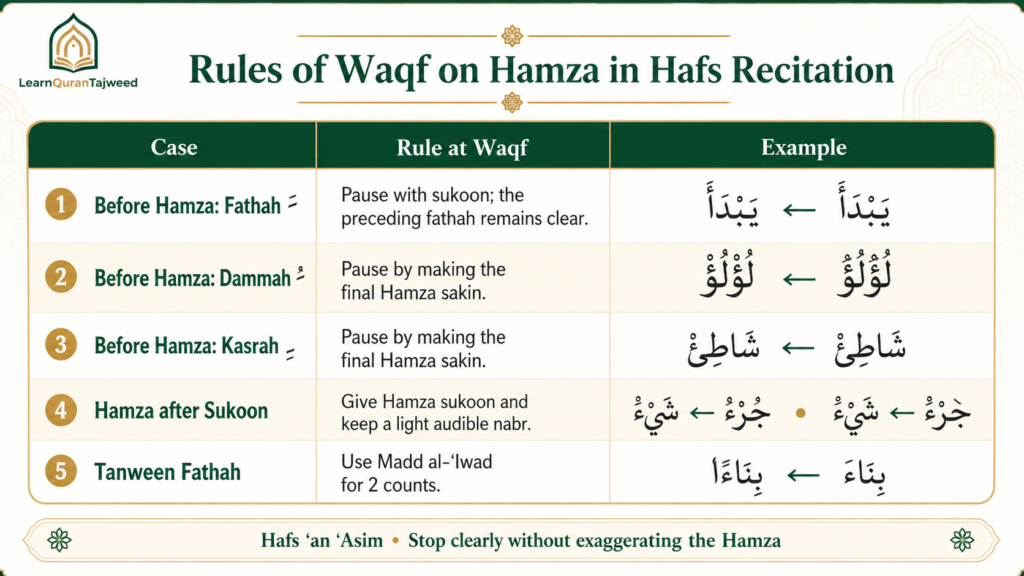
1. When The Letter Before Hamza Is Fathah
If the letter before a final Hamza carries a fathah َ, the Hamza is replaced with an alif and pronounced with natural madd. يَبْدَأُ becomes يَبْدَأْ at the pause, with the alif carrying the sound that the fathah once carried.
2. When The Letter Before Hamza Is Dammah
If the preceding letter carries a dammah ُ, the Hamza turns into a still waw (waw sakinah). لُؤْلُؤٌ is read لُؤْلُؤْ when you stop, with the final sound resting on that waw rather than a glottal stop.
3. When The Letter Before Hamza Is Kasrah
If the preceding letter carries a kasrah ِ, the Hamza becomes a still yaa (yaa sakinah). شَاطِئٌ is pronounced شَاطِئْ at waqf, the same substitution logic, just matched to the kasrah instead.
Read also: Ha Al-Kinayah/Damir in Tajweed — Rules, Madd Silah, Examples
Read also: Harakat in Tajweed
4. When Hamza Is Preceded By A Sukoon
When the letter directly before the Hamza is already sakin, as in جُزْءٌ or شَيْءٌ, there is no vowel to shift into a madd letter. As a result, the Hamza itself is simply given sukoon.
Its sound must still be audible through what Tajweed scholars call nabr, which is a light stress that keeps the glottal stop from disappearing entirely.
Learners who work through structured Tajweed practice, the kind built into Learn Quran Tajweed’s live sessions, usually catch this nabr issue within a few corrected repetitions, as it is easy to hear once a teacher points it out, but it is difficult to notice on your own.
Read also: Nabr in Tajweed: Definition, Rules, and Examples
5. Waqf On A Tanween-Fatha Hamza (Madd Al-‘iwad)
When the word ends in a Hamza with tanween fathah, such as بِنَاءً or سَوَاءً, the tanween is replaced with an alif of compensation (madd al-‘iwad), held for two counts.
The word بِنَاءً is read بِنَاءَا at the stop (waqf). This is a noticeable rule from the four above because it replaces a tanween, not a bare vowel.
Waqf on Madd Before a Final Hamza
Notice what happens when the Hamza itself is preceded by a madd letter, not just a short vowel. Words like شَاء or السَّمَاء fall into a different category called madd muttasil, which is a connected madd that already carries its own length rule before the Hamza is even reached.
a. Choosing Between Two, Four, and Six Counts When Stopping
Because the sukoon caused by stopping is ‘arid (temporary, caused only by the pause), the reader gets a choice of three lengths for the madd letter before the Hamza: qasr (two counts), tawassut (four counts), and ishba’ (six counts). All three are valid in Hafs.
The choice is a matter of the reciter’s preferred style, not a mistake in either direction.
b. Waqf on Tanween Fatha After a Madd Letter
Words such as مَاءً or سَوَاءً combine both rules at once. The tanween becomes madd al-‘iwad, and the letter before the Hamza was already a madd letter. The result is a pause held for two counts on the substituted alif, following the same logic as the standalone tanween rule above.
Read also: Al-Madd Al-Aarid Lissukoon: Definition, Types, Rules, and Examples
Waqf on Hamzah Al-Sahihah
Read carefully to learn what you do with a Hamza that has no vowel-based substitution available, such as in قُرْءٌ or شَيْءٌ.
Here the rule is sukoon mahd, a plain, unadorned stop on the Hamza itself, without turning it into a madd letter.
Avoiding Exaggeration or Weakening of the Final Hamza
Classical texts refer to two opposite errors here: ifrat (exaggerating the glottal stop until it sounds forced) and tafreet (letting the Hamza’s sound vanish so the word ends in silence). The correct target sits between the two, audible, but not strained.
This is one of the areas a live teacher corrects fastest, because the difference is subtle in a recording but obvious the moment someone recites it back to you in real time.
Read also: Tajweed Teachers
Waqf Rules of Imam Hamzah and Hisham
Read carefully to learn what changes when you’re reciting the riwayah of Imam Hamzah al-Kufi (or Hisham) instead of Hafs.
Hamzah is known for a dedicated chapter of Tajweed rules covering the softening (takhfif) of Hamza at the pause.
It is a practice Ibn al-Jazari attributed to giving the reciter a moment of relief, given how demanding Hamzah’s style of full tahqiq and extended madd already is.
a. Replacing a Saakin Hamza After a Vowel
When the Hamza is saakin and preceded by a moving letter, Hamzah’s riwayah replaces a madd letter matching the vowel before it: an alif after fathah, a waw after dammah, a yaa after kasrah.
This is the same replacement rule used in Hafs for final Hamza, but notice that Hamzah extends it further into medial positions that Hafs leaves untouched.
b. How Hisham’s Waqf Rule Differs From Hamzah’s
Hisham only applies this softening to a final (mutatarrifah) Hamza. He does not extend it to medial Hamza the way Hamzah does.
Everything ruled for Hamzah in the final position applies equally to Hisham; the medial-position rules belong to Hamzah alone.
Read also: What Are The Rules of Hamzatul Wasl?
See Our Classrooms in Action
Watch these short clips from our live, interactive Quran courses to see how our students learn and interact with our expert tutors.
Perfect Your Quran Recitation Today
Join expert-led Tajweed classes, and recite the Quran with confidence and clarity.
Start Your Free TrialA Practical Guide to Waqf on Hamza
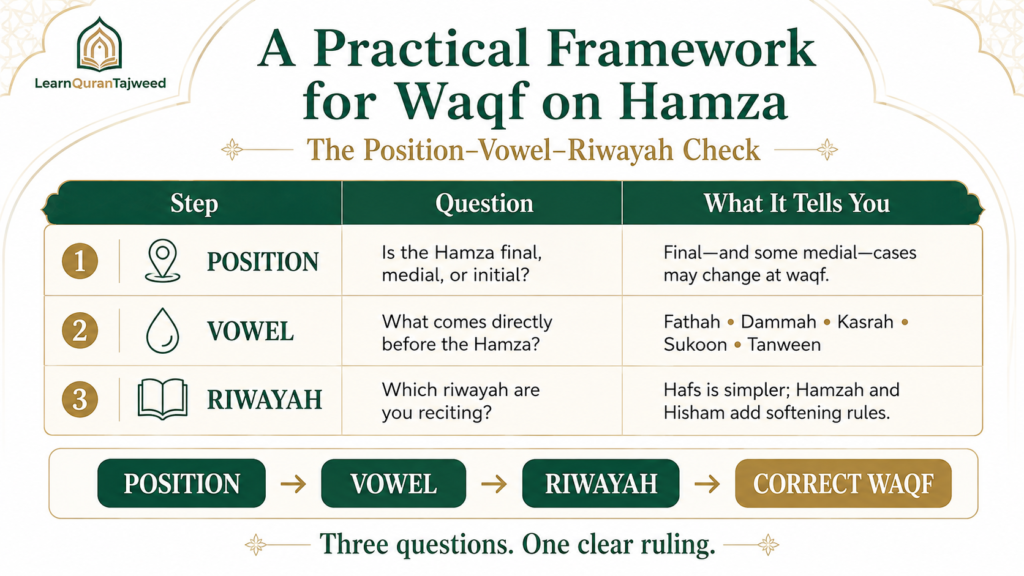
Most confusion around this topic emerges from trying to memorize dozens of individual word examples instead of a repeatable process. A simpler approach, or you can call it the Position-Vowel-Riwayah check, asks three questions in order every time you hit a Hamza at the end of a phrase:
1. Position — Is the Hamza final, medial, or initial? Only final and some medial cases are affected by waqf.
2. Vowel — What vowel or state (fathah, dammah, kasrah, sukoon, tanween) sits directly before the Hamza?
3. Riwayah — Are you reciting Hafs, or a riwayah like Hamzah’s or Hisham’s that applies extra softening rules?
Testing a word through these three questions in order removes almost all the guesswork, as each answer narrows the rule down to one specific substitution.
Common Mistakes Students Make When Pausing On Hamza
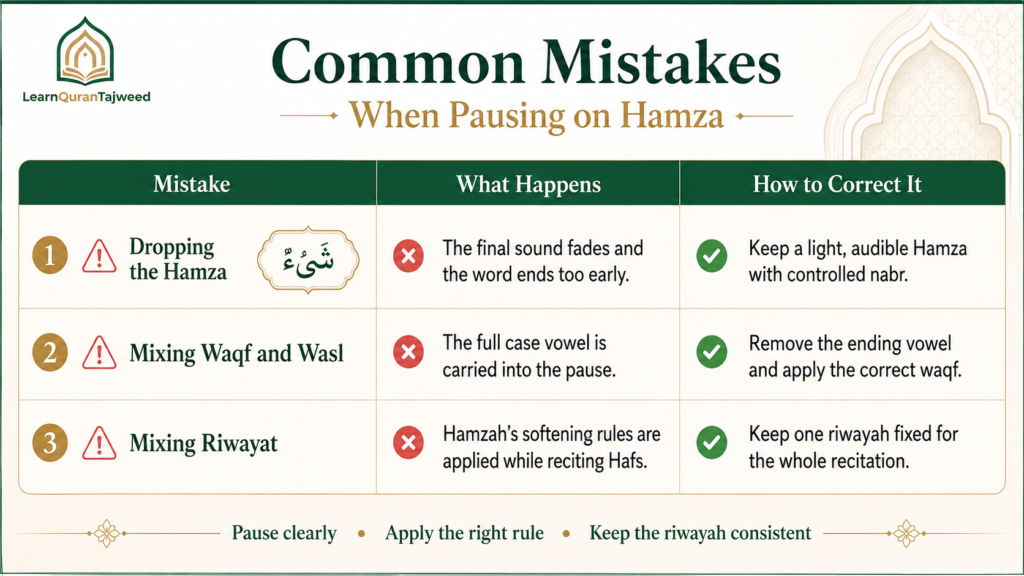
Be aware of this part to know where do most Hamza-related recitation errors actually happen. In practice, three patterns show up again and again in beginner and intermediate reciters alike.
1. Dropping The Hamza Sound Entirely
The most frequent error is tafreet. It means letting the final sound fade out so the word seems to end early. This happens most on hamza al-sahihah words like شَيْءٌ, as there’s no madd letter to “hold onto” the sound.
2. Confusing Waqf Rules With Wasl Rules
Some learners carry the Hamza’s full case vowel into the pause out of habit, effectively skipping the substitution rule altogether. This is especially common when switching quickly between continuous recitation and a stop for breath.
This is also where structured, corrected practice, rather than solo repetition, makes the difference.
Feedback from a qualified Tajweed teacher during live recitation is what usually breaks this habit, since it’s a timing issue as much as a pronunciation one.
3. Applying Hamzah’s Softening Rules While Reciting Hafs
Some self-taught reciters unintentionally borrow Hamzah’s medial softening into a Hafs recitation because online content mixes riwayat freely.
To avoid this crossover, keep the riwayah fixed for an entire recitation session and confirm which one you’re studying before memorizing exceptions.
Read also: Hamzatul Qat’ in Tajweed: Definition, Rules, and Complete Examples
Inside Learn Quran Tajweed Academy
Curious about how online learning works? Peek inside our actual Quran classes and hear the beautiful recitation of our students and teachers.
Perfect Your Quran Recitation Today
Join expert-led Tajweed classes, and recite the Quran with confidence and clarity.
Start Your Free TrialMaster Waqf On Hamza With Guided, One-On-One Practice
Reading the rules is the easy part. Hearing your own Hamza pronunciation corrected in real time is what actually fixes it.
Learn Quran Tajweed pairs students with certified teachers for live, one-on-one sessions built around exactly this kind of rule-by-rule correction, from Waqf on Hamza to the full Tajweed curriculum.
Book a session and get direct feedback on your Hamza pronunciation from a certified instructor today.
Courses we offer:
- Online Tajweed Classes
- Learn Quran with Tajweed Online
- Beginner Tajweed Course
- Intermediate Tajweed Course
- Advanced Tajweed Course
- Amali (Practical) Tajweed Course
Perfect Your Quran Recitation Today
Join expert-led Tajweed classes, and recite the Quran with confidence and clarity.
Start Your Free TrialConclusion
Waqf on Hamza comes down to three checks every time: the Hamza’s position in the word, the vowel or state directly before it, and the riwayah you’re reciting in.
In Hafs, a final Hamza converts to an alif, waw, or ya based on the vowel before it, while a sahihah Hamza with no preceding vowel takes a plain sukoon with light nabr. Imam Hamzah and Hisham extend softening further, with Hamzah alone applying it to medial positions.
None of these rules are difficult in isolation. They only feel that way when memorized as isolated word examples instead of a repeatable process.
Once you run each case through position, vowel, and riwayah, correct Waqf on Hamza becomes a habit rather than a guessing game.
Frequently Asked Questions
What Is Waqf On Hamza In Tajweed?
Waqf on Hamza is the set of Tajweed rules that determine how a final Hamza is pronounced when a reciter pauses on it, since stopping removes the Hamza’s case vowel and often requires substituting a madd letter in its place.
How Do You Pronounce A Hamza When Pausing After A Dammah?
You substitute the Hamza with a waw (waw sakinah). For example, لُؤْلُؤٌ is pronounced لُؤْلُؤْ at the pause, replacing the Hamza’s dammah-based sound with the waw.
Why Does Imam Hamzah Have Special Rules For Hamza That Hafs Doesn’t?
Imam Hamzah’s riwayah already involves extended madd, full tahqiq, and saktah, which scholars like Ibn al-Jazari noted makes a full stop a natural point to soften the Hamza for relief, extending the substitution rule into medial positions that Hafs does not touch.
What Is Madd Al-‘iwad And When Does It Apply To Hamza?
Madd al-‘iwad is the alif of compensation used when a word ends in tanween fathah at the pause, replacing the tanween sound with two counts of madd. It applies to Hamza words like بِنَاءً, read as بِنَاءَا when stopping.
What’s The Most Common Mistake Reciters Make With Waqf On Hamza?
The most common mistake is tafreet — letting the Hamza’s final sound disappear entirely, especially on hamzah al-sahihah words with no madd letter, such as شَيْءٌ, where the sound needs a light, audible nabr to stay present.