 Tajweed Basics

| Key Takeaways |
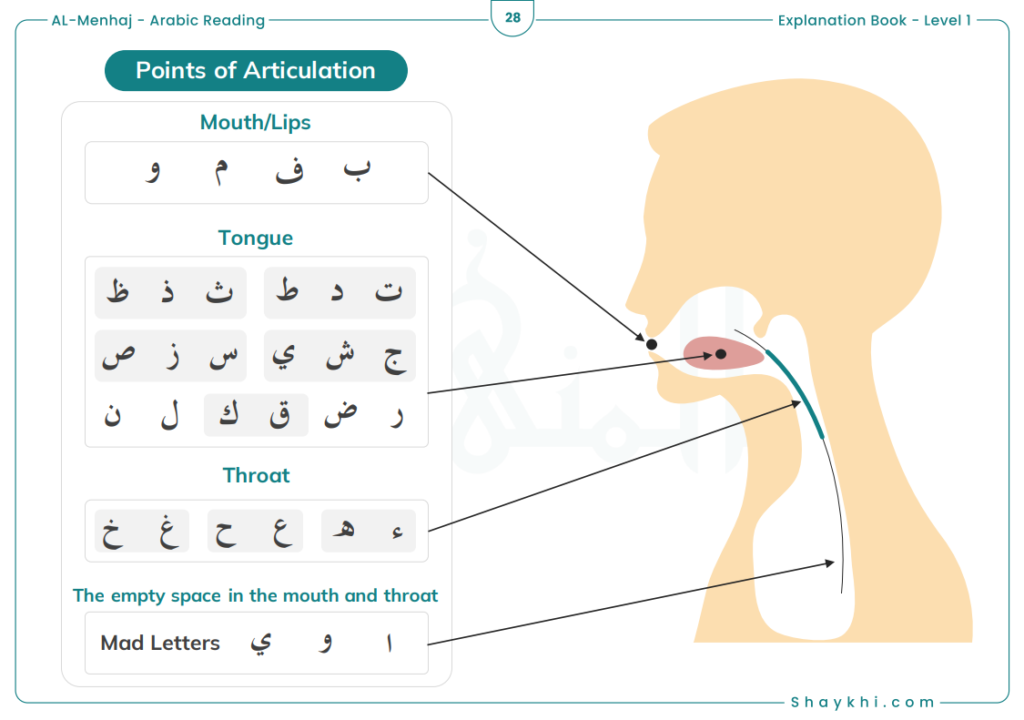
| Al-Jawf is the hollow cavity of the throat and mouth from which the three Madd letters originate. |
| The three letters of al-Jawf are: Alif (preceded by Fathah), Waw Sakinah (preceded by Dhammah), and Ya Sakinah (preceded by Kasrah). |
| Al-Jawf is classified as a makhraj muqaddar — an estimated articulation point with no fixed physical boundary inside the mouth. |
| All three Madd letters are gathered in the word نُوحِيهَا from Surah Hud, making it a practical memory anchor for students. |
| The sound of each Madd letter differs audibly due to tongue and lip position, not because they exit from different physical points. |
Unlike the letters of the tongue or lips, the Madd letters seem to emerge from nowhere you can physically touch. That is precisely what makes al-Jawf unique among all articulation points in Tajweed. Understanding it correctly removes a significant layer of confusion that students carry into their practical recitation.
Al-Jawf in Tajweed refers to the hollow cavity encompassing the throat and mouth from which the three Madd letters — Alif, Waw Sakinah, and Ya Sakinah — extend and release into the open air. It holds a single, estimated articulation point (makhraj muqaddar), meaning no specific wall, ridge, or tissue produces these sounds. They are born from openness itself, and they end when the breath ends.
What Is Al-Jawf in Tajweed?
Al-Jawf is the empty space — the hollow — that fills the throat and mouth cavity. In Arabic, jawf means emptiness or void. In Tajweed terminology, it refers to the single makhraj from which all three Huruf al-Madd (letters of extension) emerge.
Classical Tajweed scholars categorize the makharij al-huruf into five broad regions. Al-Jawf is the first, and it is also the only region that produces a makhraj muqaddar — an estimated or imagined point rather than a defined physical contact point. This is not a shortcoming in scholarship; it reflects the nature of these sounds accurately.
Most students learning Tajweed for the first time expect every letter to originate from a precise location — a spot on the tongue, the lips, or the throat. Al-Jawf disrupts that expectation in a healthy way.
Explore Al-Menhaj Book for Free (Learn to Read Quran)
Why Does Al-Jawf Have No Fixed Physical Contact Point?
The Madd letters require no contact between any two articulators. The tongue does not touch the palate. The lips do not close. No airflow is obstructed.
Sound flows outward freely through the open cavity, which is why scholars describe the makhraj as muqaddar — estimated or notional.
This distinguishes al-Jawf from, for example, the qalqalah letters, which require complete obstruction and sudden release. Understanding this contrast sharpens a student’s awareness of how fundamentally different Madd letters behave in recitation.
Shots Videos from Our Courses
Perfect Your Quran Recitation Today
Join expert-led Tajweed classes, and recite the Quran with confidence and clarity.
Start Your Free TrialWhat Are The Letters of Al-Jawf?
The letters of al-Jawf are exactly three: Alif, Waw Sakinah, and Ya Sakinah. Each one carries a specific vowel condition for the letter immediately preceding it. These conditions are not optional — they define whether a letter qualifies as a Madd letter at all.
| Madd Letter | Condition Before It | Example from Quran |
| Alif (ا) | Must be preceded by Fathah | قَالَ |
| Waw Sakinah (وْ) | Must be preceded by Dhammah | يَقُولُ |
| Ya Sakinah (يْ) | Must be preceded by Kasrah | قِيلَ |
At Learn Quran Tajweed Academy, our Beginner Tajweed Course begins by grounding students in makharij fundamentals — and al-Jawf is always one of the first breakthroughs students experience.
Our Ijazah-certified instructors guide students through live pronunciation practice that builds this awareness from the very first session.
Begin your Tajweed journey with a free lesson

1. The Alif Sakinah and Its Unique Nature Among the Three Letters
Alif in the Arabic language is always silent (sakinah) and is always preceded by a Fathah. This is not one condition among several — it is the only possible state of Alif.
Scholars of Tajweed emphasize this because it means Alif is always a Madd letter whenever it appears in a word.
There is no case in standard Arabic where Alif carries a vowel of its own or is preceded by a Dhammah or Kasrah. This consistency makes Alif the most straightforward of the three Madd letters to identify in recitation.
2. The Waw Sakinah With Dhammah Before It
Waw Sakinah becomes a Madd letter only when the letter immediately before it carries a Dhammah. If Waw is sakinah but the preceding letter carries a Fathah or Kasrah instead, it is not a Madd letter and does not originate from al-Jawf.
A clear Quranic example:
بيُوتاً
Beyootan
“homes” (An-Nur 24:61)
The Waw here is sakinah, preceded by Dhammah — a textbook Madd letter from al-Jawf.
Perfect Your Quran Recitation Today
Join expert-led Tajweed classes, and recite the Quran with confidence and clarity.
Start Your Free Trial3. The Ya Sakinah With Kasrah Before It
Ya Sakinah functions as a Madd letter when the preceding letter carries a Kasrah. Like Waw, the condition of what comes before it determines its classification.
وَقِيلَ يَا أَرْضُ
Wa qīla yā arḍ
“And it was said, ‘O earth'” (Hud 11:44)
This verse, cited in classical Tajweed texts, contains the Ya Sakinah preceded by Kasrah — a perfect example of a Jawf letter in its natural environment.
Classical Scholars Used The Word نُوحِيهَا and as a Memory Anchor for Al-Jawf
Classical Tajweed scholars gathered all three Madd letters into a single word to aid memorization: نُوحِيهَا (nūḥīhā), found in Surah Hud. This is not a mnemonic invented by modern teachers — it appears in classical Tajweed poetry and texts as a recognized didactic tool.
Breaking it down:
- نُو → Waw Sakinah preceded by Dhammah ✓
- حِي → Ya Sakinah preceded by Kasrah ✓
- هَا → Alif Sakinah preceded by Fathah ✓
وَنُوحِيهَا إِلَيْكَ Wa nūḥīhā ilayk “And We reveal it to you” (Hud 11:49)
In years of teaching at Learn Quran Tajweed Academy, I have found this single word to be one of the most effective anchors for non-Arabic speaking students. Once a student can identify all three Madd letters inside nūḥīhā, they rarely misidentify them in other verses again.
Meet One of our Certified Teachers to Correct Your Pronunciation

Al-Jawf as a Makhraj Muqaddar and What That Means for Your Recitation
Al-Jawf is classified as a makhraj muqaddar — a notional or estimated articulation point. This means Tajweed scholars acknowledge that no specific physical location within the cavity produces these sounds through contact or constriction.
The sound of each Madd letter terminates when the voice itself ends — not when the breath strikes a wall or surface. In technical terms, scholars say these letters tantahi bi-ntihā’ al-sawt fil-hawā’ taqdīran — they end by the estimated cessation of sound in the air.
This has a direct implication for recitation: the quality of a Madd letter is tied entirely to the consistency and control of airflow, not to any articulatory movement. Students who rush through Madd letters are, in effect, cutting off the hollow through which those sounds should travel.
Our Quran Tarteel Course at Learn Quran Tajweed Academy places particular emphasis on this — because tarteel (measured recitation) is impossible without honoring the full extension of Madd sounds from al-Jawf.
Join our Quran Tarteel Course and get a free trial

How Tongue and Lip Position Differentiate the Three Madd Sounds Despite One Shared Makhraj?
All three Madd letters share a single makhraj — al-Jawf — yet they sound distinctly different to the ear. This is one of the most intellectually satisfying aspects of al-Jawf: one source, three sounds.
The difference is explained by the position of the tongue and lips during each letter’s production.
| Letter | Tongue Position | Lip Position | Resulting Sound |
| Alif | Neutral, lowered | Naturally open | Flat, open vowel “aa” |
| Waw Sakinah | Pulled back slightly | Rounded and protruded | Rounded vowel “oo” |
| Ya Sakinah | Raised toward palate | Spread, not rounded | Front vowel “ee” |
This is why Tajweed scholars state that while the makhraj is one, the sifah (characteristics) of each letter cause the audible distinction. Students who conflate these sounds typically have an incorrect tongue or lip posture — not an incorrect understanding of the makhraj itself.
Working through the rules of Madd alongside a live instructor who can hear and correct your lip position makes an enormous difference. Our Practical Tajweed Course is designed specifically for students who need applied, recitation-focused correction of exactly this kind.
Join our Practical Tajweed Course and get a free trial

Read Also: Sifaat Al Huroof In Tajweed
Common Errors Non-Arabic Speakers Make With Al-Jawf Letters in Recitation
Students who come to Learn Quran Tajweed Academy from English-speaking backgrounds consistently repeat the same set of errors with Jawf letters. Identifying these errors early prevents them from calcifying into permanent habits.
The most frequent mistakes I observe:
- Shortening Alif — treating it as a short vowel rather than holding its full Madd extension
- Nasalizing Waw Sakinah — students unconsciously produce a nasal “ng” quality, especially after letters of ghunnah
- Diphthongizing Ya Sakinah — English speakers often glide into a “y” consonant at the end, distorting the pure vowel
- Ignoring the preceding vowel condition — students call every Waw or Ya a Madd letter regardless of what precedes it
The third error — diphthongizing Ya — is the most persistent. English does not have a pure “ee” vowel held without a following glide. Non-Arabic speakers must consciously retrain the tongue to hold the position without movement.
Understanding related rules like ghunnah and noon sakinah rules also matters here, because Madd letters frequently appear in the same verses as these rules, and confusing one affects the other.
Read Also: Tajweed Tongue Letters
Our Students Reviews
Perfect Your Quran Recitation Today
Join expert-led Tajweed classes, and recite the Quran with confidence and clarity.
Start Your Free TrialRead Also: Lip Letters in Tajweed
How Does Al-Jawf Connect to the Broader Madd Rules in Tajweed?
Al-Jawf is the foundation upon which the entire system of Madd rules in Tajweed is built. No Madd — whether Madd Tabee’i, Madd Muttasil, Madd Munfasil, or any other category — exists without first having a genuine Madd letter from al-Jawf.
A student who cannot correctly identify the Madd letters and their conditions will inevitably misapply the extended Madd rules. The logic is sequential: al-Jawf comes first, and everything else follows.
This connection also surfaces in rules like Idgham in Tajweed and Ikhfa, where Madd letters frequently appear before or after letters that trigger these rules — and students must learn to honor the Madd before applying the following rule correctly.
For students pursuing Ijazah certification, a precise understanding of al-Jawf is non-negotiable.
Our Tajweed Ijazah Program at Learn Quran Tajweed Academy includes structured makharij evaluation at every level of progression, ensuring no foundational gap remains when a student reaches advanced recitation.
Join our Tajweed Ijazah Program and get a free trial

Read Also: Throat Letters in Tajweed
Begin Mastering Al-Jawf With Certified Instruction at Learn Quran Tajweed Academy
Al-Jawf is where Madd begins — and Madd is at the heart of beautiful Quranic recitation. Getting it right requires a trained ear, not just a written explanation.
Learn Quran Tajweed Academy offers:
- Ijazah-certified instructors specializing in Hafs ‘an ‘Asim
- Personalized 1-on-1 instruction tailored to your exact recitation level
- Flexible scheduling available 24/7 for students worldwide
- Structured progression from makharij foundations to full Ijazah certification
- Specialized Tajweed-only focus — not a generalist Quran academy
Book your FREE trial lesson today and hear your Madd letters corrected in real time.
Check out the best tajweed course for your needs:
- Practical Tajweed Course
- Beginner Tajweed Course
- Intermediate Tajweed Course
- Advanced Tajweed Course
- Quran Tarteel Course
- Tajweed Ijazah Program
- Tajweed Course for Sisters
- Tajweed course for Kids
Book your free trial Tajweed lesson today

Conclusion
Al-Jawf stands apart from every other makhraj in Tajweed because it asks us to locate sound in emptiness — and that is precisely where its beauty lies. Mastering these three letters is not a minor step; it is the foundation on which every Madd rule in Tajweed rests.
The discipline required to hold Alif open, round Waw fully, and keep Ya pure without a glide reflects the precision that Quranic recitation demands. Alhamdulillah, these are learnable skills — but they require real auditory feedback, not just reading about them.
Carry the word nūḥīhā with you. Every time you recite it, you recite all three letters of al-Jawf in a single breath — and that is a beautiful reminder of how thoughtfully this knowledge was preserved for us.
Perfect Your Quran Recitation Today
Join expert-led Tajweed classes, and recite the Quran with confidence and clarity.
Start Your Free TrialRead Also: What Is Makhraj in Tajweed?
Frequently Asked Questions About Al-Jawf in Tajweed
Is Al-Jawf a Real Physical Location Inside the Mouth?
Al-Jawf refers to the hollow cavity of the throat and mouth, not a single touchable point. It is classified as a makhraj muqaddar — an estimated articulation point — because the Madd letters emerge from open space with no contact between articulators. The sound ends when the voice itself ends, not at any physical boundary.
How Many Letters Come From Al-Jawf in Tajweed?
Exactly three letters originate from al-Jawf: Alif Sakinah preceded by Fathah, Waw Sakinah preceded by Dhammah, and Ya Sakinah preceded by Kasrah. These are collectively called Huruf al-Madd. No other letters in Arabic share this makhraj — al-Jawf produces only these three.
Does Every Waw or Ya in the Quran Count as a Jawf Letter?
No. Waw and Ya are Jawf letters only when they are sakinah and carry the correct preceding vowel — Dhammah before Waw and Kasrah before Ya. If either letter carries a vowel itself, or if the preceding vowel condition is not met, it is not a Madd letter and does not originate from al-Jawf.
Why Do the Three Madd Letters Sound Different If They Share One Makhraj?
The audible difference between Alif, Waw, and Ya comes from tongue and lip positioning during each sound — not from different exit points. Waw requires rounded, protruded lips. Ya requires the tongue raised toward the palate with spread lips. Alif uses a neutral, open position. The makhraj is shared; the sifat (characteristics) create the distinction.
How Does Understanding Al-Jawf Help With Madd Rules in Recitation?
Every Madd rule — Madd Tabee’i, Madd Muttasil, Madd Munfasil, and all others — begins with identifying a valid Madd letter from al-Jawf. Without correctly identifying these letters and their conditions, a student cannot accurately apply any extended Madd. Al-Jawf is the entry point for the entire Madd system in Tajweed.