 Tajweed Rules

Shiddah, Tawassut, and Rakhawah are three essential characteristics in Tajweed that describe what happens to the sound when an Arabic letter is pronounced. As part of Sifat Al-Huruf—the permanent qualities of Arabic letters—they help reciters understand whether the sound is completely retained, allowed to flow partially, or allowed to flow fully at the letter’s articulation point.
In Shiddah, the sound is completely retained because the articulation point closes firmly. In Tawassut, the sound flows partially, occupying a middle state between retention and continuation.
In Rakhawah, the sound flows completely because the articulation point remains open enough for it to continue. These differences are clearest when the letters carry Sukoon, as the absence of a vowel makes it easier to hear whether the sound stops, flows moderately, or continues freely.
The Place Of Shiddah, Tawassut, And Rakhawah Within Sifat Al-Huruf
Within Sifat Al-Huruf, Shiddah, Tawassut, and Rakhawah are permanent characteristics that remain inherent to their respective letters whenever they are pronounced correctly.
A letter’s Makhraj identifies where it is articulated, while its characteristics describe how its sound behaves as it leaves that articulation point. These three qualities relate specifically to the flow of sound and should not be confused with Hams and Jahr, which concern the flow or retention of breath.
Shiddah and Rakhawah are opposite qualities: Shiddah completely retains the sound because of firm reliance on the Makhraj, whereas Rakhawah allows it to flow fully because the articulation point is less tightly closed. Tawassut occupies the intermediate state, allowing the sound to flow partially without being completely retained or fully released.
How Does The Makhraj Control Sound Flow?
The Makhraj controls sound flow through the degree of pressure placed on the articulation point and how fully it closes when a letter is pronounced. Strong reliance causes complete closure, retaining the sound in a Shiddah letter and making its duration relatively short when it carries Sukoon.
Partial closure allows some sound to escape in a Tawassut letter, producing an intermediate duration. With Rakhawah, incomplete closure and weaker reliance allow the sound to flow freely so that a silent letter can be sustained longer.
Therefore, the articulation of the Makhraj directly determines whether the sound stops, flows partially, or continues fully—and consequently affects the relative duration of a letter carrying Sukoon.
Read also: The Difference Between Makhraj and Tajweed
1. What Is Shiddah In Tajweed?
Shiddah is a permanent letter characteristic that determines how sound behaves during pronunciation.
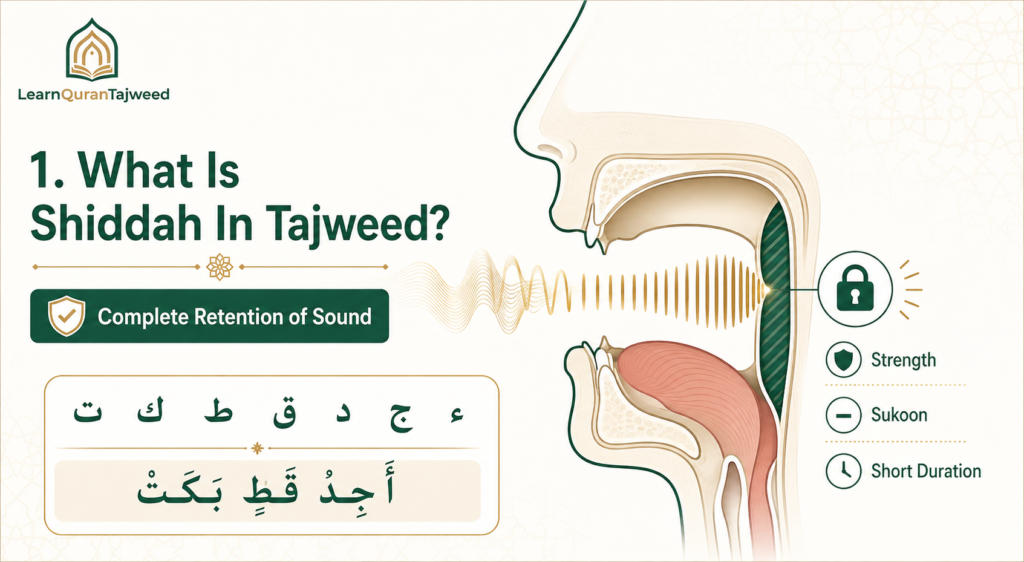
Meaning And Definition Of Shiddah
Linguistically, Shiddah means “strength.” In Tajweed, it refers to the complete retention of sound caused by strong reliance on the Makhraj and the complete closure of the articulation point when the letter is pronounced.
What Are The Letters Of Shiddah?
The eight letters of Shiddah are ء، ج، د، ق، ط، ب، ك، and ت. They are collected in the mnemonic phrase أَجِدْ قَطٍ بَكَتْ (Ajid Qatin Bakat), which helps learners memorize them easily.
How To Pronounce Shiddah Letters?
To pronounce a Shiddah letter correctly, stop the sound completely at its Makhraj. This is easiest to test when the letter carries Sukoon: the articulation point closes fully, so the sound cannot be prolonged.
As a result, a silent Shiddah letter has a shorter pronunciation time than Tawassut and Rakhawah letters.
Quranic Examples Of Shiddah Letters
Examples of silent Shiddah letters include Qaf in خَلَقْنَاكُمْ, Taa (ط) in أَطْعَمَهُمْ, Kaf in يَكْفُرْ, Baa in لَنَبْلُوَنَّكُمْ, Dal in قَدْ, Jeem in يَجْعَلْ, Hamzah in بِئْسَ, and Taa (ت) in فَتْحًا. Listen to each word from a skilled reciter, then repeat it while comparing how the sound stops completely at every silent Shiddah letter without being prolonged.
Read also: Advanced Quran Recitation With Tajweed Rules
Shiddah And Qalqalah
Five Shiddah letters—ق، ط، ب، ج، and د, collected in قُطْبُ جَدٍ (Qutbu Jadd)—also carry the quality of Qalqalah. Because Shiddah completely retains its sound when they carry Sukoon, Qalqalah releases it with a controlled echo so the letter remains clear and audible.
Produce this echo without adding Fathah, Kasrah, Dammah, or any other vowel to the silent letter.
Shiddah With Hams And Jahr
Shiddah governs sound, while Hams and Jahr govern breath. Kaf (ك) and Taa (ت) combine Shiddah with Hams, so their sound stops while the breath continues to flow.
The remaining Shiddah letters combine it with Jahr, retaining both sound and breath. Compare a silent Kaf with a silent Qaf (ق): both stop the sound, but breath flows with Kaf and is retained with Qaf.
Read also: Jahr In Tajweed
See Our Classrooms in Action
Watch these short clips from our live, interactive Quran courses to see how our students learn and interact with our expert tutors.
Perfect Your Quran Recitation Today
Join expert-led Tajweed classes, and recite the Quran with confidence and clarity.
Start Your Free Trial2. What Is Tawassut In Tajweed?
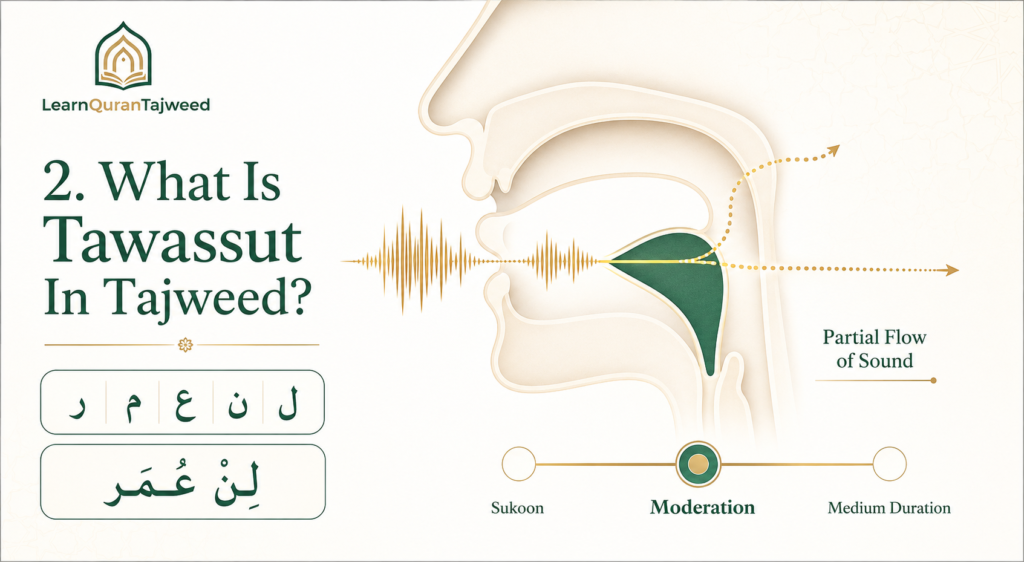
Tawassut describes a balanced state of sound between Shiddah and Rakhawah.
Meaning And Definition Of Tawassut
Linguistically, Tawassut means “moderation” and is also called Bayniyyah, meaning an intermediate state. In Tajweed, it describes a sound that is neither completely retained nor allowed to flow fully, as part of it escapes through another passage during pronunciation.
What Are The Letters Of Tawassut?
The five Tawassut letters are ل، ن، ع، م، and ر. They are collected in the mnemonic phrase لِنْ عُمَر (Lin Umar) for easy memorization.
How To Pronounce Tawassut Letters?
To pronounce a Tawassut letter correctly, allow the sound to flow partially without stopping it completely or prolonging it excessively. When the letter carries Sukoon, its sound should last for a moderate duration—longer than a Shiddah letter but shorter than a Rakhawah letter.
Why Does Each Tawassut Letter Have Partial Sound Flow?
Each Tawassut letter allows part of its sound to escape through a particular passage: Lam flows along the sides of the tongue, Noon and Meem continue through the nasal passage as Ghunnah, Raa permits a slight passage of sound around the tongue, and Ain flows through the partial opening of the throat.
These outlets prevent complete sound retention while keeping the sound from flowing as freely as it does with Rakhawah letters.
Quranic Examples Of Tawassut Letters
Examples of silent Tawassut letters include Lam in قُلْ, Noon in أَنْعَمْتَ, Ain in يَعْلَمُونَ, Meem in أَمْ, and Raa in فِرْعَوْنَ. Listen to each example from a skilled reciter, then repeat it while maintaining a moderate sound flow—neither stopping abruptly nor prolonging it excessively.
Read also: How to Improve Tajweed?
3. What Is Rakhawah In Tajweed?
Rakhawah describes the free continuation of sound when certain Arabic letters are pronounced.
Meaning And Definition Of Rakhawah
Linguistically, Rakhawah means “softness.” In Tajweed, it refers to the complete flow of sound caused by weaker reliance on the Makhraj and the incomplete closure of the articulation point during pronunciation.
What Are The Letters Of Rakhawah?
Rakhawah applies to the remaining letters after excluding the eight Shiddah letters and the five Tawassut letters: ا، ث، ح، خ، ذ، ز، س، ش، ص، ض، ظ، غ، ف، ه، و، and ي.
Some teaching traditions give a different total depending on whether Alif is counted separately and how Waw and Yaa are classified in their regular, Madd, or Leen forms; therefore, identifying Rakhawah letters through the exclusion method is often the clearest approach.
How To Pronounce Rakhawah Letters?
To pronounce a Rakhawah letter correctly, allow its sound to continue naturally without forcing the Makhraj to close completely. Test this quality by pronouncing the letter with Sukoon; its sound should flow freely and last longer than that of a silent Shiddah or Tawassut letter.
Quranic Examples Of Rakhawah Letters
Examples of silent Rakhawah letters include Seen in مُسْتَقِيمٍ, Sheen in نَشْرَحْ, Faa in يَفْعَلُ, Thaa in مَثْوَاكُمْ, Khaa in يَخْلُقُ, and Saad in أَصْحَابِ.
To identify Rakhawah, pronounce each silent letter in isolation and briefly extend its sound; if it continues naturally without closing the Makhraj, it carries Rakhawah. This elongation is only a learning test and should not be exaggerated during Quran recitation.
Read also: Complete Guide to Tajweed Rules
Shiddah Vs Tawassut Vs Rakhawah – Key Differences
The main difference between these three characteristics is the degree to which sound is retained or allowed to flow from the Makhraj, especially when the letter carries Sukoon.
| Comparison Point | Shiddah | Tawassut | Rakhawah |
| English meaning | Strength | Moderation | Softness |
| State of sound | Completely retained | Partially flows | Completely flows |
| Reliance on the Makhraj | Strong | Moderate | Weaker |
| Closure of the Makhraj | Complete | Partial | Incomplete |
| Relative duration when silent | Short | Medium | Long |
| Number or grouping of letters | Eight | Five | Remaining letters |
| Mnemonic | أَجِدْ قَطٍ بَكَتْ | لِنْ عُمَر | Exclusion method |
| Pronunciation test | Sound stops | Sound partly continues | Sound continues |
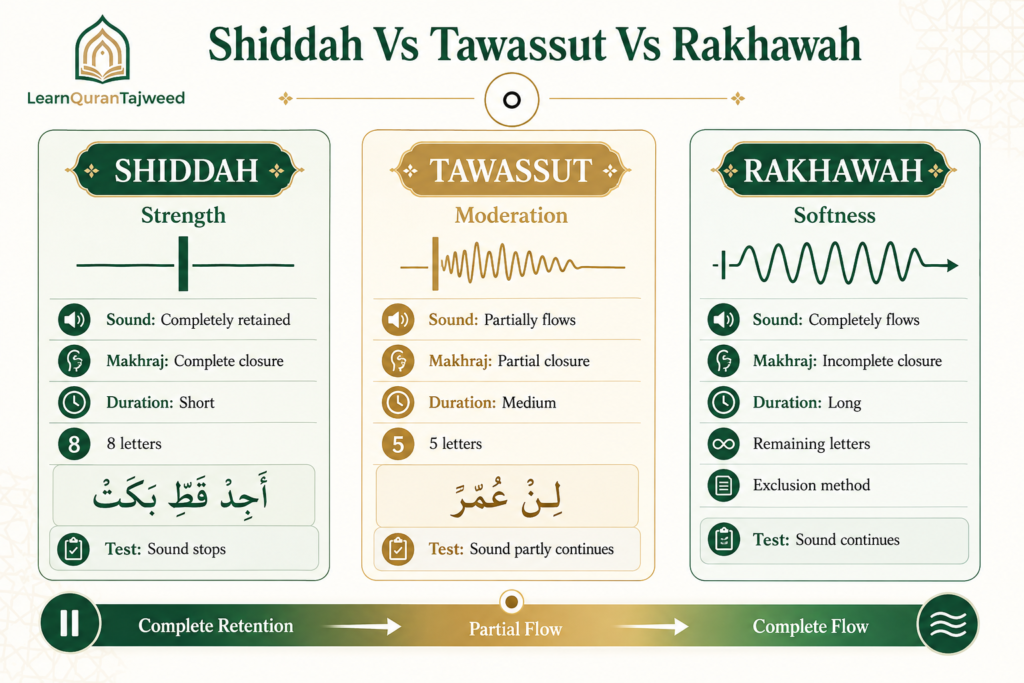
Sound-Flow Scale
The three qualities form a gradual sound-flow scale: Shiddah completely retains the sound, Tawassut permits partial sound flow, and Rakhawah allows full sound flow. This can be illustrated as a spectrum moving from complete retention → partial flow → complete flow.
Read also: Principles of Tajweed
Does Shiddah Mean Loud And Rakhawah Mean Quiet?
No. Shiddah does not mean loud, and Rakhawah does not mean quiet. Strength and softness describe the degree of reliance on the articulation point and the flow of sound—not vocal volume.
Therefore, Shiddah, Tawassut, and Rakhawah letters can all be pronounced correctly at a normal recitation volume.
Read also: Understanding Itbaq and Infitah in Tajweed Letter Attributes
How Do These Characteristics Affect Letter Duration?
Shiddah, Tawassut, and Rakhawah influence the relative duration of letters most clearly when they carry Sukoon.
Duration Of Silent Letters
A silent Rakhawah letter lasts longer than a Tawassut letter, while a Tawassut letter lasts longer than a Shiddah letter. Their exact duration changes with the recitation speed, but the proportions must remain balanced whether reciting in Tahqeeq, Tadweer, or Hadr.
What Happens When The Letter Has A Vowel?
When these letters carry ordinary short vowels, their vowel duration remains equal, so a moving Rakhawah letter should not be prolonged more than a moving Shiddah or Tawassut letter. The difference is most noticeable with Sukoon because no vowel follows the consonant to mask how its sound stops or flows.
What Happens In A Mushaddad Letter?
A Mushaddad letter consists of two identical letters: the first carries Sukoon, and the second carries a vowel. The silent component displays its inherent characteristic, so its sound is retained in a Shiddah letter, flows partially in a Tawassut letter, and flows fully in a Rakhawah letter before the vowel of the second component is pronounced.
Read also: The Benefits of Tajweed
How To Identify Shiddah, Tawassut, And Rakhawah By Sound?
The sound-flow quality of a letter is easiest to identify when it carries Sukoon.
The Sukoon Test
Select a letter carrying Sukoon and pronounce it from its correct Makhraj. If the sound stops completely, it has Shiddah; if it continues partially, it has Tawassut; and if it flows fully, it has Rakhawah. Confirm your result by checking whether the letter belongs to أَجِدْ قَطٍ بَكَتْ, لِنْ عُمَر, or the remaining letters.
Three-Way Listening Exercise
Compare Qaf in خَلَقْنَا for a complete Shiddah stop, Lam in قُلْ for moderate Tawassut flow, and Seen in مُسْتَقِيمٍ for continuous Rakhawah flow. Listening to recordings or viewing their waveforms can help you hear and see the difference between complete retention, partial flow, and full sound flow.
Physical Articulation Exercise
Pronounce silent letters slowly and observe whether the articulation point closes completely, partially, or incompletely. Focus on the sound separately from the breath, as these are governed by different characteristics.
Repeat the exercise under a qualified Quran teacher who can identify and correct subtle articulation errors.
Read also: Sifaat Al Huroof in Tajweed
Sound Flow Vs Breath Flow In Tajweed
Sound and breath are distinct elements governed by different letter characteristics in Tajweed.
What Is Sound?
Sound is air from the lungs that becomes audible through vibration during articulation. Shiddah, Tawassut, and Rakhawah describe whether this sound is completely retained, allowed to flow partially, or allowed to flow fully when a letter is pronounced.
What Is Breath?
Breath is the natural air leaving the lungs during pronunciation. In Tajweed, Hams allows the breath to flow, while Jahr retains it at the articulation point.
Can Sound Stop While Breath Continues?
Yes. Kaf (ك) and Taa (ت) combine Shiddah with Hams, so their sound stops while the breath continues. Qaf (ق) and Dal (د) combine Shiddah with Jahr, so both sound and breath are retained.
Pronouncing these letters with Sukoon reveals the difference between stopping the sound and stopping the breath.
Read also:The Difference Between Idhlaaq and Ismat Characteristics
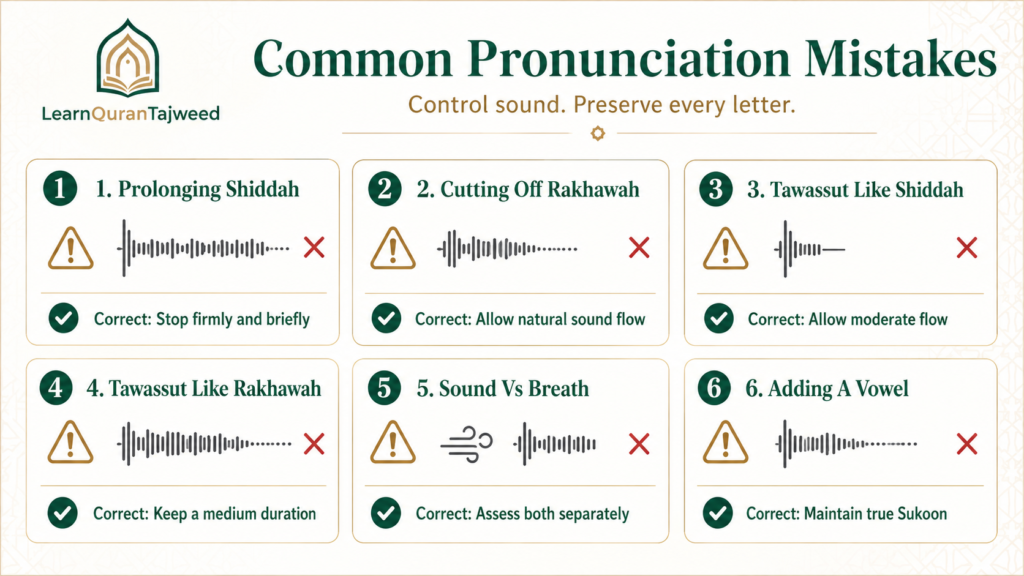
Common Pronunciation Mistakes
Correct sound control helps preserve the distinct qualities of Shiddah, Tawassut, and Rakhawah.
1. Prolonging Shiddah Letters
Prolonging a Shiddah letter turns its required complete stop into an artificial continuation and weakens reliance on the articulation point. The sound should instead be retained firmly and briefly at the Makhraj.
2. Cutting Off Rakhawah Letters
Cutting off a Rakhawah letter prevents its required sound flow and makes its soft articulation resemble that of a strong Shiddah letter. Instead, allow the sound to continue naturally without forcing the Makhraj to close completely.
3. Treating Tawassut Like Shiddah
Stopping a Tawassut letter too abruptly makes it resemble Shiddah and removes its intermediate quality. Instead, allow the sound to flow moderately without retaining it completely at the Makhraj.
4. Treating Tawassut Like Rakhawah
Extending a Tawassut letter excessively makes it resemble Rakhawah and distorts its natural duration. Its sound should flow only moderately, remaining shorter than a Rakhawah letter.
5. Confusing Sound With Breath
Testing letters through airflow alone can confuse sound with breath. Shiddah, Tawassut, and Rakhawah govern sound flow, whereas Hams and Jahr separately govern breath flow, so both qualities must be assessed independently.
6. Adding A Vowel To A Silent Letter
Adding Fathah, Kasrah, or Dammah to a silent letter changes its true Sukoon and distorts its pronunciation. This often occurs when Qalqalah is exaggerated, so its echo must remain controlled and free from any added vowel.
Read also: Tajweed Quiz
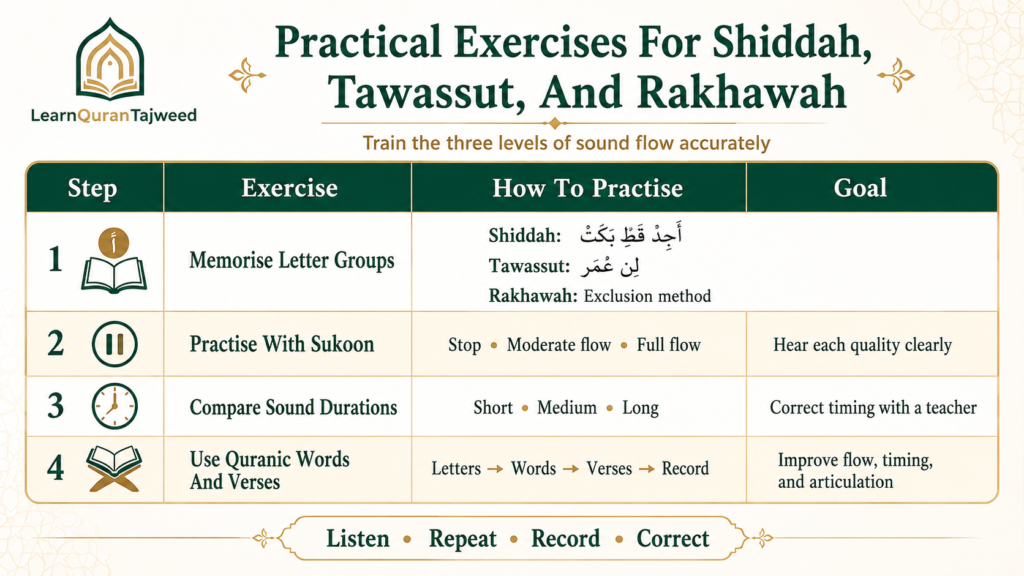
Practical Exercises For Shiddah, Tawassut, And Rakhawah
Simple exercises can help learners recognise and apply the three levels of sound flow accurately.
1. Memorise The Letter Groups
Memorise أَجِدْ قَطٍ بَكَتْ for the eight Shiddah letters and لِنْ عُمَر for the five Tawassut letters. Identify the Rakhawah letters through the exclusion method: they are the remaining letters after removing the Shiddah and Tawassut groups.
2. Practise Each Letter With Sukoon
Practise each letter with Sukoon in three separate drills: stop the sound completely with Shiddah letters, allow moderate flow with Tawassut letters, and maintain full sound flow with Rakhawah letters. Repeat each group slowly until the differences become clear and consistent.
3. Compare Similar Sound Durations
Practise Shiddah, Tawassut, and Rakhawah letters as short, medium, and long sound-flow exercises, then match each recorded or pronounced letter to its correct group. Complete the exercise with a qualified Tajweed teacher who can correct inaccurate timing and articulation.
4. Practise With Quranic Words And Verses
Begin with isolated letters, progress to short Quranic words, and then apply each characteristic within complete verses. Record your recitation for self-assessment and compare it with a qualified reciter to identify errors in sound flow, timing, and articulation.
Why Learning These Characteristics Improves Quran Recitation?
Learning Shiddah, Tawassut, and Rakhawah preserves the unique identity of each Arabic letter and prevents its sound from becoming too weak or forceful.
These characteristics improve clarity and measured recitation, support accurate application of the Makhraj, and develop better control over letters carrying Sukoon or Shaddah.
Inside Learn Quran Tajweed Academy
Curious about how online learning works? Peek inside our actual Quran classes and hear the beautiful recitation of our students and teachers.
Perfect Your Quran Recitation Today
Join expert-led Tajweed classes, and recite the Quran with confidence and clarity.
Start Your Free TrialMaster These Tajweed Rules With Expert Guidance
Understanding Shiddah, Tawassut, and Rakhawah is only the beginning—accurate recitation requires expert listening, correction, and consistent practice.
Join Learn Quran Tajweed’s live one-to-one classes to train with a qualified Quran teacher, correct hidden pronunciation mistakes, and apply every rule confidently. Book your free trial class today and start transforming your Quran recitation.
Courses we offer:
- Online Tajweed Classes
- Learn Quran with Tajweed Online
- Beginner Tajweed Course
- Intermediate Tajweed Course
- Advanced Tajweed Course
- Amali (Practical) Tajweed Course
Courses we offer:
- Tajweed Course for Kids
- Tajweed Course for Adults
- Tajweed Course for Ladies
- Tajweed ul Quran Course
- Quran Recitation with Tajweed Course
- Quran Tarteel Course
- Tajweed Ijazah Program
Conclusion
Shiddah, Tawassut, and Rakhawah explain how sound behaves when Arabic letters are pronounced. Shiddah retains the sound completely, Tawassut allows it to flow partially, and Rakhawah permits full sound flow.
Recognising these differences—especially when letters carry Sukoon—helps preserve correct articulation, timing, and letter identity. With focused listening, regular practice, and correction from a qualified Tajweed teacher, learners can apply these characteristics accurately and recite the Quran with greater clarity and confidence.
Frequently Asked Questions
What Is The Difference Between Shiddah And Rakhawah?
Shiddah completely retains the sound through firm closure of the Makhraj, whereas Rakhawah allows it to flow fully through incomplete closure.
What Is Tawassut In Tajweed?
Tawassut is the intermediate state between Shiddah and Rakhawah, in which sound flows partially without being completely retained or released.
What Are The Eight Letters Of Shiddah?
The eight Shiddah letters are ء، ج، د، ق، ط، ب، ك، and ت. They are collected in أَجِدْ قَطٍ بَكَتْ.
What Are The Five Letters Of Tawassut?
The five Tawassut letters are ل، ن، ع، م، and ر. They are collected in لِنْ عُمَر.
How Can I Identify The Letters Of Rakhawah?
Exclude the eight Shiddah letters and five Tawassut letters from the Arabic alphabet. The remaining letters carry Rakhawah.
Why Is Tawassut Also Called Bayniyyah?
Bayniyyah means an intermediate state. Tawassut receives this name because its sound lies between complete retention and complete flow.
Is Shiddah Related To Sound Or Breath?
Shiddah relates to the retention of sound, not breath. Breath flow is governed separately by Hams and Jahr.
Why Are Kaf And Taa Both Shiddah And Hams Letters?
Kaf (ك) and Taa (ت) retain sound because of Shiddah while allowing breath to flow because of Hams. Sound and breath are separate elements.
Are All Qalqalah Letters Also Shiddah Letters?
Yes. All five Qalqalah letters—ق، ط، ب، ج، and د—carry Shiddah, which completely retains their sound at the Makhraj.
When Is The Difference Between These Qualities Most Noticeable?
The difference is clearest when letters carry Sukoon because no vowel masks whether their sound stops, flows partially, or flows fully.
Does Recitation Speed Change The Relative Duration Of The Letters?
Recitation speed changes their actual duration, but not their proportion: Rakhawah remains longer than Tawassut, and Tawassut remains longer than Shiddah.
How Should Shiddah Be Applied To A Mushaddad Letter?
Treat the Mushaddad letter as two letters: retain the first silent component firmly at its Makhraj, then pronounce the second component with its vowel.