 Tajweed Rules
| Key Takeaways |
| Harakat in Tajweed are the three short vowel markings — Fathah, Dammah, and Kasrah — that determine the sound and duration of every letter. |
| Each harakah represents exactly one count (harakah unit), equal to half the duration of a natural Madd (two counts). |
| Sukoon marks the absence of a vowel; a letter with Sukoon exits from its articulation point without any mouth movement accompanying it. |
| Every harakah has a parent vowel letter: Fathah generates Alif, Dammah generates Waw, and Kasrah generates Ya — used to verify correct pronunciation. |
| The most common harakah errors — mixing vowel sounds, under-articulating mouth position, or extending beyond one count — corrupt meaning and Tajweed validity. |
Every word you recite from the Quran rides on the back of a harakah. Before Madd rules, before Ghunnah, before Qalqalah — there is the harakah. Students who skip this foundation and rush into advanced rules are building on sand, and experienced instructors can hear it immediately in their recitation.
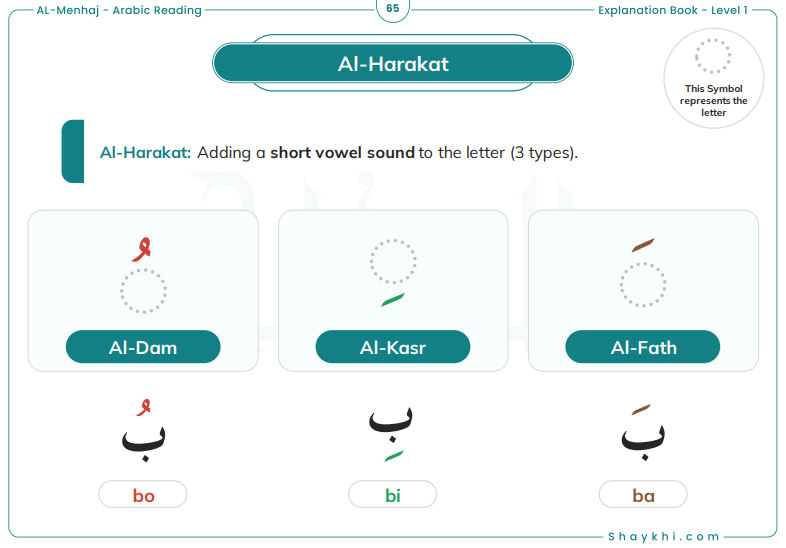
Harakat in Tajweed are the three short vowel signs — Fathah (ـَ), Dammah (ـُ), and Kasrah (ـِ) — that determine how each letter sounds and how long it lasts. Each harakah carries exactly one unit of time, and that precise, consistent duration is non-negotiable whether you read in slow Tahqeeq or fast Hadr.
What Are Harakat in Tajweed?
Harakat in Tajweed are the short vowel markers — Fathah (ـَ), Dammah (ـُ), and Kasrah (ـِ) — placed above or below Arabic letters that govern pronunciation, duration, and mouth position for every moving letter in the Quran. Without correct harakah application, no other Tajweed rule can function properly.
Explore Al-Menhaj Book for FREE (Learn to Read Quran)
Each harakah is defined by two things: its sound and its physical production.
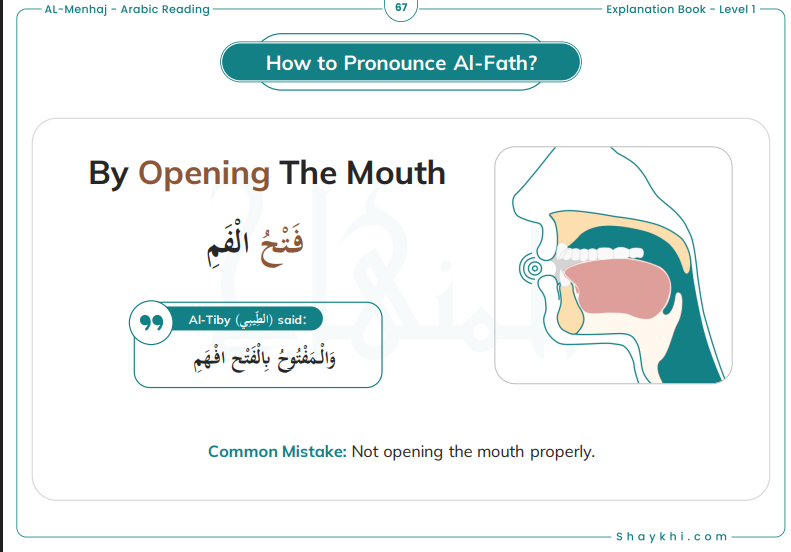
The Fathah requires the mouth to open.
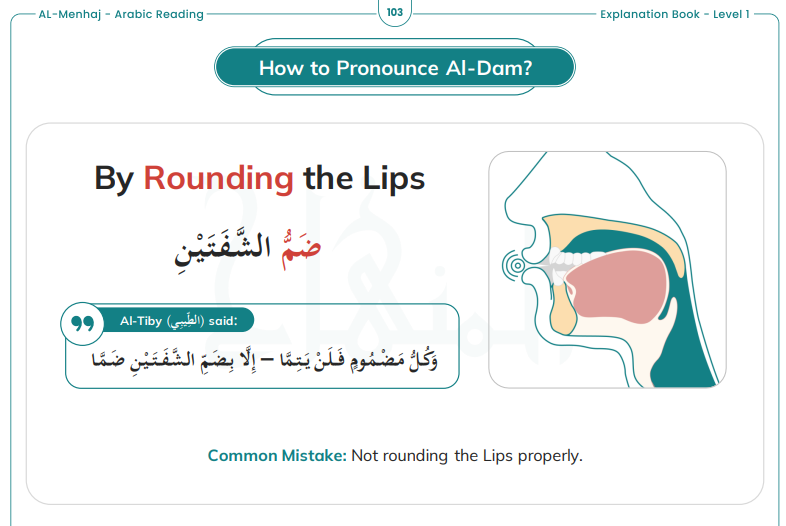
The Dammah requires the lips to round and close.
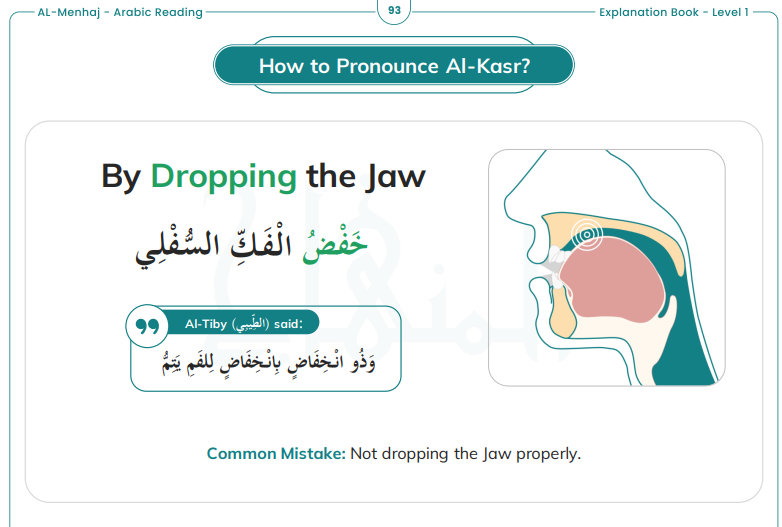
The Kasrah requires the lower jaw to drop slightly and the middle of the tongue to rise.
These physical positions are not optional — they are the harakah itself.
Classical Tajweed scholars describe each harakah as a partial segment of its corresponding Madd letter. The Fathah is a short Alif. The Dammah is a short Waw. The Kasrah is a short Ya. This is how you verify your pronunciation: extend the harakah slightly, and if the correct Madd letter emerges, your vowel is accurate.
At Learn Quran Tajweed Academy, our Beginner Tajweed Course addresses harakah precision in the earliest lessons — because every rule that follows, from Ikhfa to Idgham, depends on the student first controlling their vowel output correctly.
Begin your Tajweed journey with a free lesson

The Three Harakat and Sukoon: Definitions, Mouth Positions, and Verification
Each harakah has a specific physical mechanism and a verification test. Knowing the definition is not enough — the mouth position must become muscle memory.
1. Fathah (ـَ) in Tajweed: The Open Vowel
Fathah is produced with the mouth open, generating the short “a” sound as in “had.” Its Madd counterpart is the Alif. To verify: extend the sound — if a clean Alif emerges, the Fathah is correct.
The most common error is allowing a slight rounding of the lips during Fathah on Mufakham (heavy) letters.
Students often assume Tafkheem requires lip-rounding, but Tafkheem is a rise in the sound itself — the lips have no role. Fathah on ظ sounds deeper than on ن, but the mouth position for the Fathah remains open in both cases.
2. Dammah (ـُ) in Tajweed: The Rounded Vowel
Dammah requires genuine lip-rounding and slight forward projection. Its Madd letter is the Waw. Extend it — a clear Waw confirms accuracy.
A pattern observed repeatedly among Turkish-speaking students at Learn Quran Tajweed Academy is mixing the Dammah with a Kasrah-like sound, producing something between “u” and “i.” The fix is consistent: raise the back of the tongue and simultaneously round the lips. Both must happen together.
3. Kasrah (ـِ) in Tajweed: The Lowered Vowel
Kasrah requires lowering the jaw and raising the middle of the tongue. Its Madd letter is the Ya. Extend it — if a clean Ya emerges, the Kasrah is sound.
Under-articulation of Kasrah — not lowering the jaw enough — causes it to blur toward Sukoon. The letter appears to have no vowel, which disrupts meaning and Tajweed simultaneously.
| Harakah | Arabic | Mouth Action | Parent Madd Letter | Verification Test |
| Fathah | ـَ | Open mouth | Alif | Extend → clean Alif |
| Dammah | ـُ | Round and close lips | Waw | Extend → clean Waw |
| Kasrah | ـِ | Lower jaw, raise mid-tongue | Ya | Extend → clean Ya |
| Sukoon | ـْ | No movement — pure Makhraj | None | Clean, uncolored exit |
Read also: What Are the Levels of Quran Recitation in Tajweed?
How Does Harakah Duration Work in Tajweed Across All Recitation Speeds?
One harakah equals one unit of time — called a harakah count — and this duration remains proportionally consistent across all recitation tempos. Whether reciting in slow Tahqeeq, moderate Tadweer, or fast Hadr, the harakah to Madd ratio stays constant.
This is where many intermediate students make a critical error. They slow their Madd correctly during Tahqeeq but unconsciously extend their harakaat as well, producing a subtle Tadkheel — an unintentional Madd from a harakah. A common example:
نَسْتَعِينُ becomes incorrectly read as ناستعينو
Each harakah grew into a Madd letter. The sound is recognizable — almost melodious — but it is a recitation error that corrupts the text. This is described in classical Tajweed as the harakah giving birth to its Madd letter when overly prolonged.
The reference standard for Madd duration is always two harakah counts for the Madd Tabee’i (Natural Madd). You can read more about Madd rules and types to understand how harakah duration directly governs every Madd category.
Shots Videos from Our Courses
Perfect Your Quran Recitation Today
Join expert-led Tajweed classes, and recite the Quran with confidence and clarity.
Start Your Free TrialWhat Does Itimam al-Harakat Mean?
Itimam al-Harakat means completing each harakah fully — neither shortening it (Ikhtilas) nor extending it into a Madd (Tashbee’). It is the technical standard for correct vowel production in Tajweed.
Two errors oppose Itimam:
- Ikhtilas (Snatching): The harakah is shortened — the mouth doesn’t complete its movement, so the sound blurs toward Sukoon. Common in fast recitation.
- Isba’ (Saturation/Extension): The harakah is extended past one count, producing an unintended Madd letter. Common in slow, over-deliberate recitation.
Neither is acceptable. The harakah must be complete and contained — fully articulated in exactly one count.
The Itimam standard also applies at pause (Waqf). When stopping on a word, the last letter receives Sukoon — but the letter before it must still complete its harakah fully.
Students consistently drop the second-to-last vowel when preparing to stop, which produces an audible abbreviation error.
The Sakin Between Two Harakaat: The Most Technically Demanding Harakah Skill
A letter with Sukoon appearing between two voweled letters is one of the most technically demanding situations in applied Tajweed. The Sakin letter must exit from its Makhraj in complete neutrality — untouched by the vowel before it or after it.
The example from classical instruction is the word:
تُبْتُمْ
Tubtum
“You repented.” (At-Tawbah 9:118)
Here is what must happen with precision:
- First Taa (تُ): Lips round for Dammah, then Taa exits cleanly.
- Baa (بْ): Complete Sukoon — lips return to neutral before the Baa exits. No residual rounding from the Dammah.
- Second Taa (تُ): Lips round again for its Dammah.
The error students produce: they keep the lips rounded from the first Dammah through the Baa, so the Sakin Baa exits with a Dammah-colored sound. The Baa has effectively been given a ghost Dammah.
This same principle governs every Sakin in the Quran. It applies in ordinary eloquent Arabic speech, not exclusively in Quranic recitation — though Tajweed makes it a formal obligation.
Working with Ijazah-certified instructors at Learn Quran Tajweed Academy through our Advanced Tajweed Course provides the individualized attention needed to master this level of vowel isolation, with flexible scheduling available 24/7.
Reserve your free trial lesson for Advanced Tajweed Course

The Most Common Harakah Errors Made by Non-Arabic Speakers
Non-Arabic speakers carry phonological habits from their native languages into Quranic recitation. The errors are predictable — and correctable with targeted work.
Errors on Fathah
| Error | Description | Correction |
| Fathah mixed with Kasrah | Slight “e” coloring in the vowel | Verify: extend and check for clean Alif, not Ya |
| Fathah mixed with Dammah | Lip-rounding during Fathah on heavy letters | Remove lip involvement from Tafkheem entirely |
| Fathah reduced to Sukoon | Mouth doesn’t open fully | Practice minimum jaw-drop threshold with a mirror |
Errors on Dammah
| Error | Description | Correction |
| Dammah mixed with Fathah | Lips not rounding — open “a” sound produced | Verify: extend and check for clean Waw |
| Dammah mixed with Kasrah | Common in Turkish-speaking students | Round lips and simultaneously raise back of tongue |
| Dammah reduced to Sukoon | Insufficient lip-rounding | Practice isolated Dammah with exaggerated lip position first |
Errors on Kasrah
| Error | Description | Correction |
| Kasrah mixed with Fathah | Jaw not dropping enough | Verify: extend and check for clean Ya |
| Kasrah reduced to Sukoon | No jaw drop, no tongue rise | Isolate jaw movement in slow practice before applying to words |
The verification method — extending each harakah to check for its parent Madd letter — is the single most effective self-correction tool available. Use it in every practice session.
Our Practical Tajweed Course at Learn Quran Tajweed Academy is specifically designed for students who have learned Tajweed theory but need focused live correction of exactly these vowel errors.
Join our Practical Tajweed Course and get a free trial

Read Also: Laam Rules in Tajweed
The Singular Exception: Haa al-Dhameer and Intentional Harakah Extension
Classical Tajweed scholarship permits one specific case where a harakah may be extended into a Madd letter without constituting an error: Haa al-Dhameer (the pronoun Haa ه) when it appears between two voweled letters.
The example:
إِنَّهُ هُوَ
Innahu Huwa
“Indeed, He is.” (Ash-Shu’ara 26:9)
The Haa of the pronoun (هُ) between two voweled letters may receive an extended Dammah — producing a Madd — according to the recitation of Hafs ‘an Asim. This is a specific, rule-governed permission, not a general license to extend harakaat. Every other harakah outside this case must remain at exactly one count.
This fine distinction — knowing where extension is permitted versus where it constitutes an error — is the kind of precision separating competent recitation from truly mastered Tajweed.
Understanding the full picture of Noon Sakinah rules alongside harakah control builds the complete framework for connected recitation.
Read Also: Shaddah in Tajweed
Our Students Reviews
Perfect Your Quran Recitation Today
Join expert-led Tajweed classes, and recite the Quran with confidence and clarity.
Start Your Free TrialThe Role of a Certified Teacher in Harakah Mastery
No written resource — however detailed — can fully calibrate your harakah. The standard classical position, agreed upon across all Tajweed scholars, is that Mushafahah (direct oral transmission from teacher to student) is the only reliable path to correct vowel production.
This is not a formality. The ear of a certified instructor detects a Kasrah blending toward Fathah in a way that no self-assessment checklist can replicate. In years of teaching non-Arabic speakers at Learn Quran Tajweed Academy, the harakah errors that persist longest are always the ones students cannot hear in themselves — because their ear is calibrated to their native phonological system, not to Arabic.
The Quran Tarteel Course at Learn Quran Tajweed Academy specializes in developing the precise pacing and vowel consistency that reflects true Tarteel — the measured, beautiful recitation the Quran deserves.
Join our Quran Tarteel Course and get a free trial

Read Also: Principles of Tajweed
Begin Your Harakah Mastery with Certified Instruction at Learn Quran Tajweed Academy
Harakah accuracy is the entry point to everything in Tajweed. Correcting it requires a certified ear, not just a written rule.
Learn Quran Tajweed Academy offers:
- Ijazah-certified instructors specializing exclusively in Hafs ‘an Asim
- Personalized 1-on-1 sessions targeting your specific vowel errors
- Flexible scheduling available 24/7 for global students
- Structured progression from harakah fundamentals to full Ijazah certification
- Free trial lesson — no commitment required
Book your FREE trial lesson today and have a certified Qari diagnose your harakah in a single session.
Check out the best tajweed course for your needs:
- Practical Tajweed Course
- Beginner Tajweed Course
- Intermediate Tajweed Course
- Advanced Tajweed Course
- Quran Tarteel Course
- Tajweed Ijazah Program
- Tajweed Course for Sisters
- Tajweed course for Kids
Book your free trial Tajweed lesson today

Conclusion
Harakat are not decorative marks — they are the vowel skeleton of every word in the Quran. Getting them right means getting the meaning right, and getting them wrong, even slightly, produces a different word or a broken recitation.
The verification principle — extend any harakah and check for its parent Madd letter — gives every student an immediate self-assessment tool. Apply it consistently, and your ear will gradually calibrate to the correct standard.
Insha’Allah, with dedicated practice under certified guidance, the harakaat will move from conscious effort to natural fluency. That transition is what separates recitation from Tarteel.
Read Also: Complete Guide to Tajweed Rules
Frequently Asked Questions About Harakat in Tajweed
What Is the Difference Between a Harakah and a Madd in Tajweed?
A harakah is a short vowel lasting one count — Fathah, Dammah, or Kasrah. A Madd is the extended form of that vowel, lasting two or more counts. Every Madd originates from its corresponding harakah: Fathah produces Alif-Madd, Dammah produces Waw-Madd, and Kasrah produces Ya-Madd.
Does Harakah Duration Change When Reciting Fast or Slow?
No. The harakah count remains proportionally consistent across all recitation speeds — Tahqeeq, Tadweer, and Hadr. The absolute time changes with tempo, but the ratio of one harakah to two harakaat for Natural Madd remains constant. Extending harakaat during slow recitation is a recognized error called Tadkheel.
How Do I Know If I Am Pronouncing the Dammah Correctly?
Extend the Dammah slightly beyond its normal one-count duration. If a clean Waw sound emerges naturally, the Dammah is correct. If you hear an “a” sound or an “ee” sound instead, the Dammah is mixed with Fathah or Kasrah respectively, and mouth position needs adjustment.
Is a Letter with Sukoon Completely Silent?
Not exactly — the letter still fully exits from its Makhraj. Sukoon means the letter carries no vowel movement (no mouth opening, rounding, or jaw drop), but the letter itself is pronounced from its articulation point. It is the absence of harakah, not the absence of the letter.
Can I Learn Correct Harakah Pronunciation Without a Live Teacher?
Self-study can build theoretical understanding, but harakah calibration requires live correction. Classical Tajweed scholarship explicitly states that Mushafahah — direct oral transmission — is the only reliable method for vowel accuracy. A certified instructor detects vowel blending errors that the student’s own ear cannot identify without external reference.