 Tajweed Basics

When studying Arabic, you may notice an extra ن (Nun) appearing before Ya Al-Mutakallim (ياء المتكلم) in words such as أَكْرَمَنِي (he honored me), يُسَاعِدُنِي (he helps me), and سَاعِدْنِي (help me). This letter is not part of the original verb, nor does it carry an independent meaning.
It is known as Nun Al-Wiqayah (نون الوقاية), a small but useful Arabic grammar rule that helps preserve the grammatical form of the word before the first-person pronoun.
Understanding this rule makes it easier to recognize attached pronouns, analyze verb forms, and understand similar constructions when reading Classical or Quranic Arabic. In this guide, we will explain what Nun Al-Wiqayah means, why it is used, where it appears, and how to recognize it through simple Arabic and Quranic examples.
What Is Nun Al-Wiqayah?
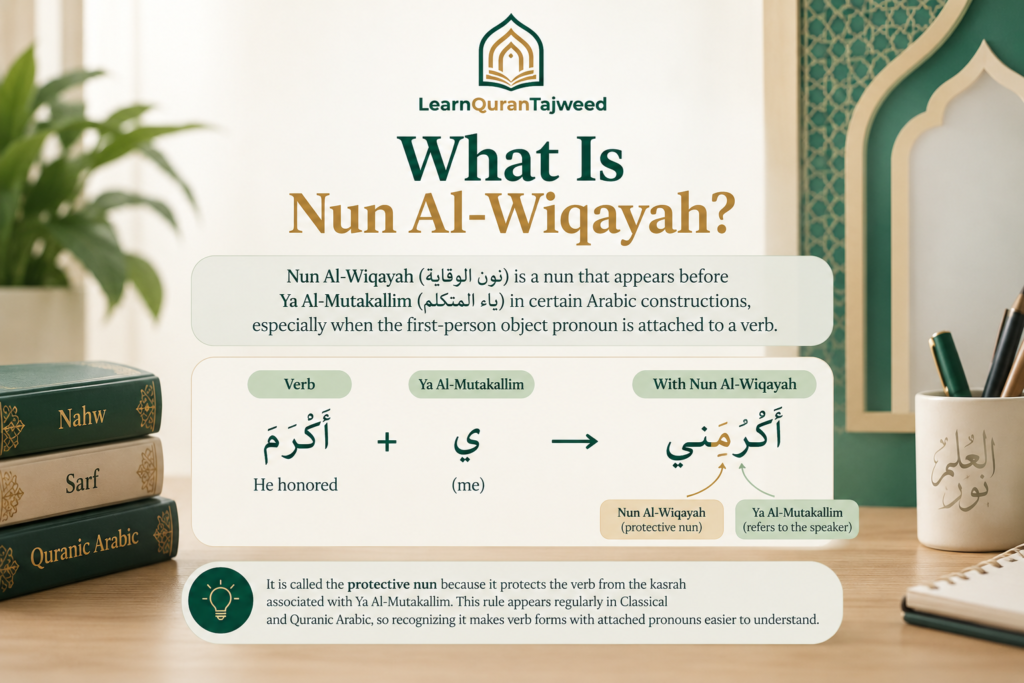
Nun Al-Wiqayah (نون الوقاية) is a nun that appears before Ya Al-Mutakallim (ياء المتكلم) in certain Arabic constructions, especially when the first-person object pronoun is attached to a verb.
It is called the protective nun because it protects the verb from the kasrah associated with Ya Al-Mutakallim. Since verbs do not take the genitive case (الجر), Arabic places this nun between the verb and the pronoun instead of allowing the kasrah to affect the verb itself.
For example:
أَكْرَمَ + ي → أَكْرَمَنِي
The word أَكْرَمَنِي means he honored me. The ن before the final ya is Nun Al-Wiqayah, while the ي is Ya Al-Mutakallim referring to the speaker.
Although the rule is small, it appears regularly in Classical and Quranic Arabic, so recognizing it makes verb forms with attached pronouns much easier to understand.
Why Is It Called the Protective Nun?
The Arabic word الوقاية means protection or prevention, which describes the grammatical purpose of this nun. When Ya Al-Mutakallim is attached to a verb, Nun Al-Wiqayah comes before it and carries the kasrah appropriate to the ya.
Compare:
أَكْرَمَنِي — He honored me
يُكْرِمُنِي — He honors me
أَكْرِمْنِي — Honor me
In each example, the nun appears immediately before Ya Al-Mutakallim. It does not have an independent meaning and does not refer to the speaker; that function belongs to the ya. The nun is present for grammatical protection.
Small rules like Nun Al-Wiqayah become much easier with clear explanation and guided practice. At Learn Quran Tajweed,
our experienced teachers help young learners build strong foundations step by step through engaging, structured lessons in the Tajweed Course for Kids, helping children improve their Quran recitation, pronunciation, and understanding of essential Tajweed rules with confidence.
Read also: Ha Al-Kinayah/Damir in Tajweed — Rules, Madd Silah, Examples

Where Is Nun Al-Wiqayah Used?
The most important place to recognize Nun Al-Wiqayah is with verbs. When Ya Al-Mutakallim is attached to a verb as its object, the protective nun is used with past, present, and imperative verbs.
| Verb Type | Example | Meaning |
| Past (ماضٍ) | أَكْرَمَنِي | He honored me |
| Present (مضارع) | يُسَاعِدُنِي | He helps me |
| Imperative (أمر) | سَاعِدْنِي | Help me |
This is also why learners should distinguish between forms such as أَكْرِمْنِي and أَكْرِمِي. The first means honor me, with Ya Al-Mutakallim as the object, while the second is an imperative addressed to a singular female.
Nun Al-Wiqayah can also occur with certain particles. It is obligatory with لَيْتَ, producing the only valid form لَيْتَنِي (not لَيْتِي), while with several of the particles belonging to إنَّ وأخواتها, Arabic allows forms with or without the additional nun.
Both forms occur in correct Classical Arabic usage. Similarly, the familiar forms مِنِّي and عَنِّي are associated with مِنْ and عَنْ when followed by Ya Al-Mutakallim.
For beginners, however, the most useful rule to remember is much simpler: when Ya Al-Mutakallim is attached to a verb as its object, expect Nun Al-Wiqayah before it.
Read also: Qirat of Quran — The 7 Famous Qira’at, and How They Differ
See Our Classrooms in Action
Watch these short clips from our live, interactive Quran courses to see how our students learn and interact with our expert tutors.
Perfect Your Quran Recitation Today
Join expert-led Tajweed classes, and recite the Quran with confidence and clarity.
Start Your Free TrialExamples of Nun Al-Wiqayah in the Quran
The Quran contains many examples that make Nun Al-Wiqayah easy to recognize in context. One clear example appears in the words of Prophet Ibrahim عليه السلام:
﴿وَالَّذِي هُوَ يُطْعِمُنِي وَيَسْقِينِ﴾
And it is He who feeds me and gives me drink.[Ash-Shu’ara 26:79]
In يُطْعِمُنِي, the final structure can be understood as the verb followed by Nun Al-Wiqayah and Ya Al-Mutakallim.
Another example is:رَبِّ أَرِنِي أَنظُرْ إِلَيْكَ
My Lord, show me [Yourself] that I may look at You.[Al-A’raf 7:143]
The form أَرِنِي contains Nun Al-Wiqayah before the first-person object pronoun.
The Quran also provides a familiar example with لَيْتَ:
﴿يَا لَيْتَنِي كُنتُ مَعَهُمْ فَأَفُوزَ فَوْزًا عَظِيمًا﴾
Oh, I wish I had been with them so I could have attained a great triumph.
[An-Nisa 4:73]
Here, the construction لَيْتَنِي shows the nun appearing before Ya Al-Mutakallim after لَيْتَ.
Read also: Tuhfat Al-Atfal – The Beginner’s Poem That Opens The Door To Tajweed
When Is Nun Al-Wiqayah Not Used?
Nun Al-Wiqayah should not be added simply because a word ends with Ya Al-Mutakallim. Ordinary nouns do not require it when the ya indicates possession.
For example:
كِتَابِي — my book
قَلَمِي — my pen
بَيْتِي — my house
We say كِتَابِي, not كِتَابَنِي, because كتاب is a noun and can naturally accept the grammatical effect of being attached to Ya Al-Mutakallim.
This creates a useful contrast for learners:
كِتَابِي → noun + Ya Al-Mutakallim
أَكْرَمَنِي → verb + Nun Al-Wiqayah + Ya Al-Mutakallim
Remembering this distinction is usually enough to recognize the rule correctly in most beginner and intermediate Arabic texts.
Turn Quran recitation rules into practical skills with Learn Quran Tajweed, where experienced teachers provide focused practice, clear guidance, and personalized correction through the Learn Quran with Tajweed Online course.
Build greater accuracy, strengthen your pronunciation, and gain confidence as you learn to apply Tajweed rules naturally throughout your Quran recitation.

Why Is Nun Al-Wiqayah Important for Arabic Learners?
Understanding Nun Al-Wiqayah helps students separate Arabic words into their grammatical components instead of memorizing each conjugated form as a completely new word.
When a learner encounters يُكْرِمُنِي, for example, recognizing the protective nun makes it easier to identify the underlying verb and understand that the final ya means “me.”
The same skill becomes especially useful when reading the Quran or Classical Arabic, where attached pronouns occur frequently.
For students of Quranic Arabic, recognizing small grammatical features such as Nun Al-Wiqayah can therefore make sentence analysis more accurate without requiring an overly complicated set of rules.
Inside Learn Quran Tajweed Academy
Curious about how online learning works? Peek inside our actual Quran classes and hear the beautiful recitation of our students and teachers.
Perfect Your Quran Recitation Today
Join expert-led Tajweed classes, and recite the Quran with confidence and clarity.
Start Your Free TrialLearn Arabic Grammar With Guided Practice
Small Arabic grammar rules often become easier when they are studied through real sentences rather than memorized as isolated definitions.
At Learn Quran Tajweed, students can develop their understanding of Arabic grammar through guided lessons that connect Nahw and Sarf principles with practical examples and Quranic Arabic.
Working with a qualified teacher also helps learners understand why forms such as أَكْرَمَنِي, لَيْتَنِي, and كِتَابِي behave differently, so they can apply the rule naturally instead of relying only on memorization.
Courses we offer:
- Online Tajweed Classes
- Learn Quran with Tajweed Online
- Beginner Tajweed Course
- Intermediate Tajweed Course
- Advanced Tajweed Course
- Amali (Practical) Tajweed Course
- Tajweed Course for Kids

Perfect Your Quran Recitation Today
Join expert-led Tajweed classes, and recite the Quran with confidence and clarity.
Start Your Free TrialConclusion
Nun Al-Wiqayah (نون الوقاية) is a protective nun that appears before Ya Al-Mutakallim in specific Arabic constructions, most importantly when the first-person object pronoun attaches to a verb. Examples such as أَكْرَمَنِي, يُسَاعِدُنِي, and سَاعِدْنِي show the basic pattern clearly.
It also appears with certain particles, particularly in forms such as لَيْتَنِي, while ordinary nouns such as كِتَابِي do not take Nun Al-Wiqayah.
Once this basic distinction is understood, there is little need to make the rule more complicated. Recognizing the verb, identifying Ya Al-Mutakallim, and noticing the protective nun between them will cover the most important practical use of Nun Al-Wiqayah.
Frequently Asked Questions
What is Nun Al-Wiqayah?
Nun Al-Wiqayah is a protective nun placed before Ya Al-Mutakallim in certain Arabic constructions, particularly when the first-person object pronoun attaches to a verb. It is called the protective nun because it protects the preceding word from the kasrah associated with the ya.
Is Nun Al-Wiqayah used with all verbs?
When Ya Al-Mutakallim is attached to a verb as its object, Nun Al-Wiqayah is used with past, present, and imperative verbs, as in أَكْرَمَنِي, يُكْرِمُنِي, and أَكْرِمْنِي.
Does Nun Al-Wiqayah appear in the Quran?
Yes. Quranic examples include يُطْعِمُنِي in Surah Ash-Shu’ara 26:79, أَرِنِي in Surah Al-A’raf 7:143, and لَيْتَنِي in Surah An-Nisa 4:73.
Is Nun Al-Wiqayah used with nouns?
No, ordinary inflected nouns do not take Nun Al-Wiqayah when attached to Ya Al-Mutakallim. For example, Arabic uses كِتَابِي for “my book,” without inserting a protective nun.
Related Articles
Tajweed Basics