 Tajweed Rules
| Key Takeaways |
| Waqf means pausing on a word with a breath, intending to resume recitation — not ending it permanently. |
| The four main types of waqf are: taam (complete), kaafi (sufficient), hasan (good), and qabih (ugly/forbidden). |
| Waqf laazim (obligatory stop) is marked with a small meem (م) in the Mushaf and must not be skipped to preserve meaning. |
| Stopping mid-sentence due to necessity requires returning to a point where meaning is grammatically and semantically complete. |
| Ta marbuta (ة) is pronounced as a silent “h” at waqf, while ta mabsuta (ت) retains its “t” sound in specific Quranic words. |
Waqf rules in Tajweed determine where a reciter pauses, breathes, and resumes — and mastering them is not optional for anyone serious about reciting the Quran correctly.
A misplaced pause can distort meaning entirely, attributing to Allah what was never intended, or severing a sentence the Quran meant to connect. This is precisely why classical scholars placed waqf knowledge at the heart of Tajweed mastery.
Ali ibn Abi Talib (رضي الله عنه) explained the meaning of tarteel in Surah Al-Muzzammil (73:4) as: “It is the beautification of letters and the knowledge of waqf.” The rules of waqf in Tajweed govern pausing with precision — protecting both the reciter’s breath and the listener’s understanding, in every single session of recitation.
What Does Waqf Mean in Tajweed?
Waqf is defined as cutting the voice on the last letter of a word for a breath’s duration, with the intention of continuing recitation. It differs fundamentally from qat’ (قطع), which means ending recitation entirely.
Every time you pause mid-recitation to breathe, you are making a waqf — and the rules of Tajweed govern exactly how and where that pause is permitted.
This distinction matters because pausing incorrectly can sever connected grammar, produce a false meaning, or — in the most serious cases — imply something that contradicts Islamic belief. Understanding the types of waqf in Tajweed is the foundation upon which every competent reciter builds their practice.
At Learn Quran Tajweed Academy, students in our Beginner Tajweed Course are introduced to waqf as one of the first applied skills — because without it, even correctly articulated letters lose their intended meaning when strung together carelessly.
Begin your Tajweed journey with a free lesson

What Are the Main Types of Waqf in Tajweed?
The types of waqf in Tajweed divide into two primary categories: ikhtiyaari (voluntary) and idtiraari (involuntary). Within voluntary waqf lies the essential fourfold classification every reciter must internalize.
| Type | Arabic Term | Definition | Ruling |
| Complete Stop | وقف تام (Waqf Taam) | Meaning complete; no connection to what follows in word or sense | Permitted and recommended |
| Sufficient Stop | وقف كافي (Waqf Kaafi) | Meaning complete; connected in sense but not in grammar | Permitted; good to resume from next word |
| Good Stop | وقف حسن (Waqf Hasan) | Meaning complete locally; grammatically linked to what follows | Permitted on it; must repeat before resuming |
| Ugly/Forbidden Stop | وقف قبيح (Waqf Qabeeh) | Meaning incomplete; distorts understanding or corrupts belief | Forbidden except by necessity |
1. Waqf Taam — the Complete Stop
Waqf taam occurs where meaning is fully concluded and there is no grammatical or semantic link to the following verse or sentence. It is the cleanest, most recommended pause point — found most naturally at the ends of Surahs, at transitions between topics, or between descriptions of believers and disbelievers.
A clear example is pausing on الْمُفْلِحُونَ at the end of Al-Baqarah 2:5, where the description of the believers concludes completely before the topic shifts to the disbelievers in verse 6. The meaning is sealed; the pause is ideal.
2. Waqf Laazim — the Obligatory Stop Within Waqf Taam
Waqf laazim — also called waqf al-bayan — is a specialized form of waqf taam. It is marked in the Mushaf with a small مـ and signals that not pausing here will cause serious misunderstanding of the verse’s meaning.
One of the most instructive examples for students is in Surah Yunus (10:65):
وَلَا يَحْزُنكَ قَوْلُهُمْ ۘ إِنَّ الْعِزَّةَ لِلَّهِ جَمِيعًا
Wa laa yahzunka qawluhum. Innal-‘izzata lillahi jamee’aa
“Do not let their words grieve you. Indeed, all honour belongs to Allah.”
Without pausing on قَوْلُهُمْ, a listener could understand that their claim that all honour belongs to Allah is what causes grief — the exact opposite of the intended meaning. This is why the pause here is not optional.
3. Waqf Kaafi — the Sufficient Stop
Waqf kaafi applies where the meaning of a phrase is complete but the following phrase carries a semantic connection — without a direct grammatical link. Pausing is permitted, and resuming from the next word is natural and correct.
An example is pausing on الْبَيْتِ in Surah Quraysh (106:3): “So let them worship the Lord of this House” — complete in itself, though the following verse explains why. The pause is valid; the connection is thematic, not syntactic.
Shots Videos from Our Courses
Perfect Your Quran Recitation Today
Join expert-led Tajweed classes, and recite the Quran with confidence and clarity.
Start Your Free Trial4. Waqf Hasan — the Good Stop
Waqf hasan is perhaps the most nuanced type. The paused word carries a complete local meaning, but it is grammatically dependent on what follows. Pausing is permitted — particularly at the end of an ayah — but resuming from the next word alone is not sufficient. The reciter must return to the paused word or a point before it to complete the grammatical sense.
The Prophet ﷺ was narrated to pause at the ends of ayaat in his recitation, as reported by Abu Dawud (1466) — and this sunnah grants general permission to pause at ayah-endings even when grammatical links exist.
A well-known example: pausing on الْحَمْدُ لِلَّهِ in Al-Fatihah (1:2) is hasan — the phrase carries meaning. But resuming from رَبِّ الْعَالَمِينَ without returning to الْحَمْدُ لِلَّهِ is incorrect, since “Lord of all worlds” depends grammatically on the praise statement before it.
5. Waqf Qabeeh in Tajweed
Waqf qabeeh — the forbidden pause — occurs when a reciter stops at a point where meaning is incomplete, producing either grammatical incoherence or, worse, a distorted implication about Allah or His religion. It is strictly prohibited except when forced by necessity such as coughing, breathlessness, or sneezing.
The prohibition has three levels of severity that students at Learn Quran Tajweed Academy are trained to identify systematically:
- Grammatically incomplete: Pausing on a verb without its subject, a preposition without its noun, or a conditional without its response — e.g., stopping on اسْمَ in Al-A’la 87:1 before رَبِّكَ
- Misleading meaning: Pausing on الصَّلَاةَ in An-Nisa 4:43 — “Do not approach the prayer” — without completing “while you are intoxicated”
- Theologically dangerous: Pausing on لَا يَهْدِي in Al-Munafiqun 63:6 implies Allah does not guide — the meaning is complete only when الْقَوْمَ الْفَاسِقِينَ is reached
In our experience teaching non-Arabic speakers, the third level is the one students least expect to encounter — and the one that causes the deepest concern when they finally hear what their accidental pause implied.
Meet One of our Certified Teachers to Correct Your Pronunciation

How Does Idtiraari (Involuntary) Waqf Work?
Waqf idtiraari covers all pauses made out of necessity — an unexpected cough, sneezing, dizziness, or simply running out of breath before reaching a proper stop. This type of waqf is always permitted by necessity, and no sin attaches to it.
The governing rule after an involuntary waqf is simple: if resuming from the next word produces a correct and complete meaning, do so.
If not — return far enough in the ayah that the resumed portion stands on its own grammatically and semantically. The principle is to protect the listener’s understanding, not merely to satisfy the reciter’s convenience.
This connects directly to the rules of Noon Sakinah and Tanween — because when resuming after an involuntary pause, the reciter must reconsider whether rules like Idgham or Ikhfa still apply at the new resumption point.
Read Also: What Are the Leen Letters in Tajweed?
Rules of Waqf in Tajweed for Ta Marbuta and Ta Mabsuta
One of the most practically important — and most frequently confused — waqf rules in Tajweed concerns how to pronounce the final letter ت when stopping.
Ta marbuta (ة): Always pronounced as a silent haa (هـ) at waqf, in every position throughout the Quran — e.g., رَحْمَةٌ becomes رَحْمَهْ when stopping.
Ta mabsuta (ت): Retained as a silent taa at waqf. This applies to a specific set of words where the letter is written as an open taa in the Uthmani Mushaf. These include رَحْمَتَ (in 7 specific positions), نِعْمَتَ (in 11 positions), امْرَأَتَ (in 7 positions), كَلِمَتَ (in 5 positions), سُنَّتَ, لَعْنَتَ, مَعْصِيَتَ, and several others.
A critical example: نِعْمَتَ اللَّهِ in Ibrahim 14:28 is stopped as نِعْمَتْ — with taa. But نِعْمَةِ رَبِّكَ in Ad-Duha 93:11 stops as نِعْمَهْ — with haa. The difference is entirely determined by how the word is written in the Mushaf, not by sound or convention.
This is one of the areas where working with an Ijazah-certified instructor makes the most difference. In sessions at Learn Quran Tajweed Academy, I consistently observe students defaulting to haa for all taa endings — a systematic error that only targeted recitation correction resolves. Our Practical Tajweed Course addresses exactly these applied pronunciation distinctions.
Join our Practical Tajweed Course and get a free trial

Read Also: What Are the Rules of Hamzatul Wasl?
How the Waqf Symbol System Works in the Mushaf
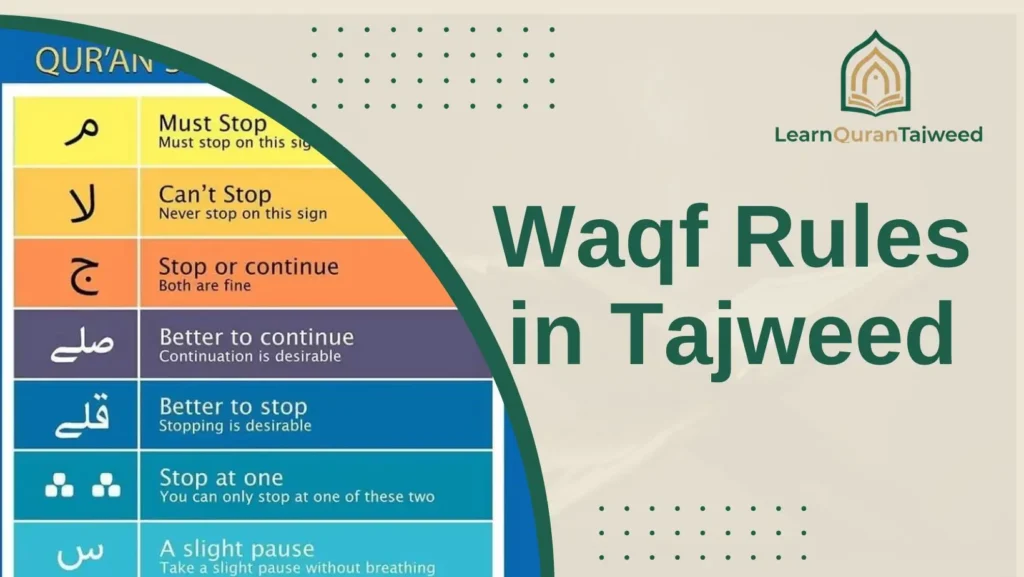
Modern Mushafs use a standardized symbol system to guide reciters. Knowing these symbols is a practical skill that directly supports applying the rules of waqf in Tajweed correctly.
| Symbol | Meaning |
| م | Obligatory stop — must pause here |
| ط | Absolute stop — strongly recommended |
| ج | Permitted stop — both pausing and continuing are acceptable |
| ز | Continuing is slightly preferred |
| ص | Pausing is permitted for breath, continuing preferred |
| لا | Do not pause here — continuing is required |
| ∴ ∴ | Pause at one of these two marks, not both |
The waqf mu’aanaqah (∴ ∴) symbol is particularly interesting — it marks two possible stopping points within close proximity, and the rule is that the reciter pauses at one or the other, never both. This preserves a deliberate ambiguity of meaning that the Quran itself encodes.
For students working toward Ijazah, memorizing these symbols and applying them in live recitation is a tested skill — and one covered in depth through our Tajweed Ijazah Program.
Join our Tajweed Ijazah Program and get a free trial

Read Also: Hamzatul Qat’ in Tajweed
How Do Waqf Rules Connect to Other Core Tajweed Topics?
Waqf does not function in isolation — it interacts directly with several other Tajweed rules that govern how letters sound at rest.
When making waqf, sukoon is applied to the final letter — which immediately activates Qalqalah on the letters ق ط ب ج د when they appear at the end of a paused word. A word-final قـ that carries no Qalqalah in wasl (continuation) acquires a strong Qalqalah kubra at waqf.
Similarly, the rules of Ghunnah and Iqlab apply at resumption points — the reciter must recalculate rule application when returning to a verse mid-way after an involuntary waqf. This is precisely the kind of advanced rule interaction that separates rote memorizers from genuinely trained reciters.
Our Students Reviews
Perfect Your Quran Recitation Today
Join expert-led Tajweed classes, and recite the Quran with confidence and clarity.
Start Your Free TrialRead Also: What Is Hams in Tajweed?
Begin Your Waqf Mastery with Certified Instruction at Learn Quran Tajweed Academy
Waqf rules are among the most meaning-critical skills in all of Tajweed — and they require live, corrective instruction to master properly.
Learn Quran Tajweed Academy offers:
- Ijazah-certified instructors specializing in Hafs ‘an ‘Asim recitation
- Personalized 1-on-1 sessions targeting your specific waqf errors
- Flexible scheduling 24/7 for students across all time zones
- Structured progression from foundational rules to full Ijazah certification
- Specialized Tajweed focus — not a generalist Quran platform
Book your FREE trial lesson today and recite with the confidence that every pause you make honours the Quran’s meaning.
Check out the best tajweed course for your needs:
- Practical Tajweed Course
- Beginner Tajweed Course
- Intermediate Tajweed Course
- Advanced Tajweed Course
- Quran Tarteel Course
- Tajweed Ijazah Program
- Tajweed Course for Sisters
- Tajweed course for Kids
Book your free trial Tajweed lesson today

Conclusion
Waqf is not simply a breathing technique — it is a meaning-preservation discipline. Every pause a reciter makes either honours the Quran’s intended message or risks fragmenting it.
Mastering the types of waqf in Tajweed, from the obligatory stop marked by the laazim symbol to the nuanced hasan pause at ayah-endings, is what separates recitation that is merely correct in letters from recitation that is truly correct in meaning.
The rules of waqf in Tajweed reward consistent, guided practice — and they deepen with every Surah a student recites under qualified instruction. Apply them with intention, verify them against the Mushaf, and let them transform how both you and your listeners experience the words of Allah.
Perfect Your Quran Recitation Today
Join expert-led Tajweed classes, and recite the Quran with confidence and clarity.
Start Your Free TrialRead Also: Complete Guide to Tajweed Rules
Frequently Asked Questions About Waqf Rules in Tajweed
What is the difference between waqf and qat’ in Tajweed?
Waqf means pausing on a word with the intention of resuming recitation after a breath. Qat’ means stopping recitation entirely with no intention to continue. Both require the voice to cease on the final letter — the distinction lies entirely in the reciter’s intention. In Tajweed practice, waqf is the relevant term for mid-recitation breath pauses.
What should a reciter do after an involuntary waqf on a forbidden stop point?
After an involuntary waqf — caused by coughing, breathlessness, or sneezing — the reciter must return to a word before the forced pause point where resumption produces a grammatically and semantically complete phrase. Simply continuing from the next word is only valid if that resumption independently makes correct sense for the listener.
How do I know when ta at the end of a word is pronounced as taa or haa at waqf?
The rule depends entirely on how the word is written in the Uthmani Mushaf. If the taa is marbuta (ة — closed with two dots), pronounce it as a silent haa at waqf. If it is mabsuta (ت — open taa), retain the silent taa at waqf. These open-taa words are a fixed, memorisable list — رَحْمَتَ, نِعْمَتَ, امْرَأَتَ, كَلِمَتَ, سُنَّتَ, and a small number of others.
What does the waqf mu’aanaqah symbol mean and how should I apply it?
The waqf mu’aanaqah (∴ ∴) marks two adjacent possible stopping points in a verse. The rule is that the reciter pauses at one of the two marked positions — never both, and never neither without a reason. This symbol encodes a deliberate dual meaning in the Quranic text, where pausing at either position produces a valid but distinct interpretation. Choosing one and continuing is the correct application.
Related Articles
Tajweed Rules