 Tajweed Rules
No doubt that every Arabic learner hits the same wall at some point. Two words look almost identical, but one ends in ة, and the other in ه, and the reader has no idea why it matters.
That small dot difference, or its absence, changes how a word is pronounced, no matter how it’s read out loud or held in a pause, and even whether a sentence in the Quran is recited correctly.
Taa marbuta rules exist to remove that confusion. If you understand the logic behind them, the “guessing” stops completely.
This guide explains what taa marbuta is, how it’s pronounced at wasl (connection) and waqf (pause). It also illustrates the written shapes it takes, and practical tests that let you identify it in seconds, including the special spellings that appear inside the Quran itself.
What You’ll Learn in This Article
- What taa marbuta means and how it differs from ta maftuha (open taa) and haa
- The exact pronunciation rules for wasl and waqf
- Three practical tests to tell taa marbuta apart from a regular haa
- Where taa marbuta is written in Arabic grammar
- The special Quranic words spelled with an open taa but read as taa marbuta
- Answers to the most common taa marbuta questions
What Is Taa Marbuta?
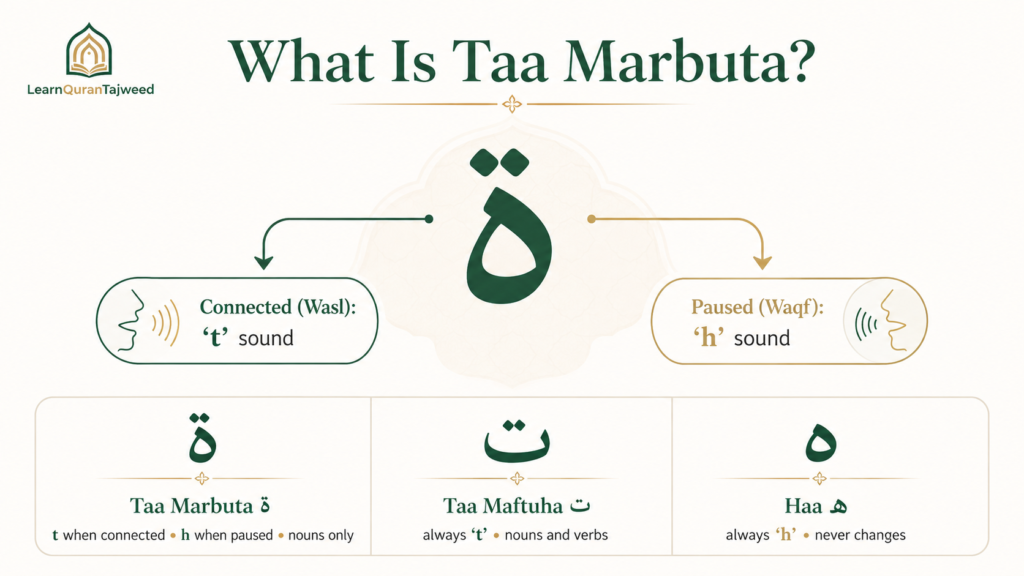
Taa marbuta (التاء المربوطة) is a letter written at the end of certain Arabic nouns that looks like the letter haa (ه) but carries two dots above it (ة). It is pronounced as a clear “t” sound when the word is connected to what follows it. It is also pronounced as a silent “h” sound when the reader pauses on it.
That single rule- taa when connected, haa when paused on- is the foundation of everything else in this guide. That’s why the same letter can sound completely different depending on where it sits in a sentence.
How Does Taa Marbuta Differ From Taa Maftuha and Haa?
The Arabic language has three letters that beginners regularly confuse. Each letter acts differently in every position.
Taa maftuha (التاء المفتوحة), sometimes known as taa mabsouta, the “open” or regular taa (ت), keeps its “t” sound in every case, whether the word is paused on or connected. It appears in both nouns and verbs. For example, “بيت” (bayt, house) stays “bayt” whether you stop there or keep reading.
In contrast, haa (ه) always stays a haa sound. It never converts to a “t,” regardless of pause or connection. For instance, a word like “وجه” (wajh, face) ends in haa ه in every context.
Taa marbuta sits between the two. It acts like taa maftuha at connection (wasl), and like haa at stopping (waqf). It also has one strict grammatical limit that the other two don’t share. It only ever appears in nouns, never in verbs.
Read also: Complete Guide to Tajweed Rules
Taa Marbuta Pronunciation Rules At Wasl And Waqf
Wasl and waqf are not just a spelling technicality. It’s a skill of recitation. There is one of the more common mistakes new Quran readers make, which is getting this rule wrong. The eye sees ة and instinctively wants to read a fixed sound instead of adjusting for context.
1. Pronunciation At Wasl (Connection)
At wasl, taa marbuta is pronounced as a clear, moving “t,” carrying whatever vowel case ending (damma, fatha, or kasra) according to the grammar. For example, in “مدرسةُ الحيّ” (madrasat al-hayy, the neighborhood’s school), the taa marbuta ة is pronounced as “t” because the reader continues straight into the next word.
Read also: Harakat in Tajweed
2. Pronunciation At Waqf (Pause)
At waqf, taa marbuta shifts to a silent haa with sukoon. The same word read alone, “مدرسة”, is pronounced “madrasah,” not “madrasat.” The letter’s shape doesn’t change on the page. What only changes is the sound, based on whether the reader stops there.
This is precisely why a Quran reciter’s tajweed matters as much as their vocabulary: the written text stays fixed, but correct recitation depends on recognizing when a stop is a true waqf and when it isn’t.
If there’s a tajweed instructor to correct this in real time, instead of a self-study app that can’t hear you, it is often what separates readers who know the rule from readers who apply it correctly every time. This is one of the areas Learn Quran Tajweed’s live one-on-one classes focus on early, since it affects nearly every page of the mus’haf.
Read also: Waqf Rules in Tajweed
See Our Classrooms in Action
Watch these short clips from our live, interactive Quran courses to see how our students learn and interact with our expert tutors.
Perfect Your Quran Recitation Today
Join expert-led Tajweed classes, and recite the Quran with confidence and clarity.
Start Your Free TrialThree Simple Tricks To Tell Taa Marbuta From Haa
Native speakers depend on instinct, but learners need a repeatable method. The following three-test method applies to virtually any word and takes seconds to apply once practiced.
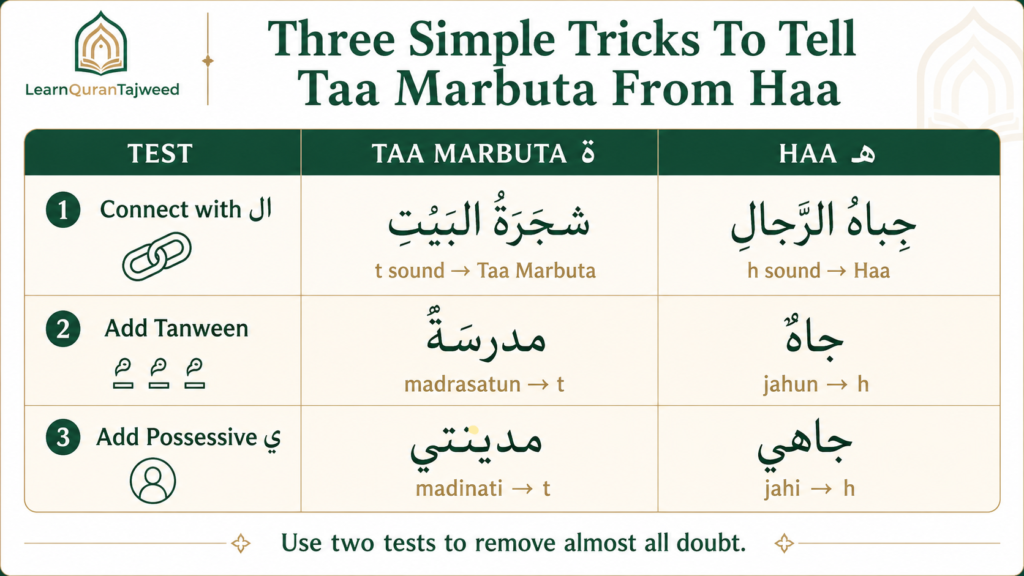
1. Add A Moon-Letter “The” (Definite Article) After The Word
Pronounce the word followed immediately by another word that starts with “ال” (the definite article, using a moon letter so the “ل” is produced clearly). If the ending sounds like “t” when it is connected, it’s taa marbuta. If it still sounds like “h,” it’s haa.
For example, “شجرةُ البيت” (shajaratu al-bayt, the tree of the house) is pronounced with a “t”, confirming taa marbuta. Another example, “جِباهُ الرِّجال” (jibahu al-rijal, the foreheads of the men) keeps its “h” sound, confirming haa.
2. Add Tanween To The Word
Attach tanween (the indefinite case ending) to the word in isolation. If the ending converts to a “t” sound, it’s taa marbuta. If it stays an “h,” it’s haa.
For example, “مدرسةٌ” (madrasatun) is pronounced with a “t” under the tanween, taa marbuta. “جاهٌ” (jahun, status) keeps its “h”, a genuine haa.
Read also: Idhlaaq Vs Ismat In Tajweed
3. Add The Possessive “Ya” To The Word
Add the possessive “ي” (my) to the end of the word. Taa marbuta converts to “t” before the “ي,” while haa stays exactly as it is.
For example, “مدينتي” (madinati, my city) voices a clear “t” taa marbuta. “جاهي” (jahi, my status) keeps the “h” (haa).
Any one of these three tests is usually enough on its own. Running an unfamiliar word through two of them removes almost all doubt.
Read also: How to Recite Quran With Tajweed?
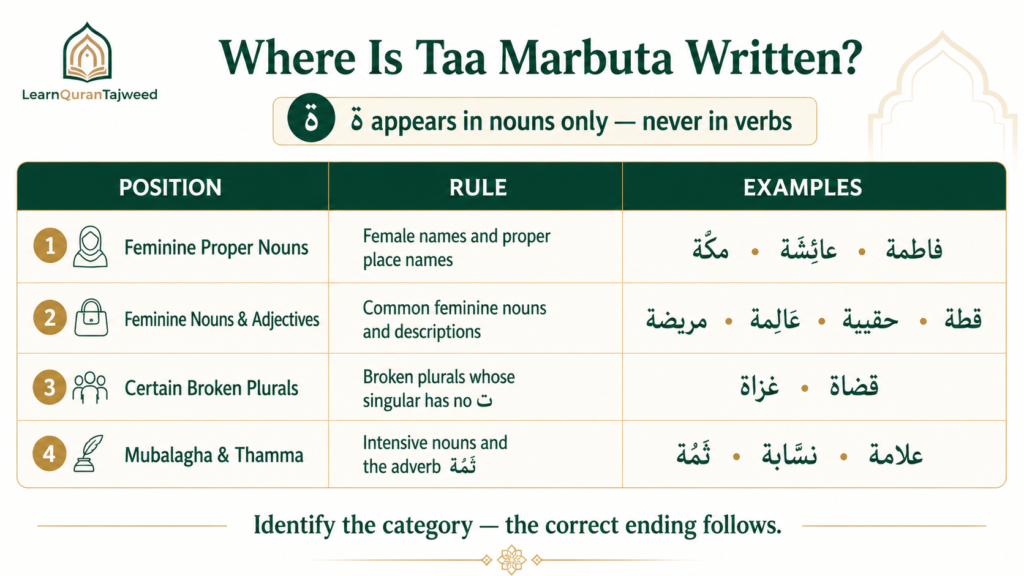
Where Is Taa Marbuta Written In Arabic Grammar?
Taa marbuta is not spread randomly across the language. It follows a small, defined set of positions, and it is exclusive to nouns.
1. Feminine Proper Nouns
Names that refer to females typically end in ة, such as فاطمة (Fatimah), عائشة (Aisha), and مكة (Makkah, used as a proper place name).
2. Feminine Common Nouns And Adjectives
Ordinary feminine nouns and adjectives take the same ending: قطة (cat), حقيبة (bag), عالِمة (a learned woman), مريضة (a sick woman).
3. Broken Plurals Without A Taa Maftuha Singular
Certain broken plurals ( Jam’a Takseerجمع تكسير) whose singular form doesn’t already contain a taa maftuha are written with ة — قضاة (judges), غزاة (raiders).
4. Words Of Exaggeration (Mubalagha) And The Adverb “Thamma”
Intensive nouns that express exaggeration also take taa marbuta. For instance, علاّمة (a great scholar) and نسّابة (an expert genealogist). The same ending appears at the close of the adverb ثَمّة when used in its locative sense (“there,” as in ثَمة رجال — there are men).
It is important to get the category right more than to memorize every example, as the position rule predicts the spelling. If a learner can identify “this is a feminine adjective” or “this is an intensive noun,” the correct ending follows automatically. Hence, there’s no need to memorize word by word.
Read also: The Benefits of Tajweed
The Two Written Shapes Of Taa Marbuta
Taa marbuta’s appearance changes according to the preceding letter that connects to it in cursive script.
1. Connected Form (ـة)
When the letter before it is one that joins to the following letter, taa marbuta is written attached, as in مدرسة (madrasah).
2. Separate Form (ة)
When the letter before it is one of the non-connecting or isolated letters (such as ا, د, ذ, ر, ز, و), taa marbuta stands apart on its own, as in إوزة (goose).
The two forms are still spoken and rule-wise identical. The shape is purely about how Arabic script physically joins letters, not about pronunciation.
Read also: Best Tajweed Books
Taa Marbuta Without Dots — Why Do The Two Dots Matter?
Remove the two dots above ة, and the letter is no longer taa marbuta at all. It becomes a plain haa. The dots aren’t decorative; they’re the only visual marker separating a word that acts as taa-at-connection from a word that is a fixed haa in every context.
A misplaced or missing dot in handwriting or typing can turn “مدرسة” (school) into something unreadable, or worse, into a different word with a different meaning.
This is one reason careful, dotted handwriting is emphasized from the earliest stages of learning Arabic script. The two dots aren’t an optional flourish. They’re grammatical information.
Read also: Sifaat Al Huroof in Tajweed
Taa Marbuta Examples In The Quran
According to the Uthmani script (الرسم العثماني) used to write the Quran, a specific group of feminine words are spelled with an open taa instead of the expected ة — yet they are still pronounced as “h” at waqf, due to the standard rule readers apply everywhere else.
Reciters are trained to pause on these exact spots with a “t” sound instead, matching the transmitted script rather than the visual shape of the letter.
The words affected include رحمت (rahmat, as in رحمت الله), نعمت (ni’mat, as in نعمت الله), كلمت (kalimat, as in كلمت ربك), لعنت (la’nat), سُنت (sunnat), فطرت (fitrat), بقيت (baqiyat), ابنت (ibnat, as in ابنت عمران), شجرت (shajarat, as in شجرت الزقوم), and معصيت (ma’siyat).
Classical linguists, including Sibawayh, al-Farra, ibn Kaysan, and ibn Jinni link this back to an older dialectal habit of pronouncing the feminine taa as an open taa rather than converting it to haa at a pause. It is a preserved usage in the Uthmani script in these specific words.
This is one of the trickier parts of Quranic recitation to self-teach, because the correct pause is tied to the exact word and its position rather than a general spelling rule.
It’s usually where a guided tajweed course pays for itself, since a teacher can flag these exceptions the first time a student encounters them rather than after a mistake becomes habit.
Read also: Tajweed Teachers
Inside Learn Quran Tajweed Academy
Curious about how online learning works? Peek inside our actual Quran classes and hear the beautiful recitation of our students and teachers.
Perfect Your Quran Recitation Today
Join expert-led Tajweed classes, and recite the Quran with confidence and clarity.
Start Your Free TrialStart Reading The Quran With Confidence Today
Rules on a page only go so far; hearing your own pronunciation corrected in real time is what actually fixes a habit.
Learn Quran Tajweed connects you with trained and certified tajweed teachers for live, one-on-one online sessions built around exactly these details: waqf and wasl, correct makharij, and the exceptions the Uthmani script preserves.
Courses we offer:
- Online Tajweed Classes
- Learn Quran with Tajweed Online
- Beginner Tajweed Course
- Intermediate Tajweed Course
- Advanced Tajweed Course
- Amali (Practical) Tajweed Course
- Tajweed Course for Kids
- Tajweed Course for Adults
- Tajweed Course for Ladies
- Tajweed ul Quran Course
- Quran Recitation with Tajweed Course
- Quran Tarteel Course
- Tajweed Ijazah Program
Conclusion
Taa marbuta is a feminine noun ending that sounds like “t” when a word connects to what follows it, and like a silent “h” when the reader pauses on it; the opposite of taa maftuha. The latter stays “t” in both cases, and haa, which stays “h” in both cases.
The three-test method (adding a moon-letter “the,” adding tanween, or adding the possessive “ya”) solves almost any doubtful case in seconds.
Taa marbuta only ever appears in nouns, feminine proper names, feminine common nouns and adjectives, certain broken plurals, and intensive nouns. It always carries two dots that distinguish it from a plain haa.
In the Quran, a small, specific group of words are spelled with an open taa under the Uthmani script but are still recited following the standard waqf-and-wasl logic. That is why these particular spots are worth learning directly from a qualified reciter rather than guessing from the page.
Frequently Asked Questions
What Is Taa Marbuta In Arabic?
Taa marbuta is a letter written at the end of certain Arabic nouns, shaped like haa but marked with two dots (ة), pronounced as “t” when connected to the next word and as a silent “h” when paused on.
What Is The Difference Between Taa Marbuta And Taa Maftuha?
Taa marbuta shifts between a “t” sound (at wasl) and an “h” sound (at waqf) and appears only in nouns, while ta maftuha keeps its “t” sound in every context and appears in both nouns and verbs, such as بيت and قالتْ.
How Is Taa Marbuta Pronounced In The Quran?
Taa marbuta in the Quran follows the standard wasl-and-waqf rule: a clear “t” when the reader continues to the next word, and a silent “h” when they pause, except for a specific set of words spelled with an open taa in the Uthmani script, such as رحمت and فطرت.
Why Is Taa Marbuta Sometimes Written Without Dots?
A ة written without its two dots is no longer taa marbuta at all; it becomes a plain haa, which changes the word’s pronunciation and grammatical identity. The dots are essential, not decorative.
Can Taa Marbuta Appear In A Verb?
No. Taa marbuta is exclusive to nouns, such as feminine names, feminine common nouns, certain broken plurals, and intensive nouns. Verbs that end in a “t” sound, such as كتبتْ or قالتْ, use taa maftuha instead.
How Many Written Forms Does Taa Marbuta Have?
Two: a connected form (ـة), used after letters that join to what follows, and a separate form (ة), used after non-connecting letters such as ا, د, ذ, ر, ز, and و.
Related Articles
Tajweed Rules