 Tajweed Basics
| Key Takeaways |
| Tajweed rules govern precise Arabic pronunciation, covering articulation points, letter attributes, and vowel elongation for every Quranic letter. |
| Noon Sakinah and Tanween carry four distinct rules — Ikhfa, Idgham, Iqlab, and Izhar — each triggered by specific following letters. |
| Madd rules require vowel elongation ranging from two to six counts depending on the type, with Madd Lazim reaching the maximum. |
| Qalqalah produces a subtle echo-bounce on five specific letters when sukoon is applied, and its strength varies by position. |
| Meem Sakinah follows three rules — Ikhfa Shafawi, Idgham Shafawi, and Izhar Shafawi — depending on the letter that follows. |
Tajweed rules are not decorative additions to Quranic recitation — they are the structural framework that preserves every word of the Quran exactly as it was revealed. For non-Arabic speakers especially, these rules provide the precise technical map needed to move from recognizable recitation to accurate, beautified tarteel.
Mastering all Tajweed rules means working systematically through articulation points, letter attributes, Noon and Meem rules, elongation types, and stopping principles. Each rule category connects to the others, forming an integrated system that Ijazah-certified instructors apply — and teach — as a unified whole.
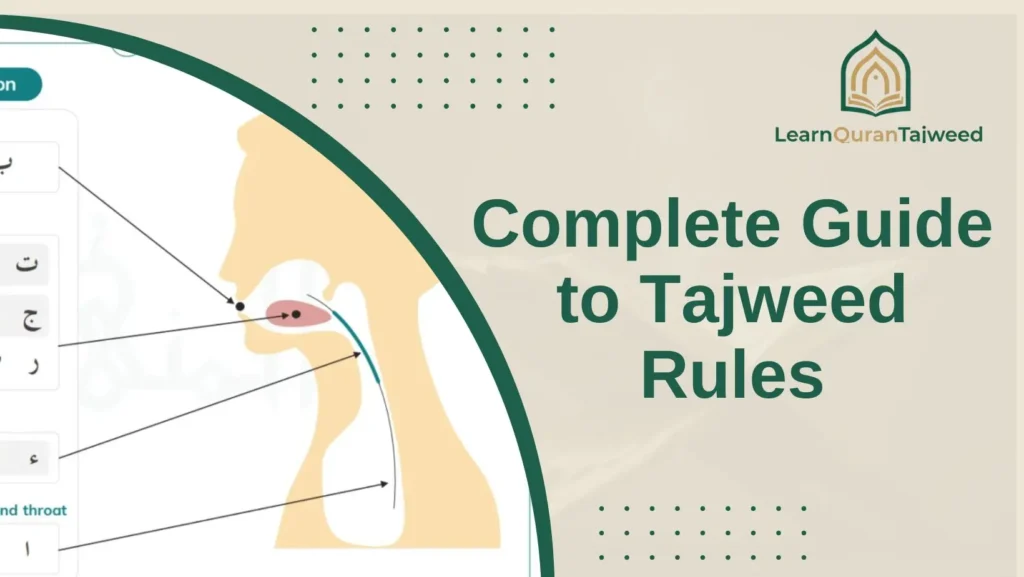
Makharij Al-Huruf — The Articulation Points of Arabic Letters
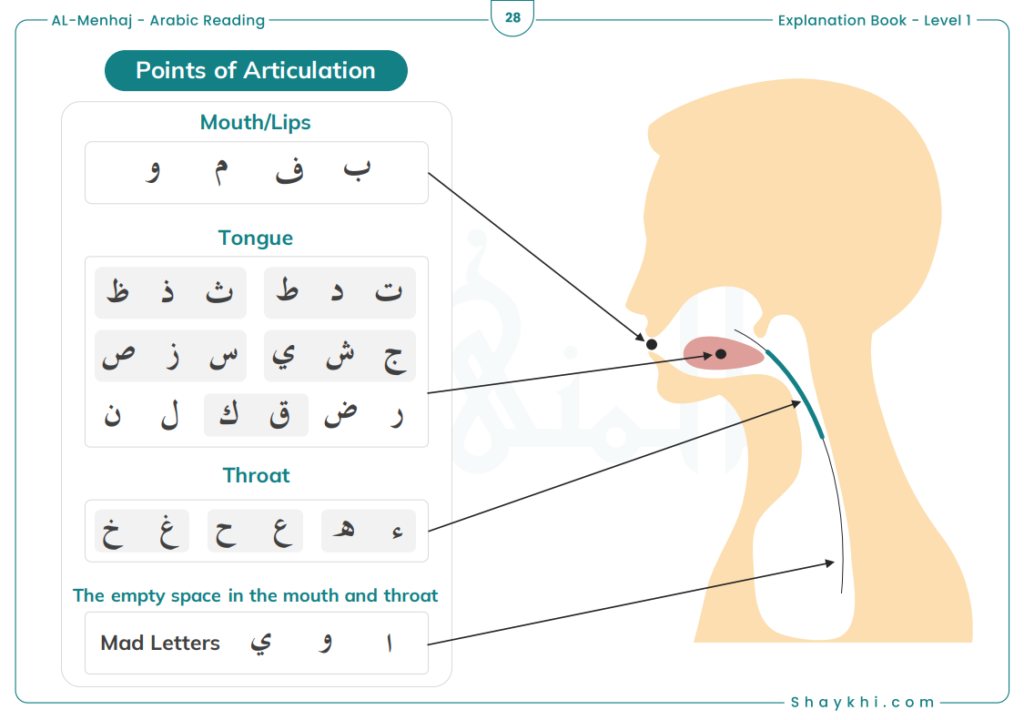
Makharij al-huruf refers to the precise exit points in the mouth, throat, and nasal cavity from which each Arabic letter is produced.
Classical Tajweed scholars identify 17 articulation points grouped across five regions: the jawf (empty oral cavity), halq (throat), lisan (tongue), shafatain (lips), and khayshum (nasal passage).
For non-Arabic speakers, makhraj errors are the single most common source of letter distortion — and also the hardest to self-diagnose. The most frequent pattern I observe at Learn Quran Tajweed Academy is students producing Ain (ع) from the wrong throat position: either too far back (confusing it with Ghain) or too far forward (producing a plain vowel).
Explore Al-Menhaj Book for Free (Learn to Read Quran)
Ain originates from the middle of the throat — the wassat al-halq — and requires active constriction that feels physically unfamiliar to most Western students in the first weeks of training.
1. The Five Makhraj Regions and Their Letters
| Region | Arabic Term | Letters Produced |
| Throat | Al-Halq | ء ه ع غ ح خ |
| Tongue | Al-Lisan | ق ك ج ش ي ض ل ن ر ط د ت ص ز س ذ ث ظ |
| Lips | Al-Shafatain | ب م و ف |
| Nasal Cavity | Al-Khayshum | Ghunnah resonance of ن and م |
| Empty oral space | Al-Jawf | Long vowels: ا و ي (Madd extensions) |
2. The Three Halq Sub-Points and Their Letters
The throat region alone carries three distinct sub-points — a detail many beginners overlook entirely.
- Aqsal Halq (deepest throat): ء (Hamzah) and ه (Haa)
- Wassat al-Halq (middle throat): ع (Ain) and غ (Ghain)
- Adna al-Halq (closest throat exit): ح (Haa) and خ (Kha)
Separating these three levels explains why Hamzah (ء) and Ain (ع) — though both “throat letters” — are produced from entirely different positions and must never be conflated.
3. Tongue Letters and Their Sub-Articulation Points
The tongue produces the largest number of Arabic letters across ten distinct positions, ranging from the deepest back of the tongue for Qaaf (ق) to the very tip for Lam (ل), Noon (ن), and Raa (ر).
The Dhad (ض) letter — famously described as the most difficult letter in Arabic — originates from the sides of the tongue pressing against the upper molars.
A Quranic example demonstrating the critical distinction between adjacent tongue letters:
وَٱلضُّحَىٰ
Wad-duhaa
“By the morning brightness.” (Ad-Duhaa 93:1)
The Dhad (ض) here is shaddah-bearing — produced from the lateral edge of the tongue against the upper molars, with Tafkhim applied. Students who substitute it with Dhal (ذ) or Daa (د) produce an entirely different — and incorrect — Arabic letter.
Correcting makhraj is not a one-session matter. Most students require three to four weeks of focused daily repetition before throat letters like Haa (ح) and Ain (ع) become physically automatic and consistent.
At Learn Quran Tajweed Academy, our Beginner Tajweed Course dedicates focused sessions specifically to these Makharij Al-Huruf — because getting them right early prevents years of embedded errors.
Begin your Tajweed journey with a free lesson

Sifat Al-Huruf — The Essential Attributes of Arabic Letters
Sifat al-huruf are the inherent characteristics that define how each letter sounds beyond its basic articulation point. Knowing a letter’s makhraj tells you where it is produced. Knowing its sifat tells you how it must sound when produced there. Both are required for correct recitation.
Sifat divide into two master categories: Sifat Lazimah (permanent attributes that never leave a letter regardless of context) and Sifat ‘Aridah (temporary attributes that appear only under specific conditions, such as stopping or voweling).
1. The Permanent Opposite Sifat Pairs
Permanent sifat always come in opposing pairs. Every letter possesses one side of each applicable pair.
| Attribute | Arabic | Opposite | Arabic | Recitation Effect |
| Voicing | Jahr | Whispering | Hams | Breath held vs. freely released |
| Strength | Shiddah | Softness | Rakhawah | Sound stops vs. flows through |
| Elevation | Isti’la | Lowering | Istifal | Heavy vs. light resonance quality |
| Sealing | Itbaq | Openness | Infitah | Deepens heaviness on four letters |
| Fluency | Idhlag | Restriction | Ismaat | Ease of articulation vs. effort |
2. The Five Letters of Shiddah and Why They Matter
The letters of Shiddah — أَجِدُ قَطٍّ (Alif, Jim, Dal, Qaf, Ta) — stop airflow completely at their articulation point. This is why Qalqalah (echo-bounce) emerges on the Shiddah letters that also appear in the Qalqalah group.
The combination of total sound-stopping with the vocal cord’s vibration creates the rebound effect.
A Quranic example showing the Shiddah of Jim (ج):
وَجَعَلْنَا مِنَ ٱلْمَآءِ كُلَّ شَىْءٍ حَىٍّ
Wa ja’alna minal-maa’i kulla shay’in hayy
“And We made from water every living thing.” (Al-Anbiya 21:30)
The Jim carries Shiddah — its sound stops completely at articulation before release, unlike soft letters like Seen whose sound flows continuously.
Shots Videos from Our Courses
Perfect Your Quran Recitation Today
Join expert-led Tajweed classes, and recite the Quran with confidence and clarity.
Start Your Free Trial3. The Four Itbaq Letters and Tafkhim Deepening
Itbaq (sealing) is exclusive to four letters: ص ض ط ظ. These letters require the tongue to rise and “seal” toward the roof of the mouth, creating a deep, resonant heaviness beyond ordinary Tafkhim.
Students who pronounce Taa (ط) like a regular Taa (ت) — missing its Itbaq and Jahr — produce a significantly distorted recitation.
Understanding sifat explains why Sad (ص) and Seen (س) sound fundamentally different despite sharing the same articulation point. Their sifat diverge decisively: Sad carries Isti’la, Itbaq, and Jahr while Seen carries Istifal, Infitah, and Hams.
Noon Sakinah and Tanween Rules — The Four Core Applications
The rules of Noon sakinah and Tanween govern how a sukoon-bearing Noon (نْ) or any double-voweled Tanween (ً ٍ ٌ) is recited when a letter follows it. The ruling changes entirely based on which letter comes next, producing four distinct recitation responses: Izhar, Idgham, Iqlab, and Ikhfa.
These four rules collectively govern an enormous portion of Quranic recitation. Barely a page passes in the Quran without a Noon sakinah or Tanween encounter.
Mastering this section alone produces a visible and immediate improvement in recitation quality — and it is precisely why our Intermediate Tajweed Course dedicates multiple focused sessions to each of the four sub-rules before moving forward.
Join our Intermediate Tajweed Course and get a free trial

1. Izhar Halqi — Clear Pronunciation Before the Six Throat Letters
Izhar Halqi requires the Noon sakinah or Tanween to be pronounced clearly and completely when followed by any of the six throat letters: ء ه ع غ ح خ. The Noon is fully articulated with zero nasal resonance — no ghunnah, no merging, no concealment.
The reason is phonetic: the six Izhar letters all originate from the throat, which is physically distant from the tip of the tongue where Noon is produced.
The distance between articulation points makes merging or concealment naturally impossible — the Noon simply rings out clearly before the throat letter begins.
مَنْ ءَامَنَ
Man āmana
“Whoever believed.” (Al-Baqarah 2:62)
Noon sakinah before Hamzah (ء) — one of the six Izhar letters. The Noon is fully clear, with no ghunnah trail.
عَلِيمٌ حَكِيمٌ
‘Aleemun Hakeem
“All-Knowing, All-Wise.”
Tanween Dhammah on ‘Aleem before Haa (ح) — Izhar applied, no nasal sound carried into the Haa.
A critical teaching point: students often unconsciously carry a slight ghunnah into Izhar out of habit from practicing other rules. The test is simple — if the nasal passage is active at all when the Noon sounds, that is incorrect for Izhar.
2. Idgham — Merging the Noon Completely into the Following Letter
Idgham eliminates the Noon sakinah or Tanween entirely by merging it into the following letter when that letter is one of six: ي ر م ل و ن — collected in the phrase يَرْمَلُون. The Noon disappears and the following letter is read with a natural shaddah.
Idgham divides into two sub-types based on whether ghunnah accompanies the merge.
Idgham with Ghunnah — applies when the following letter is ي ن م و. The Noon merges and nasal resonance is held for two counts on the merged letter.
مِن وَرَائِهِم
Mi-warā’ihim
“From behind them.”
Noon sakinah before Waw (و) — merges with ghunnah. The Noon disappears; Waw carries the resonance.
Idgham without Ghunnah — applies when the following letter is ل or ر. The Noon merges completely and cleanly — no nasal resonance whatsoever.
مِن رَّبِّهِمْ
Mir-rabbihim
“From their Lord.” (Al-Baqarah 2:5)
Noon sakinah merges silently into Raa — the merger is total and the Raa carries a natural shaddah weight.
An important exception: when Noon sakinah and the Idgham letter appear within the same word, Idgham does NOT apply — instead the Noon is read clearly (Izhar). This occurs in four specific Quranic words: بُنْيَانٌ، صِنْوَانٌ، قِنْوَانٌ، دُنْيَا. These words are among the first exceptions students at Learn Quran Tajweed Academy are taught to recognize on sight.
Perfect Your Quran Recitation Today
Join expert-led Tajweed classes, and recite the Quran with confidence and clarity.
Start Your Free Trial3. Iqlab — Converting the Noon into a Hidden Meem
Iqlab applies when Noon sakinah or Tanween is followed by Baa (ب) — and only Baa. The Noon is transformed (converted) into a Meem sound held with ghunnah for two counts, while the lips gently close in preparation for the Baa that follows.
The Meem produced in Iqlab is not a full pronounced Meem — it is a concealed nasal resonance with the lips approaching closure. The Noon is never pronounced; the Meem is never fully released. It occupies a state between the two.
سَمِيعٌۢ بَصِيرٌ
Samee’um-Baseer
“All-Hearing, All-Seeing.”
Tanween Dhammah before Baa — the Tanween converts to a hidden Meem with ghunnah for two counts before Baa sounds.
مِنۢ بَعْدِ
Mim-ba’d
“After.” (Al-Baqarah 2:27)
Noon sakinah before Baa — written as Noon, recited as hidden Meem with ghunnah.
4. Ikhfa Haqiqi — Concealing the Noon with Nasal Resonance
Ikhfa Haqiqi applies when Noon sakinah or Tanween is followed by any of 15 letters — the largest group of the four Noon rules. The Noon is neither fully pronounced (as in Izhar) nor completely merged (as in Idgham).
It is concealed — suspended between the two states — with nasal resonance held for two counts while the mouth and tongue silently prepare for the following letter.
The 15 Ikhfa letters are: ت ث ج د ذ ز س ش ص ض ط ظ ف ق ك
A critical pedagogical distinction: the articulation point of the tongue shifts during the ghunnah of Ikhfa — already preparing for the next letter while the nasal resonance continues. This is what separates genuine Ikhfa from simply adding a nasal hum before any letter.
مَنْ كَانَ
Man kāna
“Whoever was.”
Noon sakinah before Kaaf (ك) — one of the 15 Ikhfa letters. The Noon is concealed with ghunnah for two counts, tongue already raising toward the Kaaf’s makhraj.
أَنْتُمْ
Antum
“You (plural).”
Noon sakinah before Taa (ت) — Ikhfa applies, tongue tip approaching the Taa position during the nasal resonance.
وَأَنزَلْنَا
Wa anzalnā
“And We sent down.”
Noon sakinah before Zaa (ز) — Ikhfa with nasal resonance, no full Noon pronunciation.
Join our Practical Tajweed Course and get a free trial

Meem Sakinah Rules
The rules of Meem sakinah determine how a sukoon-bearing Meem (مْ) is recited based entirely on the letter that follows it. There are three rulings: Ikhfa Shafawi, Idgham Shafawi, and Izhar Shafawi — named “Shafawi” (labial) because Meem is a lip letter, and all three rules engage the lips as their primary mechanism.
1. Ikhfa Shafawi — Labial Concealment Before Baa
Ikhfa Shafawi applies exclusively when Meem sakinah is followed by Baa (ب). The Meem is concealed — the lips do not fully close to complete the Meem’s sound, but approach closure while ghunnah resonates for two counts through the nasal passage. The Baa then follows.
تَرْمِيهِم بِحِجَارَةٍ
Tarmeehim bihijāra
“Pelting them with stones.” (Al-Fil 105:4)
Meem sakinah before Baa — lips approach but do not fully seal, ghunnah held for two counts, then Baa releases.
The most common error here is completing the Meem fully before the Baa — which produces Izhar Shafawi where Ikhfa Shafawi is required. The lips must remain parted throughout the ghunnah.
2. Idgham Shafawi — Labial Merging into a Second Meem
Idgham Shafawi applies when Meem sakinah is followed by another Meem (م). The first Meem merges completely into the second, which is then read with a shaddah and full ghunnah for two counts.
This is the easiest of the three Meem rules to hear — the double-Meem with ghunnah has a distinctive, sustained nasal quality.
لَهُمْ مَّا يَشَآءُونَ
Lahum mā yashā’oon
“For them is whatever they wish.” (Az-Zumar 39:34)
Meem sakinah merges into the following Meem — the merged Meem carries shaddah weight and ghunnah for two counts.
3. Izhar Shafawi — Clear Labial Pronunciation
Izhar Shafawi applies before all 26 remaining letters — every letter except Baa and Meem. The Meem sakinah is pronounced clearly and completely with no ghunnah extended beyond its natural slight resonance.
The lips fully close, complete the Meem, and then release cleanly for the next letter.
وَهُمْ فِيهَا
Wa hum feehā
“And they therein.”
Meem sakinah before Faa (ف) — the Meem is fully pronounced, no ghunnah extension, lips seal and release cleanly.
أَنعَمتَ عَلَيهِمْ غَيرِ
An’amta ‘alayhim ghayri “You have blessed — other than.” (Al-Fatiha 1:7)
Meem sakinah before Ghain (غ) — clear Meem, fully articulated with no nasal prolongation.
Join our Tajweed Ijazah Program and get a free trial

Ghunnah — The Nasal Resonance That Runs Through Multiple Rules
Ghunnah is the nasal resonance produced exclusively from the khayshum (nasal passage) and is a Sifat Lazimah — a permanent attribute — of both Noon (ن) and Meem (م). Its standard duration in rules where it is required is two counts (harakatayn), and it manifests across six distinct Tajweed contexts: Idgham with Ghunnah, Ikhfa Haqiqi, Iqlab, Ikhfa Shafawi, Idgham Shafawi, and the Mushaddad Noon and Meem (shaddah-bearing).
Ghunnah strength is not uniform — it varies by context in a precise hierarchy. The strongest ghunnah appears in Mushaddad Noon and Meem (shaddah), followed by Idgham with Ghunnah, then Ikhfa, then Iqlab and Ikhfa Shafawi. The weakest ghunnah — almost entirely suppressed — appears in Izhar, where any audible nasal resonance constitutes an error.
The Mushaddad Noon and Meem — The Strongest Ghunnah
When Noon or Meem carries a shaddah (ّ), the ghunnah is at its maximum — two full counts of nasal resonance before the letter releases.
إِنَّ
Inna
“Indeed.” — appears hundreds of times throughout the Quran.
Shaddah on Noon — the strongest level of ghunnah, held for two full counts from the nasal passage.
ثُمَّ
Thumma
“Then.” — appears throughout the Quran.
Shaddah on Meem — same principle, maximum ghunnah.
Students often underestimate how much active work the nasal passage does in ghunnah. It is not passive humming — it requires deliberate soft palate lowering that directs sound through the nose. Ghunnah that originates from the throat or the lips is a makhraj error, not true ghunnah.
Working with Ijazah-certified instructors at Learn Quran Tajweed Academy through our Advanced Tajweed Course provides the precise auditory feedback needed to calibrate ghunnah strength accurately across all six contexts — something no recording or self-study resource can replicate.
Reserve your free trial lesson for Advanced Tajweed Course

Madd Rules — Vowel Elongation Types and Their Counts
Madd rules govern the elongation of long vowels throughout Quranic recitation. Every Madd is built on a foundation of three Madd letters — Alif (ا), Waw (و), Ya (ي) — each preceded by its matching short vowel (Fathah, Dhammah, Kasrah respectively).
Elongation is measured in counts (harakaat), where one count equals approximately the natural duration of one short vowel.
Madd rules divide into two master categories: Madd Asli (natural, with no cause) and Madd Far’i (secondary, triggered by Hamzah or Sukoon).
1. Madd Asli — The Natural Two-Count Foundation
Madd Asli (also called Madd Tabee’i) is the baseline elongation of every long vowel when no Hamzah or Sukoon follows — held for exactly two counts, no more and no less.
نُوحِيهَا
Nooheeha
“We reveal it.” (Hud 11:49)
The Waw preceded by Dhammah and the Ya preceded by Kasrah are both pure Madd Asli — two counts each, with no following cause to alter them.
Madd Asli is the most frequently occurring Madd in the Quran. Shortening it produces Qasr — a recitation error. Lengthening it beyond two counts where no cause exists is also an error. Two counts is fixed and non-negotiable for Madd Asli.
2. Madd Wajib Muttasil — The Obligatory Connected Elongation
Madd Wajib Muttasil applies when a Madd letter is followed by a Hamzah (ء) within the same word. This Madd is classified as obligatory (Wajib) because scholars unanimously agree it must be elongated beyond the natural two counts — reaching four to five counts in the Hafs recitation.
جَآءَ
Jā’a
“He came.”
Madd letter Alif followed by Hamzah in the same word — four to five counts of elongation.
ٱلسَّمَآءِ
As-samā’i
“The sky/heaven.”
Madd Alif followed by Hamzah in the same word — one of the most frequent Madd Wajib Muttasil occurrences in the Quran.
3. Madd Jaiz Munfasil — The Permitted Separated Elongation
Madd Jaiz Munfasil occurs when the Madd letter ends one word and a Hamzah begins the following word. Unlike Muttasil, this separation makes the elongation permitted (Jaiz) rather than obligatory — ranging from two to five counts. In the Hafs recitation, four to five counts is the preferred and most widely practiced level.
إِنَّا أَعْطَيْنَاكَ
Innā a’taynāk
“Indeed, We have granted you.” (Al-Kawthar 108:1)
The long Alif in إِنَّا is followed by Hamzah beginning the next word أَعْطَيْنَاكَ — Madd Jaiz Munfasil, four to five counts preferred.
قُوا أَنفُسَكُمْ
Qū anfusakum
“Protect yourselves.” (At-Tahrim 66:6)
Madd Waw ending one word, Hamzah opening the next — Jaiz Munfasil.
4. Madd Lazim — The Fixed Six-Count Elongation
Madd Lazim is the highest-level Madd — fixed permanently at six counts with no variation permitted. It occurs when a Madd letter is followed by a letter bearing a permanent sukoon or a shaddah that cannot be removed in any reading.
ٱلضَّآلِّينَ
Adh-dhāllīn
“Those who have gone astray.” (Al-Fatiha 1:7)
The Madd Alif is followed by a Lam with shaddah — Madd Lazim Kalimi Muthaqal, six counts fixed.
الۤمۤ
Alif Lam Meem (Al-Baqarah 2:1)
(The Lam and Meem letters in the disconnected letters carry Madd Lazim Harfi — six counts each on their elongated components.)
Madd Lazim is the only Madd type with zero flexibility. Shortening it to four or five counts in Hafs recitation is a recitation error — and one of the most common errors seen in students preparing for Ijazah evaluation.
Perfect Your Quran Recitation Today
Join expert-led Tajweed classes, and recite the Quran with confidence and clarity.
Start Your Free Trial5. Madd ‘Arid lis-Sukoon — Stopping-Induced Elongation
Madd ‘Arid lis-Sukoon occurs when a reciter stops at a word that ends with a Madd letter or a letter that becomes sukoon-bearing upon stopping.
The elongation is ‘Aridah — temporary, caused by the act of stopping — and may be held for two, four, or six counts, any of which is permissible as long as one level is maintained consistently.
ٱلرَّحِيمِ
Ar-raheem
“The Most Merciful.” (Al-Fatiha 1:3)
When stopping here, the Ya followed by Meem with sukoon-upon-stop creates Madd ‘Arid lis-Sukoon — two, four, or six counts.
6. Madd Leen — The Soft Glide Elongation
Madd Leen applies when a Waw (و) or Ya (ي) carries a Fathah on the letter before it (making it a “soft” glide rather than a true Madd letter) and the reciter stops on the following letter — which acquires sukoon. Madd Leen is held for two, four, or six counts upon stopping.
خَوْفٌ
Khawf
“Fear.”
(When stopping: the Waw with Fathah before it creates a soft glide, and the Faa acquires sukoon — Madd Leen, two to six counts.)
Primary Madd Categories and Their Counts
| Madd Type | Arabic Term | Trigger Condition | Count |
| Natural Madd | Madd Asli / Tabee’i | No cause present after Madd letter | 2 counts (fixed) |
| Connected Obligatory | Madd Wajib Muttasil | Hamzah follows in same word | 4–5 counts |
| Separated Permitted | Madd Jaiz Munfasil | Hamzah follows in next word | 2–5 counts (4–5 preferred) |
| Fixed Maximum | Madd Lazim | Permanent sukoon or shaddah follows | 6 counts (fixed) |
| Stopping-Induced | Madd ‘Arid lis-Sukoon | Letter acquires sukoon upon stop | 2, 4, or 6 counts |
| Soft Glide | Madd Leen | Waw/Ya with Fathah before, stop occurs | 2, 4, or 6 counts |
Qalqalah — The Echo-Bounce Rule and Its Five Letters
Qalqalah is a slight, resonant echo-bounce produced on five specific letters when they carry sukoon — whether inherent within the word or acquired by stopping. The five Qalqalah letters are collected in the mnemonic phrase قُطْبُ جَدٍّ: ق ط ب ج د.
All five letters share a defining characteristic: they combine the sifat of Shiddah (complete sound-stopping at their makhraj) with Jahr (voiced production).
When the airflow is stopped and the vocal cords remain engaged, the sound cannot simply cut off cleanly — it rebounds. That rebound is Qalqalah.
Read Also: Nabr in Tajweed
The Three Levels of Qalqalah Strength
Minor Qalqalah (Qalqalah Sughra) occurs when a Qalqalah letter carries an inherent sukoon in the middle of a word, with recitation continuing. The bounce is subtle — present but restrained.
يَجْعَلُونَ
Yaj’aloon
“They make/assign.”
The Jim carries sukoon within the word — minor Qalqalah, subtle bounce before the Ain continues.
Medium Qalqalah (Qalqalah Mutawassitah) occurs when stopping on a Qalqalah letter that carries an original sukoon in the written text. The bounce is stronger and more audible.
وَٱلْفَجْرِ
Wal-fajr
“By the dawn.” (Al-Fajr 89:1)
Stopping on the Raa — the Jim holds medium Qalqalah when the word is stopped upon.
Major Qalqalah (Qalqalah Kubra) — the strongest level — occurs when stopping on a Qalqalah letter that carries a shaddah. The concentrated double-consonant weight amplifies the rebound significantly.
قُلْ أَعُوذُ بِرَبِّ ٱلْفَلَقِ
Qul a’udhu bi-rabbil-falaq
“Say: I seek refuge with the Lord of daybreak.” (Al-Falaq 113:1)
Stopping on Falaq — the Qaaf at the end carries major Qalqalah when stopped upon.
Read Also: Lahn in Tajweed
Tafkhim and Tarqiq — Heavy and Light Pronunciation
Tafkhim (heaviness/fullness) and Tarqiq (lightness/thinness) govern the resonance quality of Arabic letters — specifically whether the tongue rises toward the roof of the mouth during pronunciation, creating a deep, heavy resonance, or remains low, producing a light, thin sound.
Seven letters are permanently heavy — collectively the Huruf Isti’la (letters of elevation): خ ص ض غ ط ق ظ. These letters always carry Tafkhim regardless of their surrounding vowels or position. All remaining letters default to Tarqiq — except Lam (ل) and Raa (ر), which shift between the two depending on precise conditions.
1. The Permanently Heavy Seven Letters in Context
وَٱلطُّورِ
Wat-toor
“By the Mount.” (At-Tur 52:1)
The Taa (ط) carries permanent Tafkhim — four sifat combine to produce maximum heaviness: Isti’la, Itbaq, Shiddah, and Jahr.
وَٱلضُّحَىٰ
Wad-duhaa
“By the morning brightness.” (Ad-Duhaa 93:1)
The Dhad (ض) — permanent Tafkhim with its lateral tongue makhraj and Itbaq attribute.
Read Also: Huroof Al Muqatta’at Tajweed
2. The Raa Rules — The Most Complex Tafkhim-Tarqiq Letter
Raa (ر) is the most nuanced letter in the Tafkhim-Tarqiq system — its pronunciation shifts based on its own vowel, the vowel before it, and whether recitation is continuing or stopping.
Raa is read with Tafkhim (heavy) in these conditions:
- When Raa carries a Fathah or Dhammah: رَبِّكَ، رُزِقُوا
- When Raa carries sukoon and the letter before it carries Fathah or Dhammah: مَرْيَمَ، بُرْهَانٌ
- When Raa carries sukoon and is preceded by a Kasrah that is not original but transitional
Raa is read with Tarqiq (light) in these conditions:
- When Raa carries a Kasrah: رِزْقًا، رِجَالٌ
- When Raa carries sukoon preceded by an original Kasrah: فِرْعَوْنَ
رَبِّ ٱلْعَالَمِينَ Rabbil-‘ālameen “Lord of all the worlds.” (Al-Fatiha 1:2)
(The Raa with Fathah — heavy Tafkhim. The tongue back rises, creating a deep resonant “R”.)
صِرَٰطَ ٱلَّذِينَ Sirātal-ladheen “The path of those.” (Al-Fatiha 1:7)
(The Raa here with Fathah is heavy — but note the Seen before it carries Kasrah, which does not affect the Raa’s heaviness in this position.)
Read Also: What Are the Rules of Hamzatul Wasl?
3. The Lam of Majesty — The Most Commonly Mispronounced Rule
The Lam (ل) is almost always light (Tarqiq) in Arabic — it is one of the Istifal letters. However, the Lam in the Majestic Name الله is a singular exception governed by the vowel that immediately precedes it.
- Tafkhim (heavy Lam): when preceded by a Fathah or Dhammah — قَالَ اللَّهُ، هُوَ اللَّهُ
- Tarqiq (light Lam): when preceded by a Kasrah — بِاللَّهِ، لِلَّهِ
قُلْ هُوَ ٱللَّهُ أَحَدٌ
Qul huwal-lāhu ahad
“Say: He is Allah, the One.” (Al-Ikhlas 112:1)
The Lam of الله follows Dhammah on the Waw — heavy Tafkhim, the tongue back rises.
بِسْمِ ٱللَّهِ ٱلرَّحْمَـٰنِ ٱلرَّحِيمِ
Bismil-lāhir-rahmānir-raheem
“In the name of Allah, the Most Gracious, the Most Merciful.” (Al-Fatiha 1:1)
The Lam of الله here follows Kasrah on the Meem of بِسْمِ — light Tarqiq applies.
This single rule governs the pronunciation of the Most Majestic Name in every recitation — and it is among the most commonly mispronounced elements in non-Arabic speakers’ recitation, regardless of their overall Tajweed level.
Read Also: Hamzatul Qat’ in Tajweed
Our Students Reviews
Perfect Your Quran Recitation Today
Join expert-led Tajweed classes, and recite the Quran with confidence and clarity.
Start Your Free TrialRead Also: What Is Hams in Tajweed?
Waqf and Ibtida — The Rules of Stopping and Starting
Waqf (stopping) and Ibtida (starting) govern where a reciter may pause during recitation and where they must resume from after a stop.
These rules are not optional stylistic choices — they directly affect meaning. Stopping incorrectly can invert the intended sense of a verse entirely.
Classical Tajweed scholars classify stopping positions into four primary categories:
| Waqf Type | Arabic | Description | Permissibility |
| Complete Stop | Waqf Taam | Full grammatical and meaning completion | Preferred and recommended |
| Sufficient Stop | Waqf Kaafi | Meaning complete; grammatical link to next verse remains | Permissible |
| Acceptable Stop | Waqf Hasan | Partial meaning conveyed; not fully complete | Permissible, resume from same point |
| Prohibited Stop | Waqf Qabeeh | Distorts or corrupts meaning | Not permissible |
Read Also: Laam Rules in Tajweed
1. Waqf Signs in the Standard Mushaf
Most printed Masahif (copies of the Quran) include waqf symbols to guide reciters. Common symbols include:
- م (Waqf Lazim) — stopping is obligatory; continuing would distort meaning
- لا (La Waqf) — stopping is not permissible here
- ج (Jaiz) — stopping is permitted
- صلى (Sala) — permissible to stop but continuing is preferred
- قلى (Qala) — stopping is slightly preferred over continuing
Read Also: Shaddah in Tajweed
2. Ibtida — Where to Resume After Stopping
Ibtida (starting) after a Waqf must begin from a point that carries complete, correct meaning on its own. Beginning from the middle of a grammatical construction — or after a negation particle — can produce the opposite of the intended meaning.
لَا يَسْتَوِى
Lā yastawi
“They are not equal.” (Al-Hadid 57:10)
If a reciter stops after لَا and then resumes from there on Ibtida, the meaning becomes “they are equal” — the opposite of the intended verse. This is a classic Waqf Qabeeh warning position.
Learn Quran Tajweed Academy’s Quran Tarteel Course dedicates focused sessions to waqf placement, breath management, and the measured pacing that produces authentic tarteel — the unhurried, contemplative recitation style commanded in Surah Al-Muzzammil.
Join our Quran Tarteel Course and get a free trial

Read Also: Harakat in Tajweed
Begin Your Tajweed Mastery with Certified Instruction at Learn Quran Tajweed Academy
Every Tajweed rule covered here requires trained ears and qualified feedback to master correctly.
Learn Quran Tajweed Academy offers:
- Ijazah-certified instructors specializing in Hafs ‘an ‘Asim
- Personalized 1-on-1 sessions tailored to your recitation level
- Flexible scheduling available 24/7 globally
- Structured progression from beginner rules to full Ijazah certification
- Specialized focus — Tajweed only, not a generalist Quran platform
Book your FREE trial lesson today and begin correcting the rules that matter most.
Check out the best tajweed course for your needs:
- Practical Tajweed Course
- Beginner Tajweed Course
- Intermediate Tajweed Course
- Advanced Tajweed Course
- Quran Tarteel Course
- Tajweed Ijazah Program
- Tajweed Course for Sisters
- Tajweed course for Kids
Book your free trial Tajweed lesson today

Conclusion
Tajweed rules form an interconnected system — not a checklist. Mastering makharij affects your sifat; understanding sifat clarifies your Tafkhim and Tarqiq; correct ghunnah placement makes your Noon and Meem rules precise. Each layer builds on the one before it.
Non-Arabic speaking students who approach these rules systematically — with qualified instruction and consistent daily practice — consistently achieve recitation accuracy that once felt impossible. The rules are learnable. The standard is reachable.
Every letter you recite correctly is an act of worship. That alone makes the effort worth it — Alhamdulillah.
Read Also: Principles of Tajweed
Frequently Asked Questions About Tajweed Rules
How Many Tajweed Rules Are There in Total?
Tajweed is not a numbered list of isolated rules — it is a layered science. Major rule categories include makharij, sifat, Noon sakinah rules (4), Meem sakinah rules (3), Madd types (6+), Qalqalah levels (3), Tafkhim and Tarqiq, and Waqf principles. Each category contains multiple sub-rulings that expand with advanced study.
Can I Learn All Tajweed Rules Without a Teacher?
Theoretical knowledge of Tajweed rules can be gained through study, but correct application requires a qualified teacher’s ear. Makhraj and sifat errors are nearly impossible to self-diagnose. Classical scholars unanimously state that Tajweed must be taken from a living, certified instructor — not learned from books or recordings alone.
What Is the Difference Between Tajweed and Tarteel?
Tajweed refers to the precise science of correct letter pronunciation and rule application. Tarteel refers to measured, unhurried recitation with contemplation and proper rhythm, as commanded in Surah Al-Muzzammil. Tajweed is the technical foundation; tarteel is the applied, beautified recitation built upon it. Both work together in perfected Quranic recitation.
Where Should a Non-Arabic Speaker Begin with Tajweed Rules?
Begin with makharij (articulation points) and the basic Noon sakinah rules — these two areas cover the highest-frequency recitation errors for non-Arabic speakers. Once letters are correctly produced and the four Noon rules are internalized, foundational Madd rules and Qalqalah naturally follow. Our Beginner Tajweed Course is structured precisely in this sequence.
Related Articles
Tajweed Basics