 Tajweed Rules
| Key Takeaways |
| Tajweed has six core principles: proper articulation points (makharij), letter attributes (sifat), Noon sakinah rules, Meem sakinah rules, Madd (elongation) rules, and stopping rules (waqf). |
| Makharij al-huruf identifies 17 articulation points across five regions of the mouth, throat, and nasal passage where each Arabic letter originates. |
| Ghunnah (nasal resonance) is measured at two counts (harakatayn) and applies to Noon and Meem in specific positions including Ikhfa and Idgham with Ghunnah. |
| Madd rules range from the natural two-count extension (Madd Asli) to the compulsory six-count elongation (Madd Lazim), each governed by specific triggering conditions. |
| Mastering Tafkhim (heavy pronunciation) and Tarqiq (light pronunciation) prevents meaning distortion, as incorrect weight application can alter the intended Quranic word. |
The principles of Tajweed are the structural framework that transforms basic Arabic reading into the precise, elevated recitation the Quran deserves. Without these principles, recitation remains incomplete — letters lose their weight, elongations collapse, and sounds blur into one another.
Every student I’ve taught eventually reaches the same realization: Tajweed isn’t a set of decorative rules layered on top of reading — it is the correct way of reading.
There are six primary principles governing Tajweed: makharij al-huruf (articulation points), sifat al-huruf (letter attributes), Noon and Tanween rules, Meem sakinah rules, Madd elongation rules, and waqf (stopping rules). Together, these principles form the complete architecture of proper Quranic recitation as transmitted through the Hafs ‘an ‘Asim chain.
1. Makharij Al-Huruf is The First and Most Foundational Principle of Tajweed
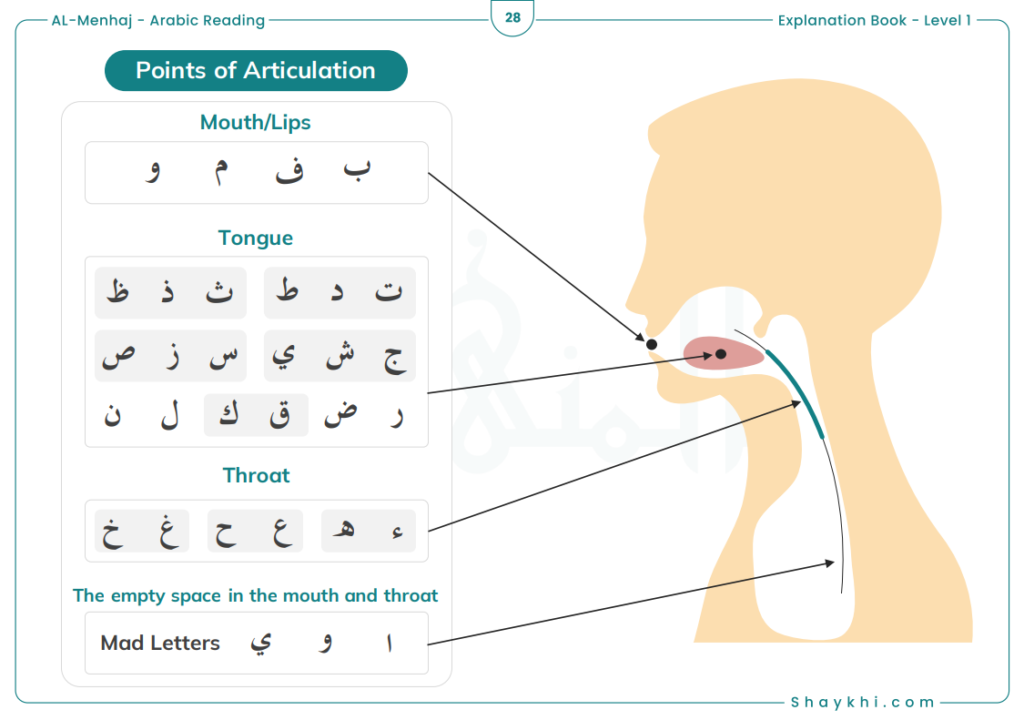
Makharij al-huruf refers to the precise articulation points from which each Arabic letter emerges. Classical Tajweed scholarship identifies 17 makhraj positions across five main regions: the oral cavity, throat, tongue, lips, and nasal passage. Mastering makharij is the non-negotiable starting point for every serious student.
The five major regions (jawf, halq, lisan, shafatayn, khayshum) each contain distinct exit points for specific letters. Without correct makharij, two letters can sound identical to the listener — and to Allah, Who hears the intention behind each sound.
Explore Al-Menhaj Book for Free (Learn to Read Quran)
The Three Throat Letters Non-Arabic Speakers Consistently Mispronounce
The halq (throat) region produces ء (Hamza), ه (Ha), ع (Ain), غ (Ghain), خ (Kha), and ح (Ha). At Learn Quran Tajweed Academy, students in our Beginner Tajweed Course consistently struggle most with ع (Ain) — producing it as a plain open vowel rather than the constricted pharyngeal sound it requires.
Begin your Tajweed journey with a free lesson

The corrective technique I use: have the student constrict the mid-throat as if clearing a slight obstruction, then produce the vowel through that constriction. Within two to three sessions, the sound locates itself.
The Tongue Letters and Their Precise Contact Points
The lisan (tongue) region contains 18 letters and is the most complex makhraj zone. Each letter requires a specific part of the tongue — tip, blade, dorsum, or sides — to contact a specific part of the palate or teeth.
ض (Dhad) and ظ (Dha) are among the most frequently confused by non-Arabic speakers. Dhad exits from the sides of the tongue against the upper molars — a sound with no equivalent in English, requiring dedicated physical training.
2. Letter Attributes That Define Each Sound’s Character
Sifat al-huruf are the inherent and variable attributes of Arabic letters that determine how each sound is produced beyond its exit point. Classical Tajweed scholarship categorizes sifat into Sifat Lazimah (permanent attributes that never change) and Sifat ‘Aridah (temporary attributes triggered by context).
The permanent attributes include Hams (whisper), Jahr (voicing), Shiddah (plosiveness), Rakhawah (continuousness), Isti’la (elevation), Istifal (lowness), Itbaq (adhesion), Infitah (openness), Idhlaq (fluency), and Ishmat (difficulty). Each letter carries a combination of these.
Tafkhim and Tarqiq: Heavy and Light Pronunciation
Tafkhim (heavy, full-mouth pronunciation) and Tarqiq (light, thin pronunciation) are context-sensitive attributes directly tied to correct meaning. The letter ر (Ra) alternates between heavy and light based on surrounding vowels and contextual rules — a point where many intermediate students make systematic errors.
The letters of Isti’la — خ، ص، ض، غ، ط، ق، ظ — always carry Tafkhim in their permanent character. Pronouncing them with the thin, front-of-mouth quality of Tarqiq alters the word’s sound and, potentially, its meaning.
| Letter Attribute | Arabic Term | Effect on Pronunciation |
| Heavy pronunciation | Tafkhim | Back of mouth resonance, raised soft palate |
| Light pronunciation | Tarqiq | Front of mouth, flat tongue |
| Plosive stop | Shiddah | Sound cuts sharply at exit point |
| Continuous flow | Rakhawah | Sound continues through letter |
| Nasal resonance | Ghunnah | Sound passes through nasal cavity |
Shots Videos from Our Courses
Perfect Your Quran Recitation Today
Join expert-led Tajweed classes, and recite the Quran with confidence and clarity.
Start Your Free Trial3. Noon Sakinah and Tanween Rules
The rules of Noon sakinah and Tanween represent one of the most systematically taught principles of Tajweed. When a sukoon Noon (نْ) or Tanween (ـً ـٍ ـٌ) meets another letter, one of four rules applies: Izhar, Idgham, Iqlab, or Ikhfa.
Each rule is triggered by the letter that follows, and each requires a distinct articulation technique. Getting these rules wrong doesn’t merely produce an accent — it can change the word being recited.
Izhar: Clear Pronunciation at the Throat Letters
Izhar (clear pronunciation) applies when Noon sakinah or Tanween is followed by one of the six throat letters: ء، ه، ع، غ، خ، ح. The Noon is pronounced clearly with no Ghunnah, no merger, and no change.
The key instructional challenge: students accustomed to English nasalization automatically carry a nasal quality into the following letter. Eliminating that carry-over requires conscious, deliberate practice.
Idgham: Merging the Noon into the Following Letter
Idgham (merging) occurs when Noon sakinah or Tanween is followed by one of six letters (ي، ر، م، ل، و، ن).
The Noon dissolves into the following letter. Idgham with Ghunnah applies to ي، و، م، ن — the Noon disappears and a two-count nasal resonance takes its place. Idgham without Ghunnah applies to ل and ر.
Iqlab: Converting the Noon to a Meem Sound
Iqlab applies exclusively when Noon sakinah or Tanween is followed by ب (Ba). The Noon converts to a Meem sound, held with a two-count Ghunnah before the Ba is pronounced.
There is only one triggering letter for this rule — making it the most straightforward of the four to memorize, though precision in the conversion itself requires practice.
Ikhfa: Concealment with Nasal Resonance
Ikhfa (concealment) applies to the remaining 15 letters of the Arabic alphabet. The Noon is neither clearly pronounced nor fully merged — it is concealed with a nasal resonance held for two counts, while the articulation point shifts toward the following letter.
Most non-Arabic speaking students at Learn Quran Tajweed Academy find Ikhfa the most difficult of the four rules because it requires holding an in-between articulation that doesn’t exist in their native phonological system.
Meet One of our Certified Teachers to Correct Your Pronunciation

4. The Three Principles Governing the Sukoon Meem
The Meem sakinah rules govern how a sukoon Meem (مْ) behaves before the 28 Arabic letters. Three rules apply: Ikhfa Shafawi, Idgham Shafawi, and Izhar Shafawi — all named “Shafawi” (labial) because Meem exits from the lips.
Ikhfa Shafawi applies when مْ is followed by ب (Ba). The Meem is concealed with a two-count Ghunnah, lips gently closed, before the Ba releases. Students frequently over-close the lips prematurely, producing a merged sound — which is the error of Idgham Shafawi instead.
Idgham Shafawi applies when مْ is followed by another م (Meem). The two Meems merge into one, held with a prominent two-count Ghunnah. Izhar Shafawi applies before all remaining letters — the Meem is pronounced clearly with no resonance carried forward.
5. The Nasal Resonance Principle That Runs Through Tajweed
Ghunnah is the nasal resonance produced from the khayshum (nasal passage) and measured at exactly two counts (harakatayn). It applies to Noon and Meem in specific positions — Mushaddad (doubled), in Ikhfa, Iqlab, Idgham with Ghunnah, and Ikhfa Shafawi.
The two-count measurement is not merely a timing guideline — it is a recitation obligation. Shortening Ghunnah to one count or extending it beyond two alters the recitation. In my experience, students who master Ghunnah duration early tend to advance through all Noon and Meem rules far more smoothly.
| Ghunnah Position | Letter | Duration |
| Mushaddad Noon or Meem | نّ / مّ | 2 counts (mandatory) |
| Ikhfa (Noon sakinah) | نْ + 15 letters | 2 counts |
| Iqlab | نْ + ب | 2 counts |
| Idgham with Ghunnah | نْ + ي،و،م،ن | 2 counts |
| Ikhfa Shafawi | مْ + ب | 2 counts |
| Idgham Shafawi | مْ + م | 2 counts |
For students pursuing structured mastery of all these rules, Learn Quran Tajweed Academy’s Intermediate Tajweed Course provides systematic progression through each Ghunnah application with live correction from Ijazah-certified instructors.
Join our Intermediate Tajweed Course and get a free trial

6. The Elongation Principle That Governs Vowel Duration
Madd (elongation) governs how long each long vowel is held in recitation. It is divided into Madd Asli (natural elongation, two counts) and Madd Far’i (secondary elongation, triggered by Hamzah or sukoon). Incorrect Madd application is among the most common errors I diagnose in students transferring from self-taught recitation.
Madd Asli (also called Madd Tabi’i) is the baseline: the three long vowels ا، و، ي are held for two counts whenever they appear without a triggering factor. This is the foundation all other Madd categories build on.
The Secondary Madd Categories and Their Count Requirements
– Madd Muttasil (connected) occurs when a Madd letter and Hamzah appear in the same word — obligatory elongation of 4–5 counts. Madd Munfasil (separated) occurs when the Madd letter ends one word and Hamzah begins the next — 4–5 counts in the recitation of Hafs ‘an ‘Asim, though some scholars permit shortening to 2 counts.
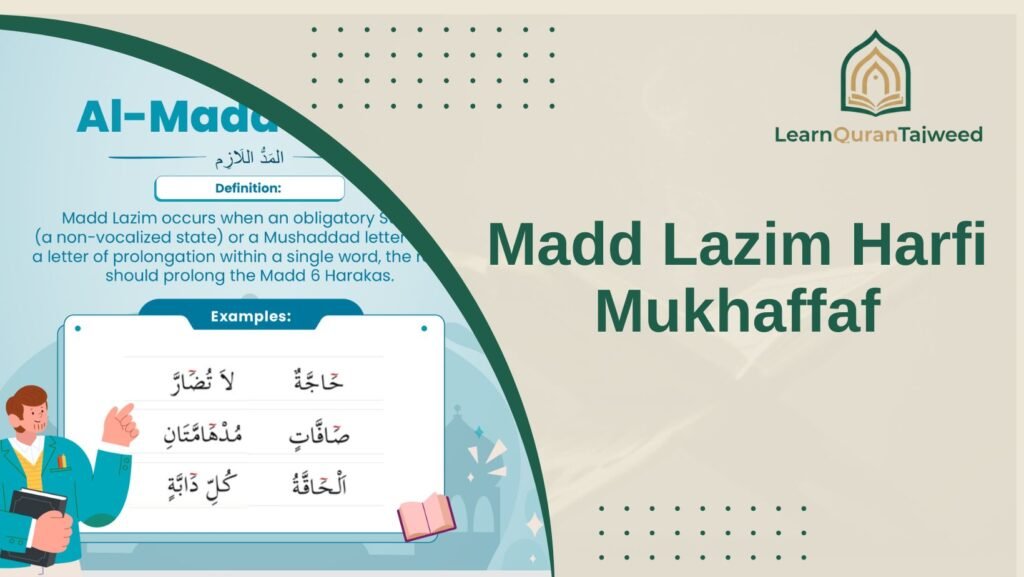
– Madd Lazim (compulsory) carries the heaviest obligation: 6 counts without exception. It occurs when a Madd letter is followed by a permanent sukoon (either in the middle or end of a word with a sukoon that remains in both continuation and stopping).
– Madd Aridh Lissukoon occurs when a Madd letter is followed by a letter on which the reciter stops, creating a temporary sukoon — permitted at 2, 4, or 6 counts, making it one of the few flexible Madd positions.
A Quranic example demonstrating Madd Lazim Kalimi Mukhaffaf:
آلْآنَ
Āl-āna
“Now?” (Yunus 10:91)
The Madd letter Alif is followed by a permanent sukoon on the Lam — 6 counts
7. The Echo Principle for Six Specific Letters
Qalqalah is the echoing, bouncing vibration produced when any of the five Qalqalah letters — ق، ط، ب، ج، د — appears with a sukoon (either original or caused by stopping). The echo prevents the letter from being swallowed into silence.
Qalqalah has two levels: Qalqalah Sughra (minor echo) occurs at a mid-word sukoon, while Qalqalah Kubra (major echo) occurs at the end of a verse when stopping. Qalqalah Kubra carries a stronger, more pronounced bounce.
The most instructive example occurs at the end of Surah Al-Ikhlas:
وَلَمْ يَكُن لَّهُۥ كُفُوًا أَحَدٌ
Wa lam yakul-lahū kufuwan aḥad
“Nor is there to Him any equivalent.” (Al-Ikhlas 112:4)
(Stopping on دٌ triggers Qalqalah Kubra — the Dal carries a clear echo, not a flat stop)
Working with Ijazah-certified Qaris at Learn Quran Tajweed Academy through our Practical Tajweed Course provides the individualized attention needed to calibrate Qalqalah strength precisely, distinguishing between the minor and major levels with authentic sound.
Join our Practical Tajweed Course and get a free trial

Read Also: Laam Rules in Tajweed
8. The Stopping and Starting Principle in Tajweed
Waqf (stopping) and Ibtida (beginning) rules govern where a reciter may pause, must pause, or must not pause within the Quran. These rules are both a Tajweed obligation and an act of preserving meaning — an incorrectly placed stop can fundamentally alter the intended sense of a verse.
Classical Tajweed scholarship categorizes stops into four levels: Waqf Lazim (obligatory stop — marked م), Waqf Ja’iz (permitted stop — marked ج), Waqf Mujawwaz (permissible with preference to continue), and Waqf Mamnu’ (prohibited stop — stopping here distorts meaning). The la (لا) symbol specifically prohibits stopping.
The principle of Ibtida — where to resume after a stop — is equally governed. Beginning at a word that makes the resumed sentence grammatically and semantically intact is obligatory. A student who stops correctly but resumes at a grammatically incomplete position has still violated the spirit of waqf rules.
Students preparing for Ijazah certification through Learn Quran Tajweed Academy’s Tajweed Ijazah Program dedicate significant time to mastering waqf markers — because Ijazah evaluation includes both Tajweed rule application and recitation pacing judgment.
Read Also: Shaddah in Tajweed
9. The Measured Recitation Principle That Ties Everything Together
Tarteel is the measured, unhurried recitation of the Quran that allows every Tajweed rule its full expression. Allah commands it directly in the Quran:
وَرَتِّلِ ٱلْقُرْءَانَ تَرْتِيلًا
Wa rattilil-Qur’āna tartīlā
“And recite the Quran with measured recitation.” (Al-Muzzammil 73:4)
Tarteel is not merely a slow pace — it is the pace at which articulation points are given their full formation, Madd elongations reach their complete counts, and Ghunnah resonates for its proper two-count duration.
Learn Quran Tajweed Academy’s Quran Tarteel Course specializes in developing the proper pacing and breath control that allows students to apply all Tajweed principles simultaneously without losing flow.
Join our Quran Tarteel Course and get a free trial

The evidence for the obligation of Tajweed itself comes from the hadith narrated by Abdullah ibn Mas’ud (may Allah be pleased with him), reported in Sahih al-Bukhari: the Prophet ﷺ said to him, “Recite the Quran to me,” demonstrating that recitation was taught, corrected, and transmitted with precision from teacher to student — the very chain that Ijazah certification preserves today.
Our Students Reviews
Perfect Your Quran Recitation Today
Join expert-led Tajweed classes, and recite the Quran with confidence and clarity.
Start Your Free TrialRead Also: Harakat in Tajweed
Begin Your Tajweed Mastery with Certified Instruction at Learn Quran Tajweed Academy
The principles of Tajweed require more than reading about them — they require a trained ear, live correction, and systematic progression.
Learn Quran Tajweed Academy offers:
- Ijazah-certified instructors specializing in Hafs ‘an ‘Asim
- Personalized 1-on-1 instruction matched to your exact recitation level
- Flexible scheduling available 24/7 for students worldwide
- Structured progression from beginner rules to full Ijazah certification
- Specialized Tajweed-only focus — not a generalist Quran platform
Book your FREE trial lesson today and experience the difference certified instruction makes.
Check out the best tajweed course for your needs:
- Practical Tajweed Course
- Beginner Tajweed Course
- Intermediate Tajweed Course
- Advanced Tajweed Course
- Quran Tarteel Course
- Tajweed Ijazah Program
- Tajweed Course for Sisters
- Tajweed course for Kids
Book your free trial Tajweed lesson today

Conclusion
The principles of Tajweed are not arbitrary rules — they are the phonological science behind the most precisely preserved oral tradition in human history. Makharij, sifat, Noon and Meem rules, Madd, Qalqalah, and waqf together form an interlocking system where each principle reinforces the others.
Every student who masters these principles is not merely improving their recitation. They are participating in an unbroken chain of transmission that stretches back to the Prophet ﷺ himself.
That is what the principles of Tajweed ultimately serve — fidelity, accuracy, and reverence. Insha’Allah, may your recitation reflect the beauty of what you are preserving.
Perfect Your Quran Recitation Today
Join expert-led Tajweed classes, and recite the Quran with confidence and clarity.
Start Your Free TrialRead Also: Complete Guide to Tajweed Rules
Frequently Asked Questions About the Principles of Tajweed
Is Learning the Principles of Tajweed Obligatory for Every Muslim?
Learning the principles of Tajweed at a scholarly level is a collective obligation (fard kifayah). However, applying main Tajweed principles correctly for Fatiha in daily recitation — in Salah — is individually obligatory (fard ‘ayn). Every Muslim who recites the Quran must apply its foundational rules to the best of their ability.
How Many Principles of Tajweed Are There?
Classical Tajweed scholarship organizes Tajweed around six primary principles: makharij (articulation points), sifat (letter attributes), Noon sakinah and Tanween rules, Meem sakinah rules, Madd elongation rules, and waqf (stopping) rules. These principles encompass all sub-rules including Ikhfa, Idgham, Qalqalah, Ghunnah, and Tafkhim.
Can I Learn the Principles of Tajweed Without a Teacher?
Self-study can build theoretical knowledge, but accurate Tajweed application requires live correction from a qualified teacher. Makharij errors, Ghunnah timing, and Madd count precision cannot be self-diagnosed reliably. Most students who attempt self-study develop habitual errors that take significantly longer to correct than if they had started with a certified instructor.
What Is the Difference Between Tajweed and Tarteel?
Tajweed refers to the set of phonological rules governing correct letter pronunciation, elongation, and merging. Tarteel refers to the measured, unhurried pace of recitation that allows all Tajweed rules their full expression. Tajweed is the system; tarteel is the manner of applying that system — both are commanded and connected.
How Long Does Mastering the Principles of Tajweed Take?
In most students’ experience at Learn Quran Tajweed Academy, foundational rule recognition takes approximately three to six months of consistent study. Correct application in flowing recitation typically requires one to two years of practice with regular teacher feedback. Full Tajweed mastery at Ijazah level requires several years of dedicated, structured training under qualified instruction.
Related Articles
Tajweed Rules