 Tajweed Rules
| Key Takeaways |
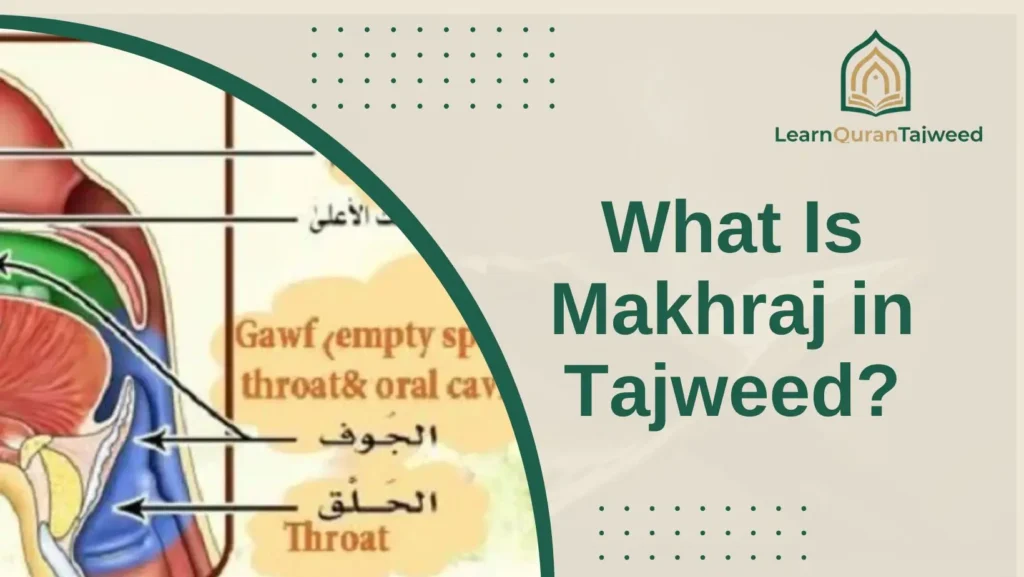
| Makhraj (plural: Makharij) refers to the precise physical location in the vocal tract where each Arabic letter originates. |
| Classical Tajweed scholarship identifies 17 detailed articulation points grouped under 5 main regions of the mouth and throat. |
| The five main Makharij regions are: the Jawf (cavity), Halq (throat), Lisan (tongue), Shafatain (lips), and Khayshum (nasal passage). |
| Makhraj defines where a letter comes from, while Tajweed governs how the entire recitation is performed — both are inseparable. |
| Mastering Makharij prevents letter substitution errors that can distort Quranic meaning, making correct articulation an obligation in recitation. |
Every student at some point asks: why do two letters that sound almost identical actually matter so much? The answer lives in makhraj in Tajweed — the precise articulation point that makes ح distinct from هـ, or ع from أ. These are not stylistic preferences; they are anatomical realities that define each letter’s identity.
A makhraj (مَخْرَج) is the specific location in the vocal tract — throat, tongue, lips, or nasal passage — from which an Arabic letter physically emerges.
Classical scholars established 17 detailed articulation points (Makharij Tafsiliyyah) organized under 5 main regions, forming the anatomical foundation of accurate Quranic recitation.
What Does Makhraj Mean in Tajweed?
Makhraj in Tajweed refers to the exact physical location where airflow is obstructed or shaped to produce a specific Arabic letter. Without correct Makharij, two different letters can sound identical — and in Quran recitation, that is never acceptable.
Changing a letter’s articulation point can change meaning entirely. Pronouncing ق (Qaf) as ك (Kaf), or ح (Ha) as هـ (Haa), produces a different word — and sometimes a distorted meaning in a Quranic verse. This is precisely why scholars of Tajweed have always treated Makharij as the entry point into all serious recitation study.
At Learn Quran Tajweed Academy, our Beginner Tajweed Course begins with Makharij training before any rule application — because a student who cannot produce letters correctly cannot apply rules meaningfully, regardless of how well they memorize them.
Begin your Tajweed journey with a free lesson

What Are the 5 Main Makharij Regions in Tajweed?
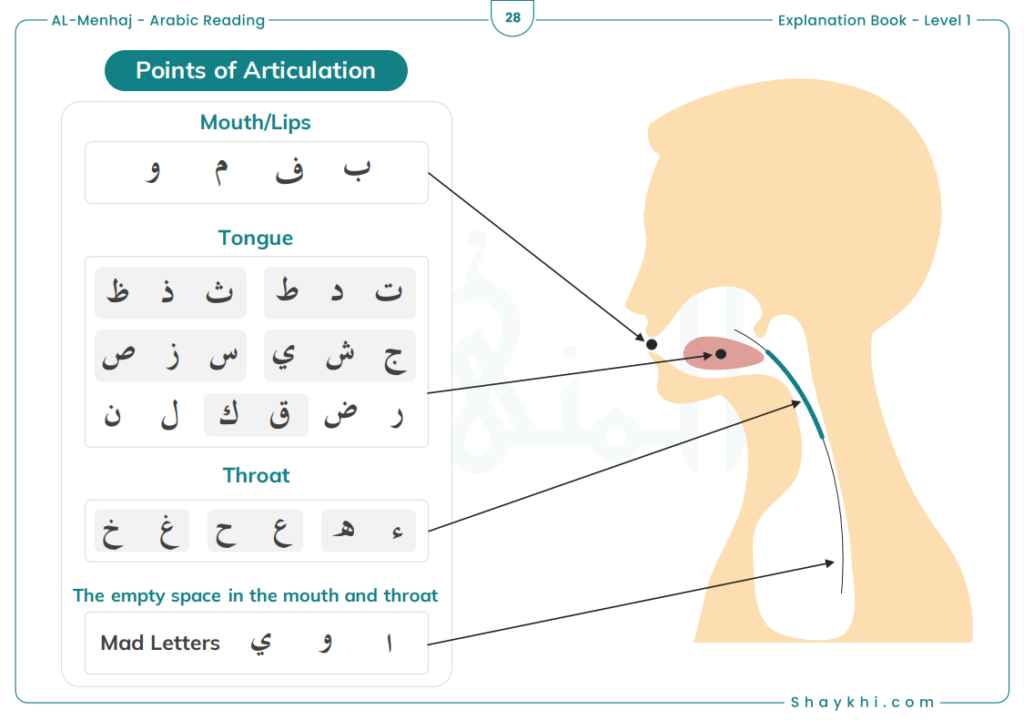
The 5 main Makharij regions contain all 17 detailed articulation points that account for every letter of the Arabic alphabet. Each region houses one or more sub-locations where specific letters originate.
| Main Region | Arabic | Detailed Points | Letters |
| Jawf (Cavity) | الجوف | 1 | ا، و، ي (Madd letters) |
| Halq (Throat) | الحلق | 3 | ء، هـ، ع، ح، غ، خ |
| Lisan (Tongue) | اللسان | 10 | 18 letters total |
| Shafatain (Lips) | الشفتان | 2 | ب، م، و، ف |
| Khayshum (Nasal) | الخيشوم | 1 | Ghunnah of م and ن |
Understanding this structure is the first step. The real mastery comes from knowing exactly what happens physically at each location — and that requires a teacher who can demonstrate, not just describe.
Explore Al-Menhaj Book for Free (Learn to Read Quran)
1. Al-Jawf is The Makhraj of the Three Madd Letters
Al-Jawf (الجوف) is the internal open cavity extending from behind the throat through the mouth. It is the articulation point for the three Madd (elongation) letters: Alif preceded by Fathah (ـَا), Waw preceded by Dhammah (ـُو), and Ya preceded by Kasrah (ـِي).
These three letters are called Huroof Jawfiyyah (cavity letters) or Huroof Hawa’iyyah (air letters) because their sound does not terminate at a fixed physical contact point — it extends and dissolves into the open air.
This is described as a Taqdeeri (estimated) makhraj, meaning no precise anatomical wall or point can be assigned.
All three Madd letters appear together in the word نُوحِيهَا in the verse:
تِلْكَ مِنْ أَنبَاءِ الْغَيْبِ نُوحِيهَا إِلَيْكَ
Tilka min anbaa’il-ghaybi nooheeha ilayk
“These are accounts of the unseen which We reveal to you.” (Hud 11:49)
For a deeper understanding of how these Madd letters function within recitation rules, see our detailed guide on Tajweed Madd rules: types of Madd, with chart.
2. Al-Halq is The Three Throat Articulation Points
Al-Halq (الحلق) contains three distinct articulation points for six letters. The throat is divided by depth, measured from the chest outward toward the mouth.
Aqsa Al-Halq — The Deepest Throat Point
Aqsa Al-Halq (أقصى الحلق) is the lowest portion of the throat, closest to the chest. From here emerge Hamzah (ء) and Haa (هـ). The Hamzah’s point sits slightly deeper than the Haa.
Wasat Al-Halq — The Middle Throat Point
Wasat Al-Halq (وسط الحلق) is the middle section of the throat. It produces Ain (ع) and Haa (ح) — known as the Huroof Halqiyyah alongside the other four. The Ain originates slightly deeper than the Haa.
Adna Al-Halq — The Nearest Throat Point
Adna Al-Halq (أدنى الحلق) is the portion of the throat closest to the mouth. From here come Ghain (غ) and Kha (خ). The Kha sits closer to the mouth than the Ghain.
One of the most consistent errors I observe among new students — particularly native English speakers — is collapsing all six throat letters into a single vague “throat sound.”
The distinction between Ain and Hamzah, for example, requires the student to feel the muscular contraction in the middle throat versus the complete glottal stop at the deepest point. These cannot be approximated; they must be physically trained.
Shots Videos from Our Courses
Perfect Your Quran Recitation Today
Join expert-led Tajweed classes, and recite the Quran with confidence and clarity.
Start Your Free Trial3. The Ten Tongue Articulation Points
Al-Lisan (اللسان) is the most complex Makhraj region, housing 10 detailed articulation points for 18 letters. The tongue is described by three zones — its root (Aqsa), middle (Wasat), edges (Hafah), and tip (Taraf) — each interacting with specific upper structures.
| Point | Tongue Position | Upper Contact | Letter(s) |
| 1 | Root (Aqsa) | Upper palate | ق |
| 2 | Root (just before Qaf) | Upper palate | ك |
| 3 | Middle (Wasat) | Upper palate | ج، ش، ي |
| 4 | One edge (Hafah) | Upper molars | ض |
| 5 | Both edges | Upper gum line | ل |
| 6 | Tip (Taraf) | Upper gum (Thanaiyyah) | ن |
| 7 | Tip + slight back | Upper gum (Thanaiyyah) | ر |
| 8 | Tip | Roots of upper incisors | ط، د، ت |
| 9 | Tip | Above lower incisors | ص، ز، س |
| 10 | Tip | Tips of upper incisors | ث، ذ، ظ |
Why the Dhad (ض) Deserves Special Attention?
The Dhad (ض) has long been recognized in classical scholarship as one of the most difficult Arabic letters for non-Arabs to produce correctly. It originates from one edge (Hafah) of the tongue against the upper molars — with the left edge being easier for most students, though either side is valid.
Students who attempt the Dhad from the tongue tip — treating it like a dental letter — produce a sound closer to Dhaal (ذ) or Dhaa (ظ), both of which are entirely different letters with different meanings in Quranic text.
Working with Ijazah-certified instructors at Learn Quran Tajweed Academy through our Advanced Tajweed Course gives students the individualized physical feedback needed to isolate the lateral tongue edge correctly.
Reserve your free trial lesson for Advanced Tajweed Course

The Ya (ي) Has Two Makharij
The Ya has two distinct articulation contexts. As a Madd letter (ـِي — preceded by Kasrah, while silent), it exits from Al-Jawf. As a non-Madd Ya (whether moving or silent without a preceding Kasrah), it exits from Wasat Al-Lisan.
This dual nature is one of the edge cases that separates intermediate students from advanced ones — and it directly affects Tajweed Madd rules application.
4. The Two Lip Articulation Points
Al-Shafatain (الشفتان) contains two detailed articulation points for four letters. The lips work in two distinct configurations depending on the letter produced.
Between Both Lips — Bain Al-Shafatain
Ba (ب) and Meem (م) both exit from the complete closure (Intibaq) of both lips pressed together — with Ba requiring slightly stronger pressure. The Waw غير المدية (non-Madd Waw — whether moving or the soft Waw Layyinah) exits from the same location but with the lips open (Infitah), not pressed.
Lower Lip and Upper Incisors — Fa (ف)
Fa (ف) originates from the inner surface of the lower lip (Batn Al-Shafah Al-Sufla) making light contact with the tips of the upper front teeth. This is a critical point — contact should be with the inner edge of the lower lip, not the outer edge or lip line.
Read also: The Difference Between Itbaq and Infitah in Quranic Recitation
Perfect Your Quran Recitation Today
Join expert-led Tajweed classes, and recite the Quran with confidence and clarity.
Start Your Free Trial5. Al-Khayshum is The Nasal Passage and the Ghunnah
Al-Khayshum (الخيشوم) is the nasal passage connecting the upper nose to the throat. Unlike the other four regions, it does not produce a standalone letter — it is the exclusive exit point of the Ghunnah (غنة), the nasal resonance that accompanies Noon (ن) and Meem (م) in specific recitation states.
Scholars include the Khayshum among the five main Makharij precisely because the Ghunnah is the only Sifah (attribute) in all of Tajweed that has its own independent articulation point, separate from the letter it accompanies.
All other attributes exit alongside their letter — the Ghunnah exits from the nose regardless of where the Noon or Meem themselves are formed.
The Ghunnah has five levels of prominence, ordered from strongest to weakest:
- Noon or Meem with Shaddah — maximum Ghunnah, held for two counts
- Noon Sakinah with Idgham Bi-Ghunnah — strong Ghunnah during merging
- Noon Sakinah or Meem Sakinah with Ikhfa — concealed with nasal resonance
- Noon or Meem Sakinah with Idhar — Ghunnah present but not emphasized
- Moving Noon or Meem — Ghunnah present as an inherent quality, not extended
For the full application of these states, the rules of Ghunnah in Tajweed, Noon Sakinah rules, Idgham, Ikhfa, and Iqlab each deserve dedicated study.
Read Also: The Difference Between Makhraj and Tajweed
What Is the Difference Between Makhraj and Tajweed?
Makhraj defines the physical origin point of each letter — where it is produced anatomically. Tajweed is the broader science governing how recitation is performed — encompassing articulation, letter attributes (Sifat), lengthening rules (Madd), assimilation rules (Idgham), and the overall flow of the recitation.
Simply put: Makhraj answers where a letter comes from. Tajweed answers how the entire recitation should sound. Makharij is a foundational chapter within the larger science of Tajweed, not a separate discipline.
You cannot apply Tajweed rules to a letter you are not producing correctly in the first place — which is why Makharij study always precedes rule application in structured Tajweed curricula.
Students enrolled in the Intermediate Tajweed Course at Learn Quran Tajweed Academy often arrive with surface-level rule memorization but unresolved Makhraj errors.
Join our Intermediate Tajweed Course and get a free trial

Read Also: Al-Jawf in Tajweed
Rebuilding from the articulation level first — before revisiting rule application — produces noticeably more accurate recitation within weeks.
In most students’ experience at our academy, targeted Makhraj correction paired with consistent daily practice yields measurable improvement within three to four weeks.
Read Also: Sifaat Al Huroof In Tajweed
Common Makhraj Errors Non-Arabic Speakers Make
Non-Arabic speakers consistently struggle with a predictable set of articulation errors. Recognizing them early prevents them from becoming entrenched habits.
| Incorrect Production | Correct Letter | Common Substitution | Root Cause |
| Ain (ع) as plain “a” | ع — Wasat Al-Halq | Open vowel “a” | No middle-throat contraction |
| Qaf (ق) as “k” sound | ق — Aqsa Al-Lisan | Kaf (ك) | Tongue root not engaged |
| Dhad (ض) as Dhaal | ض — Hafah Al-Lisan | ذ or ظ | Tongue tip used instead of edge |
| Hamzah (ء) omitted | ء — Aqsa Al-Halq | Smooth vowel onset | No glottal stop training |
| Ha (ح) as “h” | ح — Wasat Al-Halq | هـ | Breathiness instead of friction |
The most common error I encounter among English-speaking students at Learn Quran Tajweed Academy involves the Ain (ع).
Before any correction work, most students produce it as a plain open vowel — because English has no equivalent sound requiring middle-throat muscular engagement.
The correction always starts with isolating the physical sensation of the throat contracting, before any recitation context is introduced.
Read Also: Tajweed Tongue Letters
Our Students Reviews
Perfect Your Quran Recitation Today
Join expert-led Tajweed classes, and recite the Quran with confidence and clarity.
Start Your Free TrialRead Also: Lip Letters in Tajweed
Begin Your Makhraj Mastery at Learn Quran Tajweed Academy
Correct Makharij is where authentic recitation begins — and a certified instructor is where real correction happens.
Learn Quran Tajweed Academy offers:
- Ijazah-certified instructors specializing in Hafs ‘an ‘Asim recitation
- Personalized 1-on-1 sessions targeting your specific articulation errors
- Flexible scheduling available 24/7 for students worldwide
- Structured progression from Makharij training through full Ijazah certification
- Courses at every level — Beginner, Intermediate, Advanced, and Ijazah Program
Book your FREE trial lesson today →
Check out the best tajweed course for your needs:
- Practical Tajweed Course
- Beginner Tajweed Course
- Intermediate Tajweed Course
- Advanced Tajweed Course
- Quran Tarteel Course
- Tajweed Ijazah Program
- Tajweed Course for Sisters
- Tajweed course for Kids
Book your free trial Tajweed lesson today

Conclusion
Makhraj is not a theoretical concept — it is a physical reality that either produces the correct letter or does not. The 17 articulation points established by classical Tajweed scholarship give every student a precise anatomical map for training, correcting, and refining their recitation from the ground up.
Understanding the difference between Makhraj and Tajweed helps serious students recognize that correct articulation is the prerequisite, not the goal. The goal is recitation that honors the Quran as it was revealed — letter by letter, with every exit point and every attribute in its proper place.
That level of precision is built through consistent practice under qualified guidance. Insha’Allah, may Allah make the Quran easy on your tongue and light in your heart.
Perfect Your Quran Recitation Today
Join expert-led Tajweed classes, and recite the Quran with confidence and clarity.
Start Your Free TrialRead Also: Throat Letters in Tajweed
Frequently Asked Questions About Makhraj in Tajweed
Is Makhraj the Same as Sifat in Tajweed?
Makhraj and Sifat are two distinct but inseparable elements of letter identity. Makhraj refers to the physical location where the letter originates, while Sifat describes the qualities or characteristics of the sound produced — such as its strength, softness, or nasality. A complete letter is defined by both together.
How Many Makharij Are There in Tajweed According to Mainstream Scholarship?
According to the most widely accepted position among Tajweed scholars — and the view adopted in Hafs ‘an ‘Asim recitation curricula — there are 17 detailed articulation points organized under 5 main Makhraj regions. Some scholars cite 16 or 14 points, but 17 remains the standard taught in structured Tajweed programs globally.
Can I Learn Makharij Correctly Through Online Classes?
Yes — provided the instruction is live, interactive, and delivered by an Ijazah-certified instructor who can hear your pronunciation and provide real-time correction. Pre-recorded video alone is insufficient for Makhraj training because articulation errors require personalized diagnosis. Live 1-on-1 sessions, such as those offered through Learn Quran Tajweed Academy’s Practical Tajweed Course, replicate the correction environment of in-person study effectively.
Does Mispronouncing a Makhraj Invalidate Salah?
Scholars distinguish between errors that distort meaning (Lahn Jali — major error) and subtle mispronunciations (Lahn Khafi — minor error). Consistent substitution of one letter for another — such as producing Ain as Alif — constitutes a major error that affects the validity of recitation in Salah according to most scholars. This makes Makhraj correction an obligation, not an optional refinement, for any reciting Muslim.
What Is the Hardest Makhraj for Non-Arabic Speakers to Master?
Based on consistent instructional observation, the throat letters — particularly Ain (ع), Ha (ح), and Ghain (غ) — present the greatest challenge for native English, French, and Urdu speakers. The Dhad (ض) follows closely due to its unique lateral tongue-edge articulation. These letters have no equivalent sounds in most world languages, requiring deliberate physical training rather than phonetic approximation.