 Tajweed Rules
| Key Takeaways |
| Shaddah represents two identical letters merged into one — the first sukoon, the second voweled — pronounced with strong, deliberate pressure. |
| When shaddah appears on Noon or Meem, ghunnah becomes obligatory, held for exactly two counts (harakatayn) from the nasal passage. |
| Splitting a shaddah into two separate letters is a tajweed error that can alter meaning — making it a lahn jali (clear mistake). |
Every reciter who has sat with a certified Qari has heard the same correction: “You’re lightening the shaddah.” Shaddah in tajweed is one of those rules that looks simple on paper but demands genuine muscular precision when reciting. It is not an ornamental mark — it is a structural rule that, when applied incorrectly, can transform meaning entirely.
The shaddah (ّ) signals that a letter is doubled: one silent letter followed immediately by the same letter with a vowel, fused into a single, powerfully stressed sound. Mastering it means training your articulation point to hold — briefly but firmly — before releasing with controlled force, reflecting the Quran’s recitation exactly as it was preserved and transmitted.
What Is Shaddah in Tajweed?
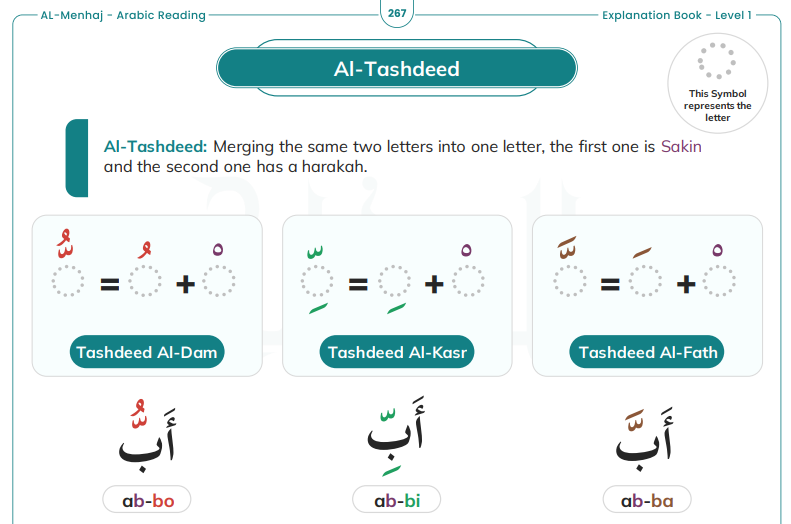
Shaddah in tajweed is the merging of two identical letters — the first bearing sukoon and the second carrying a harakah — into one doubled letter pronounced with strong pressure at its makhraj. It is not optional emphasis; it is an obligatory recitation ruling that affects meaning, sound, and worship validity.
The Arabic word شَدَّة means intensity or force. That name is the rule itself. When you encounter a shaddah, your articulation point must grip and then release with deliberate power.
Explore Al-Menhaj Book for FREE (Learn to Read Quran)
Why Does Shaddah Matter in Tajweed?
Softening it produces a distorted sound that scholars classify as lahn jali — a clear, meaning-altering error.
In everyday teaching at Learn Quran Tajweed Academy, this is one of the first corrections made with new students in the Beginner Tajweed Course. Students often read shaddah letters lightly, as if the mark were decoration rather than instruction.
Begin your Tajweed journey with a free lesson

What Does Shaddah Consist of at the Letter Level?
Shaddah is phonetically two letters compressed into one pronounced unit. The first letter is sakin (silent, bearing sukoon), and the second is mutaharrik (voweled, carrying fathah, dammah, or kasrah). The result is a single letter with doubled weight and pressure.
This is why classical scholars sometimes described the shaddah as carrying the weight of two harakahs in terms of stress. The reciter does not pronounce two separate letters sequentially — that would be an error called tafkik (splitting). Instead, both are merged seamlessly into one sustained, pressed sound at the makhraj.
How Do the Three Vowels Appear With Shaddah?
The shaddah appears with all three short vowels, and each combination has a distinct look:
| Vowel Type | Example Letter | Pronunciation |
| Fathah with shaddah | مَّ | Pressed, open “ma” sound |
| Dammah with shaddah | مُّ | Pressed, rounded “mu” sound |
| Kasrah with shaddah | مِّ | Kasrah written beneath the shaddah |
The kasrah-with-shaddah placement trips up many students visually. The kasrah sits below the shaddah mark, not below the letter body itself — a detail worth confirming with students early.
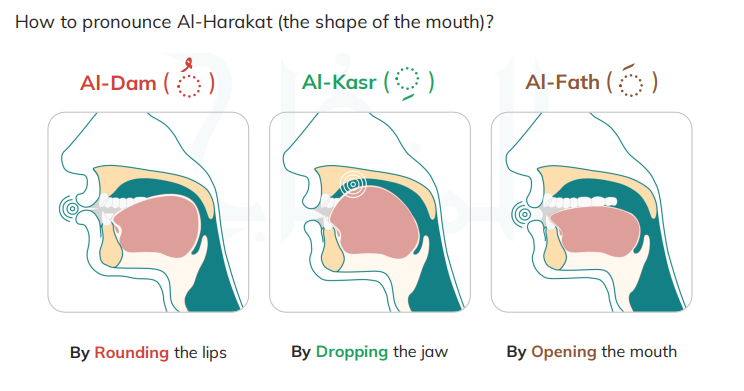
Understanding sifah al-huruf at this level is exactly what differentiates surface-level Tajweed reading from genuine mastery. Our Intermediate Tajweed Course covers these letter attribute interactions systematically, building the precision required for advanced recitation.
Join our Intermediate Tajweed Course and get a free trial

Shaddah With Noon and Meem — The Ghunnah Obligation
When the shaddah falls on a Noon (نّ) or Meem (مّ), a specific ruling activates: ghunnah becomes obligatory, held for two counts (harakatayn) from the nasal passage (al-khayshoom).
This is one of the most important intersections in all of tajweed. The shaddah already demands pressure and grip at the makhraj — but for Noon and Meem specifically, that pressure must be accompanied by a resonant nasal hum maintained for the full two-count duration before releasing into the following sound.
A clear Quranic example:
إِنَّ ٱللَّهَ كَانَ عَلِيمًا خَبِيرًا
Innallāha kāna ‘alīman khabīrā
“Indeed, Allah is ever Knowing and Acquainted.” (An-Nisa 4:35)
The إِنَّ here demonstrates shaddah on Noon with obligatory ghunnah. Students often extend the ghunnah beyond two counts in overcorrection, or suppress it entirely in haste — both are errors. For a full treatment of ghunnah rules, see our dedicated guide on ghunnah rules.
The Most Common Shaddah Errors Non-Arabic Speakers Make
Students at Learn Quran Tajweed Academy consistently present three recurring shaddah errors, regardless of their native language background. Identifying these early prevents them from becoming embedded habits.
1. Tafkik — Splitting the Shaddah Into Two Separate Letters
Tafkik is pronouncing the two constituent letters of a shaddah separately rather than as one merged unit. It sounds like a brief pause or glottal break between the two identical letters. This is a lahn jali — a clear error that violates the rule of idgham (merging) that produces the shaddah in the first place.
The correction: train the student to arrive at the shaddah letter already in position, so the makhraj is engaged before the vowel releases. There is no moment of separation.
2. Takhfif — Lightening the Shaddah
Takhfif means reading the shaddah letter without sufficient pressure, so it sounds like an ordinary voweled letter rather than a doubled one. The word قُوَّة (quwwah, meaning “strength”) is a common test case — the Waw must be pressed firmly. A light reading produces quwah, which loses the correct weight entirely.
3. Suppressing the Ghunnah on Shaddah Noon and Meem
Many students correctly identify the shaddah but forget — or do not know — that Noon and Meem shaddah carry a mandatory ghunnah. They grip the letter and release immediately without the nasal resonance. This is an error in a different category: not makhraj-based, but sifah-based.
Shots Videos from Our Courses
Perfect Your Quran Recitation Today
Join expert-led Tajweed classes, and recite the Quran with confidence and clarity.
Start Your Free TrialHow Does Shaddah Relate to Idgham in Tajweed?
Shaddah is the result of idgham — the merging of two letters. Understanding this connection deepens both rules simultaneously. When a noon sakinah or tanween is followed by a letter from the idgham group, the noon merges into the following letter, and that following letter receives — effectively — a shaddah.
This is precisely why the idgham in tajweed rule produces a doubled, pressed sound at the letter following the noon. The shaddah mark you sometimes see written above that letter in mushaf editions is not incidental — it is confirming the idgham merger.
A practical example:
مَن يَعْمَلْ
May ya’mal
The Noon of مَن merges into the Yaa of يَعْمَلْ, producing a shaddah on the Yaa — with ghunnah, because this is idgham with ghunnah (idgham bi ghunnah). See noon sakinah rules for the full breakdown of which letters trigger this merger.
Read also: At-Tafashi Pronunciation Rule: Exploring the Arabic Letter Shin
Shaddah and Qalqalah — an Important Interaction to Know
One edge case that intermediate students frequently mishandle: qalqalah letters with shaddah. The qalqalah letters are ق ط ب ج د — and some of these can appear with shaddah in Quranic text.
The ruling according to mainstream tajweed scholarship in the Hafs ‘an ‘Asim transmission: qalqalah does NOT apply to a shaddah letter mid-word.
Qalqalah activates when a letter is sukoon — but a shaddah letter’s first component (the silent one) is internal and merged; it does not stand alone as a recitable sukoon in the way that triggers qalqalah bounce.
However, if a qalqalah letter with shaddah falls at a waqf (pause), the ruling requires careful application.
For the detailed rules on qalqalah including its types and levels, our guide on what is qalqalah in tajweed addresses these interactions directly.
Perfect Your Quran Recitation Today
Join expert-led Tajweed classes, and recite the Quran with confidence and clarity.
Start Your Free TrialShaddah on the Meem — Connection to Meem Rules in Tajweed
The Meem with shaddah (مّ) deserves specific attention because Meem carries its own set of tajweed rulings beyond shaddah. When Meem bears a shaddah, the ruling is unambiguous: pronounce it as a single doubled Meem with obligatory ghunnah for two counts. No other Meem rule (ikhfa shafawi, idgham shafawi, or izhar shafawi) applies here — the shaddah ruling takes precedence.
Students pursuing structured mastery of all Meem-related rulings will find our complete guide on meem rules in tajweed an essential companion resource.
Read Also: Laam Rules in Tajweed
A Practical Drill for Mastering Shaddah Pressure
The most effective drill I assign to students struggling with takhfif is what I call the makhraj hold exercise. Before pronouncing the shaddah letter, the student closes their articulation point completely — for letters like Ba (lips sealed), for Qaf (back of tongue raised) — holds for one silent beat, then releases with the vowel and full pressure.
This physically separates the “grip” phase from the “release” phase, making the doubled weight audible and felt. Within a few sessions, most students stop unconsciously lightening the shaddah because they have now experienced what correct pressure feels like in their own articulation.
Consistent practice of this drill within structured recitation — not just isolated repetition — is what builds lasting accuracy. The Amali (Practical) Tajweed Course at Learn Quran Tajweed Academy integrates exactly this type of applied drilling with certified Ijazah-certified Qaris, ensuring errors like takhfif are corrected in real recitation context, not just theory.
Join our Practical Tajweed Course and get a free trial

Read Also: Harakat in Tajweed
Shaddah Application in Surah Al-Fatihah — a Foundational Reference
Surah Al-Fatihah contains multiple shaddah examples that every reciter encounters in every salah. Examining them concretely grounds the rule in lived practice.
ٱلرَّحْمَـٰنِ ٱلرَّحِيمِ
Ar-Rahmāni r-Rahīm
“The Entirely Merciful, the Especially Merciful.” (Al-Fatihah 1:3)
The ر in ٱلرَّحْمَـٰنِ carries shaddah — the Lam of the definite article merges into the Ra, producing a doubled Ra with full pressure. This shaddah also carries the additional ruling of tafkhim (full-mouth articulation) because Ra is a letter of tafkhim. The shaddah does not override tafkhim — both rulings apply simultaneously.
This is the kind of layered rule interaction that distinguishes careful Tajweed study from surface-level reading.
Our Students Reviews
Perfect Your Quran Recitation Today
Join expert-led Tajweed classes, and recite the Quran with confidence and clarity.
Start Your Free TrialRead Also: Principles of Tajweed
Starting Your Tajweed Mastery at Learn Quran Tajweed Academy
Shaddah is one of those rules where the gap between knowing it and applying it correctly only closes through consistent, corrected practice with a qualified teacher.
Learn Quran Tajweed Academy offers:
- Ijazah-certified instructors specializing in Hafs ‘an ‘Asim
- Personalized 1-on-1 sessions tailored to your recitation level
- Flexible scheduling 24/7 for students worldwide
- Structured progression from foundational rules to full Ijazah certification
- Tajweed-only specialization — not a generalist academy
Book your FREE trial lesson and let a certified Qari assess your shaddah application directly.
Check out the best tajweed course for your needs:
- Practical Tajweed Course
- Beginner Tajweed Course
- Intermediate Tajweed Course
- Advanced Tajweed Course
- Quran Tarteel Course
- Tajweed Ijazah Program
- Tajweed Course for Sisters
- Tajweed course for Kids
Book your free trial Tajweed lesson today

Conclusion
Shaddah is not a minor diacritical mark — it is a load-bearing tajweed rule that shapes meaning, sound, and the integrity of Quranic recitation. Applying it correctly requires understanding what it is phonetically (two merged letters), what it demands physically (pressure at the makhraj), and what additional rulings activate when it falls on Noon or Meem.
The errors students make with shaddah — splitting it, lightening it, or missing the ghunnah — are correctable with targeted instruction. Recognizing them is half the work. The other half is practiced recitation under the ears of someone certified to hear the difference.
Every letter of the Quran carries weight. The shaddah simply makes that weight visible.
Read Also: Complete Guide to Tajweed Rules
Frequently Asked Questions About Shaddah in Tajweed
Is shaddah in tajweed the same as idgham?
Shaddah is the result of idgham, not identical to it. Idgham is the process of merging two letters; the shaddah mark indicates that this merger has occurred, producing a doubled letter. Every idgham produces an effective shaddah on the following letter, but shaddah appears in other contexts too — within words, not only at word boundaries.
Does shaddah always require ghunnah?
No. Ghunnah with shaddah is obligatory only when the shaddah falls on Noon (نّ) or Meem (مّ). For all other letters bearing shaddah, ghunnah is not applicable — the ruling is simply to pronounce the letter with doubled pressure at its makhraj without any nasal resonance.
What is the difference between shaddah and sukoon in tajweed?
Sukoon indicates a single letter with no vowel sound. Shaddah indicates two identical letters merged — the first carries sukoon internally, but the combined unit carries a vowel. A sukoon letter is light; a shaddah letter is doubled and pressed. They appear similar visually to beginners but function completely differently.
Can a letter with shaddah also carry tafkhim or tarqiq?
Yes. Shaddah and tafkhim/tarqiq rulings are independent and apply simultaneously. The Ra with shaddah, for example, still follows Ra’s tafkhim and tarqiq conditions. The shaddah tells you how many letters you are pronouncing; tafkhim and tarqiq tell you how to color the sound.
Is reading shaddah incorrectly a major recitation error?
Splitting a shaddah (tafkik) or completely omitting its pressure is classified as lahn jali — a clear error that can alter meaning and, in some positions, affect the validity of salah. Lightening it without full splitting is lahn khafi — a hidden error that does not alter meaning but still violates correct Tajweed application and must be corrected.