 Tajweed Rules

Pronounce the letter (ق) qaf, then the letter (ب) baa out loud. Notice how one of the two letters fills your mouth with a heavier, rounder sound while the other stays flat and light? That difference does not happen randomly. It comes from where your tongue sits inside your mouth.
This is exactly what isti’laa vs istifal in tajweed describes: two opposite tongue positions that shape how the Arabic letters sound when you recite the Quran.
Isti’laa (elevation) and istifal (lowering) are two of the core letter characteristics, or sifaat, that tajweed scholars study to explain why some letters sound “heavy,” and others sound “light.” Getting this right isn’t just academic. It changes how accurately you recite, and mispronouncing these letters can shift the meaning of a word.
What You’ll Learn in This Article
- What isti’laa means and which seven letters carry it
- What istifal means and why it applies to the remaining letters
- The real difference between isti’laa/istifal and tafkheem/tarqeeq
- The exceptions every serious student needs to know (alif, the lam of Allah’s name, and ra)
- A simple, practical method to check your own pronunciation
What Is Isti’laa in Tajweed?
Isti’laa is the raising of the back of the tongue toward the upper palate while pronouncing a letter. The word “Isti’laa” comes from the Arabic root for “elevation” or “rising”, and that’s literally what happens inside your mouth.
When the back of the tongue lifts this way, the sound has less room to travel, so it reflects and fills the mouth with resonance. The result is a heavier, thicker sound, which tajweed scholars call tafkheem.
The Seven Isti’laa Letters
There are exactly seven isti’laa letters: خ ص ض غ ط ق ظ (khaa, saad, daad, ghayn, taa, qaaf, dhaa). Generations of tajweed teachers have memorized them through the mnemonic phrase “khuss dhaghtin qidh” (خص ضغطٍ قِظ). This phrase strings all seven letters together in a single line. As a result, students can recall them instantly.
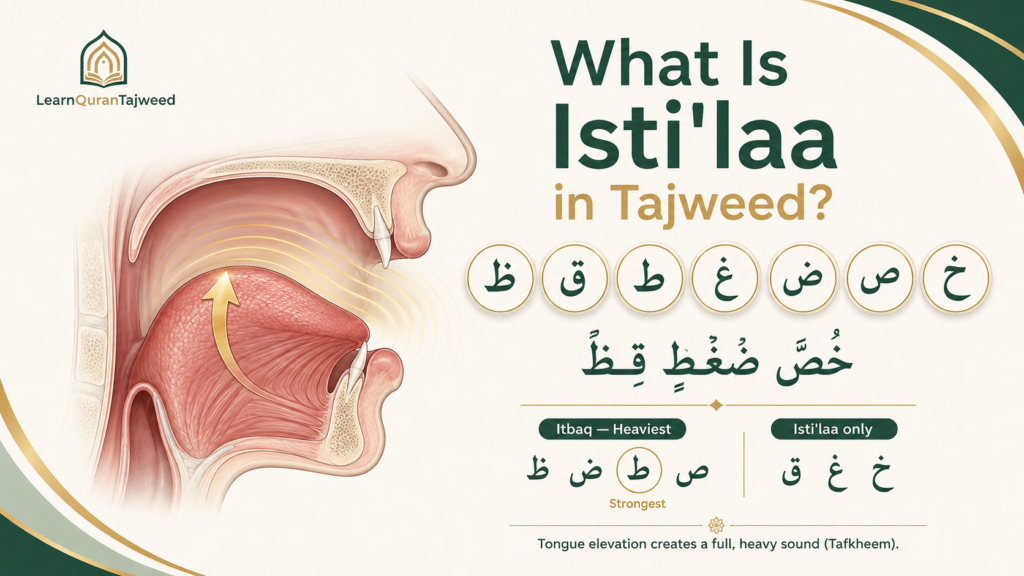
Among these seven, four—saad, daad, taa, and dhaa—are also “mutbaq” (fully closed) letters. In Itbaq, the tongue presses flat against the palate, making them the heaviest of the group. The other three, khaa, qaaf, and ghayn, are Isti’laa but not Itbaq, so they carry elevation without the full palate contact.
Why Does the Letter Taa ط Stand Out?
Not all seven isti’laa letters carry the same weight. That is a detail many articles skip. In general, Tajweed practitioners treat the letter taa (ط) as the strongest of the group, followed by the other itbaq letters (saad, daad, dhaa).
For example, if a student’s taa doesn’t sound noticeably heavier than their qaaf or khaa, that’s usually the first sign their tongue placement needs correction.
Getting the tongue position right for these seven letters is one of the first things a Learn Quran Tajweed instructor listens for in a live session. When this habit is corrected early, that’s much easier than learning it later.
Read also: Complete Guide to Tajweed Rules
See Our Classrooms in Action
Watch these short clips from our live, interactive Quran courses to see how our students learn and interact with our expert tutors.
Perfect Your Quran Recitation Today
Join expert-led Tajweed classes, and recite the Quran with confidence and clarity.
Start Your Free TrialWhat Is Istifal In Tajweed?
Instead of raising the tongue in Isti’laa, Istifal is the opposite. The back of the tongue stays low. It becomes closer to the floor of the mouth, without approaching the upper palate. As a result, the sound comes out thinner and lighter in a quality called tarqeeq, as it isn’t reflected off the palate.
The Remaining Twenty-One Letters
Istifal covers 21 letters from hamzah and baa through to yaa. It actually includes every letter of the Arabic alphabet that isn’t part of the isti’laa group. Exclude the letters of isti’laa, خ ص ض غ ط ق ظ, from the letters of the alphabet (excluding alif, which is treated separately), and you’re left with istifal letters,
Since istifal is simply “everything else,” reciters unconsciously “borrow” heaviness from a nearby isti’laa letter and apply it to an istifal letter that should stay light. Students often assume it needs no separate attention. In practice, this is where sloppy tafkheem creeps in.
Read also: Itbaq Vs Infitah In Tajweed
Isti’laa Vs Istifal – The Practical Difference
The link between the two concepts is airflow and space. In istifal, the lowered tongue leaves the mouth open, so the sound passes through without that resonance and comes out thin.
In isti’laa, the raised tongue narrows the space in the mouth; as a result, the sound resonates and comes out full.
Read also: Principles of Tajweed
Isti’laa And Istifal Are Not The Same As Tafkheem And Tarqeeq
Students are often confused by treating isti’laa and tafkheem as identical terms. For your notice, they’re closely linked but not the same thing. Isti’laa describes the tongue’s physical position; tafkheem describes the resulting sound quality.
All the letters of istifal are tarqeeq, and all the letters of isti’laa are tafkheem, with three important exceptions.
Read also: Difference Between Tafkheem and Tarqeeq With Examples
The Exceptions Every Student Should Know
This is considered one of the details neglected by most beginner guides. Three letters don’t follow the isti’laa/istifal rule neatly:
1. Alif (ا): This letter follows the letter before it; heavy after a heavy letter, and light after a light one. Since it has no fixed articulation point of its own, it can’t be classified as isti’laa or istifal at all.
2. The lam (ل) in the word “Allah”: It is pronounced heavy with tafkheem when preceded by a fatha or damma, even though “lam” is an istifal letter.
3. The ra (ر): Despite belonging to the istifal group, the letter ra ر shifts between heavy and light depending on its vowel and surrounding letters.
It’s worth revisiting tajweed rules with a live instructor if you’ve been taught them as a flat checklist without these exceptions. This is exactly the kind of distinction that’s difficult to self-correct from a book alone. A structured course from Learn Quran Tajweed makes the difference.
Read also: How to Improve Tajweed?
Control Your Own Isti’laa And Istifal Pronunciation
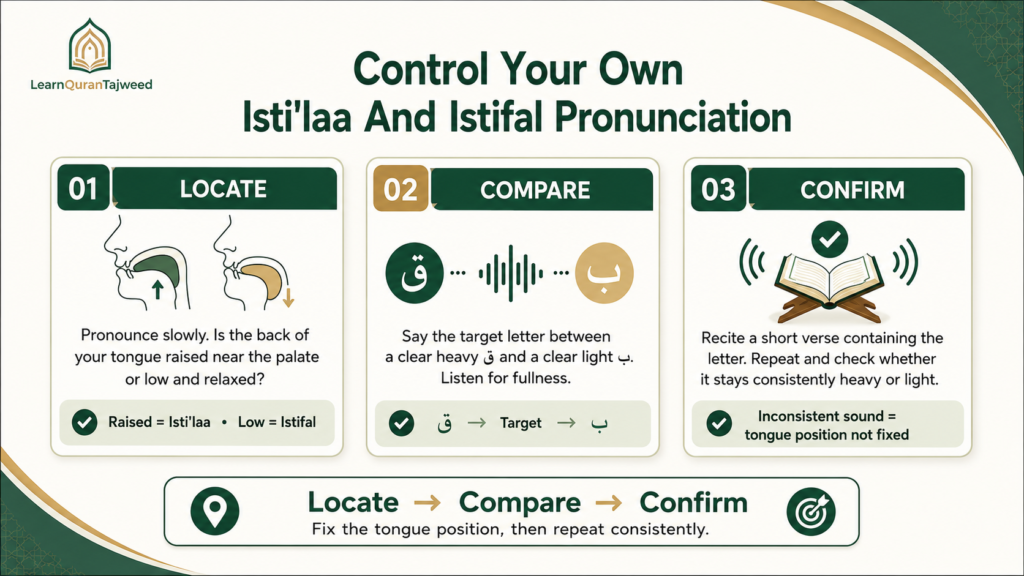
This is a simple process of three steps you can follow when you are unsure about a letter:
1. Locate: Pronounce the letter slowly while noticing where the back of your tongue sits, whether it is near the roof of your mouth (isti’laa) or low and relaxed (istifal).
2. Compare: Notice the obvious difference in “fullness” when you pair it with a clear isti’laa letter like qaaf and a clear istifal letter like baa, and say all three back to back.
3. Confirm: Choose a short verse that contains the letter. Recite it and listen for whether it sounds consistently heavy or light across repetitions; inconsistency usually means the tongue position isn’t fixed yet.
The Most Common Mistake
The recurrent mistake does not lie in the mispronunciation of the seven isti’laa letters themselves. It lies in the application of leftover heaviness to the istifal letter that follows them in the same word, a mistake known as letter “bleed.”
A teacher who can hear you when you recite live catches this instantly. It is far harder to do from an app or a written guide alone.
Read also: Best Tajweed Books
Inside Learn Quran Tajweed Academy
Curious about how online learning works? Peek inside our actual Quran classes and hear the beautiful recitation of our students and teachers.
Perfect Your Quran Recitation Today
Join expert-led Tajweed classes, and recite the Quran with confidence and clarity.
Start Your Free TrialMaster Tajweed Rules Like Isti’laa And Istifal — Start Learning Today
If reading about isti’laa and istifal is a start, tajweed is a spoken skill. Spoken skills need a professional instructor who corrects you immediately.
Learn Quran Tajweed offers certified instructors for live, one-on-one sessions where every letter, heavy or light, gets checked and corrected while reciting.
Courses we offer:
- Online Tajweed Classes
- Learn Quran with Tajweed Online
- Beginner Tajweed Course
- Intermediate Tajweed Course
- Advanced Tajweed Course
- Amali (Practical) Tajweed Course
Courses we offer:
- Tajweed Course for Kids
- Tajweed Course for Adults
- Tajweed Course for Ladies
- Tajweed ul Quran Course
- Quran Recitation with Tajweed Course
- Quran Tarteel Course
- Tajweed Ijazah Program
Conclusion
Isti’laa and istifal are considered among the most fundamental tongue mechanics in Arabic pronunciation, whether the back of the tongue rises toward the palate or stays low.
The seven isti’laa letters (خص ضغط قظ) produce a heavy, resonant sound, while the remaining 21 istifal letters produce a lighter one, with alif أ, the lam ل of Allah’s name الله, and ra ر as the well-known exceptions.
Understanding isti’laa vs istifal in tajweed isn’t just memorization. It’s the difference between reciting the Quran accurately vs reciting it with hidden pronunciation errors that are difficult to notice on your own.
Frequently Asked Questions
What Does Isti’laa Mean In Tajweed?
Isti’laa means the raising of the back of the tongue toward the upper palate when pronouncing a letter, which produces a heavier, fuller sound called tafkheem. It applies to seven letters: خ ص ض غ ط ق ظ.
What Does Istifal Mean In Tajweed?
Istifal means the back of the tongue stays low in the mouth instead of rising toward the palate, producing a lighter sound called tarqeeq. It applies to the 21 letters of the alphabet that aren’t part of the isti’laa group.
How Many Isti’laa Letters Are There In The Quran’s Alphabet?
There are seven isti’laa letters in Arabic: khaa, saad, daad, ghayn, taa, qaaf, and dhaa, commonly memorized through the phrase “khuss dhaghtin qidh” (خص ضغط قظ).
Are All Istifal Letters Always Pronounced Light?
Almost all istifal letters are consistently light, but the lam in “Allah” and the ra can be pronounced heavy under specific conditions, even though both belong to the istifal group.
Is Isti’laa The Same Thing As Tafkheem?
No. Isti’laa describes the tongue’s physical position, while tafkheem describes the resulting heavy sound. Every isti’laa letter is pronounced with tafkheem, but the two terms describe cause and effect, not the same concept.
Why Doesn’t Alif Count As Isti’laa Or Istifal?
Alif has no independent articulation point of its own, so tajweed scholars don’t classify it under either category. Instead, it simply takes on the heaviness or lightness of the letter that comes before it.