 Tajweed Basics
Pronounce the letter ط (taa), then the letter ت (taa without the dot… actually, compare ط and ت). Notice how the movement of your tongue varies even though the sounds seem close. That difference is the essence of Itbaq vs Infitah in Tajweed.
Itbaq and Infitah describe one of the four pairs of opposite qualities (sifaat mutadaddah) that shape how the Quran should be recited. The right pronunciation of this pair affects whether letters like ص, ض, ط, and ظ sound thick and full, or thin and weak.
This guide offers explanations of both qualities in plain terms and lists the exact letters involved. Moreover, it shows you how to train your tongue to produce them correctly.
What You’ll Learn in This Article
- The precise linguistic and technical (istilahi) definitions of Itbaq and Infitah
- Which four letters carry Itbaq, and why other letters are Infitah
- How Itbaq relates to — and differs from — Isti’la (the quality of tongue elevation)
- The physical tongue mechanics behind each quality, letter by letter
- Practical drills and common mistakes to fix your pronunciation
What Is Itbaq In Tajweed?
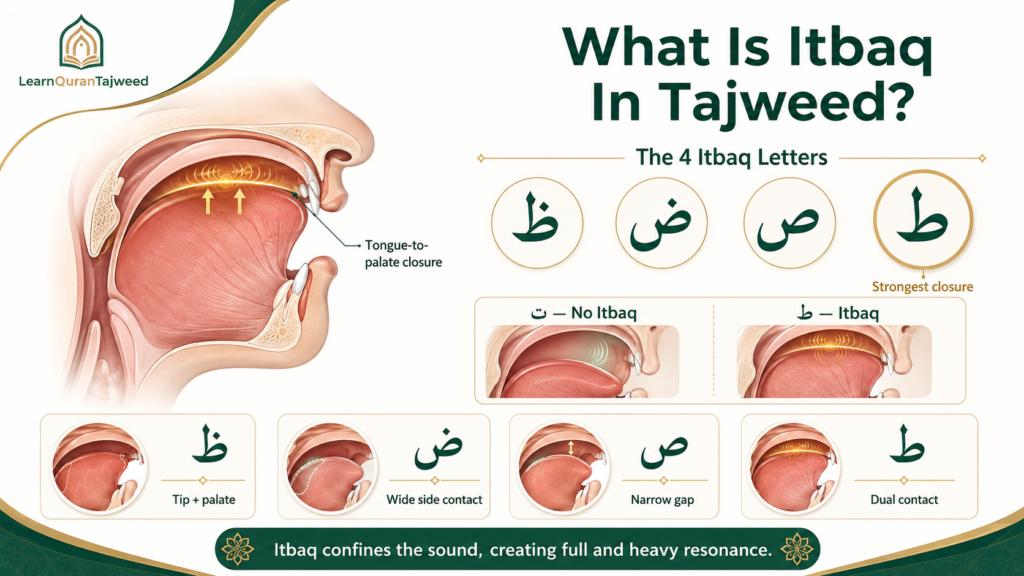
Technically, Itbaq is one of the Tajweed qualities. In Itbaq, the tongue presses against, or comes very close to, the upper palate while pronouncing a letter, trapping the sound between the tongue and the roof of the mouth. Linguistically, Itbaq (إطباق) means “sticking together” or “closing.”
It refers to the tongue rising to meet or nearly meet the hard palate at the same time the letter is articulated, which confines the airflow and gives the letter its full, heavy resonance.
There are only four letters that carry this quality: ط (taa), ص (saad), ض (daad), and ظ (dhaa). Classical Tajweed scholars, such as Ibn al-Jazari in al-Muqaddimah al-Jazariyyah and Ibn Barri in his famous Nazm al-Durar al-Lawami’, grouped these four letters specifically according to the shared tongue-to-palate contact.
Read also: The Jazariyyah Tajweed Poem
How Does The Tongue Move For Itbaq Letters?
In the pronunciation of the letters ط, ص, ض, or ظ, the body of your tongue rises and presses close to the upper palate. This applies to a wide section of the tongue’s surface, not just the tip. This near-closure traps the sound in the space between the tongue and palate before it releases.
That is why these letters sound heavier and more resonant than their non-Itbaq counterparts. For example, compare ت (no Itbaq) and ط (Itbaq). Both letters are made near the same point of articulation, but ط carries clearly more weight and depth according to this palatal pressing.
Notice the four Itbaq letters and see how each of them achieves this contact slightly in a different way.
ط produces the strongest closure according to the tongue’s lock against the palate at two points at once: its tip near the upper front teeth and its back section pressing up.
The letter ص relies on a narrow gap between the tip of the tongue and the lower front teeth. That gives it a whistling, sibilant quality alongside the Itbaq. The letter ض uses the widest contact area, with the edges of the tongue against the upper side teeth.
That’s why it has historically been considered the hardest letter to pronounce correctly. The letter ظ presses the tip of the tongue against the upper front teeth. It is similar to ذ, but with the added palatal closure.
Read also: Principles of Tajweed
What Is Infitah In Tajweed?
Infitah is the opposite quality, in which the tongue separates from the upper palate during pronunciation. As a result, the sound is not trapped and passes out of the mouth freely.
Linguistically, infitah (انفتاح) means “opening” or “separation.” But technically, it means the tongue does not press against or approach the palate the way it does with Itbaq letters, leaving the vocal passage open.
Infitah covers the remaining 25 letters of the Arabic alphabet, i.e, every letter except for ط, ص, ض, and ظ. As long as Infitah is simply the absence of palatal closure, it is the default, unmarked state; Itbaq is the exception scholars specifically define and drill.
See Our Classrooms in Action
Watch these short clips from our live, interactive Quran courses to see how our students learn and interact with our expert tutors.
Perfect Your Quran Recitation Today
Join expert-led Tajweed classes, and recite the Quran with confidence and clarity.
Start Your Free TrialHow Does Itbaq Differ From Isti’laa?
Itbaq and Isti’la are related but not identical. Confusing them is one of the most common mistakes students make. Isti’laa means the back of the tongue rises toward the upper palate without necessarily touching it. As a result, it produces a “heavy” (mufakhkham) sound.
There are seven Isti’laa letters: خ ص ض غ ط ق ظ. They are often memorized with the phrase “khus daghtin qith.” Itbaq is a stricter version of this rise, as it requires the tongue to actually press against or come very close to the palate, not just lift toward it.
Only four of the seven Isti’laa letters carry Itbaq (ص ض ط ظ), while the remaining three, خ غ ق, are Isti’la but not Itbaq. That means the tongue’s back rises but doesn’t close against the roof of the mouth.
This is why Itbaq letters sound noticeably thicker even compared to other heavy letters like ق or خ, as the closure adds more resonance that mere elevation does not produce.
A student who works through structured Quran memorization or tajweed courses will usually meet Isti’laa first, then refine it into Itbaq once tongue placement for each letter is more precise.
If you’re building this foundation from scratch, working with a certified tajweed instructor at Learn Quran Tajweed removes the guesswork. A teacher can hear the difference between a properly closed ص and a merely raised one in real time. Self-study from books alone rarely catches this slight difference.
Read also: The Benefits of Tajweed
Why Do Itbaq And Infitah Never Overlap On The Same Letter?
Itbaq and Infitah are commonly exclusive opposite qualities (didayn). Every letter of the Arabic alphabet carries exactly one of the two, never both and never neither.
This is a major aspect of the four sifaat mutadaddah pairs in Tajweed, which also include Jahr/Hams, Shiddah/Rakhawah, and Isti’laa/Istifal. If a letter has Itbaq, it is permanently and only Mutbaq; if it has Infitah, the same applies.
This is also why the four Itbaq letters are always articulated with fullness and depth, in every position in a word, while the 25 Infitah letters are always articulated with a comparatively lighter release. The quality doesn’t change depending on context.
Common Mistakes When Applying Itbaq
A recurrent mistake among reciters, especially those transitioning from casual Arabic speech to formal Quranic recitation, is under-articulating the letter ض, letting it collapse toward د sound instead of maintaining full lateral contact with the upper side teeth.
Another frequent error is over-applying Itbaq to letters that only carry Isti’laa, such as the letter ق, making them sound artificially heavier than they should be.
These issues can be fixed by isolating the letter, watching tongue placement in a mirror or with a teacher, and drilling it against a properly Mutbaq letter, such as ط for contrast, until the difference is audible and repeatable.
If you want to hear these distinctions modeled correctly rather than reconstruct them from written description alone, live recitation practice with a qualified teacher through Learn Quran Tajweed lets you get real-time correction on exactly these four letters- the ones most students misapply for years without realizing it.
Read also: Best Tajweed Books
Practice Steps To Master Itbaq And Infitah
1. Isolate each one of the four Itbaq letters (ط ص ض ظ) and pronounce them slowly. Then focus on where your tongue makes contact with the palate.
2. Pair each Itbaq letter with its closest Infitah counterpart (ط/ت, ص/س, ض/د, ظ/ذ). Alternate between these pairs to feel the contact-versus-release difference.
3. Read short Quranic phrases containing Itbaq letters, such as آية from Surah At-Talaq or Al-Qalam, at a slow, deliberate pace (tarteel). Exaggerate the closure slightly until it becomes natural.
4. Record your own recitation. Then, make a comparison against a certified reciter to check whether your Itbaq letters carry enough resonance.
5. Since palatal contact is something you often can’t judge accurately by ear alone, seek evaluation from a trusted tajweed teacher.
Persistent daily practice with correction from a trained reciter separates students who read about Itbaq from students who can actually perform it under recitation conditions. This distinction becomes especially clear once you start reciting continuously rather than letter by letter.
Read also: Sifaat Al Huroof In Tajweed
Inside Learn Quran Tajweed Academy
Curious about how online learning works? Peek inside our actual Quran classes and hear the beautiful recitation of our students and teachers.
Perfect Your Quran Recitation Today
Join expert-led Tajweed classes, and recite the Quran with confidence and clarity.
Start Your Free Trial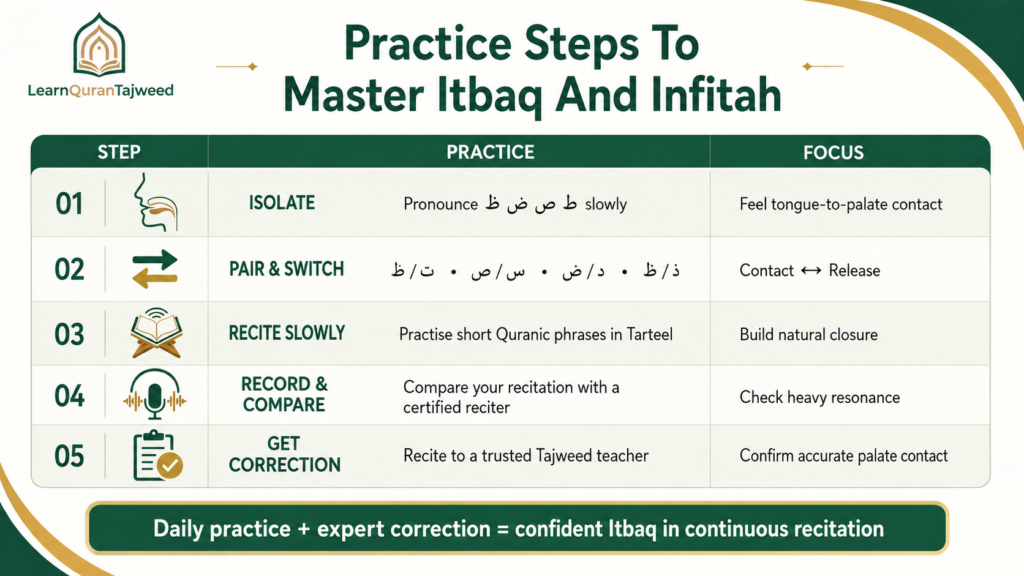
Build Correct Tajweed From The Ground Up
Stop guessing whether your ص, ض, ط, and ظ sound the way they should. One-on-one sessions with a certified Quran teacher at Learn Quran Tajweed walk you through every Tajweed rule, including Itbaq, Infitah, and all the sifaat pairs, with live correction. As a result, mistakes get fixed in real time as they happen instead of becoming habits.
Courses we offer:
- Online Tajweed Classes
- Learn Quran with Tajweed Online
- Beginner Tajweed Course
- Intermediate Tajweed Course
- Advanced Tajweed Course
- Amali (Practical) Tajweed Course
Courses we offer:
- Tajweed Course for Kids
- Tajweed Course for Adults
- Tajweed Course for Ladies
- Tajweed ul Quran Course
- Quran Recitation with Tajweed Course
- Quran Tarteel Course
- Tajweed Ijazah Program
Conclusion
Itbaq and Infitah are opposite Tajweed qualities describing whether the tongue closes against the upper palate (Itbaq) or stays separated from it (Infitah) during the pronunciation of a letter. Only four letters — ط, ص, ض, and ظ – carry Itbaq, while the remaining 25 letters of the Arabic alphabet are Infitah by default.
Because these two qualities are opposites, every letter carries one and only one of them, and mastering the difference is what gives the four Itbaq letters their distinctive weight in recitation.
The takeaway for any student working through Itbaq vs Infitah in Tajweed is simple: these four letters deserve deliberate, isolated practice, because getting them wrong subtly changes the sound of dozens of Quranic words.
With focused drilling and, ideally, feedback from a qualified teacher, the distinction becomes second nature.
Frequently Asked Questions
What Does Itbaq Mean In Tajweed?
Itbaq means the tongue presses against or comes very close to the upper palate while pronouncing a letter, trapping the sound and giving it a heavier resonance. It applies to exactly four letters: ط, ص, ض, and ظ.
How Many Letters Have The Itbaq Quality?
There are four letters that carry Itbaq: ط (taa), ص (saad), ض (daad), and ظ (dhaa). All other 25 letters of the Arabic alphabet fall under Infitah instead.
Is Itbaq The Same As Isti’laa?
No. Isti’la means the back of the tongue rises toward the palate without necessarily touching it, and applies to seven letters (خ ص ض غ ط ق ظ). Itbaq requires actual closure against the palate and applies to only four of those seven letters.
Which Letter Has The Strongest Itbaq?
Scholars rank the strength of Itbaq as ط (strongest), then ض, then ص, then ظ (weakest), based on how firmly and completely each letter’s tongue contact seals against the palate.
Can A Letter Have Both Itbaq And Infitah?
No. Itbaq and Infitah are opposite qualities, so every Arabic letter carries exactly one of the two, never both, and never neither.
Why Does ض Sound So Heavy Compared To Other Letters?
The letter ض combines Itbaq (tongue-to-palate closure) with the widest contact area of any Itbaq letter, pressing along the upper side teeth. This combination of closure and contact width is why ض is traditionally considered one of the most demanding letters to pronounce correctly.
Related Articles
Tajweed Basics