 Tajweed Rules

| Key Takeaways |
| Tafkheem means heaviness — the letter fills the mouth with a raised, resonant sound; Tarqeeq means thinness — the letter sounds light and front-placed. |
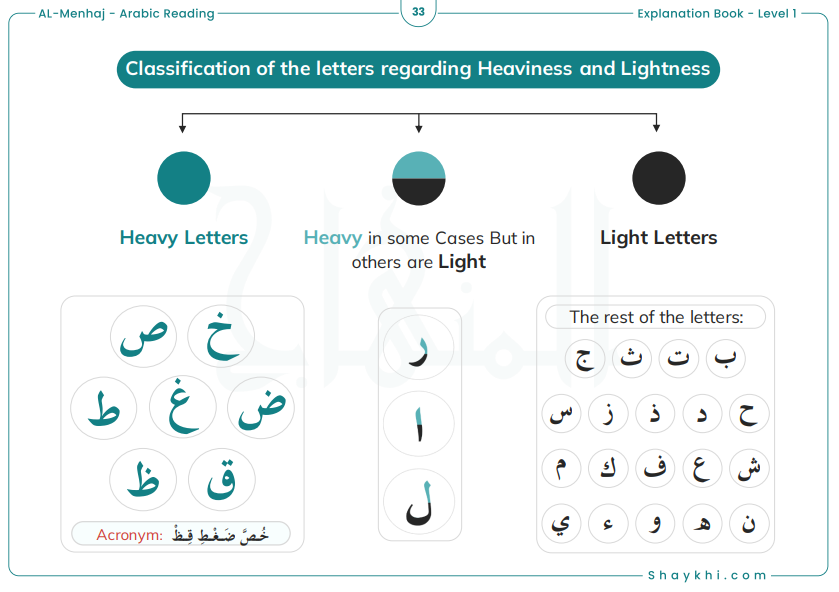
| Seven letters always carry Tafkheem: Kha, Sad, Dad, Ta, Dha, Qaf, Ghayn — collectively memorized from the phrase “خص ضغط قظ.” |
| The letter Ra can be Mufakhkham, Muraqqaq, or carry both options depending on its vowel, surrounding letters, and word position. |
| Lam is always Muraqqaq except inside the word “Allah” or “Allahumma” when preceded by a Fathah or Dhammah. |
| Alif al-Madd carries no independent ruling — it adopts the Tafkheem or Tarqeeq of whichever letter immediately precedes it. |
The difference between Tafkheem and Tarqeeq is one of the first real precision tests a student faces in applied Tajweed. You can know the rule theoretically and still produce the wrong sound the moment you open your mouth — because these are physical, muscular distinctions, not just conceptual categories.
Tafkheem (تفخيم) means heaviness or fullness of sound — the letter is articulated with the back of the tongue raised, filling the mouth with a thick, resonant quality. Tarqeeq (ترقيق) means thinness — the letter sounds light, forward, and fine. Every letter in the Quran belongs to one of three groups: always heavy, always light, or variable depending on context.
What Is the Difference Between Tafkheem and Tarqeeq in Tajweed?
Tafkheem and Tarqeeq are opposite vocal qualities governing how Arabic letters sound during Quranic recitation. Tafkheem produces a heavy, full-mouthed sound with the tongue raised toward the upper palate. Tarqeeq produces a thin, light sound with the tongue held low. Mastering both determines whether your recitation sounds authentically correct or subtly off.
Classical Tajweed scholars define Tafkheem technically as making the letter heavy at its makhraj (articulation point) and strong in its sifah (attribute). Tarqeeq is the precise opposite — the letter becomes thin at the makhraj and weak in its sifah.
These are not stylistic preferences. They are obligatory Tajweed rulings that affect meaning and recitation validity. Students at Learn Quran Tajweed Academy who begin our Beginner Tajweed Course consistently find that understanding this distinction unlocks correct pronunciation across dozens of letters simultaneously.
Begin your Tajweed journey with a free lesson

Which Letters Always Carry Tafkheem Without Exception?
The seven Huruf al-Isti’la (letters of elevation) are always pronounced with Tafkheem — no exception exists regardless of vowel or position. These letters are memorized through the phrase “خص ضغط قظ”: Kha (خ), Sad (ص), Dad (ض), Ta (ط), Dha (ظ), Qaf (ق), Ghayn (غ).
Even at the fifth level — with a Kasrah — these letters never drop to Tarqeeq. This is one of the most common errors I observe in students transferring from informal Quran learning: they soften Qaf or Sad under Kasrah, pulling them toward a thin sound. The Kasrah affects the vowel, not the letter’s fundamental weight.
Which Letters Always Carry Tarqeeq in Quranic Recitation?
All remaining Arabic letters — those not among the seven Isti’la letters — are always pronounced with Tarqeeq. This includes Ba, Ta, Tha, Jim, Ha, Dal, Dhal, Ra (in specific positions), Zayn, Sin, Shin, ‘Ayn, Fa, Kaf, Lam (in most positions), Meem, Nun, Waw, Ha, Ya, and Hamzah.
The practical challenge for non-Arabic speakers is not knowing which letters are “light” — it is preventing Tafkheem from bleeding into neighboring letters. When reciting وَالصَّابِرِينَ for example, the Sad is heavy but the Ba, Ra, Ya, Nun surrounding it remain thin and light.
Understanding ghunnah rules alongside Tafkheem and Tarqeeq helps significantly here — because Ghunnah itself can be affected by these qualities in specific contexts.
Here is the dedicated section with the detailed comparison table — ready to insert into the article after the introduction or as a standalone reference section:
Shots Videos from Our Courses
Perfect Your Quran Recitation Today
Join expert-led Tajweed classes, and recite the Quran with confidence and clarity.
Start Your Free TrialHow Do Tafkheem and Tarqeeq Differ From Each Other in Every Key Aspect?
Tafkheem and Tarqeeq are opposites in every dimension — articulation position, tongue placement, sound quality, and letter categories.
The table below maps every major point of difference with Quranic examples, making it a practical reference for applied recitation rather than abstract theory.
In over eight years of teaching non-Arabic speakers, I have found that students who study this contrast side-by-side — rather than learning each rule in isolation — internalize the distinction far faster. Seeing both qualities compared directly trains the ear and the articulators simultaneously.
| Category | Tafkheem (تفخيم) — Heaviness | Tarqeeq (ترقيق) — Lightness |
| Linguistic Meaning | Tasween — to fatten or make heavy | Tanhief — to thin or make light |
| Technical Definition | Letter is heavy at its makhraj and strong in its sifah | Letter is thin at its makhraj and weak in its sifah |
| Alternative Term Used by Scholars | Taghleedh (تغليظ) — used specifically for Lam in Allah | Tarqeeq — no alternative term |
| Tongue Position | Back of tongue raised toward upper palate | Tongue remains low; no raising toward palate |
| Mouth Space | Mouth fills with sound resonance | Sound remains forward and fine |
| Sound Quality | Thick, deep, full — like English “aw” vowel quality | Thin, light, forward — closer to neutral vowel |
| Letters Always in This Category | The 7 Isti’la letters: خ ص ض ط ظ ق غ (memorized: خص ضغط قظ) | All remaining Arabic letters except variable ones |
| Letters That Are Variable | Ra (ر), Lam (ل) in Allah only, Alif al-Madd (ا) | Same three letters under opposite conditions |
| Effect of Kasrah on Isti’la Letters | No effect — Isti’la letters stay heavy even under Kasrah | Kasrah causes Tarqeeq in Ra specifically |
| Strongest Level | Isti’la letter + Fathah + following Alif al-Madd | Light letter + Kasrah + following Alif al-Madd |
| Weakest Level | Isti’la letter + Kasrah (e.g., قِيلَ, ضِيَاء) | — |
Explore Al-Menhaj Book for FREE (Learn to Read Quran)
The Difference Between Tafkheem and Tarqeeq in Ra with Quranic Examples
| Condition | Ruling | Quranic Example | Reference |
| Ra + Fathah | Tafkheem | وَتَرَى الْجِبَالَ | An-Naml 27:88 |
| Ra + Dhammah | Tafkheem | رُوحِ الْقُدُسِ | Al-Baqarah 2:87 |
| Ra Sakinah after Fathah | Tafkheem | بَرْدًا وَسَلَامًا | Al-Anbiya 21:69 |
| Ra Sakinah after Dhammah | Tafkheem | زُرْتُمُ الْمَقَابِرَ | At-Takathur 102:2 |
| Ra Sakinah after ‘arid Kasrah | Tafkheem | رَبِّ ارْجِعُونِ | Al-Mu’minun 23:99 |
| Ra Sakinah after Sakin letter preceded by Fathah/Dhammah | Tafkheem | لَيْلَةُ الْقَدْرِ | Al-Qadr 97:2 |
| Ra Sakinah after original Kasrah + non-Kasrah Isti’la letter in same word | Tafkheem | قِرْطَاس, مِرْصَاد | — |
| Ra + Kasrah | Tarqeeq | رِزْقًا لِلْعِبَادِ | Qaf 50:11 |
| Ra Sakinah after original Kasrah, no Isti’la following | Tarqeeq | فِرْعَوْن, الْفِرْدَوْس | — |
| Ra Sakinah at end, preceded by Sakin non-Isti’la, before that a Kasrah (pause only) | Tarqeeq | الذِّكْر, السِّحْر | — |
| Ra Sakinah at end, preceded by Sakin Ya (pause only) | Tarqeeq | قَدِير, نَذِير | — |
| Ra Sakinah after original Kasrah, Isti’la in separate word | Tarqeeq | أَنْ أَنْذِرْ قَوْمَكَ | Nuh 71:1 |
| Ra Sakinah after original Kasrah + Kasrah Isti’la in same word | Both permitted | فِرْق (Ash-Shu’ara only) | — |
Working through Ra’s variable rulings is precisely the kind of advanced application covered in our Intermediate Tajweed Course at Learn Quran Tajweed Academy, where students move beyond memorizing rules into applying them across continuous recitation.
Read Also: The Rules of Heavy and Light Letters in Tajweed (Tafkheem and Tarqeeq)
The Difference Between Tafkheem and Tarqeeq in Lam with Quranic Examples
| Condition | Ruling | Quranic Example | Reference |
| Lam in الله preceded by Fathah | Tafkheem | وَعَلَى اللَّهِ | Aal Imran 3:122 |
| Lam in الله preceded by Dhammah | Tafkheem | نَصْرُ اللَّهِ | An-Nasr 110:1 |
| Lam in الله preceded by original Kasrah | Tarqeeq | بِاللَّهِ | — |
| Lam in الله preceded by ‘arid Kasrah | Tarqeeq | قُلِ اللَّهُمَّ | — |
| Lam in الله — second occurrence after Tanween pause | Tarqeeq | أَحَدٌ ۞ اللَّهُ الصَّمَدُ | Al-Ikhlas 112:1–2 |
| Lam in any word other than الله / اللَّهُمَّ | Always Tarqeeq | لَا رَيْبَ, لِلْمُتَّقِينَ, وَلَا الضَّالِّينَ | Al-Baqarah 2:2 |
Read Also: Makharij al-Huruf and Arabic Alphabet Pronunciation
The Differece Between Tafkheem and Tarqeeq in Alif al-Madd and Ghunnah — Comparative Summary
| Letter / Sound | Follows | When Tafkheem | When Tarqeeq | Example (Tafkheem) | Example (Tarqeeq) |
| Alif al-Madd (ا) | Letter before it | Preceding letter is Mufakhkham | Preceding letter is Muraqqaq | الطَّامَّة, الضَّالِّينَ | الأَنْهَار, تِجَارَة |
| Ghunnah (in Ikhfa) | Ikhfa letter after it | Ikhfa letter is an Isti’la letter | Ikhfa letter is a light letter | مِن طِينٍ, مِن ظُلْمٍ | مِن تَحْتِهَا (Al-Baqarah 2:25) |
Read Also: Tafkheem Rules in Tajweed With Examples
Our Students Reviews
Perfect Your Quran Recitation Today
Join expert-led Tajweed classes, and recite the Quran with confidence and clarity.
Start Your Free Trial
Read Also: Arabic Tajweed Letters
Starting Your Tafkheem and Tarqeeq Mastery With Certified Instruction at Learn Quran Tajweed Academy
Tafkheem and Tarqeeq require live correction — reading about the rules is the first step, but trained ears catch what self-study cannot.
Learn Quran Tajweed Academy offers:
- Ijazah-certified instructors specializing in Hafs ‘an ‘Asim
- Personalized 1-on-1 sessions targeting your specific pronunciation gaps
- Flexible scheduling available 24/7 for students worldwide
- Structured progression from beginner rules to full Ijazah certification
- FREE Trial Lesson — no commitment required
Check out the best tajweed course for your needs:
- Practical Tajweed Course
- Beginner Tajweed Course
- Intermediate Tajweed Course
- Advanced Tajweed Course
- Quran Tarteel Course
- Tajweed Ijazah Program
- Tajweed Course for Sisters
- Tajweed course for Kids
Book your free trial Tajweed lesson today

Conclusion
Tafkheem and Tarqeeq are not advanced topics reserved for scholars — they are foundational qualities that shape every letter you recite. Understanding which letters are permanently heavy, permanently light, or conditionally variable gives you a systematic framework for building genuine recitation accuracy.
The variable letters — Ra, Lam, and Alif al-Madd — each follow precise scholarly-defined conditions. Apply them carefully, one word at a time, and the distinctions become second nature. For Ghunnah, the key is always looking forward to the Ikhfa letter, not backward.
Alhamdulillah, these rulings are documented with remarkable precision in classical scholarship. Your role is to internalize them through consistent, corrected practice.
Read Also: Tarqeeq Rules in Tajweed With Examples
Frequently Asked Questions About Tafkheem and Tarqeeq
Is There a Simple Way to Remember Which Letters Always Have Tafkheem?
The seven Isti’la letters are permanently Mufakhkham and memorized through the phrase “خص ضغط قظ” — Kha, Sad, Dad, Ta, Dha, Qaf, Ghayn. Every other Arabic letter defaults to Tarqeeq unless it falls under the specific variable rulings for Ra, Lam, or Alif al-Madd.
Does Tafkheem Change the Meaning of a Quranic Word?
Yes — mispronouncing a heavy letter as light, or vice versa, can alter perceived meaning or produce an incorrect Arabic word entirely. Tajweed scholars classify errors that change meaning as Lahn Jali (clear error), which affects recitation validity. Precision in Tafkheem and Tarqeeq is therefore both a recitation and a religious obligation.
Can Ra Be Mufakhkham Even When It Has a Kasrah?
No. Ra with a Kasrah is always Muraqqaq — the Kasrah is one of the clearest Tarqeeq triggers for Ra. The confusion sometimes arises because Ra follows different rules than the Isti’la letters: the Isti’la letters remain heavy even under Kasrah, but Ra does not share this property.
Why Is Lam Heavy in “Allah” But Light in Every Other Word?
The Tafkheem of Lam in الله is a specific ruling unique to the Divine Name, established through transmitted recitation (tawatur) from the Prophet ﷺ. It reflects the majesty of the Name. No rule of grammatical analogy explains it — it is followed purely through the chain of oral transmission that Tajweed preserves.
How Long Does It Take to Apply Tafkheem and Tarqeeq Correctly in Continuous Recitation?
In most students’ experience at Learn Quran Tajweed Academy, recognizing the rules takes one to two weeks of structured study. Applying them correctly during continuous recitation — without stopping to analyze — typically develops over four to eight weeks of daily practice with live instructor feedback. Students who receive regular 1-on-1 correction progress noticeably faster than those studying from written materials alone.
Related Articles
Tajweed Rules