 Tajweed Resources
Al-Kisai Tajweed refers to the recitation system of Imam Ali ibn Hamza al-Kisai, the seventh of the Seven Canonical Readers, whose reading remains transmitted today through two primary narrators: Abu al-Harith and al-Duri. His recitation is distinguished by extensive imala (vowel inclination), systematic idgham (letter assimilation), and a moderate madd (vowel prolongation) of four counts.
If you are studying Quran with the aim of reciting by this reading, or simply want to understand what makes it distinct from the far more common Hafs ‘an ‘Asim, this article gives you a clear, rule-by-rule breakdown.
What You’ll Learn in This Article
- Who al-Kisai was and why his reading carries scholarly authority
- The defining phonetic rules of al-Kisai Tajweed with Quranic examples
- How the two narrators, Abu al-Harith and al-Duri, differ from each other
- A side-by-side comparison of al-Kisai versus Hafs ‘an ‘Asim on key rules
- How to begin learning this reading with qualified instruction
Who Is Imam al-Kisai?
Al-Kisai Tajweed is grounded in the scholarly authority of one of Islamic civilization’s most distinguished figures. Abu al-Hasan Ali ibn Hamza al-Kisai al-Kufi (d. 189 AH) was not only a canonical Quran reciter — he was simultaneously the leading Arabic grammarian of his era, the court tutor of Caliph Harun al-Rashid, and the teacher entrusted with educating the Crown Prince al-Amin.
He earned the title “al-Kisai” because he arrived at the study circle of his primary Tajweed teacher, Hamza al-Zayyat, wearing a kisa’ (cloak). He received the reading from Hamza directly, completing the chain four times by full recitation (ard), and refined it further by traveling to Basra to study Arabic phonetics under al-Khalil ibn Ahmad al-Farahidi — the founder of Arabic prosody. This combination of Quranic and phonetic scholarship produced a reading notable for its precision and internal consistency.
Abu Ubayd al-Qasim ibn Sallam described him as “the most precise of all readers and the most commanding in recitation.” Ibn Mujahid noted that al-Kisai selected a middle path from Hamza’s reading — retaining its most authenticated elements while departing from extremes others found difficult to transmit.
The Beginner Tajweed Course at Learn Quran Tajweed builds the makharij, sifat, and core interaction rules every student needs before specializing in any canonical reading — including al-Kisai Tajweed.

Build your Tajweed foundation today — enroll in the Beginner Tajweed Course at Learn Quran Tajweed
Core Rules That Define Al-Kisai Tajweed
Al-Kisai Tajweed follows the same foundational framework as all Quranic readings — makharij, sifat, and interaction rules — but applies specific choices that distinguish it from other canonical readings.
Imala in Al-Kisai Tajweed
Imala — the inclination of a fatha or alif toward a kasra/ya sound — is the single most audible characteristic of al-Kisai Tajweed. Al-Kisai applies imala extensively: all alifs derived from ya, words on the pattern fa’la with any vowel on the fa, all alifs written as ya in the Uthmanic script, words like al-Tawrah wherever they occur, and the alif falling between two ra’s of which the second is kasra (as in al-Abrar, al-Ashrar).
A practical example appears in Surah Al-A’la:
سَبِّحِ اسْمَ رَبِّكَ الْأَعْلَى
(Sabbiḥi sma rabbika l-a’lā)
(“Glorify the name of your Lord, the Most High”)
Surah Al-A’la 87:1
In Hafs ‘an ‘Asim, the final alif of al-A’la is read with a full open vowel (fath). In al-Kisai Tajweed, it carries imala — a distinctly inclined, narrowed sound.
The al-Duri narration adds a further layer: imala of any alif immediately preceding a final kasra-inflected ra — making words like al-Kafirin, al-Dar, and Absar subject to imala in al-Duri’s transmission but not in Abu al-Harith’s.
Madd in Al-Kisai Tajweed
Al-Kisai reads both al-madd al-muttasil (connected madd) and al-madd al-munfasil (separated madd) at four counts (harakats) — a moderate position between the two-count minimum and the six-count maximum found in some other readings. From the Tayyiba transmission, six counts are also permitted for al-muttasil.
This four-count standard means that in al-Kisai Tajweed, no distinction in length exists between connected and separated madd — both are treated identically. Hafs ‘an ‘Asim, by contrast, applies four to five counts to al-muttasil and two to four to al-munfasil, maintaining a meaningful length differential between the two types.
Idgham in Al-Kisai Tajweed
Al-Kisai’s idgham system is among the most comprehensive of the Seven Readings. Key assimilations include:
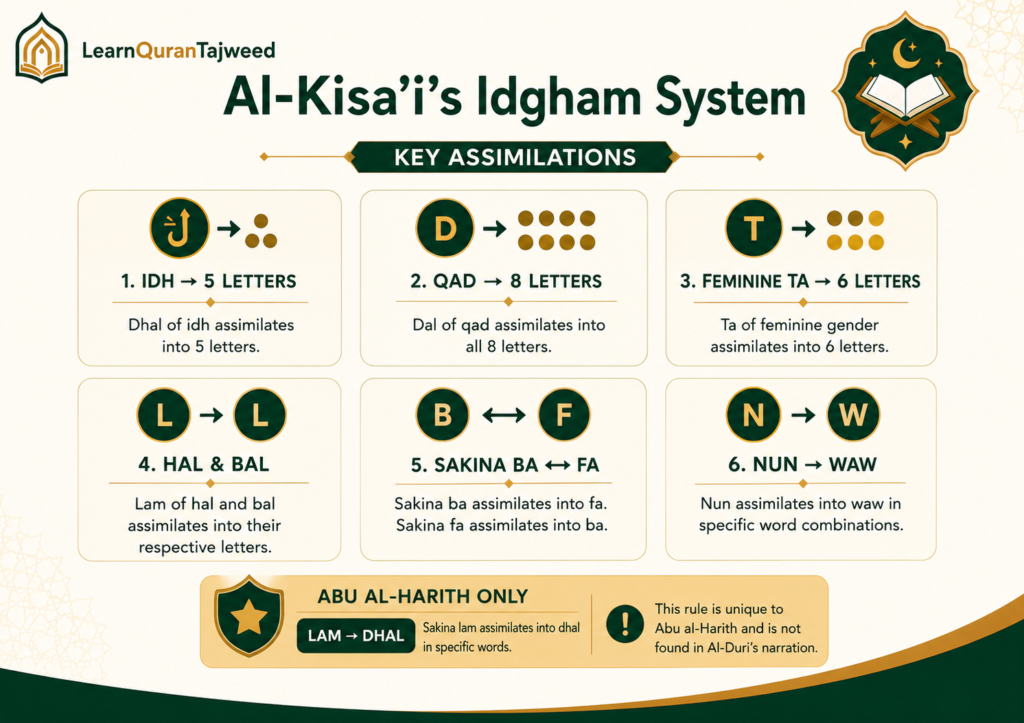
- The dhal of idh into ta, dal, sin, zay, and sad
- The dal of qad into all eight of its assimilation letters
- The ta of feminine gender into its six assimilation letters
- The lam of hal and bal into their respective letters
- A sakina ba assimilated into fa (as in yaghlib fa-sawfa)
- A sakina fa assimilated into ba (as in nakhsif bihim — Surah Saba 34:9)
- The dhal into ta in ‘udhtu, fanabadhtuha, and the ittikhadh family
- The thaa into ta in ūrithtumuha and labithtu wherever they occur
- The nun into waw in Ya Sin wal-Qur’an and Nun wal-Qalam
Abu al-Harith alone adds the assimilation of a sakina lam into dhal in yaf’al dhalika wherever it occurs — a rule unique to his narration and absent from al-Duri’s transmission.
وَمَن يُرِدْ ثَوَابَ الدُّنْيَا
(Wa man yurid thawāba d-dunyā)
(“And whoever desires the reward of this world”)
Surah Al-Imran 3:145
In al-Kisai Tajweed, the dal of yurid assimilates fully into the thaa — a complete idgham that Hafs ‘an ‘Asim does not apply.
Imala of Haa al-Taneeth at Pause
When stopping at words ending in a feminine ta (haa al-taneeth), al-Kisai inclines the vowel before that haa — making imala the default behavior at pause for all such words except those preceded by an alif. This is the transmitted preference (al-muqaddam fil-adaa) based on the Dani transmission through Abu al-Fath from al-Duri, and through Abu al-Harith as well.
رَحْمَةً مِّن رَّبِّكَ
(Raḥmatan min rabbik)
(“A mercy from your Lord”)
Surah Al-Kahf 18:2
In Hafs ‘an ‘Asim, the pause on rahmah carries no imala. In al-Kisai Tajweed, the ra-vowel before the haa is inclined — a phonetic detail that shifts the tonal character of every pause on a feminine noun.
Stopping on Haa al-Taneeth
Al-Kisai stops on feminine ta written as an open ta (ta marbuta) by converting it to haa at pause — as all Seven Readers do. He additionally stops with haa on dhat bahjah, mardhat, hayhat, al-Lat, and wa-lata hina manas — words the majority read differently at pause.
Yd al-Idafah (Possessive Ya)
Al-Kisai reads the possessive ya (yd al-idafah) with sukoon (no vowel) except in specifically excepted positions. This is notable in phrases like qul li’ibadiya alladhina (Ibrahim 31), ya ‘ibadiya alladhina (Al-Ankabut, Al-Zumar) where the ya receives sukoon — producing a more clipped, closed ending to the possessive construction.
Izhar of Hamz Groups
Al-Kisai reads the double hamz structures with full izhar (clear articulation) in positions like a’innakum la-ta’tuna and a’inna lana — applying full hamza realization rather than the facilitation (tashil) or substitution (ibdal) found in other readings.
Read also: Abu Amr Tajweed Rules, Narrators and Distinctive Recitation Features
See Our Classrooms in Action
Watch these short clips from our live, interactive Quran courses to see how our students learn and interact with our expert tutors.
Perfect Your Quran Recitation Today
Join expert-led Tajweed classes, and recite the Quran with confidence and clarity.
Start Your Free TrialAbu al-Harith and Al-Duri as Narrators of Al-Kisai Tajweed
Al-Kisai Tajweed reaches us through two distinct chains, both authenticated and transmitted continuously to the present day.
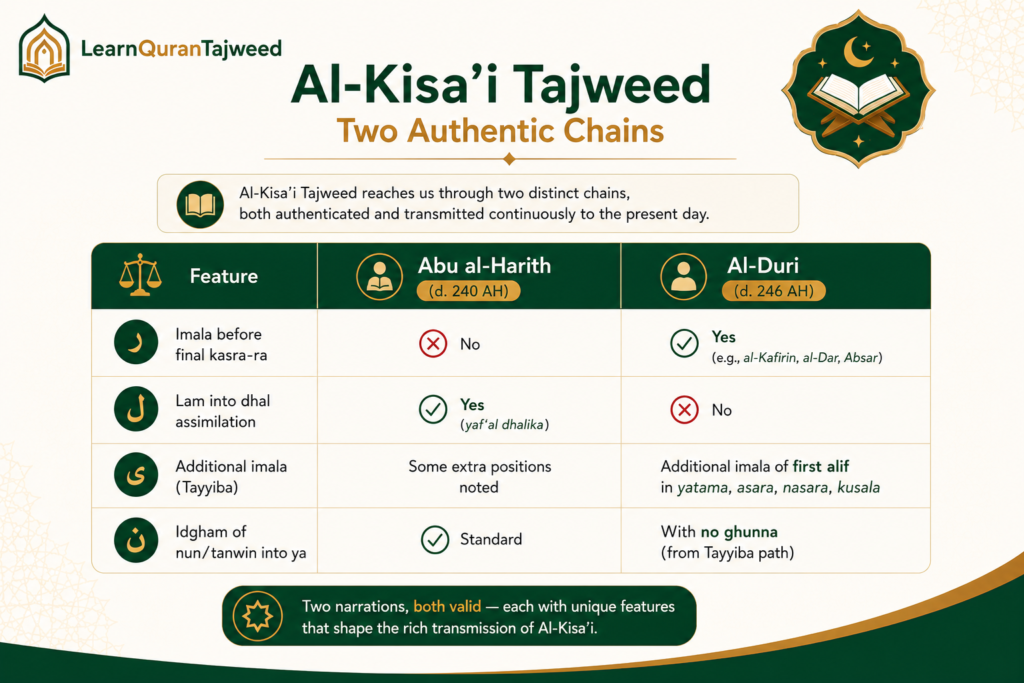
| Feature | Abu al-Harith (d. 240 AH) | Al-Duri (d. 246 AH) |
| Full name | Al-Layth ibn Khalid al-Baghdadi | Hafs ibn Umar al-Duri al-Baghdadi |
| Imala before final kasra-ra | No | Yes (e.g., al-Kafirin, al-Dar, Absar) |
| Lam into dhal assimilation | Yes (yaf’al dhalika) | No |
| Additional imala (Tayyiba) | Some extra positions noted | Additional imala of first alif in yatama, asara, nasara, kusala |
| Idgham of nun/tanwin into ya | Standard | With no ghunna (from Tayyiba path) |
Al-Duri is historically significant as the first scholar recorded to have compiled the Seven Readings — making him a central figure in the codification of Quranic transmission as a formal academic discipline.
The Intermediate Tajweed Course at Learn Quran Tajweed provides structured training in the advanced rules of recitation, including the kind of narrator-level distinctions that distinguish serious students of Tajweed from casual learners.

enroll in the Intermediate Tajweed Course at Learn Quran Tajweed
Al-Kisai Tajweed Compared to Hafs An Asim
Most Quran students globally learn through the Hafs ‘an ‘Asim reading. Al-Kisai Tajweed differs from it in several systematic and audible ways.
| Rule | Al-Kisai Tajweed | Hafs ‘an ‘Asim |
| Imala of ya-derived alifs | Extensive imala | Full fath (open vowel) |
| Madd al-munfasil | 4 counts (equal to muttasil) | 2–4 counts (variable, shorter) |
| Idgham of dhal into ta | Yes (broad category) | No |
| Idgham of dal into dhal (kaf ha ya ‘ayn sad) | Yes | No (Hafs has 4 saktahs instead) |
| Pause on feminine ta | Haa with imala of preceding vowel | Haa without imala |
| Sakt (brief silence) | None of Hafs’s four saktahs | Present in four specific positions |
| Ya al-idafah | Sukoon in many positions | Generally open/fath |
One practitioner observation worth noting: students transitioning from Hafs to al-Kisai frequently underestimate the imala requirement. They apply it to obviously ya-derived words like al-Huda and Ata, then revert to fath on subtler cases like certain surah-opening letters (al-Ra’, the ha-ya of Maryam, the ha-ta of Taha). Al-Kisai applies imala to all of these — the scope is considerably wider than most learners initially assume.
How to Learn Al-Kisai Tajweed with Qualified Instruction
Al-Kisai Tajweed is not transmitted through books — it is transmitted through a living chain of qualified teachers carrying an authenticated isnad back to the Imam himself. Any student serious about learning this reading must work with a teacher who holds either an Ijaza in the reading of al-Kisai (through al-Duri or Abu al-Harith) or verified training in its rules under such an authority.
The Tajweed ul Quran course at Learn Quran Tajweed provides systematic, rule-grounded recitation training built on classical pedagogy. For those beginning from foundational Tajweed before specializing in a specific reading, the Beginner Tajweed Course establishes the makharij, sifat, and core interaction rules every student needs regardless of which canonical reading they later pursue.
Read also: Ibn Kathir Tajweed: Rules, Narrators, and How to Learn It
The Practical Tajweed Course at Learn Quran Tajweed specifically bridges the gap between theoretical rule-knowledge and live recitation accuracy — the precise gap that learners of al-Kisai Tajweed encounter when trying to apply imala and idgham rules in continuous Quranic text.

Inside Learn Quran Tajweed Academy
Curious about how online learning works? Peek inside our actual Quran classes and hear the beautiful recitation of our students and teachers.
Start Reciting with Precision at Learn Quran Tajweed
Al-Kisai Tajweed demands accuracy that self-study cannot build alone. Learn Quran Tajweed connects you with certified instructors who correct your pronunciation in real time, guide you through the specific rules of your chosen reading, and carry the oral transmission your recitation requires.

Enroll today and claim your free trial session at Learn Quran Tajweed
Courses we offer:
- Online Tajweed Classes
- Learn Quran with Tajweed Online
- Beginner Tajweed Course
- Intermediate Tajweed Course
- Advanced Tajweed Course
- Amali (Practical) Tajweed Course
Perfect Your Quran Recitation Today
Join expert-led Tajweed classes, and recite the Quran with confidence and clarity.
Start Your Free TrialConclusion
Al-Kisai Tajweed is one of the Seven Canonical Readings of the Quran, authenticated through continuous chains of transmission reaching back to the Prophet ﷺ. Its defining features — extensive imala, four-count madd across both connected and separated types, broad idgham application, and imala of the vowel before haa al-taneeth at pause — give it a phonetic character distinctly different from the Hafs ‘an ‘Asim reading most Muslims learn today.
Learning it correctly means working with a qualified teacher, distinguishing between the rules shared by both narrators and those unique to al-Duri or Abu al-Harith, and applying each rule in live recitation rather than theoretical memorization alone. Al-Kisai Tajweed is not more difficult than other readings — it is different, and that difference deserves precise, informed instruction.
Read also: Riwayat Hamzah and its Tajweed Rules Principles
Frequently Asked Questions
What is Al-Kisai Tajweed?
Al-Kisai Tajweed is the recitation system of Imam Ali ibn Hamza al-Kisai (d. 189 AH), one of the Seven Canonical Readers. It is distinguished by extensive imala, moderate four-count madd, comprehensive idgham, and imala before haa al-taneeth at pause. It reaches students today through two narrators: Abu al-Harith and al-Duri.
How does Al-Kisai Tajweed differ from Hafs an Asim?
The most audible difference is imala — al-Kisai inclines many alifs toward a ya-sound where Hafs reads a full open vowel. Al-Kisai also applies no sakt (the four brief pauses Hafs holds), treats connected and separated madd equally at four counts, and assimilates letters Hafs pronounces distinctly.
Who are the two narrators of Al-Kisai Tajweed?
Abu al-Harith al-Layth ibn Khalid al-Baghdadi (d. 240 AH) and Abu Amr Hafs ibn Umar al-Duri al-Baghdadi (d. 246 AH). Al-Duri adds imala before final kasra-ra words (al-Kafirin, al-Dar) while Abu al-Harith alone assimilates the sakina lam into dhal in yaf’al dhalika.
Is Al-Kisai Tajweed still recited today?
Yes. Al-Kisai Tajweed through al-Duri’s narration is recited in parts of Sudan, West Africa, and among specialist Quran scholars globally. It is taught through authenticated chains of transmission in Quranic institutes that maintain the full range of canonical readings.
Can a beginner learn Al-Kisai Tajweed?
A beginner should first establish foundational Tajweed — correct makharij, sifat, and core rules — before specializing in a specific canonical reading. Al-Kisai Tajweed requires a teacher who carries a verified chain in this reading. Learn Quran Tajweed offers both foundational courses and advanced instruction for students ready to study specific canonical readings.
What is the isnad of Al-Kisai Tajweed?
Al-Kisai received the reading from Hamza al-Zayyat, who received it from Ali ibn Abi Talib, Abdallah ibn Masud, and Zayd ibn Thabit through authenticated chains ascending to the Prophet ﷺ. Ibn al-Jazari documents the complete chain in his Ghayat al-Nihaya.
Related Articles
Tajweed Resources