 Tajweed Basics

Learning how to pronounce Izhar answers a question many Quran students face when they read مِنْ خَوْفٍ: should the noon be hidden, merged, or held with a long nasal sound? Izhar is the clearest of the noon sakinah rules, and usually the first one Quran students learn.
This guide shows you exactly what to do in 3 steps: where your tongue goes, how long the nasal sound lasts, and how to move into the next letter. You will also see real Quranic examples, the 4 mistakes beginners make most often, and a 10-minute daily drill to fix them.

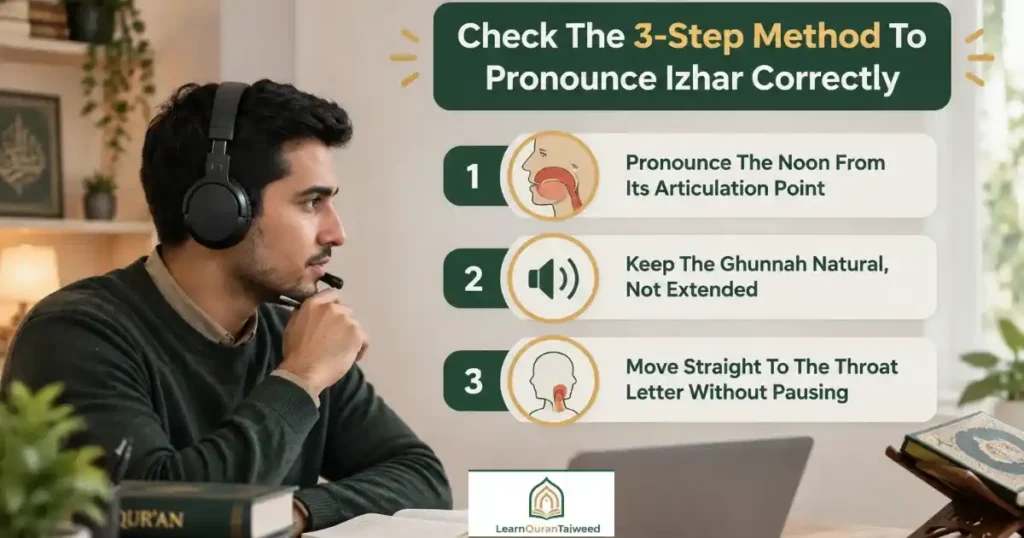
Step 1- Pronounce The Noon From Its Articulation Point
Press the tip of your tongue firmly against the gum ridge just behind your upper front teeth. This is the normal makhraj (articulation point) of the letter noon.
The contact must be full and firm. If your tongue only half-touches the gum ridge, the noon starts to sound hidden. That is ikhfa, not izhar.
Make sure the tip lands on the gum ridge, not on the back of the teeth themselves. When the tongue touches the teeth, the noon sounds flat and weak, much like the English “n” in a fast, careless word. Your lips and jaw stay relaxed; only the tongue does the work.
The most common slip at this step happens because the next letter comes from the throat. The tongue “rushes ahead” and pulls back toward the throat letter before it has fully touched the gum ridge. The result is a muffled noon that sounds close to ikhfa, even though the student believes they are reading izhar.
Step 2 – Keep The Ghunnah Natural, Not Extended
Ghunnah is the nasal sound that comes from the nose whenever you say noon or meem. In izhar, you keep this natural ghunnah but you do not hold it.
This point confuses many students. Some books say izhar is read “without ghunnah,” which sounds impossible, because a noon without any nasal sound is not a noon. What they mean is without extended ghunnah. In ikhfa and idgham with ghunnah, the nasal sound is held for about two counts. In izhar, it is not held at all.
You can prove the ghunnah is there with a simple test. Gently pinch your nose and try to say a long “nnn.” The sound stops, because the noon’s voice passes through the nasal cavity (al-khayshoom). In izhar, that nasal sound still exists; it is simply as short as possible.
Tajweed scholars rank ghunnah in degrees of strength. It is strongest in a noon or meem with shaddah (نّ / مّ), then in idgham, then in ikhfa, and it becomes much lighter in izhar. So the noon in izhar carries a light ghunnah, not a missing one.
Step 3 – Move Straight To The Throat Letter Without Pausing
After the noon, go directly to the throat letter. Do not cut your voice off between them, and do not add stress or a doubled sound to the throat letter.
Listen to مِنْ خَوْفٍ (min khawf, Surah Quraysh, 4): a clear “min,” then straight into “khawf.” There is no gap, no bounce, and no long “nnn.”
The noon must keep a complete sukoon during this transition. Adding a short vowel to it, so that “min khawf” becomes “mina khawf,” inserts a sound that is not in the text. Keeping the sukoon complete is what allows the noon to stay clear while the voice moves on.
The throat letter also has to keep its full sound. The light letter haa (هـ) is often lost after the noon, so مِنْهُمْ (minhum) slips into “minum.” Breathe the haa out clearly. With hamzah, avoid sliding the noon onto it: مَنْ آمَنَ is read “man āmana,” not “ma nāmana.” Moving the noon’s sound onto the hamzah is not part of the Hafs reading.
The same rule applies to tanween. In نَارٌ حَامِيَةٌ (nārun ḥāmiyah, Surah Al-Qari’ah, 11), the hidden noon of the tanween must be heard as “nārun.” A quick reader often swallows it as “nāru ḥāmiyah,” which removes the noon completely.
Read also: Ikhfa Letters – The 15 Letters Of Ikhfa, How To Pronounce Them And Examples From The Quran
See Our Classrooms in Action
Watch these short clips from our live, interactive Quran courses to see how our students learn and interact with our expert tutors.
Perfect Your Quran Recitation Today
Join expert-led Tajweed classes, and recite the Quran with confidence and clarity.
Start Your Free TrialWhen To Pronounce Izhar – The Six Throat Letters
Izhar applies when noon sakinah or tanween is followed by one of six throat letters (ء، ه، ع، ح، غ، خ). In this case, the noon sound is pronounced clearly without merging it into the following letter or adding a hidden nasal sound.
That is why the full name of the rule is Izhar Halqi (throat izhar), referring to the articulation point of these six letters. Learning to recognize these letters helps readers apply the rule correctly and maintain clear pronunciation during Quran recitation.
Practicing these combinations in Quranic verses helps learners distinguish izhar from other noon sakinah and tanween rules more confidently.
The Six Izhar Letters And A Mnemonic To Remember Them
The six letters are hamzah (ء), haa (هـ), ‘ayn (ع), Haa (ح), ghayn (غ), and khaa (خ). Scholars of tajweed collect them in the first letter of each word in this line:
أَخِي هَاكَ عِلْمًا حَازَهُ غَيْرُ خَاسِرِ
(Akhī hāka ‘ilman ḥāzahu ghayru khāsir)
Read the opening letter of each word, and you get all six: ء، هـ، ع، ح، غ، خ.

Why Throat Letters Cause Izhar
The noon is made at the very front of the mouth, at the tongue tip. The throat letters are made at the very back, in the throat. Because the two points are so far apart, the noon has no reason to blend into the next letter, so it stays clear.
Thinking of it this way helps you remember the rule. Idgham happens when letters are close enough to merge. Izhar happens when they are too far apart to affect each other.
The throat also has three regions, and each holds two izhar letters:
| Throat region | Letters | One-word example | Two-word example (noon sakinah) | Tanween example |
| Deepest (near the chest) | ء hamzah | وَيَنْأَوْنَ (Al-An’aam, 26) | مَنْ آمَنَ (Al-Baqarah, 62) | كُفُوًا أَحَدٌ (Al-Ikhlas, 4) |
| Deepest (near the chest) | هـ haa | مِنْهُمْ (Al-Baqarah, 75) | مِنْ هَادٍ (Ar-Ra’d, 33) | جُرُفٍ هَارٍ (At-Tawbah, 109) |
| Middle | ع ‘ayn | أَنْعَمْتَ (Al-Fatihah, 7) | مَنْ عَمِلَ (Fussilat, 46) | سَمِيعٌ عَلِيمٌ (Al-Baqarah, 181) |
| Middle | ح Haa | وَانْحَرْ (Al-Kawthar, 2) | مَنْ حَادَّ (Al-Mujadalah, 22) | نَارٌ حَامِيَةٌ (Surah Al-Qari’ah, 11) |
| Nearest to the mouth | غ ghayn | فَسَيُنْغِضُونَ (Al-Israa, 51) | مِنْ غِلٍّ (Al-A’raaf, 43) | قَوْلًا غَيْرَ (Al-Baqarah, 59) |
| Nearest to the mouth | خ khaa | وَالْمُنْخَنِقَةُ (Al-Ma’idah, 3) | مِنْ خَوْفٍ (Quraysh, 4) | يَوْمَئِذٍ خَاشِعَةٌ (Al-Ghashiyah, 2) |
Read also: Huroof Saktah In Quran – Meaning, The 4 Places And How To Recite Them Correctly
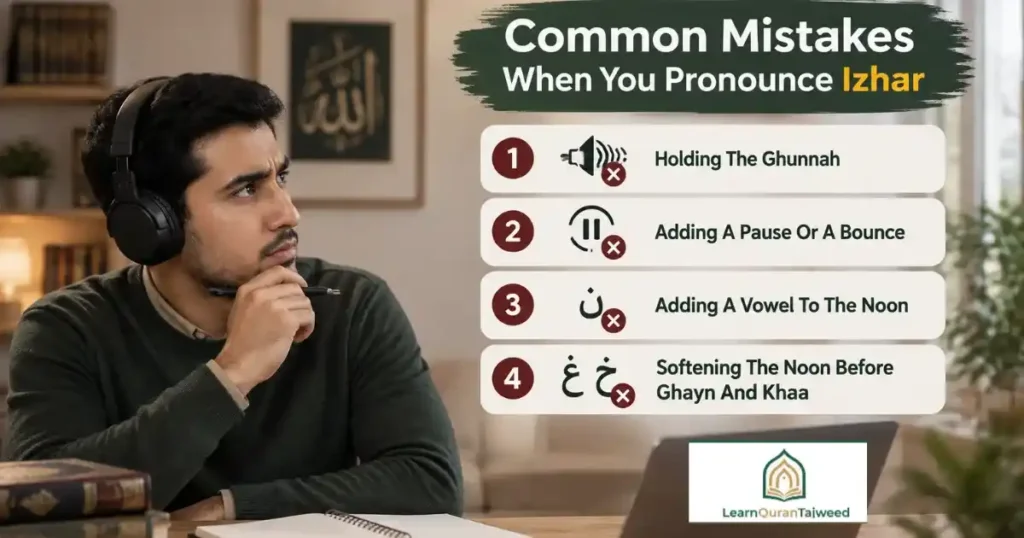
Common Mistakes When You Pronounce Izhar
Most izhar errors come from carrying habits over from other noon rules, especially ikhfa and idgham, where the pronunciation of noon sakinah or tanween changes depending on the following letter. In izhar, however, the noon must remain clear and distinct without merging, hiding, or adding unnecessary nasalization.
The four below are the ones teachers correct most often, and understanding them helps learners identify incorrect pronunciation and apply the rule more accurately during Quran recitation.
1. Holding The Ghunnah
Students who have just learned ikhfa often hold the nasal sound by habit, turning “min khawf” into “minnn khawf.” The fix: release the noon the moment your tongue makes contact.
This mistake often grows during slow recitation. When students slow down, they tend to stretch every sound, and the noon gets stretched along with the vowels. Speed does not change the rule: even at tahqiq, the slowest recitation pace, the ghunnah in izhar is never lengthened. Only the vowels and madd letters gain time.
2. Adding A Pause Or A Bounce
Some readers stop the voice after the noon, or add a small echo like qalqalah. Both break the rule. The noon and the throat letter should flow as one continuous sound.
The pause usually comes from a misunderstanding. Beginners think “clear” means “separate,” so they break the sound to make the noon stand out. In fact, the clarity of izhar comes from full tongue contact, not from a gap.
A pause on the noon is a separate rule called sakt, and in the Hafs reading it appears only in a few specific places marked in the mushaf. One example is مَنْ ۜ رَاقٍ (Surah Al-Qiyamah 75:27), where a short sakt on the noon is required. Adding a pause anywhere else turns izhar into something the text does not ask for.
3. Adding A Vowel To The Noon
Saying “mina khawf” or “mini ghill” adds a vowel that is not in the text. A noon sakinah has a sukoon, so it carries no vowel at all.
This error often comes from a pattern students learn early. In مِنَ اللَّهِ (minallāh), the noon does take a fatha, because it is followed by a letter with sukoon. Students then carry that “mina” into every case. The difference: in izhar, the letter after the noon always has its own vowel, so the noon needs no helping vowel to connect.
The mushaf helps you spot this. In the Madinah Mushaf, a noon read with izhar shows a clear sukoon sign above it, and tanween read with izhar has its two marks placed directly over each other. When you see that sukoon sign, give the noon no vowel at all, and move straight to the throat letter.
4. Softening The Noon Before Ghayn And Khaa
Ghayn and khaa are the throat letters closest to the mouth, so the tongue tends to slide into a hidden, ikhfa-like noon before them. Watch these two letters most closely, and make full tongue contact every time.
A related edge case: in the Hafs ‘an ‘Asim reading, the one most Muslims recite, noon before ghayn and khaa is always izhar. Some other recitations, such as that of Abu Ja’far, apply ikhfa before these two letters. If you recite Hafs, keep them clear.
These mistakes are hard to hear in your own voice. That is the main reason structured, teacher-led practice speeds up tajweed progress.
Read also: How To Recite Surah Kahf Tajweed Quran? – A Step-by-Step Practice Guide
Izhar Vs Other Rules You May Confuse It With
Izhar is easier to master once you can tell it apart from the rules around it. Since several Tajweed rules apply to noon sakinah and tanween, beginners may sometimes confuse their pronunciation and apply the wrong technique.
Two comparisons matter most for beginners: distinguishing izhar from idgham, where the noon sound merges into the following letter, and from ikhfa, where the noon is partially hidden with ghunnah.
Understanding these differences helps learners recognize the correct rule quickly and pronounce each combination accurately during Quran recitation.
1. Izhar Vs Ikhfa – The Minimal-Pair Test
The quickest way to train your ear is to compare two phrases that differ only in the letter after the noon. Read مِنْ خَوْفٍ (izhar) and then مِنْ قَبْلِ (ikhfa).
In the first, the noon is short and clear. In the second, the tongue does not fully touch, and the nasal sound is held for about two counts. Switching between the two makes the difference something you can hear, not just read about.
2. Izhar Halqi Vs Izhar Mutlaq Vs Izhar Shafawi
There are three kinds of izhar, and each applies to a different letter or group of letters according to its articulation point. Although they share the principle of clear pronunciation, their application differs depending on which letter appears in the Quranic word. Understanding these categories helps learners identify each type and apply the correct Tajweed rule during recitation.
| Type | Applies to | When | Example |
| Izhar halqi (throat) | Noon sakinah and tanween | Before the six throat letters | مِنْ خَيْرٍ |
| Izhar mutlaq (absolute) | Noon sakinah | Before waw or yaa in the same word (only four words in the Quran) | الدُّنْيَا، بُنْيَانٌ، صِنْوَانٌ، قِنْوَانٌ |
| Izhar shafawi (lip) | Meem sakinah | Before any letter except meem and baa | هُمْ فِيهَا |
Inside Learn Quran Tajweed Academy
Curious about how online learning works? Peek inside our actual Quran classes and hear the beautiful recitation of our students and teachers.
Perfect Your Quran Recitation Today
Join expert-led Tajweed classes, and recite the Quran with confidence and clarity.
Start Your Free TrialA 10-Minute Daily Drill To Pronounce Izhar Correctly
Repeating the rule does not build correct pronunciation; focused and consistent practice does. The “Contact, Release, Flow” drill takes about ten minutes a day and helps learners develop better control over their articulation.
By practicing slowly and paying attention to how the tongue and other speech organs move, you can gradually make the correct pronunciation more natural.
Start with individual letters and short combinations, then move to complete Quranic words and verses as your accuracy improves. Regular practice with a qualified Tajweed teacher will also help identify mistakes and reinforce the correct technique.
1. Find The Noon’s Exact Spot (2 Minutes)
Say “nn” on its own and feel your tongue tip press against the gum ridge. Do this ten times.
Keep your mouth slightly open and hold the “nn” for about two seconds. This is the only part of the drill where you hold the sound, and the goal is to feel the position, not to practice izhar timing. Stop, relax your tongue completely, then land on the same spot again.
Use a mirror if you can. Your lips should stay relaxed, and your jaw should not move; only the tongue works. You are done with this stage when your tongue finds the gum ridge right away, without searching for it.
2. Tap The Noon, Never Hold (3 Minutes)
Say “min,” “man,” and “‘an,” cutting off the nasal sound as soon as it starts. No holding.
Start with the noon alone after each vowel: “in,” “an,” “un.” Then move to the real words: “min,” “man,” “‘an,” “‘in.” Each noon should feel like a quick tap of the tongue, not a sound you rest on.
Tap a finger on the table once per syllable to set a steady rhythm. The noon must end before your next tap. If it spills over into the next beat, you are still holding the ghunnah, so slow the rhythm down and try again.
3. Glide Into Each Throat Letter
Read one example per throat letter from the table above, two letters at a time, from the deepest to the nearest.
Work through the throat in pairs: hamzah and haa (مَنْ آمَنَ، مِنْهُمْ), then ‘ayn and Haa (أَنْعَمْتَ، وَانْحَرْ), then ghayn and khaa (مِنْ غِلٍّ، مِنْ خَوْفٍ). For each letter, read the one-word example, the two-word example, and the tanween example three times each.
Finish with a full verse:
الَّذِي أَطْعَمَهُم مِّن جُوعٍ وَآمَنَهُم مِّنْ خَوْفٍ
“Who has fed them against hunger and made them safe from fear.”
It contains ikhfa in مِّن جُوعٍ and izhar in مِّنْ خَوْفٍ, so you practice switching between the two rules inside one verse, as you will in real recitation.
4. Record And Compare Your Recitation (2 Minutes)
Read the minimal pair مِنْ خَوْفٍ / مِنْ قَبْلِ five times, then record yourself and listen back.
When you listen back, check three things: the izhar noon is clearly shorter than the ikhfa noon, there is no gap between “min” and “khawf,” and no extra vowel appears after the noon. If any of these fail, go back to the stage that trains it: Release for length, Flow for gaps and vowels.
Then compare your recording with a trusted reciter. Sheikh Al-Husary’s Al-Mushaf Al-Mu’allim (the teaching recitation) is slow and designed for repeating after him, which makes it ideal for this. Write down which letter gave you trouble, and start the next day’s Flow stage with that pair.
Read also: Surah Nuh Tajweed – A Complete Guide To Reciting Surah Nuh Correctly

Book Your Tajweed Class And Recite Every Noon With Confidence
Reading an article can teach you the rule. Only a trained ear can tell you if your recitation is actually right. At Learn Quran Tajweed, qualified teachers listen to you recite, catch the exact words where your izhar slips, and guide you step by step through every tajweed rule.
Learn from home, according to your schedule, with one-on-one attention instead of a crowded class. Start today and hear the difference in your next recitation.
Take the first step today, enroll now, and experience the difference that proper Tajweed makes.
Courses we offer:
- Online Tajweed Classes
- Learn Quran with Tajweed Online
- Beginner Tajweed Course
- Intermediate Tajweed Course
- Advanced Tajweed Course
- Amali (Practical) Tajweed Course
Perfect Your Quran Recitation Today
Join expert-led Tajweed classes, and recite the Quran with confidence and clarity.
Start Your Free TrialConclusion
To pronounce izhar, press your tongue tip fully against the gum ridge, keep the natural ghunnah without holding it, and move straight into the throat letter with no pause and no shaddah. The rule applies whenever noon sakinah or tanween comes before one of the six throat letters: ء، هـ، ع، ح، غ، خ.
Remember why it happens: the noon and the throat letters are too far apart to blend. Watch ghayn and khaa most closely, and practice with minimal pairs so you can hear izhar and ikhfa as two different sounds.
The key point: knowing how to pronounce izhar is less about memorizing letters and more about training your tongue to make clean contact and let go. A few minutes of daily practice, checked by a teacher, gets you there.
Frequently Asked Questions
How Do You Pronounce Izhar In Tajweed?
You pronounce izhar by saying the noon sakinah or tanween clearly from the tongue tip, without holding its nasal sound. Then you move straight to the throat letter that follows, without pausing and without doubling that letter.
Is There Ghunnah In Izhar?
Izhar has only the natural ghunnah that is always part of the letter noon, and it is not extended. Unlike ikhfa or idgham, where the ghunnah is held for about two counts, in izhar it is released immediately.
What Are The Six Letters Of Izhar?
The six izhar letters are hamzah (ء), haa (هـ), ‘ayn (ع), Haa (ح), ghayn (غ), and khaa (خ). They all come from the throat, which is why the rule is called izhar halqi.
What Is The Difference Between Izhar And Ikhfa?
The difference between izhar and ikhfa is how clearly the noon is pronounced. In izhar, the noon is fully clear with no held ghunnah. In ikhfa, the noon is partly hidden and held with ghunnah for about two counts.
Can Izhar Happen Within One Word?
Yes, izhar with noon sakinah can happen within one word, as in أَنْعَمْتَ and مِنْهُمْ, or across two words, as in مَنْ آمَنَ. Izhar with tanween always happens across two words.
Related Articles
Tajweed Basics