 Tajweed Basics
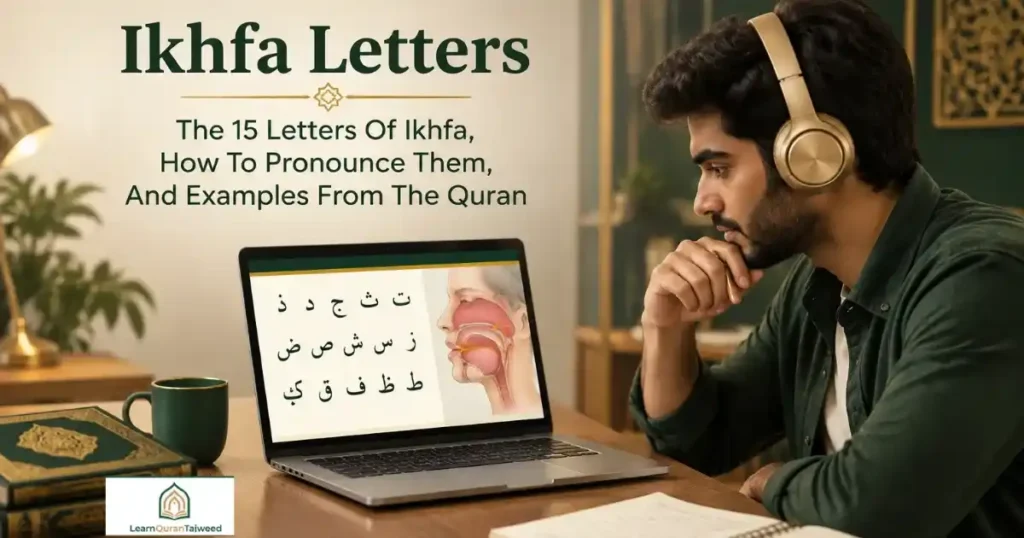
The ikhfa letters are behind one of the most common corrections in Quran class: you read kuntum (كُنتُمْ), and your teacher stops you. The word looks simple, but the noon in the middle hides a rule that many students get wrong for years, and these 15 letters decide exactly when that rule applies.
Ikhfa is the most frequently occurring rule of noon sakinah and tanween in the Quran. If you learn its 15 letters and how to pronounce them correctly, your recitation improves on almost every page.
This guide lists the 15 letters of ikhfa, explains why the noon is hidden before them, shows you how to pronounce ikhfa step by step, and gives you a Quranic example for every letter.
What Are The Ikhfa Letters?
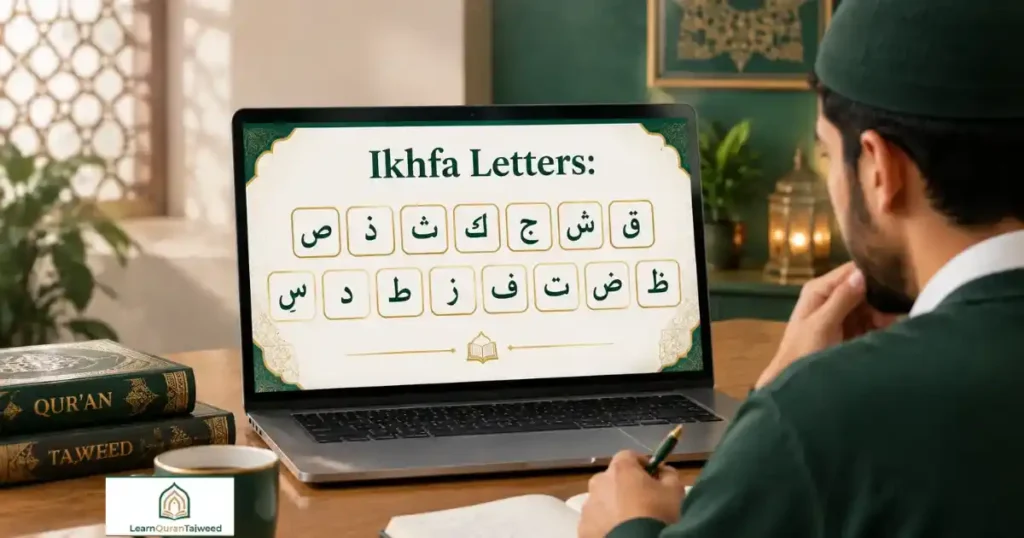
The ikhfa letters are 15 Arabic letters that cause a noon sakinah (نْ) or tanween to be pronounced in a hidden way, between clear pronunciation (izhar) and full merging (idgham), with a nasal sound (ghunnah) held for two counts.
These letters are also known as the letters of ikhfa, ikhfaa letters, or huroof e ikhfa (the term used widely in Urdu-speaking countries). The sections below cover the list, the memory verse, and the meaning of the rule itself.
What Are The 15 Letters Of Ikhfa?
Among the Arabic alphabet, there are 15 letters that carry the characteristics of ikhfa as follows:
| Letter Number | Letter | Name |
| 1 | ص | Ṣād |
| 2 | ذ | Dhāl |
| 3 | ث | Thā’ |
| 4 | ك | Kāf |
| 5 | ج | Jīm |
| 6 | ش | Shīn |
| 7 | ق | Qāf |
| 8 | س | Sīn |
| 9 | د | Dāl |
| 10 | ط | Ṭā’ |
| 11 | ز | Zāy |
| 12 | ف | Fā’ |
| 13 | ت | Tā’ |
| 14 | ض | Ḍād |
| 15 | ظ | Ẓā’ |
The Verse That Helps You Memorize The Ikhfa Letters
Imam al-Jamzuri collected the ikhfa letters in the first letter of each word of this line from his poem Tuhfat al-Atfal:
صِفْ ذا ثَنا كَمْ جادَ شَخْصٌ قَدْ سَما … دُمْ طَيِّبًا زِدْ في تُقًى ضَعْ ظالِمَا
Take the first letter of each word, and you have all 15 letters in order: ṣād from ṣif, dhāl from dhā, thā’ from thanā, and so on until ẓā’ from ẓālimā.
The Subtraction Shortcut
If the verse doesn’t stick, use this practical shortcut that many Tajweed teachers recommend. Noon sakinah and tanween have four rules, and 28 letters are divided between them.
Izhar takes the 6 throat letters, idgham takes the 6 letters of yarmalūn (ي ر م ل و ن), and iqlab takes one letter, bā’. Any letter left over is an ikhfa letter: 28 − 6 − 6 − 1 = 15.
The Meaning Of Ikhfa In Tajweed
Linguistically, ikhfa means “concealment.” In Tajweed, it means pronouncing noon sakinah or tanween in a state between izhar and idgham, without shaddah on the next letter, while keeping the ghunnah.
It is called ikhfa haqiqi (true ikhfa) to distinguish it from ikhfa shafawi, which applies to meem sakinah before bā’.
See Our Classrooms in Action
Watch these short clips from our live, interactive Quran courses to see how our students learn and interact with our expert tutors.
Perfect Your Quran Recitation Today
Join expert-led Tajweed classes, and recite the Quran with confidence and clarity.
Start Your Free TrialWhy Is The Noon Hidden Before The Ikhfa Letters?
The noon is hidden because of the distance between its articulation point (makhraj) and the articulation point of the next letter. This one principle explains all four noon rules at once.
How Articulation Distance Decides The Rule
With the throat letters of izhar, the distance is large, so the noon is pronounced clearly. With idgham letters, the makhraj is very close or identical, so the noon merges completely.
The ikhfa letters sit at a middle distance: too close for full clarity, too far for full merging. The result is a middle rule: the noon’s sound (ghunnah) stays, but the tongue’s action at the noon’s makhraj disappears.
Read also: Huroof Saktah In Quran – Meaning, The 4 Places And How To Recite Them Correctly
How To Pronounce Ikhfa Correctly
Correct ikhfa means skipping the tongue contact of the noon, moving straight toward the next letter, and holding a nasal sound for two counts.
Step-By-Step Ikhfa Pronunciation
After learning about the Ikhfa letters, you want to master this characteristic. To do that, here is the process broken into steps:
- Don’t touch the gum ridge. With a clear noon, the tip of your tongue presses behind the upper front teeth. In ikhfa, it must not.
- Prepare for the next letter. In yunfiqūn (يُنفِقُونَ), your lower lip moves toward your upper teeth for the fā’. In andādan (أَندَادًا), your tongue tip heads toward the dāl.
- Release the ghunnah through the nose for two counts. Two counts are roughly the time of folding or unfolding two fingers at a steady pace.
- Pronounce the next letter without shaddah. Ikhfa is not idgham, so the following letter is not doubled.
Quick self-test: recite kuntum (كُنتُمْ) slowly. If your tongue touched the gum ridge before the tā’, you pronounced izhar instead of ikhfa.
Heavy And Light Ghunnah
The ghunnah in ikhfa follows the letter after it. If that letter is one of the five heavy (isti’la) ikhfa letters, which are ص ض ط ظ ق, the ghunnah is pronounced heavy (tafkheem).
Examples of heavy ghunnah include yunṣarūn (يُنصَرُونَ) and yanquḍūn (يَنقُضُونَ). Before the other ten letters, the ghunnah is light (tarqeeq), as in kuntum and unzila (أُنزِلَ).
The Three Levels Of Ikhfa
Ikhfa is not one fixed degree. The closer the letter is to the noon’s makhraj, the stronger the concealment.
| Level | Letters | Why | Example |
| Strongest (closest to idgham) | ط د ت | Same area as the noon: tongue tip and upper teeth | andādan (أَندَادًا) |
| Weakest (closest to izhar) | ق ك | Back of the tongue, the farthest from the noon | minkum (مِنكُمْ) |
| Middle | The remaining 10 letters | Medium distance | yunṣarūn (يُنصَرُونَ) |
The rule above is easy to read and hard to apply by yourself, because your ear adjusts to your own mistakes. At Learn Quran Tajweed, a qualified teacher listens to your recitation live and corrects each ghunnah as you read.
Read also: Surah Qiyamah Tajweed – Verse-by-Verse Rules Guide
Examples Of The Ikhfa Letters From The Quran
Every ikhfa letter can follow noon sakinah within one word or across two words. Tanween only occurs across two words, because tanween always comes at the end of a word. Here are examples for the 15 letters from the Quran.
| Letter | Noon sakinah in one word | Noon sakinah in two words | Tanween |
| ص | يُنصَرُونَ (Al-Baqarah 48) | مِّن صِيَامٍ (Al-Baqarah 196) | بَقَرَةٌ صَفْرَاءُ (Al-Baqarah 69) |
| ذ | تُنذِرْهُمْ (Al-Baqarah 6) | مَّن ذَا (Al-Baqarah 245) | كَامِلَةٌ ذَٰلِكَ (Al-Baqarah 196) |
| ث | أُنثَىٰ (Al Imran 36) | مِن ثَمَرَةٍ (Al-Baqarah 25) | جَمِيعًا ثُمَّ (Al-Baqarah 29) |
| ك | مِنكُمْ (Al-Baqarah 65) | إِن كُنتُمْ (Al-Baqarah 23) | كِتَابٌ كَرِيمٌ (An-Naml 29) |
| ج | فَأَنجَيْنَاكُمْ (Al-Baqarah 50) | فَمَن جَاءَهُ (Al-Baqarah 275) | قَوْمًا جَبَّارِينَ (Al-Ma’idah 22) |
| ش | وَأَنشَأْنَا (Al-An’am 6) | إِن شَاءَ (Al-Baqarah 70) | عَذَابٌ شَدِيدٌ (Al Imran 4) |
| ق | يَنقُضُونَ (Al-Baqarah 27) | مِن قَبْلِكَ (Al-Baqarah 4) | شَيْءٍ قَدِيرٌ (Al-Baqarah 20) |
| س | وَتَنسَوْنَ (Al-Baqarah 44) | عَن سَبِيلِ (Al-Baqarah 217) | كَلِمَةٍ سَوَاءٍ (Al Imran 64) |
| د | أَندَادًا (Al-Baqarah 22) | مِّن دُونِ (Al-Baqarah 23) | وَلِكُلٍّ دَرَجَاتٌ (Al-An’am 132) |
| ط | قِنطَارًا (An-Nisa 20) | مِن طَيِّبَاتِ (Al-Baqarah 57) | حَلَالًا طَيِّبًا (Al-Baqarah 168) |
| ز | أُنزِلَ (Al-Baqarah 4) | فَإِن زَلَلْتُم (Al-Baqarah 209) | كُلٍّ زَوْجَيْنِ (Hud 40) |
| ف | يُنفِقُونَ (Al-Baqarah 3) | مِن فَضْلِهِ (Al-Baqarah 90) | عُمْيٌ فَهُمْ (Al-Baqarah 18) |
| ت | كُنتُمْ (Al-Baqarah 23) | مِن تَحْتِهَا (Al-Baqarah 25) | جَنَّاتٍ تَجْرِي (Al-Baqarah 25) |
| ض | مَّنضُودٍ (Hud 82) | وَمَن ضَلَّ (Yunus 108) | ذُرِّيَّةٌ ضُعَفَاءُ (Al-Baqarah 266) |
| ظ | تَنظُرُونَ (Al-Baqarah 50) | مِن ظُهُورِهَا (Al-Baqarah 189) | قَوْمٍ ظَلَمُوا (Al Imran 117) |
A Rare Case Worth Knowing – Ḍād In One Word
Ḍād after noon sakinah within a single word appears in only one Quranic word: manḍūd (مَّنضُودٍ), found in Surah Hud -82 and Al-Waqi’ah -29. If an exam asks for a one-word ikhfa example with ḍād, this is the only answer.
Inside Learn Quran Tajweed Academy
Curious about how online learning works? Peek inside our actual Quran classes and hear the beautiful recitation of our students and teachers.
Perfect Your Quran Recitation Today
Join expert-led Tajweed classes, and recite the Quran with confidence and clarity.
Start Your Free TrialHow To Spot Ikhfa In The Mushaf
The Madinah Mushaf (Hafs narration) marks ikhfa visually, so you can identify it before you pronounce it. Two signs do the work.
1. The Two Visual Signs Of Ikhfa
First, a hidden noon is written without a sukoon sign. Compare minkum (مِنكُمْ, no sukoon on the noon, so ikhfa) with minhum (مِنْهُمْ, sukoon visible, so izhar).
Second, a hidden tanween is written with its two marks staggered, one slightly after the other, as in عَذَابٌ شَدِيدٌ. Tanween with izhar has its two marks stacked directly on top of each other.
2. The Look–Ready–Weigh Check
Use this three-part check every time you meet a noon sakinah or tanween:
- Look: No sukoon on the noon, or staggered tanween, and the next letter isn’t an idgham letter or bā’? It’s ikhfa.
- Ready: Move your tongue or lips to the next letter’s makhraj, not to the noon’s.
- Weigh: Is the next letter ص ض ط ظ ق? Make the ghunnah heavy. Otherwise, keep it light.
Read also: Imala In Tajweed – What It Means And How To Pronounce It Correctly
Common Mistakes With The Ikhfa Letters
Most ikhfa errors come from three sources: the tongue, the lips, and timing. These are the mistakes teachers correct most often. The following are six mistakes to avoid:
- Pronouncing a clear noon: touching the gum ridge before the next letter. This is the most common beginner error.
- Turning noon into meem: reciting yunfiqūn as “yumfiqūn” by closing the lips. That is iqlab in the wrong place.
- Adding a madd: stretching the vowel before the noon, so kuntum sounds like “koontum.”
- Doubling the next letter: reciting min taḥtihā as “mittaḥtihā,” as if it were idgham.
- Wrong ghunnah length: holding it for less or more than two counts.
- Light ghunnah before heavy letters: reciting the ghunnah in yanquḍūn light when it should be heavy.
The difficulty is that most of these mistakes are almost impossible to hear in your own voice. One-to-one correction with a teacher at Learn Quran Tajweed fixes them in weeks rather than years of guessing.
Master The Ikhfa Letters With A Qualified Tajweed Teacher
Knowing the 15 ikhfa letters is the first step. Pronouncing them correctly in every verse takes a trained ear, and that’s what a live teacher gives you.
With Learn Quran Tajweed, you study online with qualified teachers who listen to your recitation, correct your ghunnah, and move you through ikhfa, idgham, iqlab, and izhar at your pace, from home, on your schedule.
Book your Tajweed class today and recite every ghunnah the way it was revealed.
Courses we offer:
- Tajweed Course for Kids
- Tajweed Course for Adults
- Tajweed Course for Ladies
- Tajweed ul Quran Course
- Quran Recitation with Tajweed Course
- Quran Tarteel Course
- Tajweed Ijazah Program
Perfect Your Quran Recitation Today
Join expert-led Tajweed classes, and recite the Quran with confidence and clarity.
Start Your Free TrialConclusion
The ikhfa letters are 15: ص ذ ث ك ج ش ق س د ط ز ف ت ض ظ, collected in the verse ṣif dhā thanā kam jāda shakhṣun qad samā. When one of them follows noon sakinah or tanween, skip the noon’s tongue contact, prepare for the next letter, and hold the ghunnah for two counts.
Make the ghunnah heavy before ص ض ط ظ ق and light before the rest. Use the Mushaf’s signs, a noon without sukoon and staggered tanween, to spot ikhfa before you reach it.
The key takeaway: ikhfa is the most frequent noon rule and the most frequently mispronounced, so mastering the ikhfa letters improves your recitation more than almost any other single rule.
Frequently Asked Questions
What Are The 15 Letters Of Ikhfa?
The 15 letters of ikhfa are ص ذ ث ك ج ش ق س د ط ز ف ت ض ظ. They are the first letters of each word in al-Jamzuri’s line: ṣif dhā thanā kam jāda shakhṣun qad samā, dum ṭayyiban zid fī tuqan ḍa’ ẓālimā.
How Long Is The Ghunnah In Ikhfa?
The ghunnah in ikhfa lasts two counts (two harakat). It is heavy before ص ض ط ظ ق and light before the other ten ikhfa letters.
What Is The Difference Between Ikhfa And Idgham?
In idgham, the noon merges fully into the next letter, which takes shaddah. In ikhfa, the noon’s ghunnah stays, and the next letter has no shaddah, so ikhfa sits between izhar and idgham.
Why Is It Called Ikhfa Haqiqi?
It is called ikhfa haqiqi (true ikhfa) to distinguish it from ikhfa shafawi. Ikhfa haqiqi applies to noon sakinah and tanween before 15 letters, while ikhfa shafawi applies only to meem sakinah before bā’.
What Are The Levels Of Ikhfa?
Ikhfa has three levels. It is strongest before ط د ت, weakest before ق ك, and medium before the remaining ten ikhfa letters.
What Is Haroof E Ikhfa?
Haroof e ikhfa is the Urdu term for the ikhfa letters. It refers to the same 15 letters that cause noon sakinah and tanween to be pronounced with ikhfa.








[…] Read also: Ikhfa Letters – The 15 Letters Of Ikhfa, How To Pronounce Them, And Examples From The Quran […]