 Tajweed Resources

Surah Al-Kahf has 110 verses, and many non-Arabic readers start reciting it without a clear plan. They read too fast, lean on transliteration for every word, and never check their own pronunciation against a real reciter. That’s why surah kahf tajweed quran practice so often stalls after the first few pages — not because the surah is unusually difficult, but because the practice method has no structure.
This guide breaks the process into a fixed sequence of steps. Each step covers one part of practice — listening, reading, checking, and repeating — so you always know what to do next instead of guessing what “practicing tajweed” is supposed to look like.
By the end, you’ll have a repeatable routine you can use every time you sit down with Surah Al-Kahf, whether you’re reading from the Arabic text, transliteration, or both, and a way to measure whether that routine is actually working.
1. Divide Surah Al-Kahf Into Short Sections Before You Start Practicing
Do not make all 110 verses one practice unit Choose a short passage that you can listen to, repeat, correct, and review within the same session.
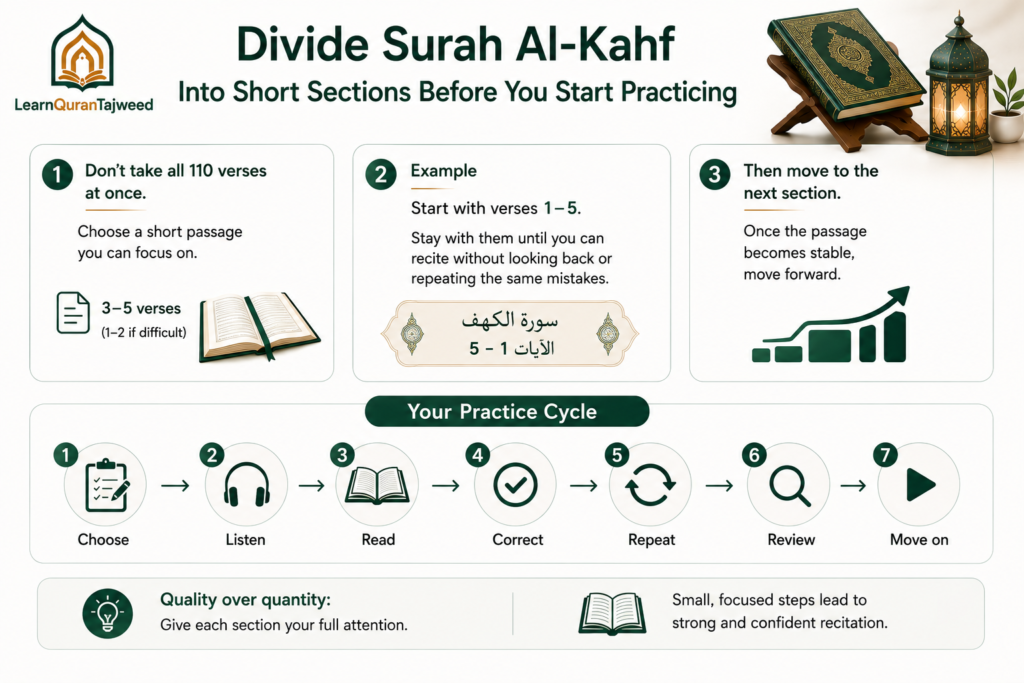
For a beginner, this may be three to five verses. If the verses are particularly difficult, even one or two can be enough.
For example, you might begin with verses 1–5 and remain with them until you can recite the passage without repeatedly returning to the text or correcting the same pronunciation mistakes. Once that section becomes more stable, move to the next group of verses.
The exact number of verses matters less than whether you can give the passage your full attention. If you’re building a full study plan rather than a single practice session, structured Quran and tajweed classes can give you a set listening-and-correction routine with a teacher, instead of relying on audio alone to catch everything.

2. Listen to the Same Verses Before Trying to Recite Them Yourself
Once you have selected your practice section, listen to those exact verses from a reliable Quran reciter while following the Arabic Mushaf.
Do not use the first listening simply as background audio. Pay attention to how the reciter:
- pronounces unfamiliar letters.
- holds long vowels.
- connects one word to another.
- applies Ghunnah.
- and stops at the ends of phrases and verses.
Then listen again while following each word visually.
For example, if you are beginning with the opening of Surah Al-Kahf, follow:
ٱلْحَمْدُ لِلَّهِ ٱلَّذِىٓ أَنزَلَ عَلَىٰ عَبْدِهِ ٱلْكِتَـٰبَ وَلَمْ يَجْعَل لَّهُۥ عِوَجَا
“All praise is for Allah Who has revealed the Book to His servant, allowing no crookedness in it.”
Listen first, then attempt the verse yourself. This gives you a correct sound model to work from instead of discovering after many repetitions that you have been practicing a word incorrectly.
Read also: Naql in Tajweed
3. Mark the Tajweed Rules That Actually Appear in Your Practice Section
After listening, look at the verses again and identify the Tajweed rules that occur in that particular passage.
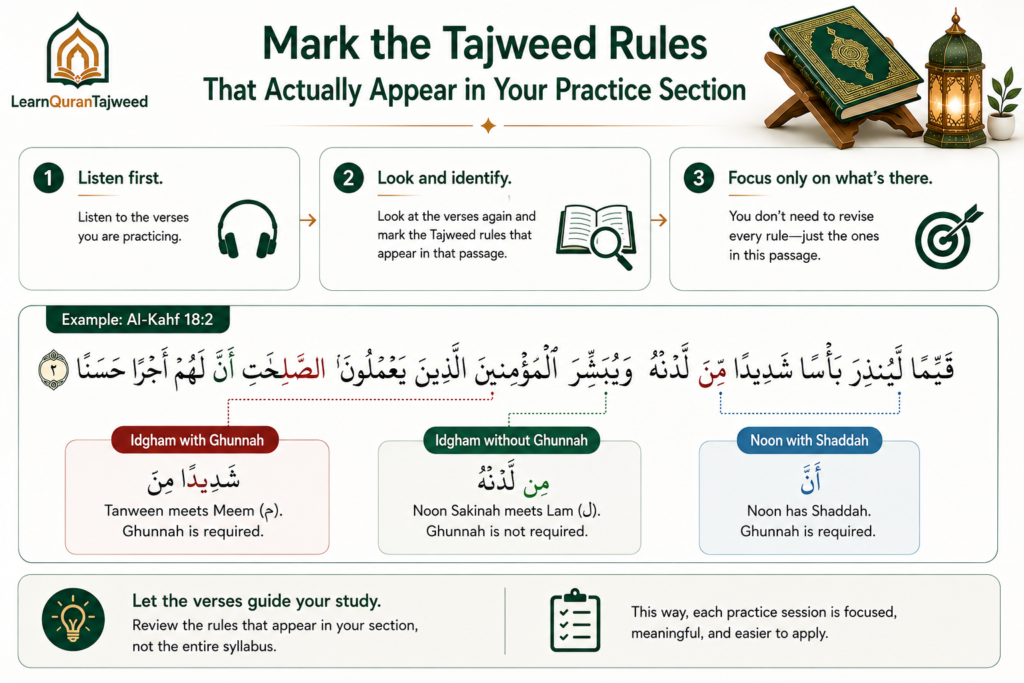
You do not need to revise the entire Tajweed syllabus every time you practice Surah Al-Kahf.
For example, the opening verses give you several different features to notice:
قَيِّمًۭا لِّيُنذِرَ بَأْسًۭا شَدِيدًۭا مِّن لَّدُنْهُ وَيُبَشِّرَ ٱلْمُؤْمِنِينَ ٱلَّذِينَ يَعْمَلُونَ ٱلصَّـٰلِحَـٰتِ أَنَّ لَهُمْ أَجْرًا حَسَنًۭا
“A straight and perfect Book, to warn of severe punishment from Him and to give good news to the believers who do righteous deeds that they will have a good reward.”
Instead of simply reading through the ayah, notice what you will need to apply In شَدِيدًا مِّن, the Tanween meets Meem, producing Idgham with Ghunnah.
A different transition appears immediately afterwards in: مِن لَّدُنْهُ Here Noon Sakinah meets Lam, producing Idgham without Ghunnah.
Later in the same verse, أَنَّ contains a Noon with Shaddah and therefore requires a clear Ghunnah.
This is a more useful way to study Surah Al-Kahf than choosing a Tajweed rule first and searching randomly for examples. Let the verses you are currently practicing determine which rules you revise.
4. Separate Difficult Words From the Ayah Before Repeating the Whole Verse
When a particular word causes a mistake, stop repeating the entire ayah Take the difficult word out temporarily and work on it by itself.
Suppose you are practicing verse 9:
أَمْ حَسِبْتَ أَنَّ أَصْحَـٰبَ ٱلْكَهْفِ وَٱلرَّقِيمِ كَانُوا۟ مِنْ ءَايَـٰتِنَا عَجَبًا
“Or did you think that the Companions of the Cave and the Inscription were among Our remarkable signs?”
If أَصْحَابَ is difficult, repeating the entire ayah ten times may simply reinforce the same mistake. Instead, work in stages: أَصْحَابَ then: أَنَّ أَصْحَابَ then: أَنَّ أَصْحَابَ ٱلْكَهْفِ and finally return to the complete ayah.
Use the same method for any word containing a difficult Makhraj, unfamiliar letter combination, Madd, Ghunnah, or transition. The aim is to solve the specific problem before hiding it again inside a long passage.
5. Practice the Transition Between Words, Not Just the Words Themselves
A word may sound correct when you pronounce it alone but change when you connect it to what comes before or after it. That is why Surah Al-Kahf practice should include short two- or three-word combinations, not only individual words and complete verses.
Consider again شَدِيدًا مِّن لَّدُنْهُ. Reading شَدِيدًا, مِن, and لَدُنْهُ separately does not fully prepare you for the Tajweed rules that appear when these words are connected.
Start by practicing شَدِيدًا مِّن until the transition becomes stable, then move to مِن لَّدُنْهُ and practice the connection between the Noon Sakinah and the following Lam. Once both transitions are clear, combine them and recite the complete phrase شَدِيدًا مِّن لَّدُنْهُ without breaking between the words.
This type of practice helps you move beyond recognizing Tajweed rules individually and trains you to maintain them during natural, connected Quran recitation.
Inside Learn Quran Tajweed Academy
Curious about how online learning works? Peek inside our actual Quran classes and hear the beautiful recitation of our students and teachers.
Perfect Your Quran Recitation Today
Join expert-led Tajweed classes, and recite the Quran with confidence and clarity.
Start Your Free Trial6. Practice Both Continuing and Stopping at Suitable Places
Do not practice every verse in only one way.
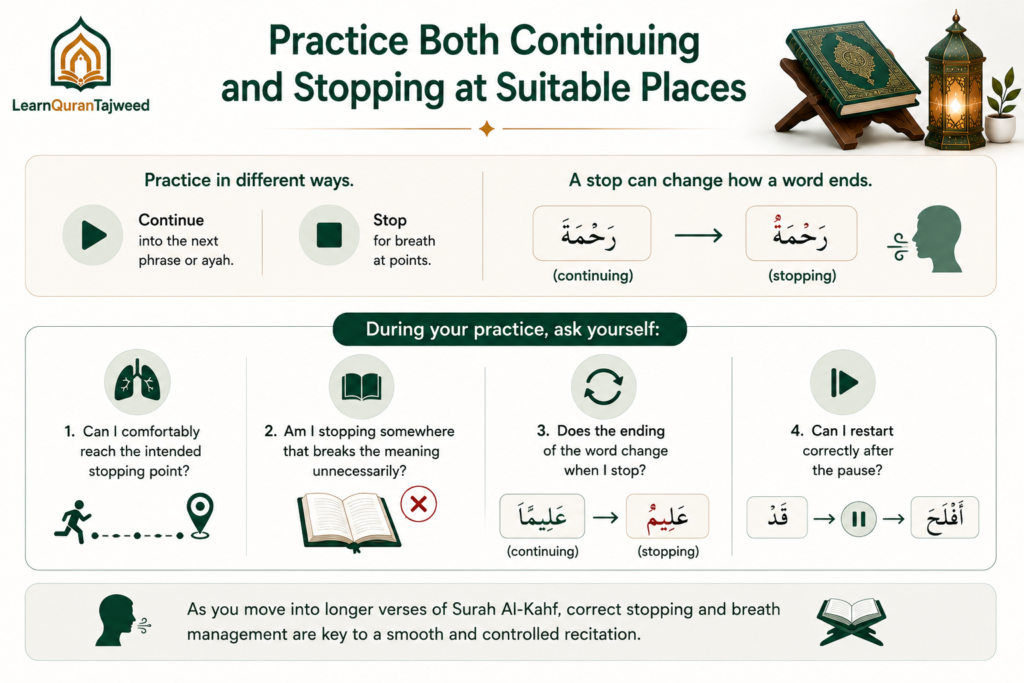
Sometimes you will continue into the next phrase or ayah, while at other times you will need to stop for breath. A stop can change the ending of a word and may affect the Madd or final vowel you hear.
During practice, first listen to where the reciter pauses. Then try the passage yourself and ask:
- Can I comfortably reach the intended stopping point?
- Am I stopping somewhere that breaks the meaning unnecessarily?
- Does the ending of the word change when I stop?
- Can I restart correctly after the pause?
This becomes increasingly important as you move into longer verses of Surah Al-Kahf, where breath management and correct stopping become part of maintaining a controlled recitation.
7. Read the Complete Practice Section Without Stopping at Every Mistake
After practicing difficult words and transitions separately, return to the complete section and recite it from beginning to end. At this stage, the goal is to see whether the corrections you made in isolation remain consistent during continuous recitation.
If you notice a mistake, avoid stopping immediately unless it prevents you from continuing correctly. Make a mental note of where it happened, finish the passage, and then return to that specific word or phrase for focused practice.
For example, you may be able to pronounce مِن لَّدُنْهُ correctly several times on its own but fall back into your previous pronunciation when reciting the complete ayah. This usually means that you understand and can produce the rule, but it has not yet become stable during connected recitation.
In that case, practice مِن لَّدُنْهُ again, place it back into the surrounding words, and then recite the complete ayah once more. Repeat this process until the correction remains present without forcing you to interrupt the flow of the verse.
If you want a teacher to point out exactly where these three apply, verse by verse, in real time, a practical tajweed course is built for that kind of live correction — something audio alone can’t fully replace, since a recording can’t hear your specific mistake and respond to it.

8. Use Transliteration Only to Solve a Specific Reading Problem
If you are still developing your Arabic reading skills, transliteration can help you identify an unfamiliar word.
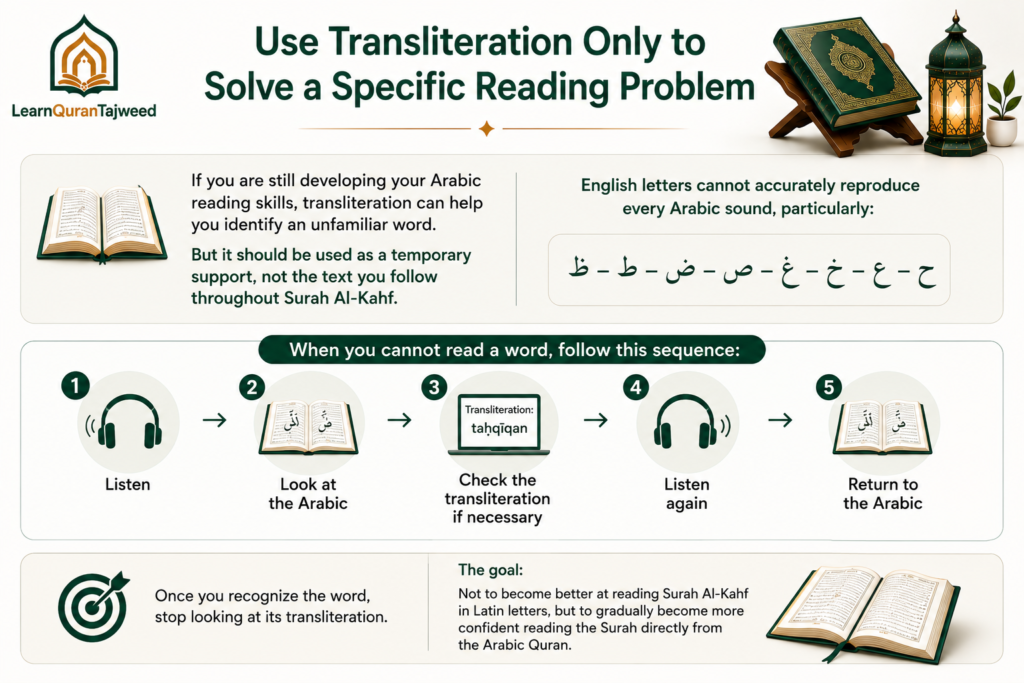
But it should be used as a temporary support rather than the text you follow throughout Surah Al-Kahf. English letters cannot accurately reproduce every Arabic sound, particularly letters such as:
ح – ع – خ – غ – ص – ض – ط – ظ
Once you recognize the word, stop looking at its transliteration. The goal is not to become better at reading Surah Al-Kahf in Latin letters. It is to gradually become more confident reading the Surah directly from the Arabic Quran.
Read also: How to Recite Surah Al-Mulk With Tajweed?
9. Record One Difficult Passage Instead of Recording the Entire Surah
Recording your recitation is most useful when you know what you are listening for Choose one passage that has been difficult during practice and record it.
Then listen to the recording several times, changing your focus each time On the first replay, listen only to the difficult letters On the second, check Madd and Ghunnah.
On the third, listen to the connections between words and your stopping points Finally, compare that exact passage with a reliable reciter.
You are not trying to copy the reciter’s voice, melody, or personal style. The comparison should help you notice differences in pronunciation, vowel length, and application of Tajweed.
10. Review Previous Sections Before Adding New Verses
One of the biggest challenges with a long Surah is not learning the next passage. It is keeping earlier passages accurate while you continue moving forward.
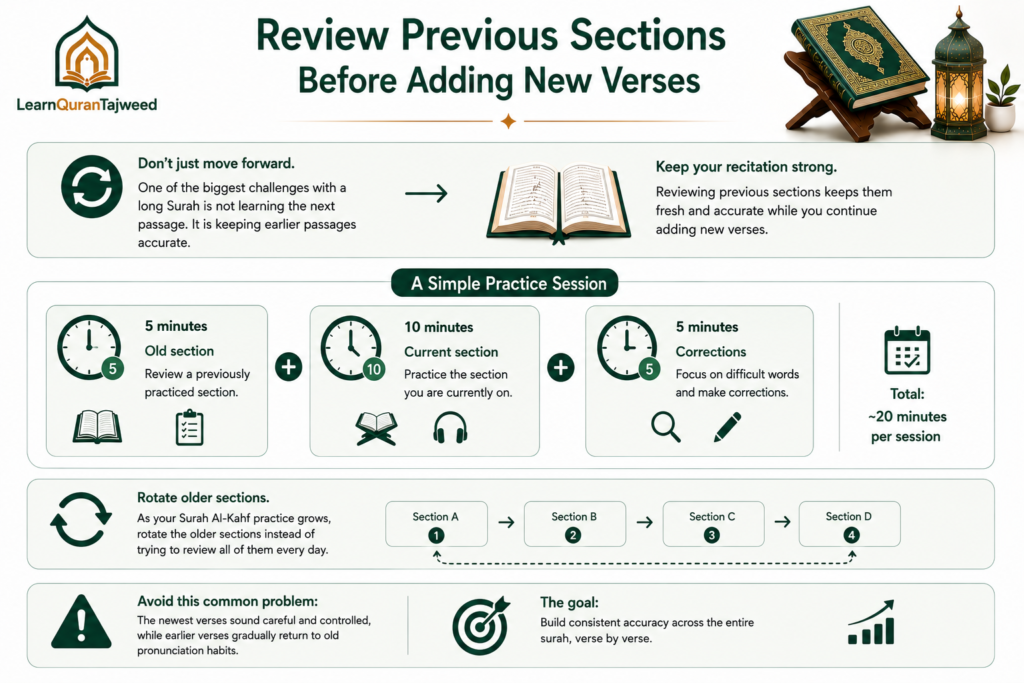
Before adding new verses, spend part of your session reviewing a section you practiced previously.
A simple session could look like this:
5 minutes — old section
10 minutes — current section
5 minutes — difficult words and corrections
As your Surah Al-Kahf practice grows, rotate the older sections instead of trying to review all of them every day. This prevents a common problem: the newest verses sound careful and controlled while earlier verses gradually return to old pronunciation habits.
11. Combine Practiced Sections Without Losing Tajweed Accuracy
Once two neighboring sections are stable, join them before moving to new verses. For example, after practicing verses 1–5 and 6–10 separately, recite verses 1–10 together.
As the passage becomes longer, check that your Madd, difficult letters, and stopping points remain accurate and that you do not rush familiar verses. If your Tajweed begins to weaken, return to the difficult section, correct it separately, and then reconnect it.
This gradual approach helps you maintain accurate Tajweed during longer, continuous recitation.
12. Have a Tajweed Teacher Check the Mistakes You Cannot Diagnose Yourself
Listening and recording can reveal many problems, but they cannot always tell you why a pronunciation is incorrect. You may hear that your pronunciation differs from the reciter without knowing whether the problem comes from the Makhraj, tongue position, Sifat of the letter, Ghunnah, Madd timing, or the way you are connecting two words.
This is where direct correction becomes useful. A qualified Tajweed teacher can identify the specific cause of the mistake and show you what needs to change instead of leaving you to repeat the same sound and hope it improves.
The aim is not to have a teacher correct every word of Surah Al-Kahf forever. It is to identify recurring weaknesses so that your independent practice becomes more accurate.
At Learn Quran Tajweed Academy, we make it simple, structured, and spiritually uplifting to learn from qualified Tajweed teachers—no matter your age or level.

How Do You Know Your Surah Al-Kahf Recitation Is Improving?
Do not measure progress only by how many verses you can complete A stronger sign is that corrections begin to remain present when you stop concentrating on them individually.
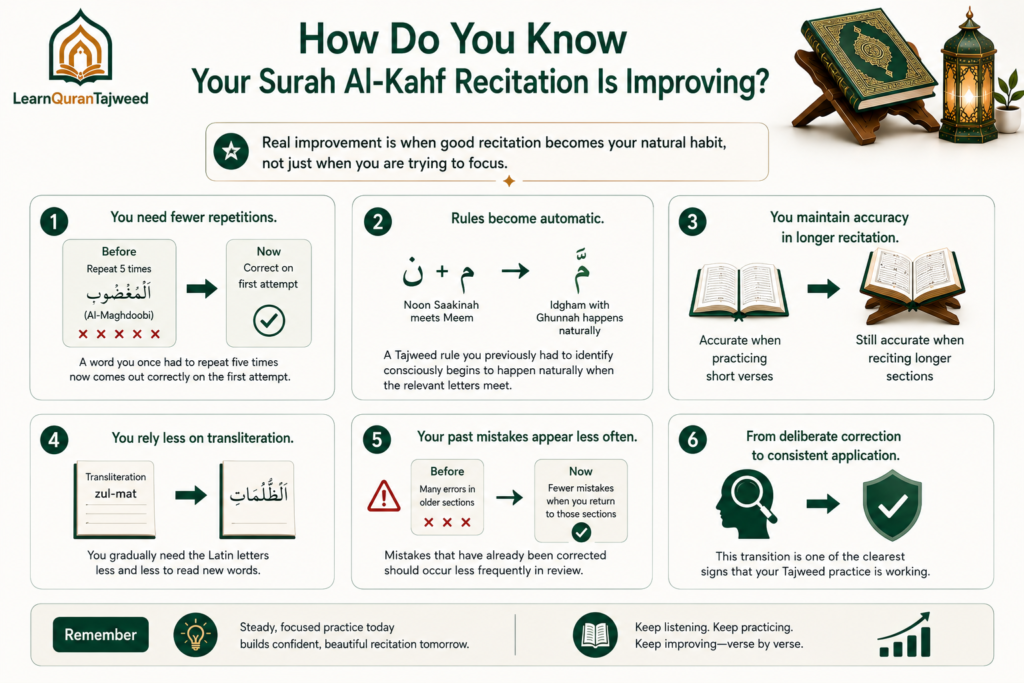
A word you once had to repeat five times now comes out correctly on the first attempt. A Tajweed rule you previously had to identify consciously begins to happen naturally when the relevant letters meet.
You can also recite a longer section without losing the accuracy you had when practicing individual verses Your dependence on transliteration should gradually decrease as well.
Most importantly, mistakes that have already been corrected should occur less frequently when you return to older sections. That transition from deliberate correction to consistent application is one of the clearest signs that your Tajweed practice is working.
See Our Classrooms in Action
Watch these short clips from our live, interactive Quran courses to see how our students learn and interact with our expert tutors.
Perfect Your Quran Recitation Today
Join expert-led Tajweed classes, and recite the Quran with confidence and clarity.
Start Your Free TrialPractice Surah Al-Kahf With Direct Tajweed Correction
Working through Surah Al-Kahf independently can help you identify difficult verses and build a consistent practice routine, but some pronunciation problems are difficult to assess from your own voice alone.
At Learn Quran Tajweed Academy, students can practice Quran recitation with qualified teachers who listen directly to their reading and correct Makharij, Madd, Ghunnah, connected recitation, and other Tajweed issues as they occur.
This allows you to take the same practice method used in this guide—short sections, focused correction, repetition, and review—and apply it with feedback from someone who can hear the details you may be missing yourself.
Courses we offer:
- Online Tajweed Classes
- Learn Quran with Tajweed Online
- Beginner Tajweed Course
- Intermediate Tajweed Course
- Advanced Tajweed Course
- Amali (Practical) Tajweed Course

Conclusion
Learning to recite Surah Al-Kahf with Tajweed is easier when you stop treating the entire Surah as a single task.
Work with a short passage, listen before reading, identify the rules that actually appear in those verses, isolate difficult words, and then return them to connected recitation. Once the section becomes stable, review it while gradually moving forward.
Over time, the sections become longer and the corrections require less conscious effort.
The goal is not simply to reach verse 110. It is to reach it without losing the pronunciation and Tajweed you worked to establish in the verses that came before it.
Frequently Asked Questions
What is the best way to begin surah al-kahf tajweed practice?
Start by listening to the surah from a reliable reciter before reading any text yourself. This builds an accurate sense of rhythm and pronunciation first, so your later reading practice corrects toward the right sound instead of a guessed one.
Can I learn Surah Al-Kahf using transliteration only?
Transliteration alone isn’t enough, because it can’t represent every Arabic sound, especially throat and emphatic letters with no English equivalent. Use it as a support tool alongside the Arabic text and audio, not as your primary reading source.
How long should I practice each day?
A focused 10 to 15 minute session is enough for steady progress, especially if you follow a fixed sequence: listen, read, repeat line by line, then read once more slowly. Short, consistent sessions outperform occasional long ones.
What should I listen for in surah al-kahf pronunciation?
Listen for where each letter is formed (makhraj), how long vowel sounds are held (madd), and where nasal sounds occur naturally (ghunnah). These three concepts cover most of what a beginner needs to notice in this surah, and working on them in this order makes each one easier to fix.
How do I know if my recitation is improving?
Record yourself reading a portion and compare it directly to the reciter’s audio for the same verses. This reveals timing and pronunciation issues you can’t easily hear while speaking in real time, and it’s the fastest way to catch a habit before it becomes fixed.
Is Surah Al-Kahf harder to practice than shorter surahs?
It isn’t harder in terms of individual letters, but its length means mistakes can compound if you read too quickly. Breaking it into short portions, practicing them consistently, and only extending once a portion feels stable addresses this directly.
Related Articles
Tajweed Resources