 Tajweed Rules

Have you ever noticed that some short surahs teach you more tajweed than a whole textbook chapter? Surah Nuh is exactly that kind of surah. In just 28 verses, it quietly contains almost every core recitation rule a beginner needs to master.
That is why Surah Nuh tajweed is such a popular study unit in Quran classes for both children and adults.
It is short enough to finish in a few sessions, yet rich enough to cover nun sakinah rules, meem sakinah rules, the madd family, qalqalah, and the two types of lam.
In this guide, you will learn which tajweed rules appear in Surah Nuh, where exactly they occur, which mistakes learners repeat most often, and how to build a realistic practice plan.
Everything is explained in plain language, with the Arabic word beside each rule so you can check it in your own mushaf.
What You Will Learn
- Why Surah Nuh works as a complete, self-contained tajweed lesson for kids and adults.
- The exact verses where all five nun sakinah rules and all three meem sakinah rules appear.
- How to handle the surah’s repeated rhyme ending (ـارًا) using madd ‘iwad.
- The most common pronunciation mistakes learners make in this surah, and how to fix them.
Surah Nuh Tajweed – Why This Surah Is a Complete Tajweed Lesson
Surah Nuh is the 71st chapter of the Quran, a Meccan surah of 28 verses located in Juz 29. It tells the story of Prophet Nuh (Noah) calling his people for centuries, and it includes the well-known verses on istighfar — seeking forgiveness — in verses 10 to 12.
From a recitation standpoint, its value is structural. The surah is short, its vocabulary repeats, and its verses are mostly brief.
That combination lets a student focus on articulation instead of struggling with length, which is why teachers introduce it early in tajweed programmes.
A. Every Nun Sakinah Rule Appears in One Short Surah
This is the strongest reason to study Surah Nuh for tajweed. All five rules of nun sakinah and tanween occur inside it — something you rarely find in such a compact chapter.
1. Izhar (Clear Pronunciation)
Izhar happens when nun sakinah or tanween is followed by one of the six throat letters (ء ه ع ح غ خ). You can hear it in عَذَابٌ أَلِيمٌ in verse 1 and أَنْهَارًا in verse 12, where the nun is pronounced clearly with no added ghunnah. Move directly from the nun to the next letter without any nasal hold.
2. Ikhfa (Light Concealment With Nasal Sound)
Ikhfa applies when nun sakinah or tanween meets one of fifteen letters, so the nun is hidden somewhere between clear pronunciation and full merging, with a two-count ghunnah. Surah Nuh offers three clear examples: أَنذِرْ and مِن قَبْلِ in verse 1, and كُنتُمْ in verse 4. Prepare your tongue for the next letter while the nasal sound continues through the nose.
3. Idgham With Ghunnah (Merging With Nasalisation)
This rule applies when nun sakinah or tanween is followed by one of the four letters of يَنمُو (ي ن م و). In أَن يَأْتِيَهُمْ (verse 1) and نَذِيرٌ مُّبِينٌ (verse 2), the nun merges into the next letter while a two-count ghunnah is held. The shaddah on the meem in مُّبِينٌ is your visual cue in the mushaf.
4. Idgham Without Ghunnah
When nun sakinah or tanween is followed by lam or ra, the nun merges completely, and no nasal sound remains. Surah Nuh’s example is نُوحٌ رَّبِّ in verse 26, where the tanween disappears into a heavy, doubled ra. Avoid adding any nasal hum before the ra, which is a common slip.
5. Iqlab (Nun Turning Into a Meem Sound)
Iqlab occurs only before the letter ba, where the nun sound changes into a hidden meem with ghunnah. You will find it in أَنبَتَكُم in verse 17, usually marked by a small meem above the nun in the mushaf. Keep your lips lightly closed without pressing them, and hold the ghunnah for two counts.
Because these examples sit in verses students memorise anyway, the rules stop feeling like abstract theory. This is the approach our tajweed circles at Learn Quran Tajweed are built around: learn the rule, then immediately find it in a verse you are already reciting.
B. The Meem Sakinah Rules Are All Here Too
The three meem sakinah rules also show up naturally, so you can teach the full set from one surah.
1. Idgham Shafawi and Ikhfa Shafawi
Idgham shafawi appears in لَكُم مِّن (verse 4) and عَلَيْكُم مِّدْرَارًا (verse 11), where the two meems merge into one held nasal sound. Ikhfa shafawi appears in وَيُمْدِدْكُم بِأَمْوَالٍ (verse 12), where the meem is concealed before the letter ba. In both cases, hold the ghunnah for a full two counts so the lips have time to settle on the sound.
b. Izhar Shafawi (The Clear Meem)
Izhar shafawi, the clear meem, is easiest to hear in أَلَمْ تَرَوْا (verse 15) and لَكُمْ جَنَّاتٍ (verse 12). Take extra care before fa and waw, as in أَصَابِعَهُمْ فِي and ثِيَابَهُمْ وَأَصَرُّوا (verse 7), where the meem must stay clear and not be hidden. Reading these three cases back to back in a single sitting trains the ear faster than isolated drills.
C. The Madd Family, From Two Counts to Five
Surah Nuh gives you a clean ladder of elongation types. Madd wajib muttasil (4–5 counts) appears in جَاءَ (verse 4), دُعَائِي (verse 6), and السَّمَاءَ (verse 11).
Madd jaiz munfasil opens the surah in إِنَّا أَرْسَلْنَا, and returns in إِلَىٰ أَجَلٍ (verse 4). Madd badal appears in آذَانِهِمْ (verse 7), and madd silah sughra in إِنَّهُ كَانَ (verse 10).
D. Qalqalah and the Two Types of Lam
Qalqalah sughra — the light echo on a letter with sukoon inside a word — is practised in قَبْلِ (verse 1), يَزِدْهُمْ (verse 6), and وَقَدْ (verse 14). Keep the bounce light; over-bouncing is the most common beginner error here.
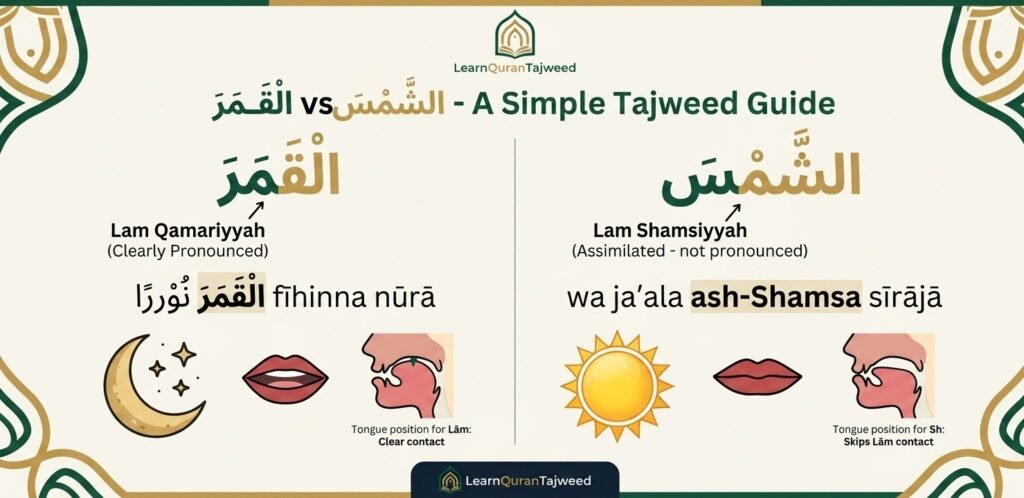
Verse 16 is a gift for teaching lam: وَجَعَلَ الْقَمَرَ فِيهِنَّ نُورًا وَجَعَلَ الشَّمْسَ سِرَاجًا. The same verse contains lam qamariyyah in الْقَمَرَ (pronounced clearly) and lam shamsiyyah in الشَّمْسَ (assimilated). One verse, both rules, no extra explanation needed.
See Our Classrooms in Action
Watch these short clips from our live, interactive Quran courses to see how our students learn and interact with our expert tutors.
Perfect Your Quran Recitation Today
Join expert-led Tajweed classes, and recite the Quran with confidence and clarity.
Start Your Free TrialHow to Read Surah Nuh With Tajweed: A Practical Method
Knowing the rules and applying them fluently are two different skills. The method below is what we use with students who want to read Surah Nuh with tajweed correctly rather than just recognise the rules on paper.
The order matters. Learners who jump straight to full-verse recitation tend to build habits that take months to unlearn, so each stage below closes one gap before opening the next.
Step 1: Fix the Letters Before the Rules
Start with makharij — the articulation points. Surah Nuh leans heavily on emphatic letters: طِبَاقًا (verse 15), أَطْوَارًا (verse 14), and الظَّالِمِينَ (verse 28).
Read these three words alone, slowly, ten times each. If the ta in طِبَاقًا sounds like an English “t”, the tajweed rules layered on top will not rescue the recitation.
Step 2: Master the Rhyme Ending With Madd ‘Iwad
Here is a detail specific to this surah. From verse 5 onward, almost every verse ends in tanween fath: وَنَهَارًا, فِرَارًا, جِهَارًا, غَفَّارًا, مِّدْرَارًا, أَنْهَارًا, أَطْوَارًا, and so on.
When you stop on any of these, the tanween is dropped, and you elongate for two counts. That is madd ‘iwad. Because the pattern repeats more than fifteen times, one correct habit carries you through most of the surah.
Step 3: Recite Three Verses at a Time
Take verses 1 to 3, then 4 to 6, and so on. Recite each block slowly (tahqiq), then at normal pace (tadwir), naming the rules aloud on the slow pass.
Blocks of three keep working memory free for pronunciation. This is also how our teachers structure live sessions, so students always leave a class having completed something whole rather than half a page.
Step 4: Record Yourself and Compare
Record your recitation on your phone, then listen alongside a trusted reciter. Focus on one thing per listen — ghunnah length, then madd counts, then stopping points.
Self-correction has a ceiling, though. Errors in sifat (letter qualities) are notoriously hard to hear in your own voice, which is exactly where a qualified teacher’s ear saves you months.
Inside Learn Quran Tajweed Academy
Curious about how online learning works? Peek inside our actual Quran classes and hear the beautiful recitation of our students and teachers.
Perfect Your Quran Recitation Today
Join expert-led Tajweed classes, and recite the Quran with confidence and clarity.
Start Your Free TrialCommon Mistakes Students Make in Surah Nuh
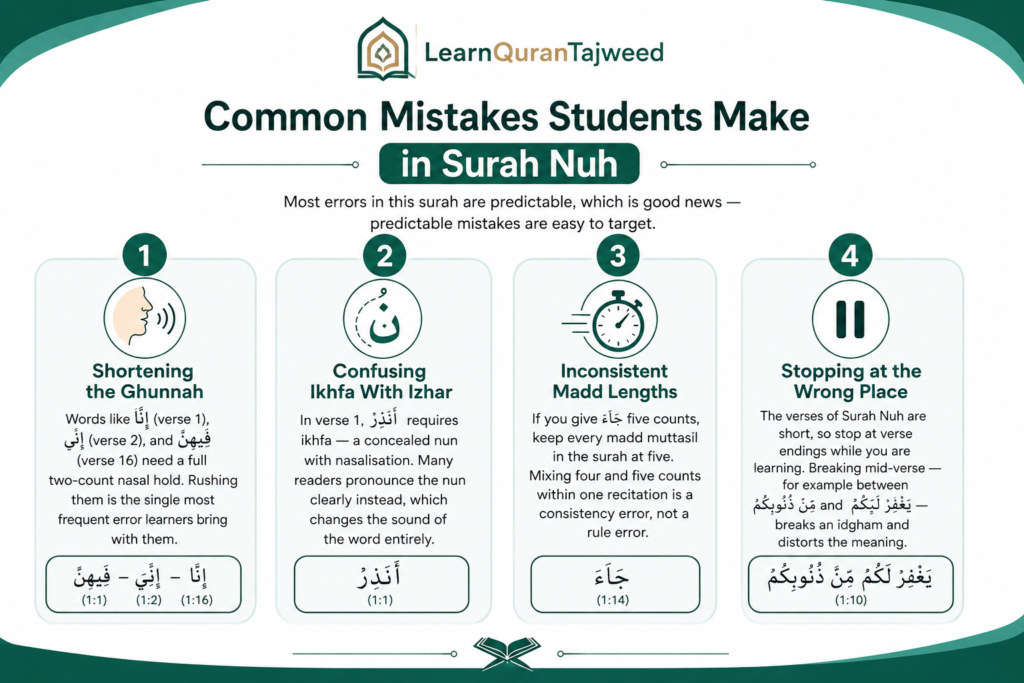
Most errors in this surah are predictable, which is good news — predictable mistakes are easy to target. Here are the four that appear most often in class.
1. Shortening the Ghunnah
Words like إِنَّا (verse 1), إِنِّي (verse 2), and فِيهِنَّ (verse 16) need a full two-count nasal hold. Rushing them is the single most frequent error learners bring with them.
The same applies to the doubled meem in ثُمَّ (verses 8, 9 and 18), which also carries a full ghunnah. A simple fix is to count the hold silently on your fingers until the two-count length becomes automatic. If the ghunnah is too short, the doubled letter sounds like a single one.
2. Confusing Ikhfa With Izhar
In verse 1, أَنذِرْ requires ikhfa — a concealed nun with nasalisation. Many readers pronounce the nun clearly instead, which changes the sound of the word entirely.
The same slip often appears in مِن قَبْلِ and كُنتُمْ. To fix it, keep your tongue from pressing fully on the nun position and let the sound pass through the nose while you prepare for the next letter. Comparing it with the clear nun in أَنْهَارًا (verse 12) helps your ear hear the difference.
3. Inconsistent Madd Lengths
If you give جَاءَ five counts, keep every madd muttasil in the surah at five. Mixing four and five counts within one recitation is a consistency error, not a rule error.
The same principle applies to madd munfasil: whatever length you choose for إِنَّا أَرْسَلْنَا, keep it for every munfasil until the end. Decide your counts before you begin, and check them by recording the full surah. Madd ‘iwad at the verse endings, however, always stays at two counts.
4. Stopping at the Wrong Place
The verses of Surah Nuh are short, so stop at verse endings while you are learning. Breaking mid-verse — for example, between يَغْفِرْ لَكُم and مِّن ذُنُوبِكُمْ — breaks an idgham and distorts the meaning.
If you run out of breath mid-verse, go back to a suitable starting point and repeat the phrase rather than continuing from the word you stopped on. The small waqf signs in your mushaf show you where pausing is permissible. With practice, breath control will let you finish each verse in one breath.
Start Your Surah Nuh Tajweed Lessons With a Qualified Teacher Today
Reading about tajweed rules will only take you so far — correct recitation is transmitted through listening and correction.
At Learn Quran Tajweed, our tajweed and Quran recitation circles pair you with a certified teacher who listens to every verse, corrects your makharij and sifat on the spot, and moves you forward at your own pace.
Classes are available for children and adults, one-to-one and online, with flexible scheduling and a structured curriculum that starts exactly where you are.
Courses we offer:
- Online Tajweed Classes
- Learn Quran with Tajweed Online
- Intermediate Tajweed Course
- Advanced Tajweed Course
- Tajweed Course for Adults
- Tajweed Course for Ladies
- Tajweed ul Quran Course
- Quran Recitation with Tajweed Course
- Quran Tarteel Course
- Tajweed Ijazah Program
Book your free trial session and recite Surah Nuh correctly, from the first verse to the last.
Perfect Your Quran Recitation Today
Join expert-led Tajweed classes, and recite the Quran with confidence and clarity.
Start Your Free TrialConclusion
Surah Nuh is far more than a 28-verse chapter about Prophet Nuh’s mission. It is a compact and complete tajweed workshop, holding all five nun sakinah rules, all three meem sakinah rules, several madd types, qalqalah, and both forms of lam — often within neighbouring verses.
Study it in stages: fix your letters first, then master the repeated ـارًا rhyme with madd ‘iwad, then work in blocks of three verses until the whole surah flows. Watch for the four common errors, and keep your madd lengths consistent throughout.
The skills you build here also carry into the rest of the Quran. Once you can recite Surah Nuh accurately, you will spot the same rules quickly in other surahs of Juz 29 and beyond. Your recitation will get faster and more confident with each new chapter.
Take-away message: working on Surah Nuh tajweed is one of the most efficient ways to build a solid recitation foundation — but the rules only become real when a qualified ear corrects you. Read the rules, then read them aloud to a teacher.
FAQs
How many verses does Surah Nuh have?
Surah Nuh has 28 verses. It is the 71st chapter of the Quran, a Meccan surah, and it is found in Juz 29 between Surah Al-Ma’arij and Surah Al-Jinn.
Which tajweed rules are found in Surah Nuh?
Surah Nuh contains all five nun sakinah and tanween rules (izhar, ikhfa, idgham with and without ghunnah, and iqlab), all three meem sakinah rules, qalqalah sughra, several madd types including muttasil, munfasil, badal, and ‘iwad, and both lam shamsiyyah and lam qamariyyah.
Is Surah Nuh good for beginners learning tajweed?
Yes. Its verses are short, its vocabulary repeats, and its rhyme pattern is consistent, so beginners can focus on pronunciation rather than length while still meeting nearly every foundational rule.
How long does it take to learn Surah Nuh with tajweed?
Most students reach accurate recitation in three to five weeks with two or three guided sessions per week. Children usually need shorter, more frequent sessions; adults progress faster with longer sessions and written practice.
What is the difference between reciting Surah Nuh and memorising it?
Recitation with tajweed focuses on correct articulation and rule application while reading from the mushaf. Memorisation (hifz) comes after that, because memorising a verse incorrectly makes the error much harder to correct later.
Can I learn Surah Nuh tajweed online?
Yes. Live online lessons work well for tajweed because the teacher hears your recitation in real time and corrects it immediately, which is the essential element.
Related Articles
Tajweed Rules