 Tajweed Rules

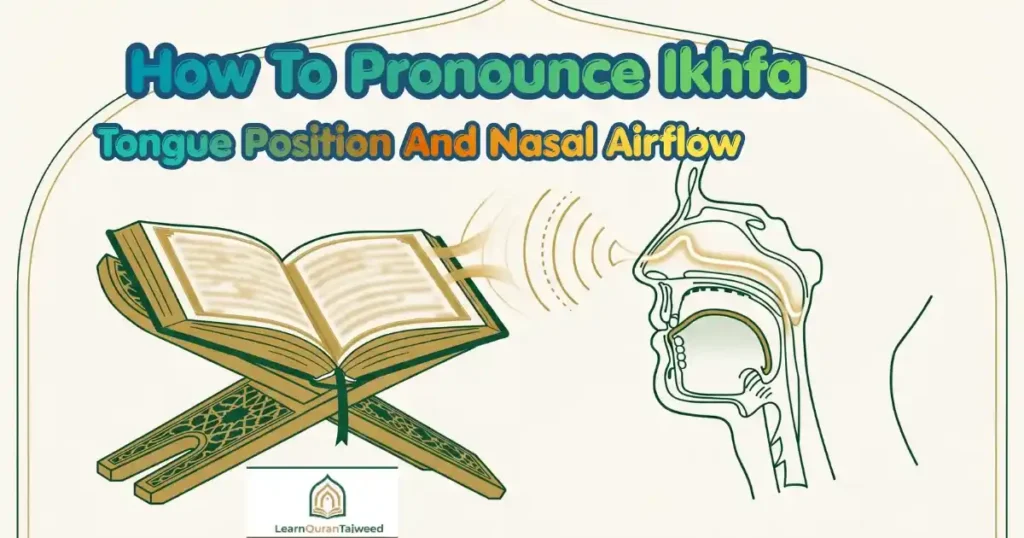
Learning how to pronounce ikhfa comes down to one sound: the nasal hum that sits between a clear noon and a fully merged one. Read مِن شَرِّ and listen. Do you hear a clear “min,” or does the noon vanish completely? Both are mistakes.
Ikhfa is one of the most frequent rules in the Quran, so getting it right changes how almost every page of your recitation sounds. This guide shows you exactly what your tongue, nose, and voice do during ikhfa.
You’ll get a four-step pronunciation method, the tongue position for each group of the 15 letters, the heavy-and-light rule for the ghunnah, and the five mistakes English speakers make most often, with a fix for each.
Step 1 – Say The Letter Before The Noon Normally
Ikhfa (الإخفاء, “concealment”) is the rule of pronouncing a noon sakinah or tanween in a state between izhar (clear pronunciation) and idgham (full merging), without a shaddah, while keeping a nasal ghunnah for two counts. The noon is not said clearly, and it is not swallowed into the next letter either.
It is hidden, and what remains audible is the nasal hum. We call it the “Approach–Hum–Release method”: say the preceding letter normally, approach the next letter’s articulation point, hum through the nose for two counts, then release into the next letter.
Pronounce the letter carrying the vowel before the noon sakinah exactly as you would anywhere else. In مِن شَرِّ, say the “mi” crisply; in أَنزَلْنَاهُ, say the “a” with no change. Do not stretch this vowel. A common habit is drawing it out (“meeen”) because you sense something nasal is coming. That extra length turns a short vowel into an unwanted madd. The vowel stays short; the length belongs to the ghunnah.
Step 2 – Move The Tongue Toward The Next Letter, Not To The Noon
This is the core of ikhfa. Instead of placing your tongue tip on the gum ridge behind the upper teeth (where a clear noon is made), you move it toward the articulation point of the letter that comes next.
The tongue gets close to that point without pressing firmly on the noon’s position. That near-contact is what makes the sound “between” izhar and idgham.
This means the position changes with each letter: the tongue tip hovers near the front teeth before ت or س, the middle of the tongue rises before ج or ش, and the lower lip approaches the upper teeth before ف.
Timing matters as much as position. The tongue should start moving the moment the vowel before the noon ends, so it is already in place when the hum begins. A late move produces a short, clear “n” first, then the ikhfa.
Classical Tajweed scholars also note that ikhfa is not equally strong before every letter. Concealment is strongest before ت د ط, whose articulation point is closest to the noon, weakest before ق ك, which are farthest away, and moderate before the remaining letters.
Step 3 – Hum The Ghunnah Through The Nose For Two Counts
While the tongue is hovering in that prepared position, release the sound through the nasal passage (al-khayshum), the nasal cavity at the back of the nose. This nasal resonance is called the ghunnah, and it lasts two counts.
Classical works such as Ghayat al-Murid measure two counts by closing or opening a finger twice at an even, steady pace. Al-Marsafi in Hidayat al-Qari adds that the ghunnah should be smooth, without stretching it unnaturally or chewing the sound, and never longer or shorter than its measure.
Keep the hum at a steady volume from start to finish. A ghunnah that swells in the middle or fades away before the next letter sounds uneven, even when its length is correct.
To confirm the sound is truly nasal, rest a fingertip lightly on the side of your nose while humming. You should feel a gentle vibration. If you feel nothing, the sound is coming from the mouth instead.
See Our Classrooms in Action
Watch these short clips from our live, interactive Quran courses to see how our students learn and interact with our expert tutors.
Perfect Your Quran Recitation Today
Join expert-led Tajweed classes, and recite the Quran with confidence and clarity.
Start Your Free TrialStep 4 – Release Into The Next Letter
After two counts, complete the contact for the next letter and pronounce it with its own vowel. Because your tongue was already near that position, the transition should feel short and seamless.
If you can hear a gap, a clear “n,” or a doubled letter at this point, one of the earlier steps went wrong.
Use the sound to diagnose. A clear “n” means the tongue touched the noon’s position in Step 2. A doubled letter means you merged with a shaddah instead of humming. A gap means the ghunnah stopped before the tongue arrived, so the airflow broke between the hum and the letter.
Practicing these four steps alone builds the shape of the sound, but only a listener can confirm your ghunnah length and tongue position. In Learn Quran Tajweed’s live online classes, a teacher hears each ikhfa you recite and corrects it on the spot, before a bad habit sets in.
Read also: Ikhfa Letters – The 15 Letters Of Ikhfa, How To Pronounce Them And Examples From The Quran

When Does Ikhfa Apply?
Ikhfa applies when a noon sakinah (نْ) or tanween (ـً ـٌ ـٍ) is followed by one of 15 letters: ت ث ج د ذ ز س ش ص ض ط ظ ف ق ك. Tanween counts because it is a noon sakinah that is pronounced but not written.
Classical teachers gather these letters in the first letter of each word in this line:
صِفْ ذا ثَنا كَمْ جادَ شَخْصٌ قَدْ سَما … دُمْ طَيِّباً زِدْ في تُقىً ضَعْ ظالِما
“Describe the one who possesses praise and glory; how many generous people have attained greatness. Remain good, increase in piety, and leave the unjust behind.”
Ikhfa happens in three situations:
1. Across two words with noon sakinah:
مِن شَرِّ
From the evil
2. Inside a single word:
أَنزَلْنَاهُ
We sent the Qur’an down
(Al-Qadr, 1). This only happens with noon sakinah, never tanween.
3. Across two words with tanween:
عَذَابٌ شَدِيدٌ
a severe punishment
Two edge cases catch learners out. First, ikhfa only applies when you connect the words. If you stop on a word ending in tanween, as at the end of مِّن سِجِّيلٍ (Al-Fil, 4), there is no ikhfa because no letter follows.

How To Spot Ikhfa In The Mushaf
In most mushafs printed in the Madinah style, the noon in an ikhfa position carries no sukoon mark. That missing sukoon is your signal that the noon is not pronounced clearly.
To tell ikhfa apart from idgham, look at the next letter. If the noon has no sukoon and the next letter has no shaddah, it is ikhfa. If the next letter has a shaddah, as in مِن رَّبِّهِمْ, the noon is merged (idgham).
For tanween, the two vowel marks are written staggered (one slightly after the other) rather than stacked directly on top of each other. Stacked marks signal izhar; staggered marks signal ikhfa or idgham, and the shaddah test above tells you which one.
A quick summary of the Madinah mushaf signals:
- Sukoon on the noon / stacked tanween: izhar; say the noon clearly
- No sukoon + no shaddah on the next letter: ikhfa
- No sukoon + shaddah on the next letter: idgham
- Small meem (ـۢ) above the noon or tanween: iqlab
Read also: Imala In Tajweed – What It Means And How To Pronounce It Correctly

Where Your Tongue Goes Before Each Group Of Ikhfa Letters
Because ikhfa borrows its tongue position from the following letter, the “same” rule sounds slightly different before different letters. Grouping the 15 letters by articulation area makes this easier to practice.
This approach helps learners recognize subtle pronunciation differences and avoid applying one fixed tongue position to every ikhfa letter.
The groupings below follow standard makharij (articulation points) and describe where the tongue approaches during the hum. Practicing each group separately helps develop better control over tongue movement and nasalization. It also makes it easier to distinguish between the different ikhfa sounds during continuous Quran recitation.
1. Tip Of The Tongue Near The Upper Teeth Or Gum Ridge
This group covers nine of the 15 letters, so it is where most of your ikhfa practice happens. The tongue tip does the work, but its exact target shifts within three sub-groups.
Before ت د ط, the tongue tip hovers near the gum ridge behind the upper front teeth, as in مِن تَحْتِهَا and يَنطِقُونَ. This is right beside the noon’s own point, so learners often over-pronounce the “n” here. Keep a small gap until the hum ends.
Before ث ذ ظ, the tongue tip moves forward toward the edges of the upper front teeth, as in
مَّنثُورًا
dispersed
and مِّن ظَهِيرٍ
any assistant
(Saba, 22). The common error is holding the tongue back, which produces a clear noon. Use a mirror: the tongue tip should be just visible.
2. Middle And Back Of The Tongue
These letters are made further back in the mouth, so the tongue tip stays down and relaxed during the hum. If you feel the tip rising toward the gum ridge, you are drifting back into a clear noon.
Before ج ش, the middle of the tongue rises toward the hard palate, as in
مِّن جُوعٍ
from hunger
(Quraysh, 4) and مِن شَرِّ
From the evil
(Al-Falaq, 2). Before ض, one or both sides of the tongue move toward the upper molars, as in
مَّنضُودٍ
layered hard clay
(Hud, 82), with a heavy ghunnah.
Before ق and ك, the back of the tongue rises toward the soft palate. For ق, the contact point is deeper, and the ghunnah is heavy, as in مِن قَبْلِ. For ك, it is slightly forward, and the ghunnah is light, as in مِنكُمْ. Reciting these two back to back is one of the best drills for feeling the heavy-light difference.
3. The Lips
ف is the only ikhfa letter made with the lips. During the hum, the inner part of the lower lip moves lightly toward the tips of the upper front teeth, as in
يُنفِقُونَ
spend out
(Al-Baqarah, 3) and مِن فَضْلِهِ
His favor
The tongue has no contact role here, so it rests low while the ghunnah flows through the nose. If the tongue tip touches the gum ridge, you will hear a clear “n” before the ف.
The other common mistake is closing both lips fully, which turns the hum into an “m” sound, closer to iqlab or ikhfa shafawi. Keep the contact light, between the lower lip and upper teeth only, and the ghunnah stays a true ikhfa.

When Is The Ikhfa Ghunnah Heavy Or Light?
The ghunnah of Ikhfa follows the letter after it in heaviness (tafkhim) or lightness (tarqiq). This is the opposite of the alif of madd, which follows the preceding letter.
Understanding this difference helps learners apply the correct tongue position and maintain accurate pronunciation. It also ensures that the nasal sound blends smoothly with the following letter without losing its proper quality.
This single rule determines whether your ghunnah sounds full and deep or thin and forward. Paying attention to the following letter prevents inconsistent nasalization and helps produce a smoother, more accurate recitation. Regular practice with both heavy and light Ikhfa letters makes this distinction easier to recognize and apply.
1. Heavy Ghunnah Before The Five Elevated Letters
The ghunnah becomes heavy when the next letter is one of the elevated (isti’la) letters. The full set of elevated letters is خص ضغط قظ, but only five of them are ikhfa letters: ص ض ط ظ ق.
(خ and غ are elevated too, but they are throat letters, so a noon before them takes izhar, not ikhfa.)
Here is one example for each heavy letter, so you can practice all five:
ص: مِن صَلْصَالٍ
out of clay
ض: مَّنضُودٍ
layered hard clay
(Hud, 82)
ط: يَنطِقُونَ
speak
2. Light Ghunnah Before The Other Ten Letters
Before the remaining ten ikhfa letters (ت ث ج د ذ ز س ش ف ك), the ghunnah is light. Examples: مَا نَنسَخْ
We do not abrogate
(Al-Baqarah, 106) and مُنفَكِّينَ
were not to be parted
A light ghunnah keeps the back of the tongue low and the sound forward in the face, closer to the nose than the throat. It should sound clear and thin, not hollow.
The rule depends only on the letter after the noon, never the letter before it. In خَلْقًا جَدِيدًا
a new creation
(Al-Isra, 49), the tanween sits on a heavy ق, yet the ghunnah is light because the next letter, ج, is light. Learners often carry the ق’s heaviness into the ghunnah here.
Know Where Ikhfa Ends, And Ikhfa Shafawi Begins
Ikhfa shafawi is a separate rule: a meem sakinah followed by ب, with the lips closed lightly during a two-count ghunnah. It shares the name and the hum but uses the lips, not the tongue’s approach.
Once ikhfa is steady, the related rules to study next are izhar, idgham, and iqlab (the other three noon sakinah rules), then the meem sakinah rules. A structured Tajweed course at Learn Quran Tajweed takes you through all of them in that order, so each new rule builds on a sound you already own.
Read also: How To Recite Surah Al-Mulk With Tajweed?
Perfect Your Quran Recitation Today
Join expert-led Tajweed classes, and recite the Quran with confidence and clarity.
Start Your Free TrialCommon Ikhfa Mistakes And How To Fix Them
Most ikhfa errors come from three sources: the tongue lands in the wrong place, the timing is off, or the learner’s first language interferes. These mistakes can affect the clarity and natural flow of recitation, even when the learner knows the rule theoretically.
Knowing the specific error makes it far quicker to correct. With focused practice and feedback from a qualified teacher, learners can gradually develop more accurate and consistent ikhfa pronunciation.
Regular listening to a skilled reciter also helps reinforce the correct sound and identify subtle pronunciation mistakes.
1. Turning Ikhfa Into An English “Ng”
Before ق and ك, English speakers often produce the “ng” of “sing” or “think.” That happens because the tongue’s back fully closes against the soft palate, which creates a complete sound, not a concealed one.
The fix: keep the back of the tongue raised but not sealed during the two counts, then complete the closure only for the ق or ك itself.
2. Saying A Clear Noon (Accidental Izhar)
If your tongue tip presses fully onto the gum ridge, you produce a clear “n,” which is izhar, not ikhfa. This is most common before ت د ط, as in أَنتُمْ and مِن دُونِ, because those letters sit right next to the noon’s point.
The habit usually comes from reading every noon the same way, or from the English “n,” which always involves full tongue contact.
The fix: recite slowly and hold the tongue tip a hair’s width away from the gum ridge during the hum. You should feel no contact until the ت, د, or ط itself.
3. Merging With A Shaddah (Accidental Idgham)
Reading مِن شَرِّ as “mish-sharri” doubles the ش and drops the ghunnah. Ikhfa never adds a shaddah; the hum must stay audible for its full two counts.
This error mostly appears when reading fast, as the noon gets skipped to reach the next letter sooner. The result is idgham, a rule that belongs only to the six letters ي ر م ل و ن.
The fix: compare a true idgham, such as مِن رَّبِّهِمْ, with مِن شَرِّ. In the first, the noon disappears into a doubled ر. In the second, you should still hear a nasal hum before a single, undoubled ش.
4. Getting The Length Wrong
A ghunnah of one count sounds rushed; three or four counts sound dragged. Tap two even beats with your finger while reciting until the length becomes automatic.
The two counts are relative to your recitation speed. In slow recitation (tahqiq), they are longer; in fast recitation (hadr), they are shorter. What stays fixed is the proportion: the ghunnah equals two short vowels at your current pace.
The less obvious error is inconsistency, where one ghunnah is short, and the next is long within the same passage. Recording yourself reading a page and listening only to the ghunnahs is the quickest way to catch this.
5. The Nose-Pinch Self-Check
Hum the ghunnah, then gently pinch your nose. If the sound stops or changes sharply, it was nasal and correct. If nothing changes, the sound came from the mouth, and the ghunnah is missing.
Use the same test in reverse on the vowel before the noon. Pinch your nose while saying the “mi” of مِن شَرِّ: the sound should not change. If it does, you are nasalizing the vowel too early, which blurs the letter before the ikhfa even begins.
The check confirms that the ghunnah is nasal, but it cannot confirm tongue position or heaviness. Those still need a trained ear, whether a teacher’s or a careful comparison with a recognized reciter.

How To Practice Ikhfa With Real Verses
Practicing ikhfa through real Quranic verses helps learners apply the rule naturally rather than recognizing it only in isolated words. Start with short examples containing noon sakinah or tanween followed by an ikhfa letter, and repeat each example slowly while focusing on the correct ghunnah, tongue position, and timing.
Once you can pronounce these combinations accurately, move on to longer verses and gradually increase your recitation speed without losing clarity. Listening to a qualified reciter and repeating after them can also help you recognize the subtle differences between the 15 ikhfa letters and develop smoother, more confident Quran recitation.
A Three-Stage Practice Routine
This routine moves from single sounds to full verses, so each stage trains one skill before adding the next. Spend a few focused minutes on each stage, and move forward only when the previous one feels controlled.
Stage 1 – pairs: recite the hum into one letter at a time, choosing one letter from each tongue group: “an-ta,” “an-sa,” “an-sha,” “an-qa,” “an-ka,” “an-fa.” Check your tongue position, tap two counts, and use the nose-pinch test. Then contrast “an-qa” (heavy) with “an-ka” (light) until you can hear the difference clearly.
Stage 2 – short verses: recite
مِن شَرِّ مَا خَلَقَ
From the evil of that which He created
(Al-Falaq, 2),
إِنَّا أَنزَلْنَاهُ فِي لَيْلَةِ الْقَدْرِ
Indeed, We sent the Qur’an down during the Night of Decree.
(Al-Qadr, 1),
and مِّن جُوعٍ
from hunger
(Quraysh, 4). Listen to a recognized reciter such as al-Husary first, then repeat. His teaching recitation (al-Mushaf al-Mu’allim) pauses after each phrase, leaving space for you to repeat it.
Stage 3 – find it yourself: read a verse and mark each ikhfa before reciting, noting its tongue group and whether the ghunnah is heavy or light. In
تَرْمِيهِم بِحِجَارَةٍ مِّن سِجِّيلٍ
Striking them with stones of hard clay
(Al-Fil, 4), the ikhfa is in مِّن سِجِّيلٍ: a tongue-tip letter with a light ghunnah. The tanween at the end of سِجِّيلٍ has no ikhfa, because you stop there.
Read also: Idgham Letters – The 6 Letters Of Idghaam, 2 Types, And Examples From The Quran
Inside Learn Quran Tajweed Academy
Curious about how online learning works? Peek inside our actual Quran classes and hear the beautiful recitation of our students and teachers.
Perfect Your Quran Recitation Today
Join expert-led Tajweed classes, and recite the Quran with confidence and clarity.
Start Your Free TrialStart Reciting Ikhfa Correctly With A Live Tajweed Teacher
Reading about ikhfa gives you the method. Hearing a teacher say “your tongue touched too early” gives you the result. Most learners can’t hear their own ikhfa errors, especially the “ng” slip and an uneven ghunnah.
With Learn Quran Tajweed, you recite to a qualified teacher in one-on-one online sessions from home, at times that fit your schedule. Every ikhfa, every ghunnah, every heavy and light letter gets checked in real time.
Book your first class today and hear the difference in your recitation.
Courses we offer:
- Online Tajweed Classes
- Learn Quran with Tajweed Online
- Beginner Tajweed Course
- Intermediate Tajweed Course
- Advanced Tajweed Course
- Amali (Practical) Tajweed Course
Perfect Your Quran Recitation Today
Join expert-led Tajweed classes, and recite the Quran with confidence and clarity.
Start Your Free TrialConclusion
Ikhfa is the concealment of a Noon Sakinah or Tanween before 15 letters, pronounced between Izhar and Idgham with a two-count Ghunnah and no Shaddah. Unlike Izhar, the Noon is not pronounced clearly, and unlike Idgham, it does not merge completely into the following letter.
To pronounce Ikhfa, follow the Approach–Hum–Release method: say the letter before it normally, move your tongue toward the next letter’s articulation point, hum through the nose for two counts, then release.
Match the Ghunnah’s heaviness to the next letter: heavy before ص ض ط ظ ق and light before the rest. Keep the nasal sound smooth and controlled without pressing the tongue against the Noon’s articulation point.
The key takeaway: Ikhfa is decided by the letter that comes after the Noon. Prepare for that letter, and the correct sound follows. Practicing examples with both heavy and light letters will help you develop consistent pronunciation and recognize the rule more easily during recitation.
Frequently Asked Questions
What Is Ikhfa In Tajweed?
Ikhfa is the Tajweed rule of pronouncing a noon sakinah or tanween between clear pronunciation and full merging, with a two-count nasal ghunnah. It applies before 15 letters: ت ث ج د ذ ز س ش ص ض ط ظ ف ق ك.
How Do You Do Ikhfa Step By Step?
To do ikhfa, say the preceding letter normally, bring your tongue near the next letter’s articulation point without pressing on the noon’s position, hum through the nose for two counts, and then pronounce the next letter.
How Long Is The Ghunnah In Ikhfa?
The ikhfa ghunnah lasts two counts (harakatain). You can measure it by closing or opening a finger twice at a steady pace while reciting.
Is The Ikhfa Ghunnah Heavy Or Light?
The ikhfa ghunnah follows the next letter. It is heavy before ص ض ط ظ ق and light before the other ten ikhfa letters, as in يَنطِقُونَ (heavy) and مَا نَنسَخْ (light).
What Is The Difference Between Ikhfa And Ikhfa Shafawi?
Ikhfa applies to noon sakinah and tanween before 15 letters, using the tongue’s approach to the next letter. Ikhfa shafawi applies only to meem sakinah before ب, using lightly closed lips with a two-count ghunnah.
Why Does My Ikhfa Sound Like “Ng”?
An “ng” sound in ikhfa means the back of your tongue is fully closing against the soft palate, usually before ق or ك. Keep the tongue raised but not sealed during the ghunnah, and close it only for the next letter.
Related Articles
Tajweed Rules