 Tajweed Resources

Reciting Surah Al-Mulk with Tajweed requires more than reading its 30 verses slowly. The Surah brings together several important Tajweed rules, including different types of Madd, Ghunnah, Noon Sakinah and Tanween, Qalqalah, Shaddah, and rules that become especially noticeable when stopping at the ends of verses.
Instead of learning these rules only as separate definitions, this guide takes you through them using examples directly from Surah Al-Mulk. You will first learn to recognize each sound in the verses, then see how several rules work together during continuous recitation.
1. Begin With the Natural Madd Sounds in Surah Al-Mulk
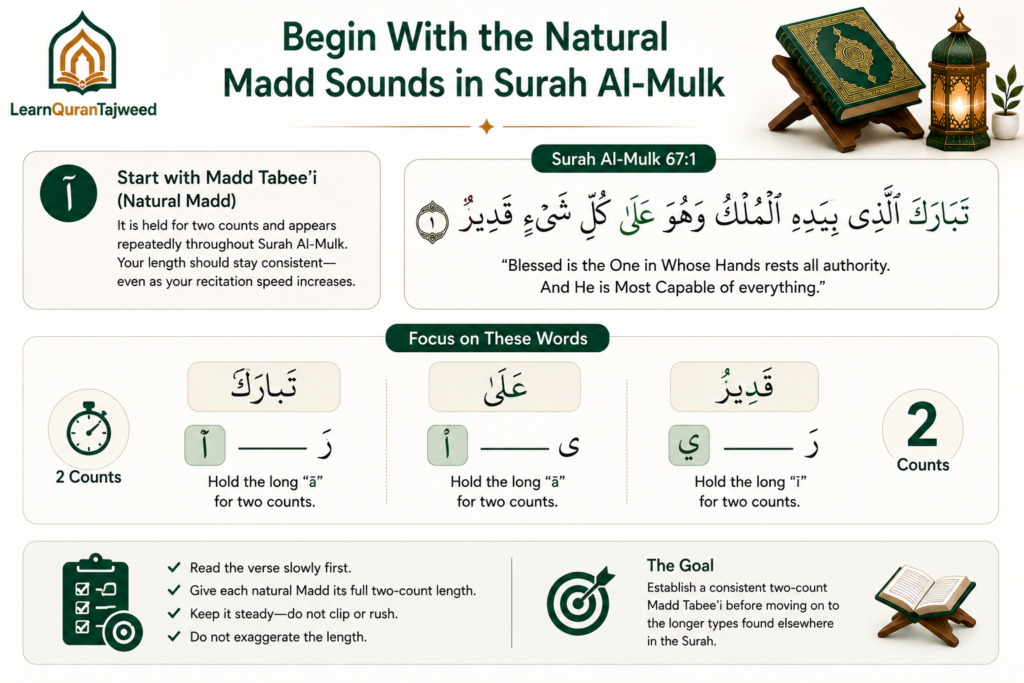
Start with Madd Tabee’i, or natural Madd, because it appears repeatedly throughout Surah Al-Mulk. It is held for two counts and should remain consistent even when you increase your recitation speed.
Allah says:
تَبَارَكَ ٱلَّذِى بِيَدِهِ ٱلْمُلْكُ وَهُوَ عَلَىٰ كُلِّ شَىْءٍ قَدِيرٌ
“Blessed is the One in Whose Hands rests all authority. And He is Most Capable of everything.” Surah Al-Mulk 67:1
Words such as تَبَارَكَ, عَلَىٰ, and قَدِيرٌ contain long vowel sounds that should not be clipped or rushed. Read them slowly first and make sure the long vowel receives its full natural length without being exaggerated.
The goal is to establish a consistent two-count Madd before dealing with the longer types that appear elsewhere in the Surah.
2. Distinguish Longer Madd From Natural Madd
Not every stretched sound in Surah Al-Mulk has the same length. Once you can recognize the two-count natural Madd, begin noticing places where the presence of a Hamzah or Sukoon changes the required length.
A clear example appears in verse 5:
وَلَقَدْ زَيَّنَّا ٱلسَّمَآءَ ٱلدُّنْيَا بِمَصَـٰبِيحَ وَجَعَلْنَـٰهَا رُجُومًۭا لِّلشَّيَـٰطِينِ وَأَعْتَدْنَا لَهُمْ عَذَابَ ٱلسَّعِيرِ
“And indeed, We adorned the lowest heaven with lamps, and made them as missiles for stoning devils, for whom We have also prepared the torment of the Blaze.” Surah Al-Mulk 67:5
In ٱلسَّمَآءَ, the Madd letter is followed by a Hamzah within the same word. This is Madd Muttasil, which is prolonged for four or five counts in the commonly taught Hafs recitation, rather than the two counts of Madd Tabee’i.
Compare ٱلسَّمَآءَ with a natural Madd such as تَبَارَكَ. Hearing and maintaining this difference helps prevent the common mistake of giving every long vowel the same duration.\
Read also: How to recite Surah Kahf Tajweed Quran?
3. Keep Ghunnah Clear in Noon and Meem Mushaddadah
When Noon or Meem carries a Shaddah (نّ or مّ), it is pronounced with a clear Ghunnah for two counts. Surah Al-Mulk contains several examples, including ثُمَّ, زَيَّنَّا, جَهَنَّمَ, and إِنَّ.
For example, Allah says:
ثُمَّ ٱرْجِعِ ٱلْبَصَرَ كَرَّتَيْنِ يَنقَلِبْ إِلَيْكَ ٱلْبَصَرُ خَاسِئًۭا وَهُوَ حَسِيرٌ
“Then look again and again—your sight will return frustrated and weary.” Surah Al-Mulk 67:4
In ثُمَّ, the Meem carries a Shaddah, so its Ghunnah should be held for two counts. Keep the nasal sound clear and controlled without exaggerating it or turning it into a pause. Apply the same principle whenever you encounter a Noon or Meem Mushaddadah elsewhere in the Surah.
If you prefer to develop these details through guided recitation and direct correction, our Online Tajweed Classes for Sisters provide dedicated Tajweed instruction for female learners at different stages.

4. Apply Ikhfa When Noon Sakinah Is Followed by an Ikhfa Letter
One of the clearest examples of Ikhfa in Surah Al-Mulk appears in verse 3:
مَا تَرَىٰ فِى خَلْقِ ٱلرَّحْمَـٰنِ مِن تَفَـٰوُتٍۢ ۖ فَٱرْجِعِ ٱلْبَصَرَ هَلْ تَرَىٰ مِن فُطُورٍ
“You will never see any imperfection in the creation of the Most Compassionate. So look again: do you see any flaws?”
In مِن فُطُورٍ, the Noon Sakinah is followed by Fā (ف), one of the Ikhfa letters. This means the Noon is concealed with Ghunnah rather than pronounced completely clearly.
Keep the nasal sound controlled as you move from مِنْ into فُطُورٍ. Avoid making the Noon too distinct as in Izhar or removing its Ghunnah altogether; the transition into the Fā should remain smooth.
5. Distinguish Idgham With Ghunnah From Idgham Without Ghunnah
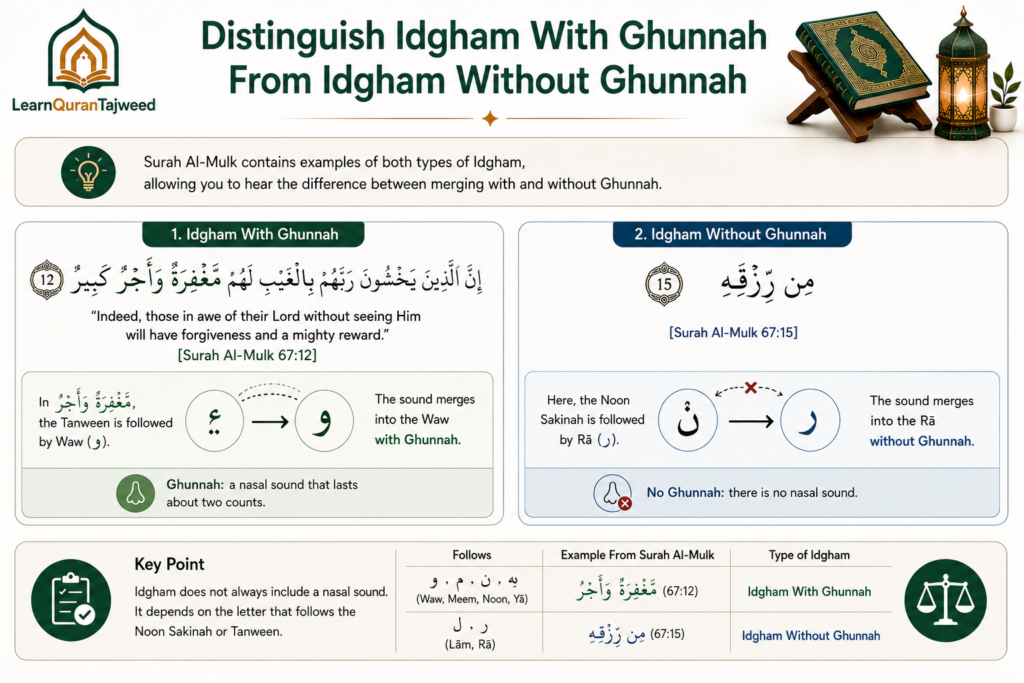
Surah Al-Mulk contains examples of both types of Idgham, allowing you to hear the difference between merging with and without Ghunnah.
For Idgham with Ghunnah, Allah says:
إِنَّ ٱلَّذِينَ يَخْشَوْنَ رَبَّهُم بِٱلْغَيْبِ لَهُم مَّغْفِرَةٌ وَأَجْرٌ كَبِيرٌ
“Indeed, those in awe of their Lord without seeing Him will have forgiveness and a mighty reward.” Surah Al-Mulk 67:12
In مَغْفِرَةٌ وَأَجْرٌ, the Tanween is followed by Waw (و), so the sound merges into the Waw with Ghunnah.
For Idgham without Ghunnah, verse 15 contains: مِن رِّزْقِهِ
Here, the Noon Sakinah is followed by Rā (ر), so it merges into the Rā without Ghunnah. Comparing these two examples helps you remember that Idgham does not always include a nasal sound; it depends on the letter that follows the Noon Sakinah or Tanween.
6. Pronounce Noon Sakinah Clearly When Izhar Applies
When Noon Sakinah or Tanween is followed by one of the six throat letters ء، هـ، ع، ح، غ، خ, it is pronounced clearly without being concealed or merged. This rule is known as Izhar Halqi.
A clear example appears in verse 14:
أَلَا يَعْلَمُ مَنْ خَلَقَ وَهُوَ ٱللَّطِيفُ ٱلْخَبِيرُ
“How could He not know His Own creation? For He alone is the Most Subtle, All-Aware.” Surah Al-Mulk 67:14
In مَنْ خَلَقَ, the Noon Sakinah is followed by Khā (خ), so pronounce the Noon clearly before moving into the Khā without concealing or merging it.
Compare this with مِن فُطُورٍ in verse 3. There, the Noon Sakinah is followed by Fā (ف) and requires Ikhfa. Paying attention to the letter immediately after the Noon helps you distinguish between the two rules while reciting Surah Al-Mulk.
See Our Classrooms in Action
Watch these short clips from our live, interactive Quran courses to see how our students learn and interact with our expert tutors.
Perfect Your Quran Recitation Today
Join expert-led Tajweed classes, and recite the Quran with confidence and clarity.
Start Your Free Trial7. Recognize Iqlab When Noon Sakinah Comes Before Baa
The fourth major rule of Noon Sakinah and Tanween is Iqlab. It occurs when Noon Sakinah or Tanween is followed by Bā (ب).
A clear example appears in Surah Al-Mulk:
فَٱعْتَرَفُوا۟ بِذَنۢبِهِمْ فَسُحْقًۭا لِّأَصْحَـٰبِ ٱلسَّعِيرِ
“And so they will confess their sins. So away with the residents of the Blaze!” Surah Al-Mulk 67:11
In بِذَنۢبِهِمْ, the Noon Sakinah is followed by Bā (ب), so the Noon changes into a concealed Meem sound with Ghunnah.
Here, the Noon and Bā occur within the same word, which is a useful reminder to look at the letters themselves rather than relying on spaces between words when identifying Tajweed rules.
For adults returning to Quran study or building their Tajweed knowledge more systematically, Online Tajweed Classes for Adults can help turn rules such as Ikhfa, Idgham, Izhar, and Iqlab into consistent recitation.

8. Give Qalqalah a Clear Bounce Without Adding a Vowel
The five Qalqalah letters are ق، ط، ب، ج، د. When one of these letters carries Sukoon, it is pronounced with a slight rebound that makes the consonant clear without adding a vowel.
A clear example appears in verse 5:
وَلَقَدْ زَيَّنَّا ٱلسَّمَآءَ
“And We have certainly adorned the heaven.” Surah Al-Mulk 67:5
In لَقَدْ, the Dāl (دْ) carries Sukoon, so it receives Qalqalah. Give the Dāl a controlled rebound, then move naturally into زَيَّنَّا.
Be careful not to turn the Qalqalah into an extra Fathah, Kasrah, or Dammah. The Dāl should remain sakin while still being clearly audible.
Read also: Naql in Tajweed
9. Hold the Shaddah Without Rushing the Doubled Letter
Shaddah tells you that a consonant is doubled, so it must not be pronounced like an ordinary single letter.
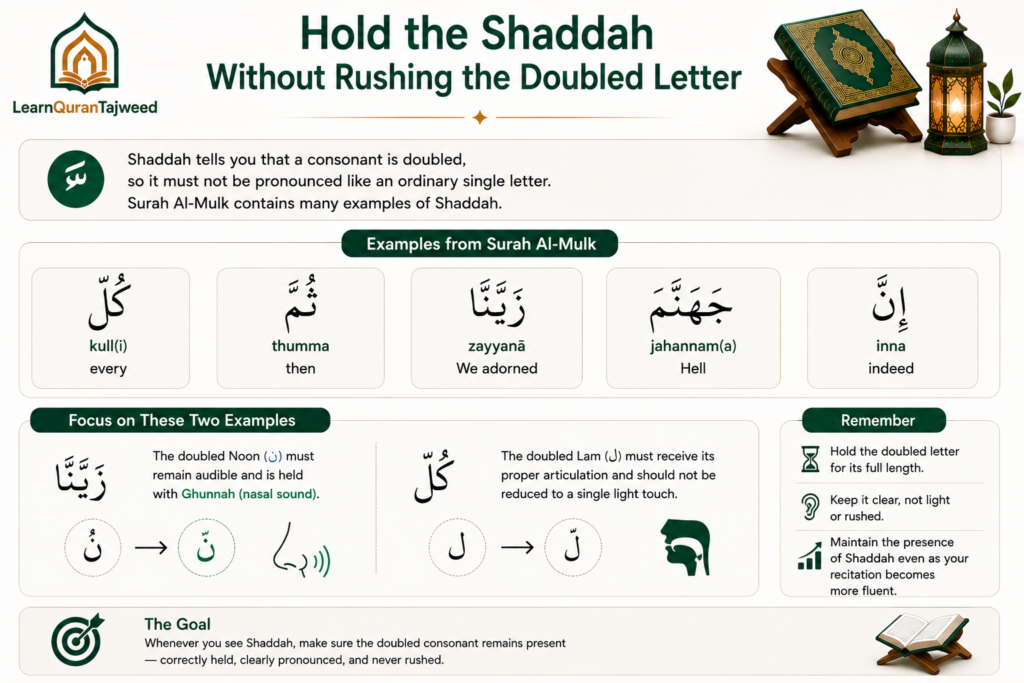
Surah Al-Mulk contains many examples, including كُلِّ, ثُمَّ, زَيَّنَّا, جَهَنَّمَ, and إِنَّ. These words are easy to recognize, but familiarity can make a learner rush through the doubled consonant.
In زَيَّنَّا, for example, the doubled Noon must remain audible and also carries Ghunnah. In كُلِّ, the doubled Lam must receive its proper articulation without being reduced to a single light touch.
Whenever you see Shaddah, make sure the doubled consonant remains present even as your recitation becomes more fluent.
10. Change the Word Ending Correctly When You Stop on an Ayah
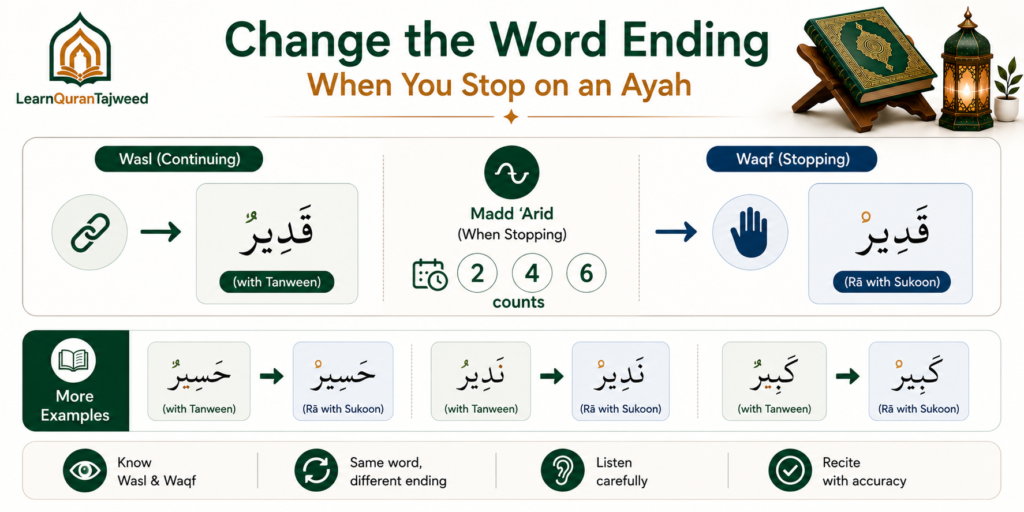
Stopping at the end of an ayah can change how the final word is pronounced, so you need to distinguish between Wasl (continuing) and Waqf (stopping).
Consider the final word of verse 1:
قَدِيرٌ
When continuing, the final Tanween is pronounced according to the rules of connected recitation. When stopping, however, the Tanween is dropped and the final Rā becomes sakin:
قَدِيرْ
This temporary Sukoon creates Madd ‘Arid li-s-Sukun, so the Madd before the final Rā may be prolonged for 2, 4, or 6 counts when stopping.
The same pattern can be practiced with other verse endings in Surah Al-Mulk, such as حَسِيرٌ, نَذِيرٌ, and كَبِيرٌ. Pay attention to whether you are continuing or stopping, because the same word ending may be pronounced differently in each case.
11. Apply Several Tajweed Rules Together in the Same Ayah
After practicing the rules individually, begin applying them together in a complete ayah. Surah Al-Mulk 67:5 is a useful example:
وَلَقَدْ زَيَّنَّا ٱلسَّمَآءَ ٱلدُّنْيَا بِمَصَـٰبِيحَ وَجَعَلْنَـٰهَا رُجُومًۭا لِّلشَّيَـٰطِينِ وَأَعْتَدْنَا لَهُمْ عَذَابَ ٱلسَّعِيرِ
“And We have certainly adorned the nearest heaven with lamps, and We have made them missiles for the devils, and We have prepared for them the punishment of the Blaze.” Surah Al-Mulk 67:5
As you recite, apply the Qalqalah on the Dāl in لَقَدْ, maintain the Ghunnah of the Noon Mushaddadah in زَيَّنَّا, and give Madd Muttasil its correct length in ٱلسَّمَآءَ.
Read the ayah again without stopping between these examples. The goal is to maintain each rule while keeping the verse connected and natural, rather than treating Qalqalah, Ghunnah, and Madd as separate exercises.
Being able to recognize Tajweed rules is only the first stage; the next is applying them correctly while reciting complete verses. If you want more guided practice with this transition, our Amali (Practical) Tajweed Course focuses on the practical application of Tajweed during Quran recitation.

Common Mistakes When Reciting Surah Al-Mulk With Tajweed
Even after learning the individual rules, some mistakes can appear when you begin reciting Surah Al-Mulk continuously. Watch especially for the following:
1. Giving Every Madd the Same Length
Madd Tabee’i, Madd Muttasil, and Madd ‘Arid li-s-Sukun do not all have the same duration. Identify the type of Madd before deciding how long to hold the sound.
2. Treating Every Noon Sakinah the Same Way
The letter that follows Noon Sakinah determines the rule. Compare مِن فُطُورٍ for Ikhfa, مَنْ خَلَقَ for Izhar, مِن رِّزْقِهِ for Idgham without Ghunnah, and بِذَنۢبِهِمْ for Iqlab.
3. Weakening the Shaddah When Reciting Quickly
Words such as ثُمَّ and زَيَّنَّا contain doubled letters that should remain clearly audible even when your recitation becomes faster.
4. Adding a Vowel to Qalqalah
The rebound of a sakin Qalqalah letter should not turn into an extra Fathah, Kasrah, or Dammah. In لَقَدْ, for example, the final Dāl should remain sakin while still being clearly heard.
5. Using the Same Pronunciation for Wasl and Waqf
Stopping can change the ending of a word. Pay attention to the final vowel or Tanween and to any Madd affected by the temporary Sukoon rather than pronouncing the word exactly as you would when continuing.
Recognizing these mistakes helps you move beyond simply remembering how Surah Al-Mulk sounds and focus instead on what each Tajweed rule requires during continuous recitation.
How a Color-Coded Tajweed Quran Can Help With Surah Al-Mulk?
A color-coded Tajweed Quran can make the rules in Surah Al-Mulk easier to identify, especially when you are still learning to distinguish Madd, Ghunnah, Ikhfa, Qalqalah, and other patterns visually.
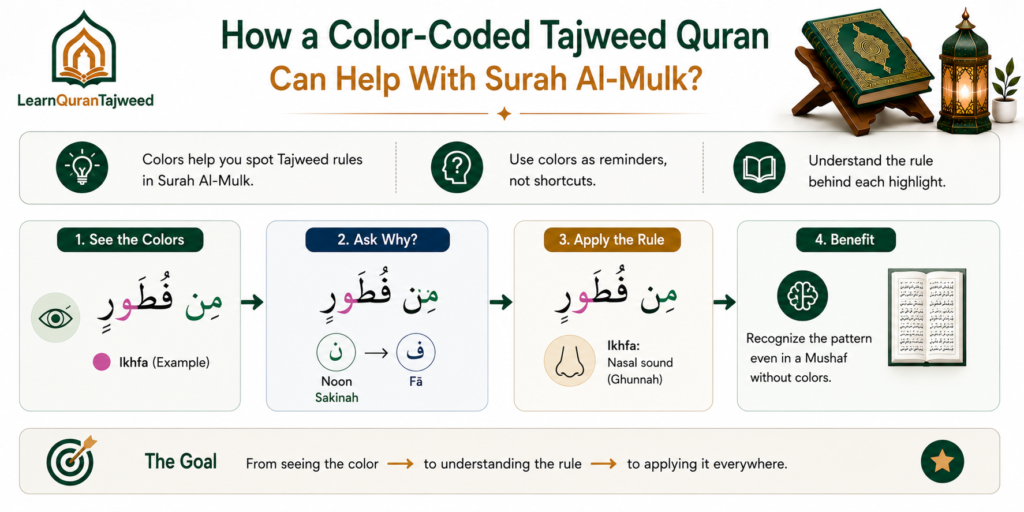
However, the colors should function as reminders rather than replacements for understanding. When a word is highlighted, ask yourself which letters caused the rule and how the pronunciation should change.
For example, instead of remembering only that مِن فُطُورٍ appears in an Ikhfa color, recognize that the rule occurs because Noon Sakinah is followed by Fā.
Over time, this helps you recognize the same Tajweed patterns even when reading from a Mushaf without color coding.
Inside Learn Quran Tajweed Academy
Curious about how online learning works? Peek inside our actual Quran classes and hear the beautiful recitation of our students and teachers.
Perfect Your Quran Recitation Today
Join expert-led Tajweed classes, and recite the Quran with confidence and clarity.
Start Your Free TrialLearn Surah Al-Mulk With a Qualified Tajweed Teacher
Written rules can show you what should happen in a word, but they cannot always tell you whether your own pronunciation is producing the rule correctly.
A qualified Tajweed teacher can hear details that are difficult to judge yourself, such as whether a Ghunnah is too short, a Madd is inconsistent, Qalqalah has gained an extra vowel, or an Arabic letter is coming from the wrong articulation point.
At Learn Quran Tajweed Academy, students can study Quran recitation with direct teacher correction and learn how Tajweed rules apply in actual verses rather than only memorizing definitions.
This can be especially valuable when you already recognize the rules in Surah Al-Mulk but need help making their pronunciation accurate and consistent.
Courses we offer:
- Online Tajweed Classes
- Learn Quran with Tajweed Online
- Beginner Tajweed Course
- Intermediate Tajweed Course
- Advanced Tajweed Course
- Amali (Practical) Tajweed Course

Conclusion
Learning Surah Mulk with Tajweed becomes much clearer when you connect each rule to an actual example from the Surah. Its verses contain natural and longer Madd, Ghunnah, Shaddah, Qalqalah, and clear examples of Ikhfa, Izhar, Idgham, and Iqlab.
Start by recognizing these rules individually, then return to the verses and apply several of them together. As the patterns become familiar, you can focus less on identifying rule names and more on maintaining accurate Tajweed throughout the recitation.
Frequently Asked Questions About Surah Mulk With Tajweed
What Tajweed Rules Are Found in Surah Al-Mulk?
Surah Al-Mulk contains several important Tajweed rules, including Madd, Ghunnah, Shaddah, Qalqalah, Ikhfa, Izhar, Idgham, Iqlab, and rules related to stopping at the ends of verses.
What Is an Example of Ikhfa in Surah Al-Mulk?
A clear example is مِن فُطُورٍ in Surah Al-Mulk 67:3. Noon Sakinah is followed by Fā, so the Noon is concealed with Ghunnah.
What Is an Example of Iqlab in Surah Al-Mulk?
In بِذَنۢبِهِمْ from Surah Al-Mulk 67:11, Noon Sakinah is followed by Bā. The Noon therefore changes into a concealed Meem sound with Ghunnah.
What Is an Example of Izhar in Surah Al-Mulk?
مَنْ خَلَقَ in Surah Al-Mulk 67:14 is an example of Izhar Halqi. Noon Sakinah is followed by Khā, so the Noon is pronounced clearly.
Does Surah Al-Mulk Contain Qalqalah?
Yes. One example appears in لَقَدْ in Surah Al-Mulk 67:5. The Dāl carries Sukoon and is one of the five Qalqalah letters.
Can Beginners Learn Surah Al-Mulk With Tajweed?
Yes. Beginners can start with the most recognizable rules, such as natural Madd, Ghunnah, and Shaddah, before learning to distinguish the different Noon Sakinah and Tanween rules found throughout the Surah.
Is a Color-Coded Quran Useful for Learning Surah Al-Mulk Tajweed?
Yes. Color coding can make Tajweed rules easier to locate, but it is best used alongside an understanding of why each rule occurs. The long-term goal is to recognize the rule from the Arabic letters themselves rather than depending entirely on the colors.
One response to “How To Recite Surah Al-Mulk With Tajweed?”
Related Articles
Tajweed Resources









[…] Read also: How to Recite Surah Al-Mulk With Tajweed? […]