 Tajweed Rules

Imala in Tajweed (also written Imalah) is one of the recitation styles carried down from the classical Arab dialects in which the Quran was revealed. If you have ever heard a reciter tilt the sound of an alif toward a “ya” sound in certain words, you have heard Imalah in action.
This article explains what Imalah means, how it differs from its opposite (Fath), the two recognized types — Major and Minor — and where each appears in the Hafs and Warsh recitations.
What You’ll Learn in This Article
- What Imalah means linguistically and technically.
- The difference between Imalah and Fath.
- The two types: Major Imalah (Kubra) and Minor Imalah (Sughra/Taqleel).
- A real Quranic example of Imalah in the Hafs recitation.
- How Imalah differs between Hafs and Warsh.
What Is Imalah in Tajweed?
Imalah is defined as inclining the sound of a fatha toward a kasra, and the sound of an alif toward a ya, without fully converting either letter.
Linguistically, “Imalah” comes from an Arabic root meaning to bend or tilt something away from its straight line — the same root used to describe bending a spear. In recitation, this bending applies to how the mouth shapes the sound, not to the written alif itself, since the alif letter cannot physically take a vowel mark.
Historically, Fath was the dialect of the people of the Hijaz, while Imalah was the dialect of the Najd tribes, including Tamim, Asad, and Qays. Both styles were considered correct and eloquent Arabic speech, and classical scholars of recitation, including Abu Amr al-Daani, classified Imalah among the recognized modes of Quranic recitation.
Imalah vs. Fath Key Differences at a Glance
Fath and Imalah sit at opposite ends of the same sound. Fath keeps the fatha and alif at their normal open pronunciation. Imalah pulls that same sound partway or fully toward the kasra and ya.
Reciters also refer to Imalah by other names depending on how strong the tilt is — including Idjaa الإضجاع (reclining), Bath البَطْح (spreading), Taqleel (lessening), and “bayna bayn” (between the two pronunciations).
Learning to hear this difference by ear is often faster than reading about it, which is one reason many students of the Learn Quran Tajweed program choose live sessions where a certified teacher can demonstrate the sound directly and correct it in real time.
Reading about the difference between Fath and Imalah is useful, but hearing and reproducing the sound correctly requires guided practice. With Learn Quran Tajweed,
students can strengthen their recitation through the Quran Tarteel Course, receiving live instruction, direct pronunciation correction, and personalized feedback from qualified teachers.
Practice subtle distinctions such as Fath, Imalah, and Taqleel until they become natural and confident parts of your recitation.

Types of Imalah in Tajweed
Imalah is divided into two categories based on how far the sound moves from Fath toward Kasra.Both types involve the same underlying change — the alif’s point of articulation shifts toward the ya’s point of articulation — but they differ in how far that shift goes.
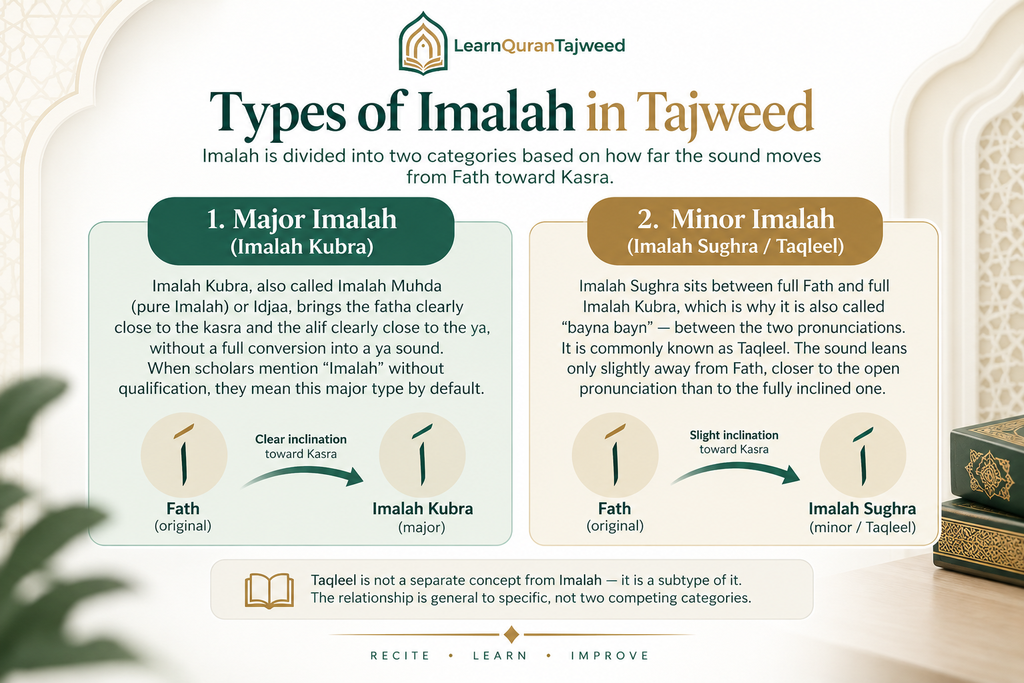
1- Major Imalah (Imalah Kubra)
Imalah Kubra, also called Imalah Muhda (pure Imalah) or Idjaa, brings the fatha clearly close to the kasra and the alif clearly close to the ya, without a full conversion into a ya sound. When scholars mention “Imalah” without qualification, they mean this major type by default.
2- Minor Imalah (Imalah Sughra / Taqleel)
Imalah Sughra sits between full Fath and full Imalah Kubra, which is why it is also called “bayna bayn” — between the two pronunciations. It is commonly known as Taqleel. The sound leans only slightly away from Fath, closer to the open pronunciation than to the fully inclined one.
A useful way to tell them apart: Taqleel is not a separate concept from Imalah — it is a subtype of it. The relationship is general to specific, not two competing categories.
Read also: Tajweed Common Mistakes by Beginners (And How to Correct Them)
See Our Classrooms in Action
Watch these short clips from our live, interactive Quran courses to see how our students learn and interact with our expert tutors.
Perfect Your Quran Recitation Today
Join expert-led Tajweed classes, and recite the Quran with confidence and clarity.
Start Your Free TrialHow to Pronounce Imalah Correctly?
For Imalah Kubra, the mouth shapes the fatha and following alif closer to the ya’s articulation point, without collapsing fully into a ya. For Taqleel, the shift is lighter — the vowel stays recognizably open but with a light lean toward kasra.
A Common Mistake Learners Make
A frequent error is over-inclining the sound until it becomes a full ya, erasing the alif’s own identity. The opposite mistake is under-inclining, which makes Taqleel indistinguishable from ordinary Fath.
Both errors change the intended sound of the word. Correcting this by ear, with feedback from a qualified reciter, is usually faster than trying to fix it from written description alone.
Examples of Imalah in the Quran
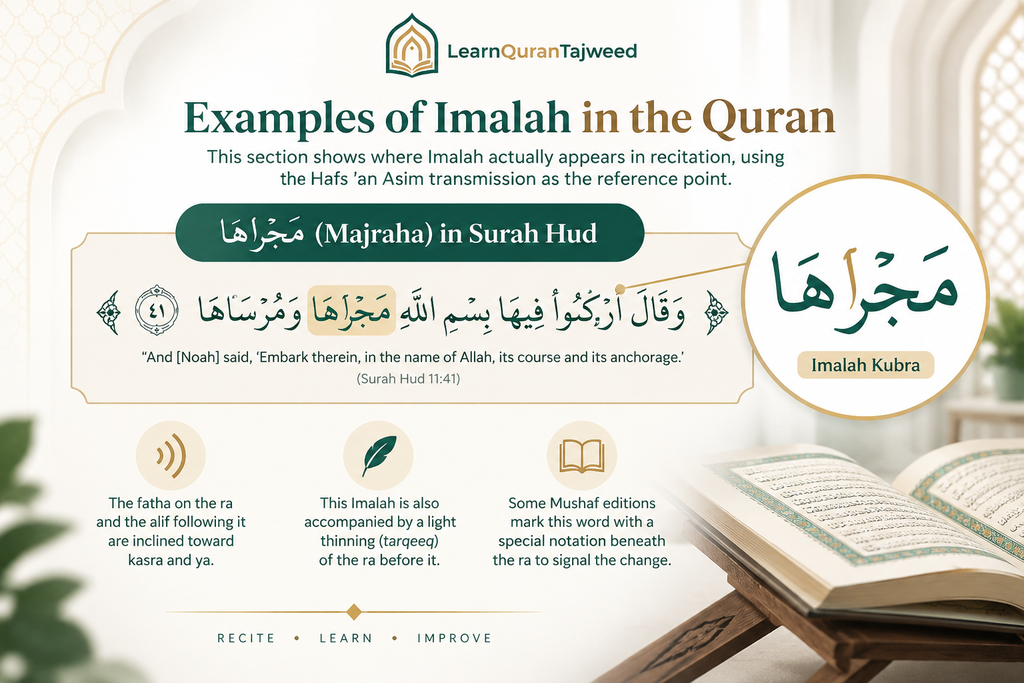
This section answers where Imalah actually appears in recitation, using the Hafs ‘an Asim transmission as the reference point.
Majraha(مَجْرَاهَا) in Surah Hud (Hafs Recitation)
In the Hafs ‘an Asim reading, there is one word in the entire Quran agreed upon for Imalah Kubra: مَجْرَاهَا (majraha), in Surah Hud, verse 41 — “وَقَالَ ارْكَبُوا فِيهَا بِسْمِ اللَّهِ مَجْرَاهَا وَمُرْسَاهَا. Here, the fatha on the ra and the alif following it are inclined toward kasra and ya.
This Imalah is also accompanied by a light thinning (tarqeeq) of the ra before it. Some Mushaf editions mark this word with a special notation beneath the ra to signal the change.
Imalah in Warsh Recitation
The Warsh ‘an Nafi’ recitation, transmitted through Al-Azraq, applies Taqleel (minor Imalah) far more broadly than Hafs does. Words ending in an alif maqsurah are frequently recited with Taqleel rather than full Fath in this transmission.
This reflects a difference in recitation lineage rather than a disagreement over the underlying rule — each transmission preserves a distinct, verified chain of pronunciation passed down from the reciters who established it.
A simple decision framework for students facing an unfamiliar word:
- First, check whether the riwayah being recited applies Imalah at all in that position.
- Second, determine whether it is Kubra or Taqleel.
- Third, confirm the linguistic reason, since words with an alif that historically derives from a ya are the ones most often affected.
Getting this right consistently is exactly the kind of detail a live tajweed teacher checks word by word, which is the core of the one-on-one sessions offered through Learn Quran Tajweed.
Inside Learn Quran Tajweed Academy
Curious about how online learning works? Peek inside our actual Quran classes and hear the beautiful recitation of our students and teachers.
Perfect Your Quran Recitation Today
Join expert-led Tajweed classes, and recite the Quran with confidence and clarity.
Start Your Free TrialStart Reciting With Confidence
Reading about Imalah only gets a learner so far — the sound itself has to be heard and corrected in real time.
Learn Quran Tajweed connects you with certified teachers for live, one-on-one sessions where every Imalah, Taqleel, and Fath is checked as you recite, not after.
Courses we offer:
- Online Tajweed Classes
- Learn Quran with Tajweed Online
- Beginner Tajweed Course
- Intermediate Tajweed Course
- Advanced Tajweed Course
- Amali (Practical) Tajweed Course

Conclusion
Imalah in Tajweed is the inclination of a fatha toward kasra and an alif toward ya, rooted in the classical Najd dialect and preserved through the Hafs and Warsh transmissions. It divides into Imalah Kubra, the clear, pure inclination, and Imalah Sughra (Taqleel), the lighter middle state between Fath and full Imalah.
Hafs preserves a single agreed case of Imalah Kubra, in majraha, while Warsh applies Taqleel far more widely. Recognizing which type applies, and to which word, is a core skill in accurate Quranic recitation.
FAQs
What is Imalah in Tajweed?
Imalah is the inclination of a fatha’s sound toward kasra and an alif’s sound toward ya, without fully converting either. It originates from the classical Najd Arab dialect and is preserved in several Quranic recitations.
What are the types of Imalah in Tajweed?
Imalah has two types: Imalah Kubra (major), a clear, pure inclination toward kasra and ya, and Imalah Sughra (minor), also called Taqleel, a lighter middle state between Fath and full Imalah.
What is the difference between Imalah and Taqleel?
Taqleel is not separate from Imalah — it is Imalah Sughra, a subtype of Imalah. The relationship is general to specific: all Taqleel is Imalah, but not all Imalah is Taqleel.
Where does Imalah appear in the Hafs recitation?
In Hafs ‘an Asim, there is one agreed case of Imalah Kubra in the entire Quran: majraha, in Surah Hud, verse 41, where the ra’s fatha and the following alif incline toward kasra and ya.
Is Imalah used in the Warsh recitation?
Yes. The Warsh ‘an Nafi’ recitation, through Al-Azraq, applies Taqleel (minor Imalah) more broadly than Hafs, particularly in words ending with an alif maqsurah.
Related Articles
Tajweed Rules