 Tajweed Resources
Ibn Kathir Tajweed refers to the recitation tradition of Imam Ibn Kathir al-Makki, one of the seven canonical Quranic reciters, transmitted through two narrators — al-Bazzi and Qunbul. His reading is distinguished by specific phonetic rules that differ measurably from the widely-taught Hafs recitation most learners encounter first.
What you’ll learn in this article:
- Who Ibn Kathir was and why his recitation tradition matters
- The two narrators of his reading and how they differ
- His most distinct Tajweed rules with Quranic examples
- Common mistakes students make when switching from Hafs
- How to start learning Ibn Kathir Tajweed online
Who Were the Two Narrators of Ibn Kathir Tajweed?
Ibn Kathir’s recitation reached us through two Makkan scholars — al-Bazzi and Qunbul — each carrying the same chain back to Ibn Kathir al-Makki with documented, unbroken transmission.
Al-Bazzi and His Distinctive Rules
Al-Bazzi (d. 250 AH) is the source of several rules found nowhere else in the ten recitations — including prolonged stretching before doubled letters following a long vowel, and the Takbir recited between the final surahs from al-Duha through al-Nas.
Qunbul and His Hamza Positions
Qunbul (d. 291 AH) preserves different options in several Hamza positions, particularly where two Hamzas meet across two words — softening the second rather than dropping the first, which is al-Bazzi’s approach in the same positions.
The Most Distinctive Rules of Ibn Kathir Tajweed
The rules that set Ibn Kathir apart from Hafs — the dominant recitation in most of the Muslim world — cluster around five core areas. Each is grounded in the classical sources: al-Taysir of Abu Amr al-Dani and al-Nashr fi al-Qira’at al-‘Ashr of Ibn al-Jazari.
Connecting the Plural “Meem” with a Waw
Ibn Kathir recites the plural suffix مُ (meem al-jam’) with a following waw when the next word begins with a vowel. So ﴿وَمِمَّا رَزَقْنَاهُمْ يُنفِقُونَ﴾ becomes “raza-qna-humū yunfiqūn” — the meem extends into a connecting waw before the moving letter.
وَمِمَّا رَزَقْنَاهُمْ يُنفِقُونَ
(Wa-mimmā razaqnāhumu yunfiqūn)
(“And of what We have provided them, they spend”)
Surah Al-Baqarah 2:3
This rule has no parallel in Hafs and is the first phonetic shift students notice when they begin studying Ibn Kathir Tajweed.
Extending the Pronoun Haa in Specific Conditions
Ibn Kathir gives full extension (silah) to the singular masculine pronoun هُ and هِ when it falls between two moving letters — connecting it with a waw or yaa respectively.
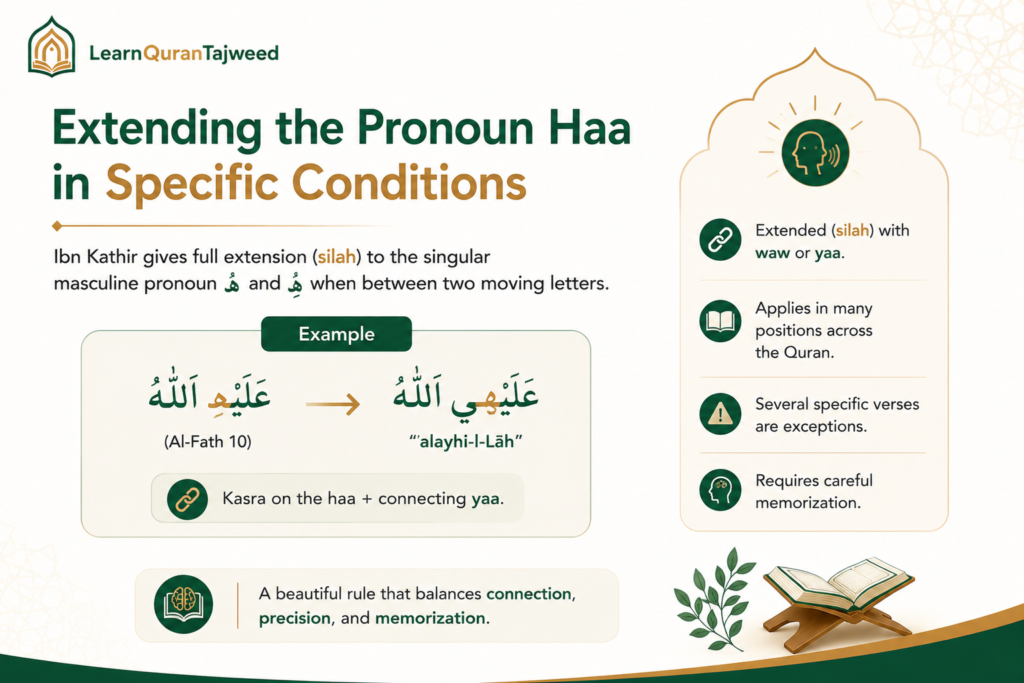
So ﴾عَلَيْهِ اللَّهُ﴿ (Al-Fath 10) is read with kasra on the haa plus a connecting yaa: “ʿalayhi-l-Lāh.” This applies across dozens of positions and demands careful memorization, since several specific verses carry exceptions.
Shortening the Separated Madd and Raising the Connected Madd
Ibn Kathir’s Madd (elongation) rules differ from Hafs in a measurable way. He shortens the separated Madd (Madd al-munfasil — where a long vowel ends one word and a Hamza begins the next) to two counts. For the connected Madd (Madd al-muttasil), he reads slightly above the short level at three counts — and this is the preferred form from al-Taysir.
Al-Bazzi adds a special elongation before doubled letters (shadda) that follow a long vowel, such as in:
لَآتَّكَلَّمَ
La-‘attakallam
Surah Maryam 19:10
This elongation before the shadda is exclusive to al-Bazzi and has no equivalent in any other narration transmitted through al-Taysir.
How Ibn Kathir Handles Two Consecutive Hamzas
When two Hamzas meet inside a single word, Ibn Kathir softens (yusahhil) the second Hamza rather than fully articulating both. So ﴿أَأُنزِلَ﴾ and ﴿أَئِنَّكُمْ﴾ are read with the second Hamza eased into a near-vowel sound.
أَأُنزِلَ عَلَيْهِ الذِّكْرُ مِن بَيْنِنَا
A-unzila ʿalayhi al-dhikru min bayninā
(“Has the Reminder been sent down upon him from among us?”)
Surah Saad 38:8
When two Hamzas meet across two separate words and share the same vowel type, al-Bazzi drops the first (if both carry fatha) or softens the first (if both carry kasra or damma). Qunbul softens the second Hamza instead — and this is where the most detailed divergence between the two narrators appears.
Transferring Hamza Movement and Omitting the Hamza Itself
Ibn Kathir transfers (naqala) the vowel of a Hamza to the sukoon before it, then drops the Hamza. This produces smooth, flowing connections across what would otherwise be glottal-stop boundaries.
The clearest example is the word ﴿قُرْءَانٌ﴾ wherever it appears — Ibn Kathir reads it “Qurān” (without the glottal stop), transferring the fatha of the Hamza to the raa and omitting the Hamza entirely.
The same transfer applies to ﴿فَسَلْ﴾ and ﴿وَسَلْ﴾ when preceded by waw or faa:
فَاسْأَلِ الَّذِينَ يَقْرَءُونَ الْكِتَابَ
(Fas-al alladhīna yaqra’ūna al-Kitāb)
(“So ask those who read the Scripture”)
Surah Yunus 10:94
Ibn Kathir reads this “Fasal” — the Hamza’s kasra shifts to the siin and the Hamza disappears.
The Beginner Tajweed Course at Learn Quran Tajweed walks students through these foundational phonetic shifts — including Madd rules, Hamza treatment, and pronoun extensions — from the ground up with certified instructors.

Start your first lesson today at Learn Quran Tajweed
Ibn Kathir Tajweed Rules on Pausing and the Letter Yaa
Ibn Kathir’s rules for pausing (waqf) and the treatment of the yaa at pause contain details that generic Tajweed courses rarely cover. These details matter in recitation because they change the audible sound at the end of verses and phrases.
Pausing with a Written Yaa on Four Words
Ibn Kathir stops on four specific words with a retained yaa: ﴿هَادٍ﴾, ﴿وَاقٍ﴾, ﴿بَاقٍ﴾, and ﴿وَالٍ﴾ wherever they appear. So where Hafs pauses on هَادٍ with a tanwin-like sound, Ibn Kathir pauses on “hādī” — the yaa is fully pronounced.
This is sourced directly from al-Taysir as the preferred transmitted form (al-wajh al-muqaddam fi al-ada’).
Stopping on Feminine Taa with a Haa
Ibn Kathir pauses on the feminine taa marbuta written as taa (not haa) by converting it to haa at pause — with the exception of ﴿مَرْضَاتٌ﴾, which he stops on with a taa. So ﴿رَحْمَتٌ﴾ and ﴿نِعْمَتٌ﴾ both become “rahmah” and “ni’mah” at pause.
Read also: Al-Kisai Tajweed Rules, Recitation Style, and How to Learn It
See Our Classrooms in Action
Watch these short clips from our live, interactive Quran courses to see how our students learn and interact with our expert tutors.
Perfect Your Quran Recitation Today
Join expert-led Tajweed classes, and recite the Quran with confidence and clarity.
Start Your Free TrialAl-Bazzi’s Exclusive Rule — Takbir at the End of Surahs
One of the most celebrated and exclusive features of Ibn Kathir Tajweed — specifically through al-Bazzi — is the Takbir recited after completing each surah from Surah al-Duha (93) through Surah al-Nas (114).
The reciter says “Allāhu Akbar” at the end of each surah in this range, then begins the Basmalah and the following surah. This practice — known as al-Hal wal-Murtahal — is recorded in al-Taysir (p. 226) and is confirmed in al-Nashr (Vol. 2, pp. 413–429) as exclusive to al-Bazzi’s chain.
Three modes of connecting the Takbir are permitted:
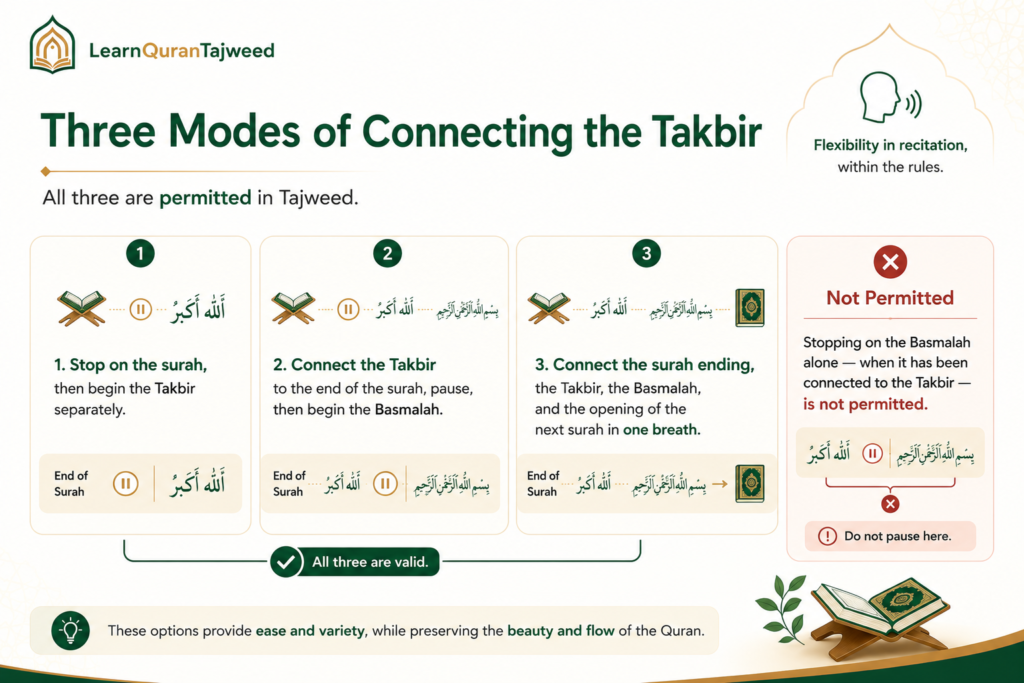
- Stop on the surah, then begin the Takbir separately
- Connect the Takbir to the end of the surah, pause, then begin the Basmalah
- Connect the surah ending, the Takbir, the Basmalah, and the opening of the next surah in one breath
Stopping on the Basmalah alone — when it has been connected to the Takbir — is not permitted.
This rule does not apply to Qunbul. What classical sources like al-Shatibiyya attribute to Qunbul on this matter is not from his verified transmission path.
The Quran Tarteel Course at Learn Quran Tajweed is designed for students who want to recite with precision and measured pace — the exact environment where mastering rules like the Takbir and the extended Madd of al-Bazzi becomes natural and consistent.

Recite with measured precision — enroll in the Quran Tarteel Course
How Ibn Kathir Tajweed Differs from Hafs at a Glance
| Rule | Hafs (Common) | Ibn Kathir |
| Madd al-Munfasil | 4–5 counts | 2 counts (short) |
| Madd al-Muttasil | 4–5 counts | ~3 counts |
| Meem al-Jam’ | No extension | Extended with waw |
| Haa al-Dhamir | No silah in most cases | Silah applied between two vowels |
| Two Hamzas in one word | Both articulated | Second Hamza softened |
| Hamza transfer (Naqal) | Not applied | Applied (e.g., Qurān, Fasal) |
| Takbir between surahs | Not practiced | Al-Bazzi only (93–114) |
| No pause (sakt) | 4 fixed positions | Not practiced |
Common Mistakes When Switching from Hafs to Ibn Kathir
Students who learned Hafs first carry habits that clash directly with Ibn Kathir Tajweed. Three mistakes appear most consistently.
Applying Hafs Madd lengths to Ibn Kathir. The instinct to elongate the separated Madd to four or five counts is deeply trained in Hafs learners. In Ibn Kathir, that same position is two counts — rushing past it sounds incomplete; holding it too long is an error.
Ignoring the Meem al-Jam’ extension. This rule has no equivalent in Hafs, so students skip it unconsciously. Reading ﴿رَزَقْنَاهُمْ يُنفِقُونَ﴾ without the connecting waw is a departure from Ibn Kathir’s narration that trained ears will catch immediately.
Conflating al-Bazzi and Qunbul. Students learning from mixed sources sometimes apply al-Bazzi’s Hamza-dropping rules in positions where Qunbul softens instead, or vice versa. The two narrators must be studied separately, then compared — not blended.
Read also: Abu Amr Tajweed Rules, Narrators and Distinctive Recitation Features
Start Learning Ibn Kathir Tajweed with a Certified Instructor
Mastering Ibn Kathir Tajweed requires live recitation practice with a teacher who knows both narrations and can correct errors in real time — written explanations alone are not enough for a phonetic tradition.
The Tajweed ul Quran Course at Learn Quran Tajweed gives students structured access to certified instructors trained in multiple narrations, with sessions built around correcting articulation errors before they become habits.

Book your session with a certified instructor at Learn Quran Tajweed
Inside Learn Quran Tajweed Academy
Curious about how online learning works? Peek inside our actual Quran classes and hear the beautiful recitation of our students and teachers.
Begin Your Ibn Kathir Recitation Journey at Learn Quran Tajweed
Learning Ibn Kathir Tajweed is one of the most rewarding paths in Quranic study — it connects you directly to the Makkan recitation tradition and deepens your understanding of how the Quran was transmitted across fourteen centuries. Learn Quran Tajweed offers structured, instructor-led courses designed for every level, from beginners taking their first steps to advanced students refining a specific narration.

Enroll today and learn Ibn Kathir Tajweed with certified teachers
Courses we offer:
- Tajweed Course for Kids
- Tajweed Course for Adults
- Tajweed Course for Ladies
- Tajweed ul Quran Course
- Quran Recitation with Tajweed Course
- Quran Tarteel Course
- Tajweed Ijazah Program
Perfect Your Quran Recitation Today
Join expert-led Tajweed classes, and recite the Quran with confidence and clarity.
Start Your Free TrialConclusion
Ibn Kathir Tajweed is the recitation tradition of Imam Ibn Kathir al-Makki, carried through al-Bazzi and Qunbul, and verified through classical texts including al-Taysir and al-Nashr. Its defining rules — the extension of Meem al-Jam’, the shortening of the separated Madd, the softening of doubled Hamzas, and Hamza transfer — are not stylistic preferences but documented phonetic rules with precise conditions.
Students who approach Ibn Kathir Tajweed methodically, working through the narrators separately and applying each rule in recitation practice, gain access to a tradition that most of the world has never heard — and that the Quran’s oral chain has preserved without interruption.
Read also: Riwayat vs Qira’at Every Student Must Know
Frequently Asked Questions
What is Ibn Kathir Tajweed?
Ibn Kathir Tajweed is the system of recitation rules attributed to Imam Ibn Kathir al-Makki, one of the seven canonical Quran reciters. It includes distinct rules for Madd lengths, Hamza treatment, pronoun extensions, and pausing — transmitted through two narrators, al-Bazzi and Qunbul.
Who are the two narrators of Ibn Kathir’s recitation?
The two narrators are al-Bazzi and Qunbul, both Makkan scholars who preserved Ibn Kathir’s reading with documented chains. Al-Bazzi is known for the Takbir between surahs and extended Madd before shadda; Qunbul differs mainly in Hamza positions across words.
How is Ibn Kathir Tajweed different from Hafs?
The main differences are: Ibn Kathir shortens the separated Madd to two counts (Hafs uses four to five), extends the plural meem with a connecting waw, softens the second of two consecutive Hamzas inside a word, and drops Hamzas through Naqal in specific positions. None of these apply in Hafs.
Is it hard to learn Ibn Kathir Tajweed after learning Hafs?
It requires unlearning specific Madd habits and building new ones. The Meem al-Jam’ rule and Hamza transfer have no Hafs equivalent, so they need focused drilling. Most students who learned Hafs well can transition to Ibn Kathir Tajweed within months with a qualified instructor.
Where can I find a certified teacher for Ibn Kathir Tajweed?
Learn Quran Tajweed offers online courses with certified instructors who teach multiple narrations including Ibn Kathir. The Online Tajweed Course for Adults and the Practical Tajweed Course both include live correction sessions suited to students studying specific recitation traditions