 Tajweed Rules
Hamzah Tajweed refers to the complete system of recitation rules attributed to Imam Hamzah ibn Habib al-Zayyat al-Kufi, one of the seven canonical Quranic reciters. His reading differs from the globally dominant Hafs narration across more than a dozen distinct rule categories — from how Surahs are connected without Basmala, to the precise handling of Hamzah softening at pause.
Whether you are a student of the ten Qira’at or simply want to understand why different reciters sound so different, learning Riwayat Hamzah and its Tajweed Rules gives you access to one of the most technically detailed and phonetically demanding recitation traditions in Quranic scholarship.
What You’ll Learn in This Article
- Who Imam Hamzah was and why his recitation holds scholarly authority
- The two narrators of his Qira’ah — Khalaf and Khallad — and how they differ
- His most distinctive Tajweed rules, from Madd to Imala to Waqf on Hamzah
- A comparison of Hamzah Tajweed against Hafs ‘an ‘Asim across key rule categories
- How to begin learning Hamzah Tajweed with a structured course
Who Is Imam Hamzah?
Imam Hamzah Tajweed takes its name from Abu ‘Imarah Hamzah ibn Habib ibn ‘Imarah al-Zayyat al-Kufi, born around 80 AH in Kufa, Iraq. He was the sixth of the seven canonical reciters (Qurra’ al-Sab’ah) and held the position of leading Imam of recitation in Kufa after Imam ‘Asim — the very narrator whose student Hafs produced the recitation most Muslims use today.
Imam Hamzah was not only a scholar of recitation. He was known for his mastery of Arabic grammar, Islamic jurisprudence, and the science of inheritance law. Imam Abu Hanifah — the founder of the Hanafi school of fiqh — is reported to have said to him: “There are two things you have surpassed us in completely, and we do not compete with you in either: the Quran and the rules of inheritance.”
He passed away in 156 AH in Hulwan, at the age of seventy-six, having transmitted his recitation to a generation of students who spread it across the Islamic world.
Scholarly Authority of Imam Hamzah Recitation
Every authentic Qira’ah must meet three conditions established by classical scholarship. It must conform to Arabic grammar, match the ‘Uthmani Mushaf’s consonantal skeleton, and trace an unbroken chain of transmission back to the Prophet ﷺ. Hamzah’s recitation meets all three conditions without exception.
His chain passes through major Tabi’een scholars including Sulayman ibn Mihran al-A’mash, Abu Hamzah Humran ibn A’yan, and — through multiple paths — back to the companions of the Prophet ﷺ. This sanad is authenticated and documented in Ibn al-Jazari’s foundational work Al-Nashr fi al-Qira’at al-‘Ashr.
Primary Narrators of Imam Hamzah Recitation
Riwayat Hamzah reaches us today through two primary narrators, both transmitted through the student Sulaym ibn ‘Isa. Their narrations are largely identical, but differ in a meaningful number of positions — enough that each narration is studied as distinct.
Khalaf ibn Hisham and His Narration
Khalaf ibn Hisham al-Bazzar (155–229 AH) is considered the primary and more precise narrator of Hamzah Tajweed. He memorized the Quran at age ten, studied under Sulaym ibn ‘Isa, and became a Imam in his own right — so distinguished that his own independent recitation counts as the tenth of the ten Qira’at (Khalaf al-‘Ashir). Khalaf is given priority in cases of disagreement between the two narrators.
Khallad ibn Khalid and His Narration
Khallad ibn Khalid al-Kufi is the second narrator and transmits several additional options not found in Khalaf’s narration. In certain positions — particularly regarding Sukut (pausing before Hamzah) — Khallad offers more flexibility. Where Khalaf holds a single accepted position, Khallad frequently offers two.
Riwayat Hamzah and its Tajweed Rules Overview
Hamzah Tajweed differs from the recitation of Hafs ‘an ‘Asim — the globally dominant narration — in over a dozen rule categories. The most significant are detailed below.
Connecting Surahs Without Basmala
Imam Hamzah recites without inserting the Basmala between consecutive Surahs. He connects the final verse of one Surah directly to the opening of the next, as though they form a single continuous recitation. This approach — described by Imam al-Shatibiyy as “eloquence” — requires the reciter to correctly apply junction rules: a Hamzah al-Wasl that drops at connection, any resulting Madd, and Sukut rules that apply at junctions with Hamzah.
The Basmala is required when Imam Hamzah begins any Surah from its opening, or transitions between Surah Al-Anfal and Surah Al-Tawbah (where three options apply for all reciters: connection, pause, or Sukut).
Mandatory Madd Elongation Principles
Imam Hamzah recites both Madd Muttasil (connected elongation) and Madd Munfasil (separated elongation) at six counts (Isba’). This is one of the most immediately audible characteristics of his recitation — many other reciters apply four or five counts to Madd Munfasil, but Hamzah holds both types at the maximum length without exception.
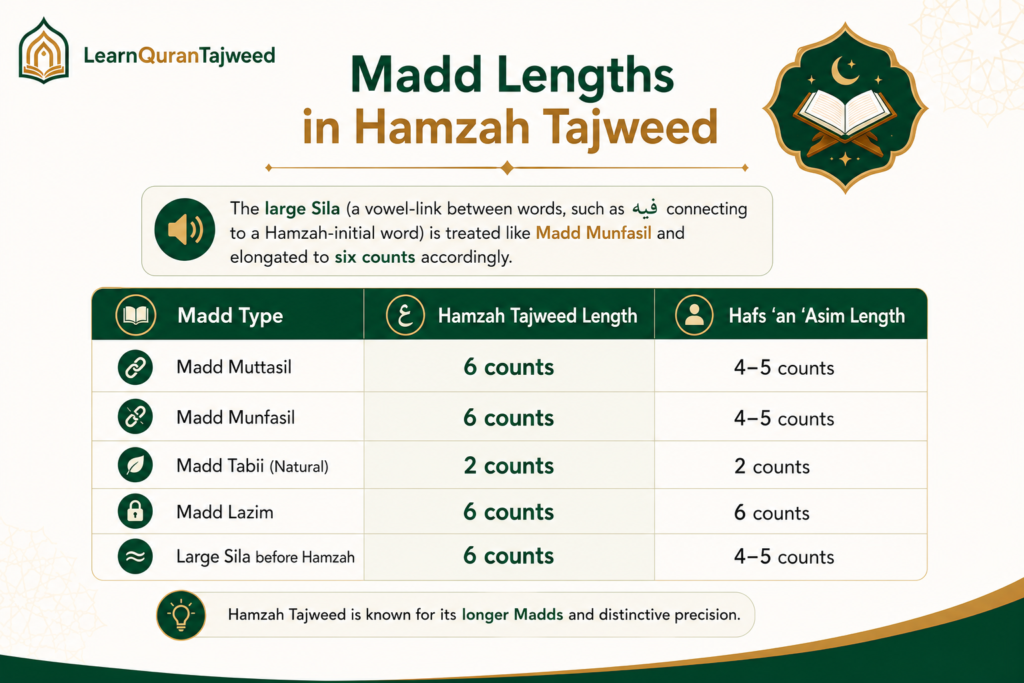
The large Sila (a vowel-link between words, such as في أنفسكم fihi connecting to a Hamzah-initial word) is treated like Madd Munfasil and elongated to six counts accordingly.
| Madd Type | Hamzah Tajweed Length | Hafs ‘an ‘Asim Length |
| Madd Muttasil | 6 counts | 4–5 counts |
| Madd Munfasil | 6 counts | 4–5 counts |
| Madd Tabii (Natural) | 2 counts | 2 counts |
| Madd Lazim | 6 counts | 6 counts |
| Large Sila before Hamzah | 6 counts | 4–5 counts |
Application of Imala Kubra Rules
Imala — tilting a long “a” vowel toward an “e” sound — is one of the most extensive and distinctive features of Hamzah Tajweed. Imam Hamzah applies full Imala (Imala Kubra) to every Alif that has derived from a Ya’ in origin, wherever it occurs in a noun or a verb.
A practical test for identifying Yaa’-origin Alifs: in nouns, form the dual (e.g., huda → hudayan — the Ya’ appears, confirming it is Yaa’-origin and therefore subject to Imala); in verbs, conjugate to the first person (e.g., rama → ramayt — Ya’ appears, confirming Imala applies).
Hamzah also applies Imala to the end-of-verse Alifs in eleven specific Surahs — including Surah Taha, Al-Najm, Al-Qiyamah, and Al-‘Alaq — and to the Alif in the eye-letter (‘ayn) of certain disconnected letters at Surah openings.
A critical practitioner note: Hamzah exempts certain Yaa’-origin words from Imala and reads them with Fath (full opening). These include خَطَايَا wherever it occurs, هَدَانِي in Al-An’am, عَصَانِي in Ibrahim, أَوْصَانِي in Maryam, and مَحْيَاهُمْ in Al-Jathiyah. Students who apply Imala to these words without knowing the exceptions will produce errors.
The Intermediate Tajweed Course at Learn Quran Tajweed trains students in the precise conditions for Imala, including both the rules and the named exceptions.

Enroll in the Intermediate Tajweed Course at Learn Quran Tajweed
Sukut Pausing Rules Before Hamzah
One of the most analyzed features of Hamzah Tajweed is the Sukut — a brief, soundless pause — applied before certain Hamzah-initial words when reciting in continuous flow. The positions are:
Lam al-Ta’rif (ال before Hamzah): Sukut is applied, holding the Lam in a silent stop before pronouncing the Hamzah. Example: الأَرْضِ, الآخِرَةِ.
The word شَيْءٌ / شَيْئًا wherever it occurs: Sukut is applied before the Hamzah in شَيْء in all grammatical cases.
Separated sukun before Hamzah (المفصول): A sukun letter at the end of one word before a Hamzah-initial word, such as مَنْ آمَنَ or عَذَابٌ أَلِيمٌ.
The narrators differ here. Khalaf applies Sukut to ال and شيء without exception, and has two options on the separated sukun (Sukut or Tahqiq). Khallad applies Sukut to ال and شيء by one transmission path, while his other path carries no Sukut at all.
Advanced Waqf Softening Rules on Hamzah
Stopping at a Hamzah-containing word is where this narration becomes most intricate and most discussed in classical scholarship. No other recitation tradition has an equivalent system. When Imam Hamzah pauses at a word containing Hamzah, he softens (yukhaffif) the Hamzah according to two established methods.
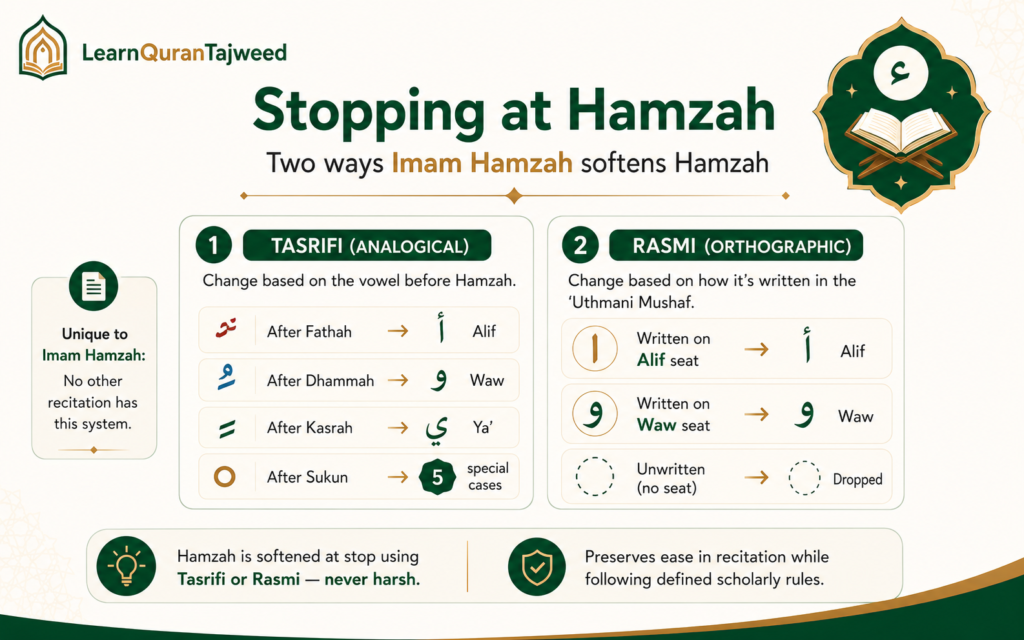
- Method One — Tasrifi (Analogical Substitution): The Hamzah is transformed based on the vowel of the letter preceding it. A Hamzah preceded by a Fathah is converted to Alif. A Hamzah preceded by a Dhamma is converted to Waw. A Hamzah preceded by a Kasra is converted to Ya’. A stationary (Sukun) Hamzah follows its own sub-rules covering five distinct positional categories.
- Method Two — Rasmi (Orthographic Substitution): The Hamzah is converted to match how it was written in the ‘Uthmani Mushaf. Where the Mushaf wrote the Hamzah on an Alif seat, it becomes Alif. Where it was written on a Waw seat, it becomes Waw. Where unwritten (without a seat letter), it is dropped.
When both methods produce the same result, only one option is recited. When they produce different results, multiple recitation options exist — sometimes reaching nine or twelve options for a single word depending on whether it carries a preceding Madd letter. This is a topic of dedicated study in advanced Hamzah Tajweed, not introductory learning.
The Tajweed ul Quran Course at Learn Quran Tajweed gives advanced students structured training in Waqf rules with a certified instructor who corrects errors in live recitation.

Begin advanced Waqf training at Learn Quran Tajweed today
See Our Classrooms in Action
Watch these short clips from our live, interactive Quran courses to see how our students learn and interact with our expert tutors.
Perfect Your Quran Recitation Today
Join expert-led Tajweed classes, and recite the Quran with confidence and clarity.
Start Your Free TrialSpecific Idgham Merging Applications of Imam Hamzah Riwayah
Imam Hamzah applies a broader set of Idgham (merging) rules than Hafs. Several of these are shared across both narrators; others belong to Khallad alone.
From both narrators, Hamzah merges the Dhal of إِذْ into Taa and Daal. He merges the Daal of قَدْ into all eight of its applicable following letters. He merges the Taa’ al-Ta’nith (feminine Taa’) into its six applicable letters. He merges the Lam of بَلْ into Taa and Seen, and the Lam of هَلْ into Taa and Thaa.
Notable specific merges: Taa into Taa from أُورِثْتُمُوهَا wherever it occurs, and Dhal into Taa from عُذْتُ, فَنَبَذْتُهَا, and the entire class of اتَّخَذْتُمْ words.
Khallad alone merges the Baa’ (when carrying Jazm) into Faa’ — such as in يَغْلِبْ فَسَوْفَ — with two options available from one transmission route.
Khalaf alone transmits the narration of Idgham of Noon Sakinah and Tanwin into Waw and Ya’ without Ghunnah. This directly affects every occurrence of مِن وَلِيٍّ and مَن يَقُولُ in the Quran when reciting by Khalaf’s narration.
Read also: Taa Marbuta Rules – Pronunciation, Differences From Taa Maftuha and Haa
Haa al-Kinayah Pronoun Rules of Imam Hamzah Riwayah
Imam Hamzah applies Sukun (no vowel extension) to certain pronoun Haa’ letters that other reciters elongate. The affected positions are يُؤَدِّهِ إِلَيْكَ (both occurrences in Ali ‘Imran), نُؤْتِهِ مِنْهَا (in Ali ‘Imran and Al-Shura), and نُوَلِّهِ and نُصْلِهِ in Al-Nisa’. He also elongates the Haa’ in لِأَهْلِهِ امْكُثُوا in Taha and Al-Qasas by applying a Dhamma vowel.
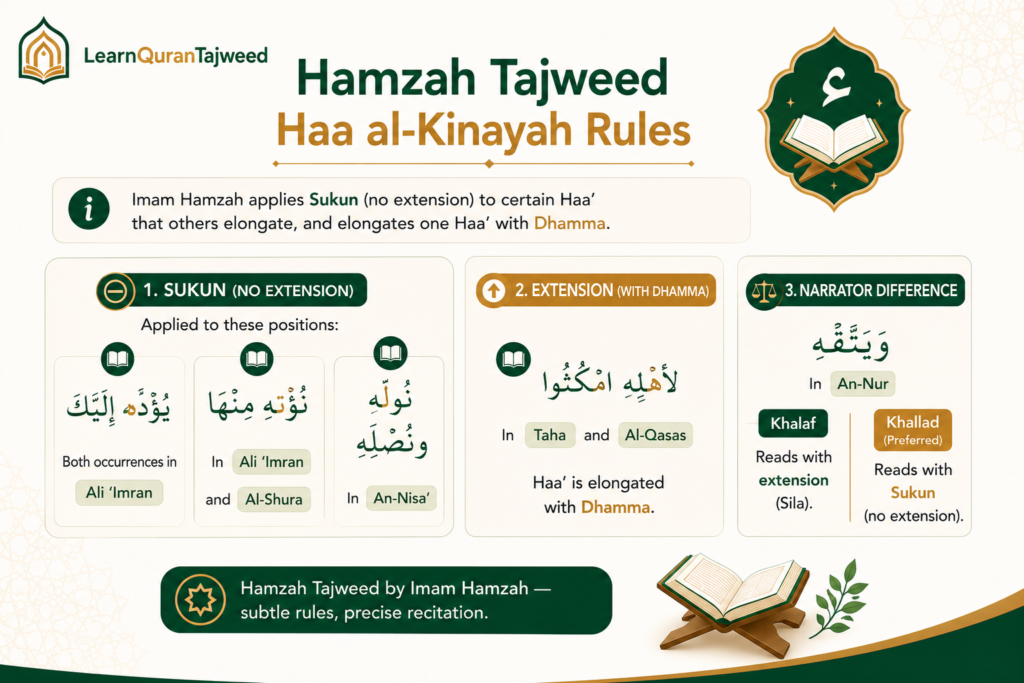
The word وَيَتَّقْهِ in Al-Nur carries a split between the two narrators: Khalaf reads it with vowel extension (Sila), while the preferred narration for Khallad applies Sukun.
Imala Rules in Ten Verbs of Imam Hamzah
Beyond the broad Yaa’-origin Imala rule, Imam Hamzah applies Imala specifically to the Alif that forms the ‘ayn (middle root letter) of ten past-tense triliteral verbs: شَاءَ, جَاءَ, خَافَ, خَابَ, طَابَ, ضَاقَ, حَاقَ, زَادَ, رَانَ, and زَاغَ — wherever these occur. He exempts زَاغَتِ الْأَبْصَارُ in Al-Ahzab and Sad from this rule.
This applies in addition to — and separately from — his general Yaa’-origin Imala rule. A student who knows only the general rule will miss these ten verb Imalas, which apply even though the Alif in words like شَاءَ is Waaw-origin, not Yaa’-origin.
شَآءَ (Sha’a) — “He willed” — appears dozens of times throughout the Quran and is recited with Imala in his Tajweed rules, producing a sound audibly distinct from the Hafs reading at every occurrence.
The Quran Recitation with Tajweed Course at Learn Quran Tajweed gives students direct live practice applying these distinctions within actual Quranic verses.

Start your recitation training at Learn Quran Tajweed now
Imam Hamzah Tajweed vs Imam Hafs Tajweed
| Rule Category | Hafs ‘an ‘Asim | Hamzah Tajweed |
| Basmala between Surahs | Present (3 options) | Absent — Surahs connected |
| Madd Munfasil | 4–5 counts | 6 counts (Isba’) |
| Imala | None (all Fath) | Extensive — Yaa’-origin, 10 verbs, Surah endings |
| Sukut before Hamzah | None | Applied to ال, شيء, and separated Sukun (Khalaf) |
| Waqf on Hamzah | Straight pronunciation | Softening via Tasrifi or Rasmi method |
| Idgham breadth | Standard positions | Broader — including Khalaf’s Idgham without Ghunnah |
| Haa al-Kinayah (select positions) | Elongated | Sukun applied |
Inside Learn Quran Tajweed Academy
Curious about how online learning works? Peek inside our actual Quran classes and hear the beautiful recitation of our students and teachers.
Structured Paths to Learn Riwayat Hamzah Online
Hamzah Tajweed is a complete, technically demanding recitation system that requires a qualified teacher who holds a Sanad in this Qira’ah. Self-study through texts alone cannot correct the phonetic precision that Waqf on Hamzah, Imala, and extended Madd require. Every rule needs to be heard, applied, and corrected in live recitation.
Learn Quran Tajweed connects students with certified instructors trained in advanced Quranic sciences — including the rules of Hamzah Tajweed — through structured one-on-one sessions scheduled around your availability.

Book your free trial session at Learn Quran Tajweed and begin Hamzah Tajweed today
Take the first step today, enroll now and experience the difference that proper Tajweed makes.
Courses we offer:
- Online Tajweed Classes
- Learn Quran with Tajweed Online
- Beginner Tajweed Course
- Intermediate Tajweed Course
- Advanced Tajweed Course
- Amali (Practical) Tajweed Course
Perfect Your Quran Recitation Today
Join expert-led Tajweed classes, and recite the Quran with confidence and clarity.
Start Your Free TrialConclusion
Hamzah Tajweed is not simply a set of variant readings — it is a complete, internally consistent recitation system built on authenticated transmission from the Prophet ﷺ through Imam Hamzah ibn Habib al-Zayyat. Its most defining characteristics — full Imala of Yaa’-origin Alifs, six-count Madd without exception, Sukut before Hamzah, and the sophisticated Waqf softening system — place it among the most technically rich of the ten Qira’at.
Students who study Hamzah Tajweed alongside Hafs develop a far deeper understanding of how Arabic phonology shapes recitation, why the Quran sounds different across the Muslim world, and what “correct recitation” means beyond a single narration. Whether your goal is scholarly study of the Qira’at or simply a more grounded understanding of Tajweed principles, Hamzah Tajweed offers both in one tradition.
Frequently Asked Questions
What Is Hamzah Tajweed?
Hamzah Tajweed is the recitation system attributed to Imam Hamzah ibn Habib al-Zayyat al-Kufi (80–156 AH), one of the seven canonical Quranic reciters. It is one of the ten authenticated Qira’at transmitted through two narrators — Khalaf and Khallad — and differs from the globally dominant Hafs narration in Madd lengths, Imala, Sukut, Waqf on Hamzah, and several Idgham positions.
Who Are the Two Narrators of Hamzah Tajweed?
Khalaf ibn Hisham al-Bazzar and Khallad ibn Khalid al-Kufi are the two narrators. Both transmitted Hamzah’s recitation through Sulaym ibn ‘Isa. Khalaf is considered the more precise narrator and is given priority in cases of disagreement. In a number of positions — particularly Sukut and Waqf on Hamzah — Khallad carries additional options not found in Khalaf.
How Is Madd Different in Hamzah Tajweed?
Both Madd Muttasil and Madd Munfasil are elongated to six counts (Isba’) in Hamzah Tajweed without exception. Hafs ‘an ‘Asim applies four to five counts to these same Madd types. The large Sila — a connecting vowel before a Hamzah-initial word — is also elongated to six counts in Hamzah Tajweed, treated as equivalent to Madd Munfasil.
What Is Imala in Hamzah Tajweed?
Imala is the tilting of a long “a” vowel toward an “e” sound. Imam Hamzah applies full Imala (Imala Kubra) to every Alif confirmed as Yaa’-origin in a noun or verb, to end-of-verse Alifs in eleven specific Surahs, and to the Alif in ten specific triliteral past-tense verbs including شَاءَ, جَاءَ, and خَافَ. Certain words are explicitly exempted and recited with Fath (full opening).
Is Hamzah Tajweed Still Taught Today?
Yes. Hamzah Tajweed remains a living, transmitted recitation tradition. Scholars holding Ijazah in the Khalaf and Khallad narrations teach it through direct instruction. Students must learn from a certified teacher who holds an unbroken chain of transmission — the Sanad — connecting their recitation back to Imam Hamzah and ultimately to the Prophet ﷺ.
How Is Waqf on Hamzah Applied in Hamzah Tajweed?
When Imam Hamzah pauses at a Hamzah-containing word, he softens the Hamzah rather than pronouncing it with full force. Two methods exist: the Tasrifi (analogical) method — which substitutes the Hamzah with Alif, Waw, or Ya’ based on the preceding vowel — and the Rasmi (orthographic) method — which converts the Hamzah to match its written form in the ‘Uthmani Mushaf. Both methods are valid; when they produce different results, multiple recitation options are accepted.
Where Can I Take a Structured Hamzah Tajweed Course?
Learn Quran Tajweed offers structured, one-on-one Tajweed courses taught by certified instructors, including programs that cover advanced Qira’at rules. You can begin with a free trial session to assess your current level and discuss your learning goals before committing to a course.
Related Articles
Tajweed Rules