 Tajweed Resources

Abu Amr Tajweed refers to the recitation rules and principles associated with Abu Amr ibn al-Ala al-Basri, one of the Seven Canonical Reciters whose reading methodology is transmitted through two major narrators: al-Duri and al-Susi. His recitation is recognized by classical scholars as the most eloquent among the seven readings, combining deep linguistic mastery with strict adherence to prophetic transmission.
If you are studying Abu Amr Tajweed today, you are engaging with a tradition that Imam Ahmad ibn Hanbal described as “the recitation of Quraysh and the Companions.” That is not a minor distinction — it is the highest linguistic endorsement in classical Islamic scholarship.
What You Will Learn in This Article
- Who Abu Amr al-Basri was and how he built his chain of recitation back to the Prophet ﷺ
- The two narrators of Abu Amr Tajweed — al-Duri and al-Susi — and what distinguishes them
- The seven defining features of his recitation method not found in other canonical readings
- Practical examples of al-Idgham al-Kabir, Imalah, and Hamzah reduction
- How to begin learning this recitation through structured online courses
Abu Amr al-Basri and His Position Abu Amr Tajweed
Abu Amr ibn al-Ala — full name: Zabban ibn al-Ala ibn Ammar al-Mazini al-Basri — was born in Makkah in 68 AH and grew up in Basra. He is the Imam of the people of Basra and the most prolific student among the Seven Reciters in terms of the number of teachers he studied under.
He read in Makkah, Madinah, Kufa, and Basra under a large group of Tabi’in, including al-Hasan al-Basri, Abu al-Aliyah, Sa’id ibn Jubayr, and Ibn Kathir al-Makki. He also heard directly from Anas ibn Malik, a Companion of the Prophet ﷺ.
Why Classical Scholars Praised Abu Amr Above Other Reciters?
Al-Suyuti in Al-Itqan stated: “The most eloquent of readings are those of Abu Amr and al-Kisa’i.” This is a technical linguistic judgment, not a general preference. His recitation consistently favored ease of articulation and phonetic precision over rhythmic weight, which made it the most widely adopted reading across the Levant, Hijaz, Yemen, and Egypt according to Ibn al-Jazari.
Harun al-Rashid ordered that his own children be taught by the recitation of Abu Amr specifically because of its linguistic eloquence. His student al-Yazidi confirmed: “He had reviewed all the readings and recited from each what was best, and what had reached him of the Prophet’s ﷺ speech — and its confirmation came in the Book of Allah.”
Isnad of Abu Amr Tajweed Back to the Prophet ﷺ
The chain of Abu Amr Tajweed is one of the most documented in classical recitation science. Abu Amr transmitted from Abu Ja’far Yazid ibn al-Qa’qa’, who transmitted from Abdullah ibn Abbas and Abu Hurayrah. Abu al-Aliyah al-Riyahi transmitted from Umar ibn al-Khattab, Ubayy ibn Ka’b, and Zayd ibn Thabit — all of whom received directly from the Prophet ﷺ.
This means the Tajweed rules practiced under Abu Amr’s method carry a traceable, verified chain reaching the Prophet ﷺ through multiple Companions. Ibn al-Jazari concluded in Al-Nashr: “Recitation is a followed Sunnah — once it is confirmed, no Arabic grammatical argument can override it.”
Who Transmitted Abu Amr Tajweed to Later Generations?
Abu Amr’s reading was transmitted to later generations primarily through his student Abu Muhammad al-Yazidi, who in turn was the teacher of both al-Duri and al-Susi. Al-Yazidi is described as “the pinnacle in the recitation of Abu Amr” — a title granted only to the most precise transmitter from a given imam.
Al-Duri and Al-Susi as the Two Narrators of Abu Amr Tajweed
The two narrators of Abu Amr Tajweed are Abu Umar Hafs al-Duri and Abu Shu’ayb Salih al-Susi, both of whom received from al-Yazidi. Al-Duri is given precedence in performance and in cases of difference between them.
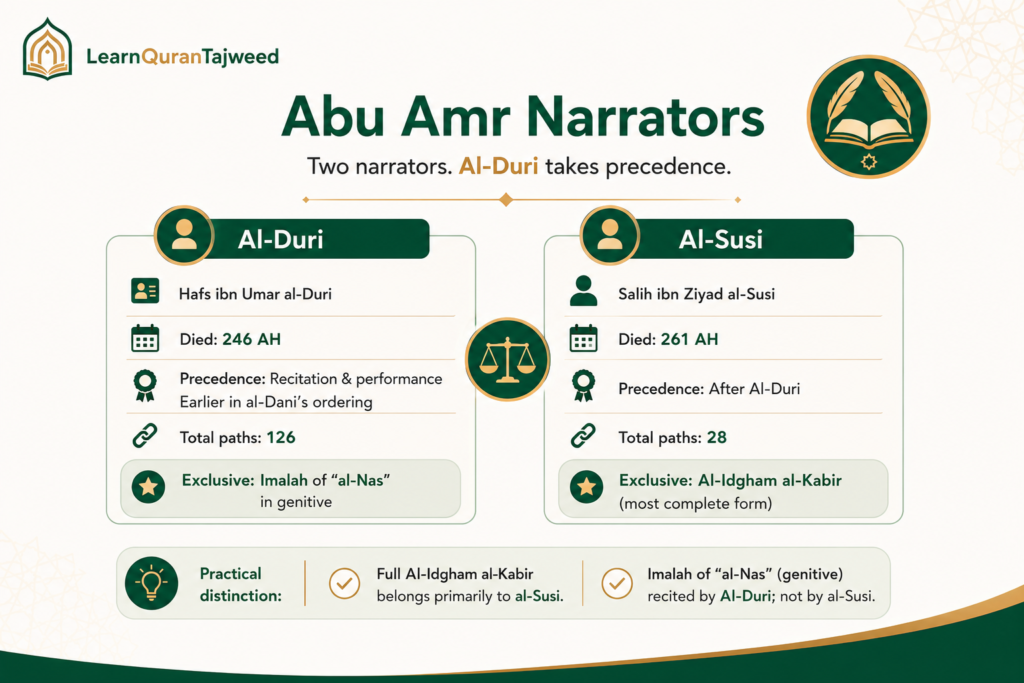
Al-Shatibi gave priority to al-Duri because of his mastery, his wider transmission across the Seven Readings, and his reputation as the first scholar to compile the readings systematically. Al-Duri died in 246 AH. The total number of transmission paths from both narrators reaches 150 chains.
| Feature | Al-Duri | Al-Susi |
| Full name | Hafs ibn Umar al-Duri | Salih ibn Ziyad al-Susi |
| Death year | 246 AH | 261 AH |
| Precedence | Recitation and performance | Earlier in al-Dani’s ordering |
| Total paths | 126 paths | 28 paths |
| Exclusive narrations | Imalah of “al-Nas” in genitive | Al-Idgham al-Kabir (most complete form) |
A practical distinction: the full Al-Idgham al-Kabir — the assimilation of two consecutive moving letters — is attributed primarily to al-Susi, while al-Duri’s narration includes it with some additional variations. Learners studying under Duri recite the Imalah of “al-Nas” when genitive; those under Susi recite it without.
Al-Idgham al-Kabir as the Defining Feature of Abu Amr Tajweed
Al-Idgham al-Kabir is the assimilation of the first of two consecutive moving (voweled) letters into the second, causing them to be pronounced as one doubled letter. It is the single most distinctive feature of Abu Amr Tajweed and is not found in any other canonical reading.
Abu Shama in Ibraz al-Ma’ani states: “The entirety of Al-Idgham al-Kabir rests on Abu Amr — from him it was taken, to him it was attributed, and through him it became known among the Seven Reciters.” Al-Shatibi described him as the “axis” (qutb) of this rule.
How Al-Idgham al-Kabir Works in Practice?
When two identical or phonetically similar moving letters meet across two words, the first is assimilated into the second, producing one doubled sound. This appears in seventeen letter types across the Quran.
Examples include: yabtaghi ghayra, al-Rahimi Maliki, innaka kunta, and fi-hi hudan. The rule’s linguistic basis, as stated by Abu Amr himself, is: “Assimilation is the speech of the Arabs that flows on their tongues — they cannot do otherwise.”
ذَٰلِكَ الْكِتَابُ لَا رَيْبَ فِيهِ هُدًى لِّلْمُتَّقِينَ
(Dhālikal-Kitābu lā rayba fīhi hudal-lil-muttaqīn)
(“That is the Book about which there is no doubt, a guidance for those conscious of Allah”)
Surah Al-Baqarah 2:2
Within a single word, al-Idgham al-Kabir under al-Susi applies only to two positions: manasikakum in Al-Baqarah and wa ma salakakum in Al-Muddaththir.
Al-Idgham al-Saghir and Abu Amr Tajweed Compared to Other Reciters
Al-Idgham al-Saghir involves the assimilation of a silent (sukun) letter into what follows it. Abu Amr’s approach here is more comprehensive than all other canonical reciters.
For dhal of idh, dal of qad, and the ta of the feminine — Abu Amr assimilates them into all relevant following letters without exception. Other reciters assimilate some letters and pronounce others clearly. This pattern confirms his broader principle: whenever two letters clash phonetically, he chooses assimilation.
The Intermediate Tajweed Course at Learn Quran Tajweed trains students specifically in these advanced assimilation rules, covering Sifaat and advanced Ahkam to precise classical standards.

Enroll in the Intermediate Tajweed Course today at Learn Quran Tajweed
Imalah and Taqlil Are Unique Rules of Abu Amr Tajweed
Imalah in Abu Amr Tajweed refers to tilting a fathah toward a kasrah and an alif toward a ya sound. Abu Amr applies Imalah more extensively than most other reciters, and his application of al-Nas in the genitive case is a feature not attributed to any other of the Seven Reciters by the same scope.
Ibn al-Jazari records that this tilting of al-Nas in genitive position is a linguistic feature of the people of the Hijaz. For al-Duri, Imalah applies; for al-Susi, fath (open pronunciation) is standard.
Read also: Al-Kisai Tajweed Rules, Recitation Style, and How to Learn It
Where Abu Amr Applies Imalah Across the Quran?
He applies full Imalah to every alif written as ya in the Mushaf when preceded by ra, such as ishtara and bushra. He also applies it to every alif followed by a final lowered ra, such as al-Dar and al-Ghar, with three exceptions: al-Jar, Jabbarin, and Ansari.
Taqlil (partial tilting) applies to all feminine shortened plurals ending in alif maqsurah, such as Tuba, Taqwa, Musa, Isa, and Yahya. This careful distinction between full Imalah and Taqlil is a technical skill that requires live correction — it cannot be acquired from text alone.
The Quran Recitation with Tajweed Course at Learn Quran Tajweed focuses on correct letter articulation from precise Makhraj points, making Imalah and Taqlil into internalized habits rather than memorized lists.

Start the Quran Recitation with Tajweed Course at Learn Quran Tajweed
See Our Classrooms in Action
Watch these short clips from our live, interactive Quran courses to see how our students learn and interact with our expert tutors.
Perfect Your Quran Recitation Today
Join expert-led Tajweed classes, and recite the Quran with confidence and clarity.
Start Your Free TrialHamzah Rules In Abu Amr Tajweed
Abu Amr’s treatment of Hamzah (glottal stop) is built on his consistent preference for ease of articulation. He never pronounces two qat’ Hamzahs consecutively — he either softens the second or drops one entirely, depending on whether they are in the same or different words.
When two Hamzahs of qat’ appear in the same word, he softens (yusahhil) the second between its full sound and the sound of the vowel before it. In A’imma specifically, he substitutes the second Hamzah with a pure ya. This is one of the positions where Abu Amr’s approach uniquely serves both linguistic flow and semantic precision.
How Al-Susi Handles Silent Hamzah in Abu Amr Tajweed?
Al-Susi narrates a rule exclusive to his transmission: every silent Hamzah is converted into a letter of prolongation matching the vowel before it. So yu’ti becomes yuti and mu’minin is pronounced muminin in his narration.
Exceptions apply where the Hamzah is silenced by grammatical reason (jazm), where the substitution would cause confusion with another word, or where the substitution produces a word from a different dialect (as in mu’sadah in Surah Al-Balad and Al-Humazah). These nuances are not arbitrary — they reflect Abu Amr’s principle that the recitation is a followed Sunnah, not a phonological experiment.
Mad Rules and Waqf Practices in Abu Amr Tajweed
Abu Amr reads with qasr (short) for the disconnected Madd al-Munfasil and tawasut (medium) for the connected Madd al-Muttasil. Al-Duri adds the option of medium prolongation for both types, giving the reciter two valid choices under Duri’s narration.
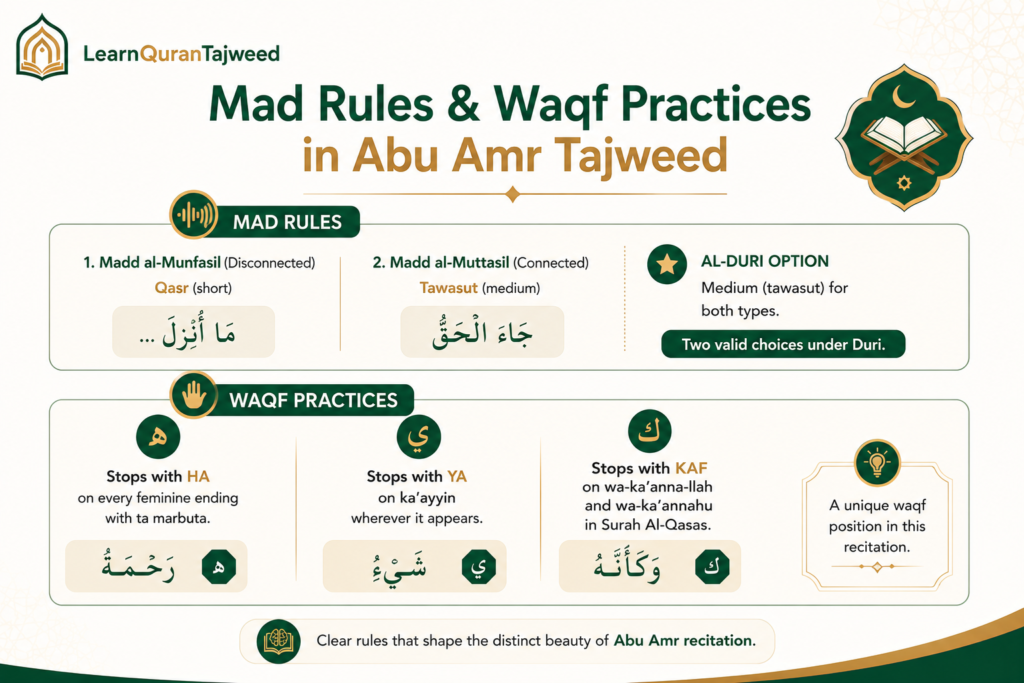
On waqf (stopping), Abu Amr stops with ha on every feminine ending written with ta marbuta in the Mushaf. He stops with ya on ka’ayyin wherever it appears, and stops with kaf on wa-ka’anna-llah and wa-ka’annahu in Surah Al-Qasas — a waqf position that surprises students unfamiliar with this reading.
Stopping on Idgham and the Rule of Imalah at Waqf
A critical rule for students of Abu Amr Tajweed: everything that receives Imalah or Taqlil in connection also receives the same treatment at stopping. Idgham does not prevent Imalah from applying.
When a moving letter or tanwin follows the tilted letter and causes the alif to drop, Imalah is suspended during connection — but returns at waqf when the blocker disappears. Al-Susi has a variant position on letters with ra before a sukun (nara-llah for example), allowing both fath and Imalah.
The Beginner Tajweed Course at Learn Quran Tajweed establishes these foundational Madd and waqf principles clearly before students advance to the more specialized rules of any particular canonical reading.

Book your first session in the Beginner Tajweed Course at Learn Quran Tajweed
Seven Defining Features of Abu Amr Tajweed Not Found in Other Readings
Classical scholars identified seven technical features that distinguish Abu Amr Tajweed from the other six canonical readings. These are not minor variants — each one carries a documented linguistic or transmission justification.
- Al-Idgham al-Kabir for two consecutive moving letters, which no other of the Seven Reciters applies
- Consistent preference for ease of articulation (takhfif) across the entire recitation
- Dropping one of two identical Hamzahs that meet from two words when their vowels match
- Full Imalah of al-Nas in genitive position (al-Duri narration)
- Iskan (silencing) of letters where consecutive movements cluster — such as bari’ikum and ya’murakum — based on the dialect of Banu Tamim and Banu Asad
- Instances where he diverges from the consensus of the other six reciters, consistently with deeper linguistic justification
- Selected positions where his reading differs from the Uthmanic script and is defended by valid transmission chains
Feature 5 — the iskan of bari’ikum — generated significant debate. Sibawayhi and al-Mubarrad rejected it. But Abu Amr al-Dani, Ibn al-Jazari, Ibn Khalawayh, and Abu Hayyan al-Andalusi all defended it, with Ibn al-Jazari stating: “The reciters who transmitted the iskan also transmitted the ikhtillas (brief movement) — it is not acceptable to charge them with inaccurate hearing in one and not the other.”
Feature 6 reveals Abu Amr’s linguistic depth: when he diverged from the majority, the justification always lay in a more precise Arabic grammatical reading. In Surah Yusuf 12:31, he read hashallah with an alif, arguing that the form hashaka does not exist in Arabic — only hashaka and hashallaka — while others read without the alif, following the Mushaf script.
Read also: Ibn Kathir Tajweed: Rules, Narrators, and How to Learn It
Inside Learn Quran Tajweed Academy
Curious about how online learning works? Peek inside our actual Quran classes and hear the beautiful recitation of our students and teachers.
Begin Learning Abu Amr Tajweed with Expert Online Instruction
Learn Quran Tajweed provides live, structured courses under certified tutors who specialize in classical recitation rules, including the reading of Abu Amr al-Basri through Duri and Susi narrations.
Every rule described in this article — the Idgham levels, Imalah positions, Hamzah treatment, and waqf practices — is taught with direct oral correction. Text alone cannot transfer a recitation method that has been transmitted mouth-to-ear for fourteen centuries.

Start your free trial session at Learn Quran Tajweed today
Courses we offer:
- Tajweed Course for Kids
- Tajweed Course for Adults
- Tajweed Course for Ladies
- Tajweed ul Quran Course
- Quran Recitation with Tajweed Course
- Quran Tarteel Course
- Tajweed Ijazah Program
Perfect Your Quran Recitation Today
Join expert-led Tajweed classes, and recite the Quran with confidence and clarity.
Start Your Free TrialConclusion
Abu Amr Tajweed is a complete recitation methodology grounded in the highest standards of Arabic linguistic precision and unbroken prophetic transmission. Its defining features — Al-Idgham al-Kabir, full Imalah, Hamzah reduction, and iskan under consecutive movement — are not stylistic choices but documented linguistic positions carried through verified chains back to the Prophet ﷺ.
The reading reaches the student today through two narrators: al-Duri, who is given precedence in performance, and al-Susi, who is known for the most complete application of Al-Idgham al-Kabir. Learning this tradition requires a qualified teacher — the phonetic distinctions involved, particularly Imalah degrees and Hamzah substitution, cannot be reliably acquired from written material alone. Learn Quran Tajweed offers the structure and the certified instructors to take you from foundational rules to precise application.
Frequently Asked Questions
What is Abu Amr Tajweed?
Abu Amr Tajweed refers to the Quranic recitation rules attributed to Abu Amr ibn al-Ala al-Basri, one of the Seven Canonical Reciters. His method is transmitted through al-Duri and al-Susi and is characterized by preference for phonetic ease, Al-Idgham al-Kabir, and extensive Imalah application.
Who are the two narrators of Abu Amr Tajweed?
Al-Duri (full name: Hafs ibn Umar al-Duri, died 246 AH) and al-Susi (Salih ibn Ziyad al-Susi, died 261 AH) are the two narrators. Both received from Abu Muhammad al-Yazidi, who received directly from Abu Amr. Al-Duri is given precedence in recitation performance.
What is Al-Idgham al-Kabir in Abu Amr Tajweed?
Al-Idgham al-Kabir is the assimilation of the first of two consecutive moving letters into the second, producing one doubled letter. It is exclusive to Abu Amr among the Seven Reciters and applies when two identical, homorganic, or phonetically close letters meet across two words.
How does Abu Amr Tajweed differ from Hafs recitation?
Hafs recitation (the most widely used globally) does not apply Al-Idgham al-Kabir and does not include the extensive Imalah positions of Abu Amr. Abu Amr also drops one of two identical Hamzahs from adjacent words — a rule absent in Hafs — and applies iskan in positions where Hafs maintains full voweling.
Is Abu Amr Tajweed still taught and practiced today?
Yes. Ibn al-Jazari documented that the recitation of Abu Amr remains the dominant reading in the Levant, Hijaz, Yemen, and Egypt, particularly in its fard (obligatory) letter variations. It is actively taught through certified online institutions including Learn Quran Tajweed, which offers both beginner and advanced courses in classical recitation.
What does Imalah mean in Abu Amr Tajweed?
Imalah is the tilting of a fathah toward a kasrah and of an alif toward a ya sound. In Abu Amr Tajweed, it applies to alifs written as ya in the Mushaf when preceded by ra, to alifs followed by a final genitive ra, and — in al-Duri’s narration — to al-Nas in genitive position. Partial Imalah (Taqlil) applies to feminine shortened plural endings.
Can I learn Abu Amr Tajweed online with a qualified teacher?
Yes. Learn Quran Tajweed provides structured online courses with certified tutors who specialize in classical Tajweed rules. The Practical Tajweed Course and the Quran Tarteel Course are both designed to develop precise oral recitation under direct instructor correction.