 Tajweed Rules

At-Tafashi in tajweed is the characteristic (sifah) of a single Arabic letter, the Shin (ش), spreading its sound and breath across the mouth until it strikes the inner surface of the teeth. If you have ever heard a reciter’s Shin ش blend into the following letter or sound flat and lifeless, the missing ingredient is usually this exact sifah.
Understanding At-Tafashi in tajweed matters, as it is one of the “sifat with no opposite”, which is a defining feature of the letter Shin ِش that has no counterpart (Didd) among the 28 Arabic letters. Get it wrong, and a word like الرّشد can start to sound like it ends in a Jeem ج instead of a Shin ش.
This article breaks down the linguistic and technical definition of At-Tafashi. It also explains why only the letter Shin carries this attribute, walks through its three degrees of strength. Furthermore, it shows exactly where reciters go wrong, with real Quranic examples throughout.
What You’ll Learn In This Article
- The linguistic and technical (istilahi) definition of At-Tafashi.
- Why Shin is the letter associated with this sifah, and the minority views that disagree.
- The three degrees of Tafashi and how they change with shaddah, sukoon, and harakah.
- The most common recitation mistakes tied to this rule.
- Quranic examples where At-Tafashi must be clearly pronounced.
What Does At-Tafashi Mean In Tajweed?
At-Tafashi is defined by both aspects; its origin in the Arabic language and its specific role in the science of tajweed. The two definitions work together.
The linguistic meaning explains the word, and the technical meaning explains what happens in your mouth.
The Linguistic Meaning Of At-Tafashi
The linguistic meaning of At-Tafashi (التفشي) refers to the spreading or diffusion. Classical Arabic sources describe a wound as “tafashat” when it widens or spreads across the skin. The same root idea applies to how the sound of the Shin spreads inside the mouth.
The Technical (Istilahi) Definition Of At-Tafashi
In tajweed terminology, At-Tafashi means the spreading of air in the mouth when pronouncing a letter, to the point that the airflow strikes the inner surface of the upper and lower teeth. It is not simply “airflow”. Many letters release air (the sifah of Rakhawah covers that).
At-Tafashi specifically describes the sound extending and spreading until it feels like it reaches the makhraj (articulation point) of a neighboring letter.
Read also: What is Makhraj in Tajweed?
Which Letter Carries The Sifah Of At-Tafashi?
Scholars of tajweed largely agree on one answer, but the classical texts preserve a real debate worth understanding. It shapes how carefully you need to apply the rule.
Why Is Shin The Only Letter With This Attribute?
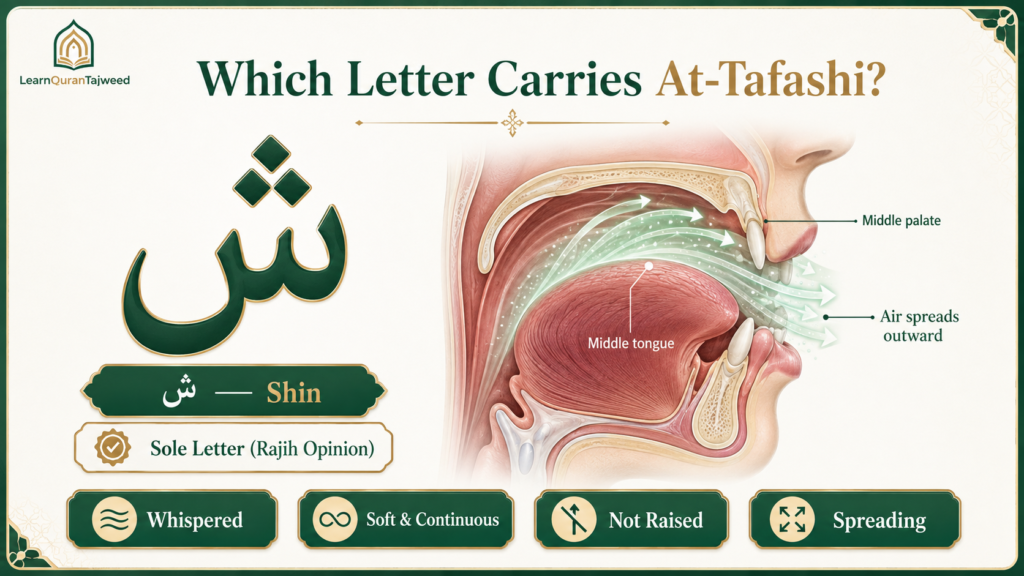
The rajih (strongest, most accepted) opinion is that the letter Shin ش is the sole letter with At-Tafashi.
Shin is articulated from the middle of the tongue against the middle of the palate, and it is described as mahmoosah (whispered), rakhwah (soft/continuant), mustafilah (not raised), and mutafashiyah (spreading).
When you pronounce Shin correctly, its sound extends outward in the mouth until it approaches the makhraj of the Tha or Dhad, that extension is the tafashi itself.
The Minority Scholarly Opinions On Tafashi Letters
Not every linguist limited At-Tafashi to Shin alone. Ibn Maryam al-Shirazi believed that four letters carry it, Meem, Shin, Faa, and Raa.
He held that as each letter of these four produces a distinct kind of “spreading” sound: ghunnah in the Meem, intishar (dispersal) in the Shin, ta’afuf (a puffing sound) in the Faa, and takrir (repetition/trilling) in the Ra.
A broader classical view, recorded by Ibn al-Jazari in his text At-Tamhid fi ‘Ilm at-Tajweed, lists eight letters: Meem, Shin, Faa, Raa, Thaa, Saad, Seen, and Daad. He grouped them by different underlying features (ghunnah, safeer, istitalah).
Ibn al-Jazari himself pushed back on this reasoning: if Meem qualifies through ghunnah, he argued, then Noon should qualify too, as it also carries ghunnah. This is why the single-letter (Shin-only) opinion remains the standard taught in tajweed today. It is the most internally consistent.
Read also: Ghunnah Rules in Tajweed
See Our Classrooms in Action
Watch these short clips from our live, interactive Quran courses to see how our students learn and interact with our expert tutors.
Perfect Your Quran Recitation Today
Join expert-led Tajweed classes, and recite the Quran with confidence and clarity.
Start Your Free TrialHow Does At-Tafashi Sound? – The Three Degrees
At-Tafashi does not apply with the same intensity every time Shin appears. The letter’s state, shaddah, sukoon, or harakah, determines how strongly the spreading sound should come through. This is where most reciters either overdo it or miss it entirely.
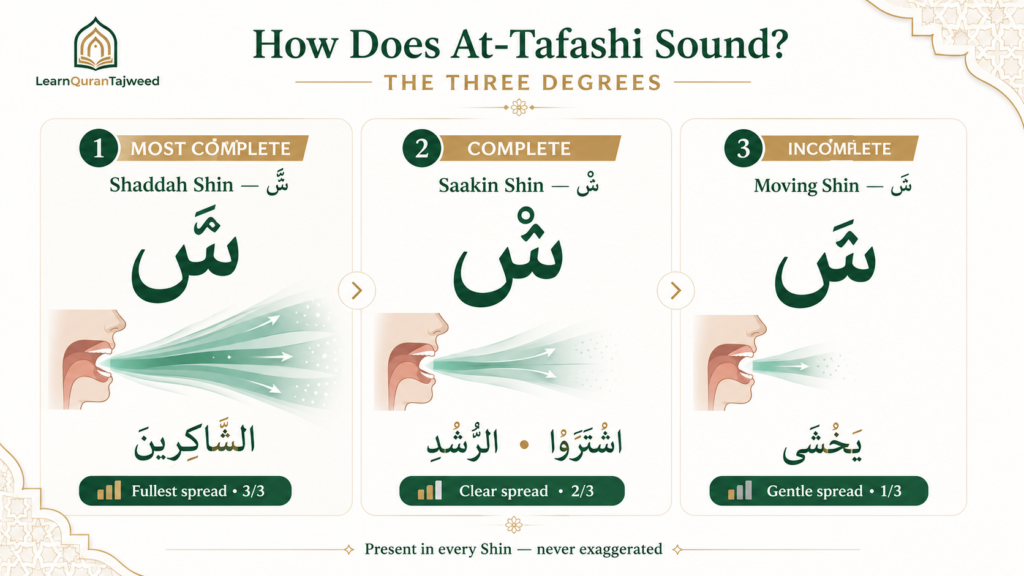
1. Most Complete Tafashi — Shaddah Shin
When Shin ش carries a shaddah, the tafashi must be given its fullest expression, because a doubled letter is treated as two consecutive letters. In الشَّاكِرِينَ, the Quran reciter needs to let the spreading of the sound sit for the full duration of the doubled letter before releasing it.
2. Complete Tafashi — Saakin (Silent) Shin
A Shin ش with sukoon shows tafashi clearly and completely, as in اشْتَرَوْا and الرُّشْد. This is where the attribute is most audible in normal speech, since there is no vowel (harakah) afterward to shorten the sound.
3. Incomplete Tafashi — Moving (Mutaharrik) Shin
When Shin carries a short vowel, as in يَخْشَى, the tafashi is present but weaker, because the vowel that follows moves the sound forward before the spreading can fully develop. It should still be present, just not exaggerated.
Getting these three degrees right is a skill that develops fastest with a teacher listening in real time, correcting the exact moment the tafashi drops out or gets overdone.
That kind of live, letter-by-letter feedback is exactly what one-on-one sessions at Learn Quran Tajweed are built around.
Read also: Harakat in Tajweed
Common Mistakes Reciters Make With At-Tafashi
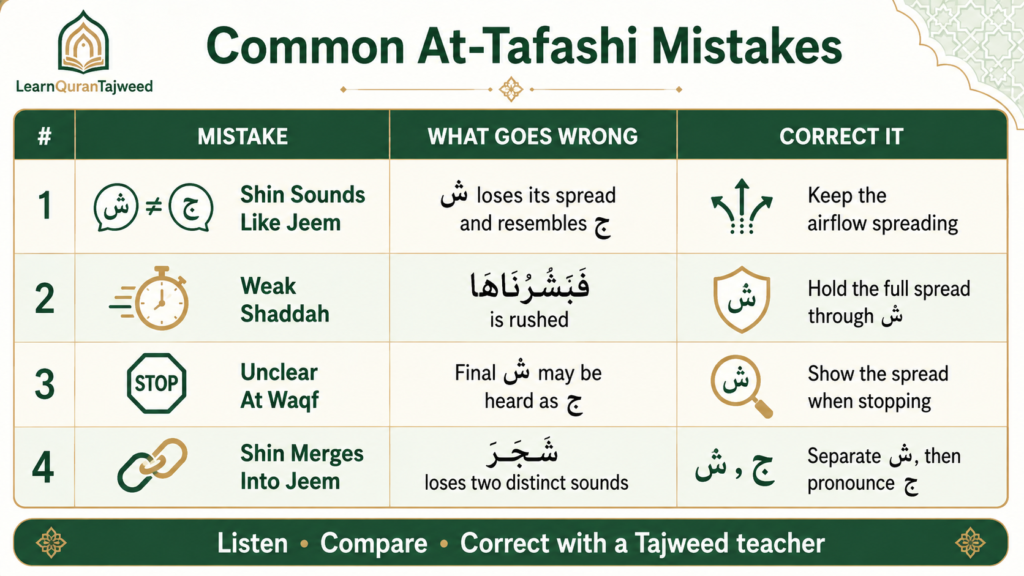
There are four recurring errors that show up across learners at every level.
1.Confusing Shin with Jeem:
If the tafashi is dropped, a saakin Shin can sound almost identical to a Jeem. This is the single most common mistake, especially at speed.
2. Weak shaddah pronunciation:
A doubled Shin (as in فبشّرناها) needs its tafashi fully “filled out” for the entire duration of the shaddah, rushing through it flattens the sound.
Read also: The Whistling Quality in Tajweed: Safeer Explained
3. Unclear Tafashi At Waqf (Stopping):
Stopping on a word ending in Shin, like الرّشد, requires deliberately showing the spreading sound; otherwise the final letter can be misheard as a Jeem ج.
4. Shin Merging Into A Following Jeem:
When Shin is immediately followed by Jeem, as in شَجَرَ بَيْنَهُم or ُشَجَرَةً تَخْرُج, reciters must keep the two letters distinct rather than letting the Shin’s sound bleed into the Jeem.
A trained ear catches these patterns instantly, which is why structured tajweed correction, not just self-study from articles, is what actually fixes them long-term.
Read also: Waqf Rules in Tajweed
Quranic Examples Of At-Tafashi
Seeing the rule inside real ayat makes it easier to apply than reading a definition alone.
In:
“اشْدُدْ بِهِ أَزْرِي “ “Reinforce through him my strength. “(Surah Taha, 31)
The saakin Shin needs its tafashi shown clearly before the following letter.
In:
وَقَالَ الَّذِي اشْتَرَاهُ مِن مِّصْرَ” “ And the one from Egypt who bought him said… “(Surah Yusuf, 21)
The same rule applies mid-word.
And when stopping on:
“ الَّذِينَ يَحْمِلُونَ الْعَرْشَ” “Those [angels] who carry the Throne and those around it exalt [Allah] with praise of their Lord. “(Surah Ghafir, 7)
The reciter must preserve the tafashi at the point of waqf so the Shin does not collapse into a Jeem-like sound.
Read also: How to Recite Quran With Tajweed?
Inside Learn Quran Tajweed Academy
Curious about how online learning works? Peek inside our actual Quran classes and hear the beautiful recitation of our students and teachers.
Perfect Your Quran Recitation Today
Join expert-led Tajweed classes, and recite the Quran with confidence and clarity.
Start Your Free TrialMaster At-Tafashi And Every Other Tajweed Rule With Guided Practice
Reading about sifaat al-huruf only gets you so far — Tafashi, like most tajweed rules, is something your ear and mouth need to practice under correction, not just understand in theory.
Learn Quran Tajweed pairs you with a certified teacher for live, one-on-one sessions where every letter – including the exact strength of a Shin’s tafashi — gets checked in real time, so mistakes get corrected before they turn into habits.
Courses we offer:
- Online Tajweed Classes
- Learn Quran with Tajweed Online
- Beginner Tajweed Course
- Intermediate Tajweed Course
- Advanced Tajweed Course
- Amali (Practical) Tajweed Course
- Tajweed Course for Kids
- Tajweed Course for Adults
- Tajweed Course for Ladies
- Tajweed ul Quran Course
- Quran Recitation with Tajweed Course
- Quran Tarteel Course
- Tajweed Ijazah Program
Conclusion
At-Tafashi in tajweed is the spreading of the Shin’s sound until it strikes the inner surface of the teeth, a sifah that belongs, according to the strongest scholarly opinion, to Shin alone.
Its strength shifts across three degrees depending on whether the Shin is doubled, silent, or vowelled, and the most common mistakes all trace back to letting that spreading sound drop out, whether at speed, at a shaddah, at a stop, or next to a Jeem.
Recognizing these patterns in real ayat, and hearing them corrected live, is what turns the rule from a definition into a habit.
Frequently Asked Questions
What Does At-Tafashi Mean In Tajweed?
At-Tafashi is the spreading of air in the mouth when pronouncing the letter Shin, until the sound strikes the inner surface of the upper and lower teeth. It is classified among the sifat al-quwwah (attributes of strength) because it has no opposite characteristic.
Which Letter Has The Sifah Of At-Tafashi?
The strongest scholarly opinion holds that Shin is the only letter with At-Tafashi. Some classical scholars, including Ibn Maryam al-Shirazi, extended the attribute to Meem, Fa, and Ra as well, but this is a minority view not followed in standard tajweed teaching today.
Why Is Shin Called “Mutafashi”?
Shin is called mutafashi because its sound spreads in the mouth when pronounced, extending until it approaches the makhraj of a neighboring letter such as the Tha or Dhad. The name comes directly from the linguistic meaning of tafashi: spreading or diffusion.
Does At-Tafashi Apply The Same Way In Every Word?
No. At-Tafashi appears at its most complete in a shaddah Shin, complete in a sakin (silent) Shin, and incomplete in a Shin carrying a short vowel. The degree changes based on the letter’s state in each word.
What Happens If A Reciter Ignores At-Tafashi?
Ignoring At-Tafashi typically causes the Shin to sound closer to a Jeem, especially when the Shin is silent or when stopping on a word that ends with it. This is one of the most common correction points tajweed teachers flag in live sessions.