 Tajweed Rules

Pronounce the word “Rabb” slowly and notice the movement of your tongue. Does it strike the roof of your mouth once, or does it bounce several times like a rolled Spanish R? Both answers point to a real question in Tajweed.
It centers on one sifah, which is Takrir in Tajweed. It is the quality that differs the letter Raa ر from any other Arabic sound.
Takrir, or Takreer in Tajweed, describes the natural trembling of the tongue tip when pronouncing the letter Raa. Quran Reciters are taught to recognize this quality specifically so they can control it without exaggeration.
Getting this balance wrong is one of the most common lahn (pronunciation errors) in Quran recitation. It is rarely explained beyond a one-line definition.
This article explains what Takrir actually is. It also illustrates where scholars disagree on how to apply it, the physical mechanism behind it, and the two opposite mistakes reciters make when handling the letter Raa.
What You’ll Learn in This Article
- The linguistic and technical definition of Takrir.
- Why Takrir belongs to the letter Ra alone.
- The three classical scholarly positions on how to treat this sifah.
- The tongue mechanism that produces (and controls) the trill.
- The two most common mistakes reciters make with Raa.
- When Takrir becomes most noticeable in recitation.
What Is Takrir in Tajweed and How Does It Affect the Pronunciation of Raa?
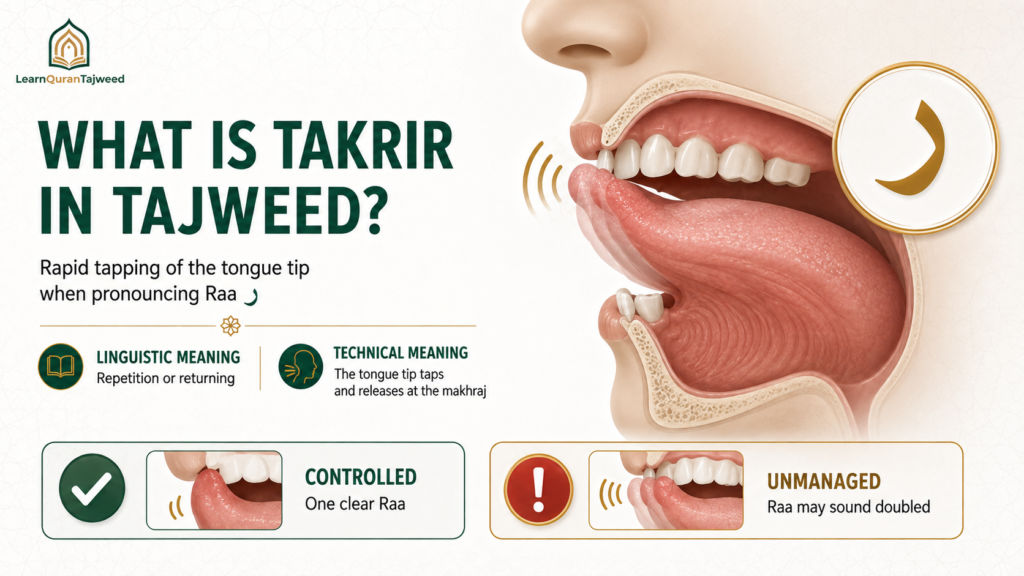
Takrir is the sifah (characteristic) of a letter that describes the tongue tip trembling against its articulation point when producing the sound.
In Tajweed, it is defined as the repeated tapping of the tongue tip at the makhraj of the letter Raa, which can make the letter sound like more than one Raa if left unmanaged.
The Linguistic and Technical Meaning of Takrir in Tajweed
The linguistic definition of “takrir” refers to repetition or returning to something again. Tajweed scholars borrowed this common word to describe a specific physical event.
The tongue tip does not strike its articulation point once and holds still. It taps and releases in rapid succession.
Linguists such as Sibawayh described this directly, noting that when the letter Raa is pronounced, it “comes out as if doubled.”
Ibn Jinni also made a similar observation. He states that when a reciter stops on the letter Raa, the tongue tip visibly stumbles as a result of this repeated contact.
Why Raa Is the Only Arabic Letter With the Quality of Takrir
Takrir is one of the sifaat that has no opposite (a sifah without a didd). Every other characteristic in Tajweed has a contrasting counterpart-for instance, hams and jahr, or shiddah and rakhawah. Takrir stands alone, and it belongs exclusively to the letter Raa.
This is directly linked to where Raa is produced. Raa comes from the tip of the tongue, slightly deeper into the mouth than the letter Nun ن, meeting the upper palate. That specific contact point, combined with the tongue’s natural curve, produces the unique tapping sensation of this letter.
It is difficult to correct a sifah like Takrir by just listening to recordings alone. At Learn Quran Tajweed, trained and certified instructors listen to your pronunciation of the letter Raa in real time during one-on-one sessions.
They can hear immediately whether the trill is under- or over-produced. It is something self-study often misses entirely.
Read also: Jahr in Tajweed
See Our Classrooms in Action
Watch these short clips from our live, interactive Quran courses to see how our students learn and interact with our expert tutors.
Perfect Your Quran Recitation Today
Join expert-led Tajweed classes, and recite the Quran with confidence and clarity.
Start Your Free TrialThe Three Scholarly Opinions on How Takrir Should Be Applied to Raa
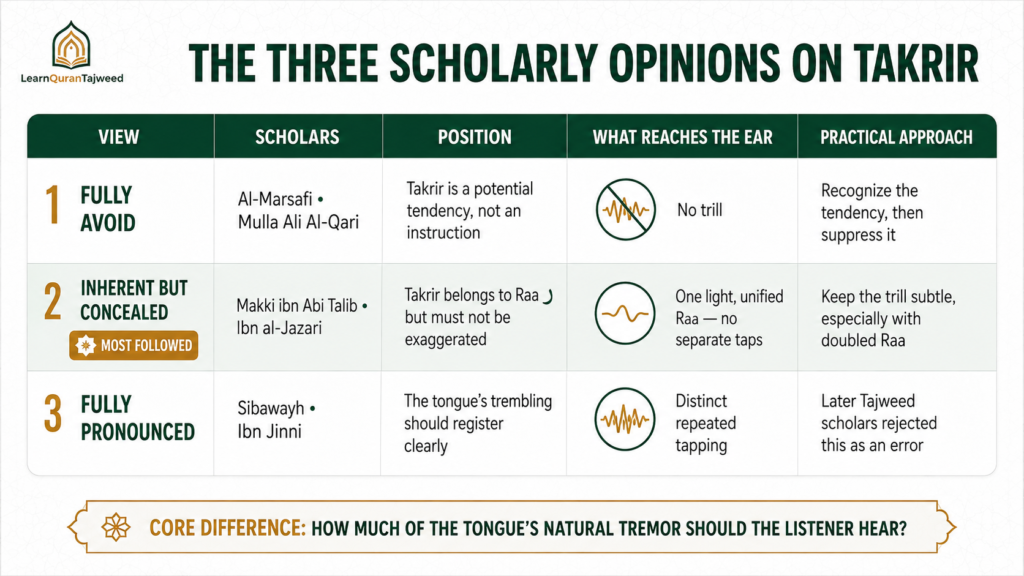
Classical scholars did not reach agreement on a single answer for how much trilling should actually reach the ear.
Their positions fall into three distinct camps. Understanding all three explains why different teachers sometimes give slightly different corrections for the same word.
1. The View That Takrir Should Be Fully Avoided During Recitation
Scholars such as Al-Marsafi and Mulla Ali Al-Qari believed that Takrir describes a letter’s potential, not an instruction to perform it.
In their view, the letter Raa is simply “capable” of trilling, and the reciter’s job is to recognize this tendency only in order to suppress it. This is similar to how a student studies a mistake so they know how to avoid it.
2. The View That Takrir Is Inherent in Raa but Should Be Concealed and Controlled
Makki ibn Abi Talib and Ibn al-Jazari represent the position that most reciters follow today. In this view, Takrir is a permanent characteristic of the letter Raa that cannot be removed entirely, but the reciter must prevent it from being exaggerated.
Concealing the trill does not mean the complete erasing of it. It means keeping it light enough that the listener does not perceive separate taps.
This is the opinion the majority of qualified reciters (ahl al-ada’) have practiced and passed down. It is the one reflected in Ibn al-Jazari’s well-known line from Al-Muqaddimah Al-Jazariyyah: “wa akhfi takriran idha tushaddad,” meaning “conceal the trilling when the letter is doubled.”
3. The View That Takrir Should Be Clearly Pronounced as an Audible Trill
Linguists including Sibawayh and Ibn Jinni argued that the tongue’s trembling should register clearly, to the point that a doubled Raa is treated as equivalent to two separate letters for rulings such as Imalah (vowel inclination).
This position dominates among linguists rather than Tajweed specialists. Later on, scholars such as Zakariyya Al-Ansari explicitly rejected it as a pronunciation error that must be corrected.
Read also: What is Makhraj in Tajweed?
How the Tongue Produces Takrir When Pronouncing the Letter Raa
True understanding of the mechanics makes the difference between memorizing a rule and actually applying it correctly.
How a Small Gap Between the Tongue and Palate Helps Control the Raa Sound
When the tongue tip meets the upper palate to form Raa, it does not fully seal. As a result of the natural tongue concave, a small gap remains at the point of contact. This gap acts as a release valve, letting some of the airstream pass through continuously instead of building up behind a sealed tongue.
That same gap is why Raa is classified as bayniyyah, or a letter that sits between shiddah (a fully stopped sound, like Taa) and rakhawah (a fully open sound, like Faa). Raa is neither fully blocked nor fully open. The small gap is what keeps it in that middle category.
Read also: Principles of Tajweed
What Happens When the Tongue Completely Seals the Makhraj of Raa
When the tongue presses down and seals the makhraj entirely, air pressure builds up behind it. That pressure eventually pushes the tongue tip down, releasing a burst of air, after which the tongue reseals and the pressure builds again.
When this mechanism is repeated several times, this produces the exaggerated “arrrr” sound reciters are trained to avoid, a series of distinct taps rather than one clean articulation.
The correction is not to eliminate the tongue’s involvement, but rather to maintain that small gap so the sound passes through gradually rather than building into repeated pressure releases.
Common Mistakes That Cause Incorrect Takrir When Pronouncing Raa
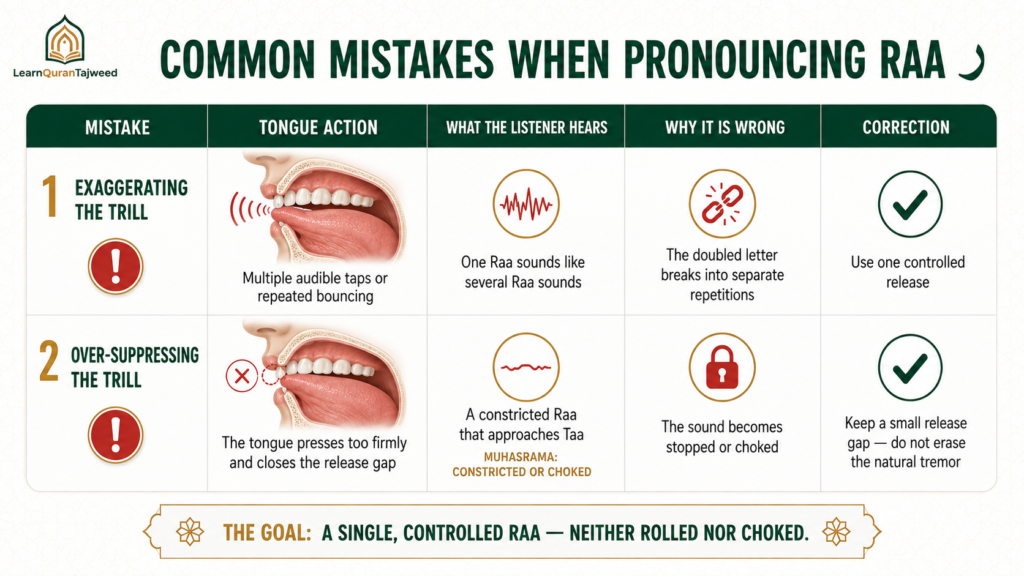
Every professional instructor watches for the same two extremes, and both count as lahn in formal recitation.
1. Exaggerating Takrir by Producing Multiple Audible Trills in Raa
Rolling the Raa with multiple audible taps, especially in words like الرَّحْمَٰن or خَرَّ, turns a single doubled letter into what sounds like several separate Raa sounds strung together. Ibn al-Jazari specifically warned against this in his commentary in An-Nashr.
He described the correct approach as a single, controlled release of the tongue rather than a repeated bounce.
2. Over-Suppressing Takrir by Pressing the Tongue Too Firmly Against the Palate
The opposite error is pressing the tongue too firmly against the palate attempting to completely eliminate the trembling. This closes the small release gap. As a result, the letter starts to sound closer to Taa, a fully stopped consonant.
Ibn al-Jazari explained this outcome using the term “muhasrama,” meaning constricted or choked. He also classified it as an equally unacceptable error.
Getting this right takes repeated listening and correction. That is why many students find it faster to build the habit under live guidance.
Learn Quran Tajweed structures early lessons around exactly these sifaat, so students correct the Raa sound before it becomes a permanent habit that’s more difficult to unlearn later.
Read also: Tajweed Common Mistakes by Beginners (And How to Correct Them)
When Is Takrir Most Noticeable?
Takrir happens in every Raa, but it becomes most audible in two specific situations: when the Raa is saakin (still, without a vowel) and when it carries a shaddah (doubling).
Words such as رَبّ, مَرّة, and الرَّحِيم require closer attention than a lightly vowelled Raa in the middle of a word. The doubled or stopped articulation gives the tongue more time and more contact pressure, both of which increase the risk of an exaggerated trill.
Quran learners preparing for Hifz or working through structured Tajweed lessons benefit from practicing these word types deliberately rather than treating every Raa the same way.
Read also: How to Recite Quran With Tajweed?
Inside Learn Quran Tajweed Academy
Curious about how online learning works? Peek inside our actual Quran classes and hear the beautiful recitation of our students and teachers.
Perfect Your Quran Recitation Today
Join expert-led Tajweed classes, and recite the Quran with confidence and clarity.
Start Your Free TrialStart Correcting Your Ra Pronunciation Today
Reading about Takrir is one thing. Hearing your own Ra corrected in real time is what actually fixes it. A live instructor can catch an exaggerated trill or an over-suppressed one in seconds, something no amount of self-study or app feedback can replicate.
Learn Quran Tajweed pairs you with a certified instructor for one-on-one sessions built around exactly this kind of detail, so the sifat you’re reading about here become sifat you can actually produce correctly, and keep for life.
Book Your Free Trial Class.
- Online Tajweed Classes
- Learn Quran with Tajweed Online
- Beginner Tajweed Course
- Intermediate Tajweed Course
- Advanced Tajweed Course
- Amali (Practical) Tajweed Course
- Tajweed Course for Kids
- Tajweed Course for Adults
- Tajweed Course for Ladies
- Tajweed ul Quran Course
- Quran Recitation with Tajweed Course
- Quran Tarteel Course
- Tajweed Ijazah Program
Conclusion
Takrir in Tajweed describes the natural trembling of the tongue tip that occurs when pronouncing the letter Ra, a quality unique to that single letter among all Arabic sounds.
Classical scholars differ on how much of that trembling should reach the listener’s ear, but the position followed by most qualified reciters, rooted in Ibn al-Jazari’s teaching, calls for a controlled trill: present, but never amplified into separate taps and never suppressed into a stopped sound like Taa.
The physical key is the small gap that remains between the tongue tip and the palate, which keeps Ra in its correct bayniyyah category. Reciters who understand this mechanism, rather than simply memorizing “don’t roll the Ra too much,” tend to correct the habit faster and retain it longer.
Frequently Asked Questions
What Does Takrir Mean In Tajweed?
Takrir is the sifah describing the trembling of the tongue tip against the palate when pronouncing the letter Ra. It is one of the sifat that has no opposite characteristic and applies to no other Arabic letter.
Which Letter Has The Sifah Of Takrir?
Only the letter Ra carries the sifah of Takrir. Its articulation point and the natural curve of the tongue at that spot are what create the trembling sensation this sifah describes.
Should Takrir Be Pronounced Or Hidden?
According to the view most reciters follow, Takrir should be concealed but not eliminated. The tongue should tap once with a controlled release rather than bouncing repeatedly or sealing completely.
What Does “Wa Akhfi Takriran Idha Tushaddad” Mean?
This line from Ibn al-Jazari’s Al-Muqaddimah Al-Jazariyyah instructs the reciter to conceal the trilling of Ra specifically when the letter carries a shaddah, since doubling makes the trill most likely to become exaggerated.
What Happens If Takrir Is Exaggerated?
An exaggerated trill produces multiple distinct taps of the tongue, making a single Ra sound like several Ra letters in sequence. Ibn al-Jazari classified this as an error that reciters must actively guard against.
Is Takrir Necessary For Correct Quran Recitation?
Some degree of Takrir is unavoidable because it results from how Ra is physically articulated. What matters for correct recitation is controlling the trill so it stays light and consistent, avoiding both exaggeration and complete suppression.
Related Articles
Tajweed Rules