 Tajweed Basics
The Quran can be recited at different speeds depending on the reader’s purpose, ability, and setting. These recognized levels of recitation allow a Muslim to read slowly for careful learning, at a moderate pace for balanced daily practice, or more quickly when reviewing longer passages.
Regardless of speed, every valid level must preserve correct pronunciation and the essential rules of Tajweed; reciting faster must never mean dropping letters, shortening required elongations, or sacrificing clarity.
The three principal levels are Al-Tahqeeq, the slowest and most precise form; Al-Tadweer, a balanced pace between slowness and speed; and Al-Hadr, the fastest form of controlled recitation. Scholars have also discussed At-Tarteel: some classify it as a separate fourth level, while others regard it as a quality that should be present in all three—reciting the Quran clearly, correctly, and with proper attention to its words.
The Three Principal Levels Of Quran Recitation
Quran recitation is generally divided into three principal levels according to pace: Al-Tahqeeq, Al-Tadweer, and Al-Hadr. Each level serves a different purpose, but all three require clear pronunciation and proper application of Tajweed.
1. Al-Tahqeeq
Al-Tahqeeq is the slowest and most precise level of recitation. The reader carefully articulates every letter, observes the correct elongations and nasal sounds, and pays close attention to stopping and starting. It is commonly used when teaching beginners, correcting pronunciation, and practising Tajweed.
2. Al-Tadweer
Al-Tadweer is a moderate style between the careful pace of Al-Tahqeeq and the speed of Al-Hadr. It combines clarity with a smooth, balanced flow, making it suitable for daily Quran reading, prayer, and regular practice.
3. Al-Hadr
Al-Hadr is the fastest recognized level of Quran recitation. It allows the reader to recite longer portions or review memorized passages more efficiently. Despite its speed, every letter must remain clear, and all applicable Tajweed rules must be observed without rushing or omission.
Some scholars list At-Tarteel as a fourth level of Quran recitation, describing it as a calm, measured style that combines clear pronunciation, correct Tajweed, and reflection on the verses.
Others consider At-Tarteel a quality that should be maintained across Al-Tahqeeq, Al-Tadweer, and Al-Hadr rather than a separate level. Its foundation is Allah’s command: “And recite the Quran with measured recitation” (Surah Al-Muzzammil 4), which emphasizes that the Quran should always be read clearly and carefully, regardless of pace.
Read also: How to Practice Tajweed Daily?
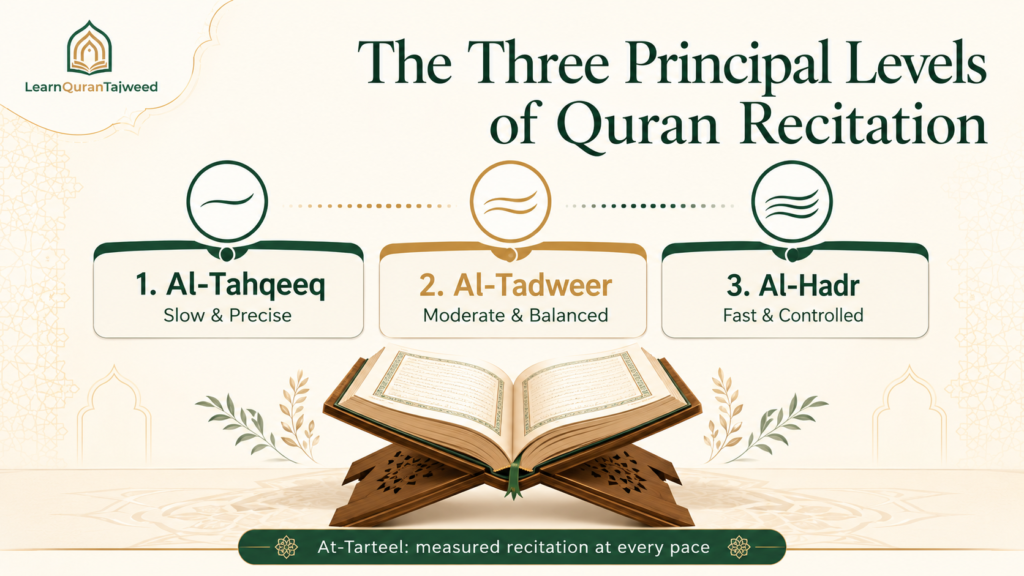
| Level | Relative Speed | Primary Purpose | Tajweed Requirement |
| Al-Tahqeeq | Slowest | Learning and correcting pronunciation | Fully maintained |
| Al-Tadweer | Moderate | Balanced everyday recitation | Fully maintained |
| Al-Hadr | Fastest | Reviewing and reciting extended passages | Fully maintained |
1. Al-Tahqeeq—The Slow And Precise Level
Al-Tahqeeq linguistically means precision, verification, and careful execution. In Tajweed terminology, it is the deliberate recitation of the Quran in which every letter is articulated clearly and given its proper rights and characteristics, including accurate elongation, nasalization, and stopping.
As the slowest and most careful level of recitation, Al-Tahqeeq is especially useful for learning, correcting pronunciation, and mastering the practical application of Tajweed rules.
Characteristics Of Al-Tahqeeq
Al-Tahqeeq requires the careful articulation of every letter, with close attention to its makhraj and distinguishing characteristics. The reciter accurately applies madd, ghunnah, vowels, and shaddah while observing suitable places for stopping and restarting.
Letters should remain clear and distinct from one another, but the slow pace must not lead to artificial exaggeration, unnecessary prolongation, or the addition of sounds that do not belong in the recitation.
When Is Al-Tahqeeq Used?
Al-Tahqeeq is commonly used when teaching beginners because its slow pace allows them to hear and reproduce each letter correctly. It is also helpful for correcting pronunciation, practising newly learned Tajweed rules, and identifying mistakes before they become habits.
During Quran memorization and revision with a qualified teacher, Al-Tahqeeq gives students enough time to apply corrections carefully and strengthen both accuracy and confidence.
Mistakes To Avoid In Al-Tahqeeq
Although Al-Tahqeeq is deliberately slow, excessive slowness can interrupt the natural flow of recitation and distort words.
Reciters should avoid producing extra letters or vowel sounds, extending madd or ghunnah beyond their correct lengths, and repeating or exaggerating individual letter sounds. The aim is careful, accurate recitation—not artificial pronunciation or unnecessary prolongation.
Read also: Tajweed Common Mistakes by Beginners (And How To Correct Them)
See Our Classrooms in Action
Watch these short clips from our live, interactive Quran courses to see how our students learn and interact with our expert tutors.
Perfect Your Quran Recitation Today
Join expert-led Tajweed classes, and recite the Quran with confidence and clarity.
Start Your Free Trial2. Al-Hadr—The Fast Level Of Recitation
Al-Hadr linguistically refers to speed or rapid movement. In Tajweed terminology, it refers to reciting the Quran at a fast pace while preserving correct pronunciation and applying all relevant Tajweed rules.
Al-Hadr is therefore a form of controlled, fluent recitation—not careless or rushed reading—and its speed must never cause letters, vowels, elongations, or nasal sounds to be omitted or distorted.
Characteristics Of Al-Hadr
Al-Hadr features a rapid yet clear delivery, with the reciter connecting phrases more frequently to maintain a smooth flow. Where the accepted recitation permits different lengths, shorter permissible madd values may be used to suit the faster pace.
However, pronunciation, grammar, and letter formation must remain accurate, and every applicable Tajweed rule must still be observed without omission or distortion.
When Is Al-Hadr Used?
Al-Hadr is often used when reviewing memorized portions or reciting longer sections of the Quran within a limited time. Its controlled, rapid pace can also help experienced readers complete the Quran more efficiently.
It may be used in voluntary and Taraweeh prayers where appropriate, provided that the speed does not compromise clear pronunciation, proper Tajweed, or thoughtful observance of suitable stopping points.
Read also: Is Tajweed Obligatory In Salah?
Mistakes To Avoid In Al-Hadr
When reciting in Al-Hadr, readers must not allow speed to cause them to drop letters or vowels, swallow the ghunnah, or shorten required elongations beyond their correct measures.
They should also observe appropriate stopping points instead of pausing where the meaning may become incomplete or misleading. If the pace makes words unclear, distorts pronunciation, or changes the intended meaning, it is no longer an acceptable form of Al-Hadr.
3. Al-Tadweer—The Moderate Level of Recitation
Al-Tadweer linguistically means making something round or moving it in a balanced cycle. In Tajweed terminology, it refers to reciting the Quran at a moderate pace between the careful slowness of Al-Tahqeeq and the controlled speed of Al-Hadr.
This middle level combines clear pronunciation and complete observance of Tajweed with a smooth, natural flow.
Characteristics Of Al-Tadweer
Al-Tadweer follows a moderate, balanced pace that combines a smooth flow with clear articulation of every letter.
Elongations are performed proportionately, neither shortened improperly nor extended excessively, giving the reader space to reflect on the verses without unnecessarily slowing the recitation. Throughout this measured style, all applicable Tajweed rules remain fully observed.
When Is Al-Tadweer Used?
Al-Tadweer is commonly used for daily Quran reading because it offers a practical balance between careful reflection and fluent recitation. Its moderate pace also makes it suitable for obligatory prayers and congregational settings, where clarity must be maintained without unnecessarily lengthening the recitation.
It is an ideal choice for readers who want to contemplate the verses, preserve a natural flow, and manage their recitation time effectively.
Why Al-Tadweer Is Suitable For Many Learners
Al-Tadweer helps learners move naturally from the slow, careful practice of Al-Tahqeeq toward more fluent Quran recitation.
Its moderate pace is easier to maintain consistently during daily practice and gives students enough time to apply Tajweed rules without interrupting the recitation’s flow. As a result, learners can develop accuracy, rhythm, and confidence together.
Read also: Do I Have To Learn Tajweed?
Al-Tahqeeq Vs. Al-Tadweer Vs. Al-Hadr
These three levels differ mainly in speed and purpose, but each requires clear pronunciation and full observance of Tajweed.
1. Differences In Recitation Speed
Al-Tahqeeq is the slowest level; Al-Tadweer is moderate; and Al-Hadr is the fastest. Despite these differences in speed, each level requires clear pronunciation and correct application of Tajweed.
2. Differences In Purpose
Al-Tahqeeq is mainly used for instruction, pronunciation correction, and careful Tajweed practice. Al-Tadweer is well suited to balanced daily reading and prayer, while Al-Hadr helps experienced reciters review memorized portions or read extended passages efficiently.
Each level therefore serves a distinct purpose while preserving accurate recitation.
3. Differences In Madd, Ghunnah, And Pausing
The overall timing of madd, ghunnah, and pauses naturally varies with the pace of recitation, but prescribed Tajweed measures and rules must never be ignored.
Madd should remain proportionate to the chosen speed and comply with the accepted narration, while ghunnah must stay clear, audible, and correctly performed.
Pauses may be longer and more frequent in Al-Tahqeeq, balanced in Al-Tadweer, and fewer in Al-Hadr, provided that suitable stopping points and the intended meaning are preserved.
| Feature | Al-Tahqeeq | Al-Tadweer | Al-Hadr |
| Pace | Very slow | Moderate | Fast |
| Main focus | Precision | Balance | Fluency and coverage |
| Typical setting | Teaching and correction | Daily reading and prayer | Review and longer recitations |
| Pauses | More frequent and deliberate | Balanced | Fewer where appropriate |
| Common risk | Exaggeration | Inconsistent pacing | Loss of clarity |
Read also:Understanding Idhlaaq and Ismat in Tajweed
Is At-Tarteel A Fourth Level Of Recitation?
Linguistically, At-Tarteel means arranging words clearly and delivering them in a measured, unhurried manner. In Tajweed terminology, it refers to reciting the Quran with clarity and deliberation while giving each letter its proper pronunciation and observing all applicable Tajweed rules.
It also requires attention to correct stopping and starting so that the meaning of the verses remains clear and complete.
The Scholarly Views On At-Tarteel
Scholars have expressed several views about the position of At-Tarteel among the levels of recitation. Some classify it as an independent fourth level characterized by measured reading and reflection, while others treat it as another designation for Al-Tahqeeq or as a closely related style.
A further view considers At-Tarteel a general quality that encompasses Al-Tahqeeq, Al-Tadweer, and Al-Hadr, meaning that every level should preserve clarity, correct Tajweed, and appropriate stopping regardless of speed.
Read also: What Is the Difference between Tarteel and Tajweed?
At-Tarteel And Al-Tahqeeq – What Is The Difference?
Al-Tahqeeq is primarily used for teaching, training the tongue, and correcting pronunciation through slow, highly precise recitation. At-Tarteel places greater emphasis on calmly reflecting upon and contemplating the meanings of the verses while maintaining clear pronunciation and correct Tajweed.
Therefore, every Al-Tahqeeq recitation may be considered Tarteel, but not every Tarteel recitation is Al-Tahqeeq, since measured, reflective reading does not always require the exceptionally slow pace used for instruction.
Which Level Of Recitation Should You Use?
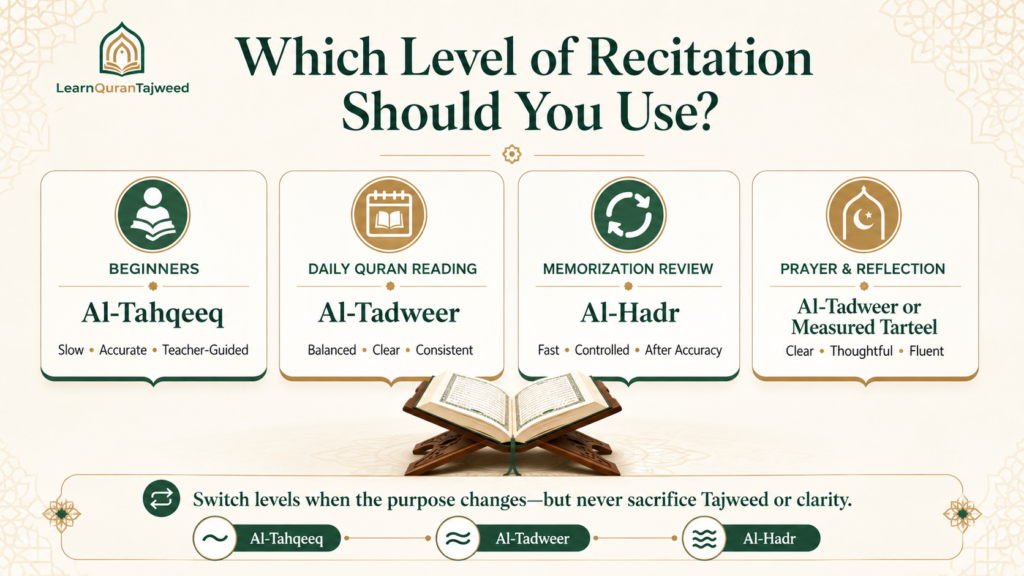
The most suitable level depends on your experience, purpose, and ability to maintain correct Tajweed.
1. Best Level For Beginners
Beginners should start with Al-Tahqeeq under the guidance of a qualified Quran teacher. Its slow, deliberate pace gives learners time to pronounce each letter correctly, apply Tajweed rules carefully, and correct mistakes before progressing to faster recitation.
2. Best Level For Daily Quran Reading
Al-Tadweer is generally the most suitable level for daily Quran reading because its moderate pace balances accuracy, reflection, and fluency. It helps readers maintain correct Tajweed without moving too slowly, making regular recitation easier and more consistent.
3. Best Level For Memorization Review
Controlled Al-Hadr is well suited to reviewing memorized passages after accurate pronunciation and Tajweed have been firmly established.
Its faster pace allows learners to revise longer portions efficiently, but it should be used only when speed does not cause mistakes, unclear words, or neglected recitation rules.
4. Best Level For Prayer And Reflection
Al-Tadweer or a measured Tarteel pace is generally suitable for prayer and reflection, depending on the setting and the reciter’s ability. Both allow the verses to be read clearly and thoughtfully while preserving a natural flow, correct Tajweed, and awareness of their meanings.
5. Can A Reciter Switch Between The Levels?
A reciter may switch between Al-Tahqeeq, Al-Tadweer, and Al-Hadr according to the purpose and setting, such as learning, daily reading, prayer, or revision.
However, the pace should remain reasonably consistent within each passage to preserve a natural, balanced flow. Regardless of the chosen level, Tajweed and clarity must never be sacrificed for either speed or slowness.
Read also: How to Recite Quran With Tajweed?
How Can Children Practise The Levels Of Recitation?
Children should begin with slow, teacher-led recitation, practising short ayahs in Al-Tahqeeq so they can pronounce each letter correctly and apply basic Tajweed rules. After developing reliable accuracy, they can progress to the balanced pace of Al-Tadweer.
Al-Hadr should be introduced only when their pronunciation and Tajweed are secure enough to remain correct at a faster pace. Listening to an expert reciter, repeating each passage, recording practice sessions, and receiving regular teacher feedback can help children improve steadily.
Read also: Tajweed Rules With Examples For Kids
Common Misunderstandings About The Levels Of Recitation
The levels of recitation describe different speeds or modes of Quranic performance; they are not the same as the canonical Qira’at. Faster recitation does not permit abandoning Tajweed, and Al-Hadr must remain controlled and clear rather than rushed or careless.
Likewise, slower reading is not automatically more accurate, as Al-Tahqeeq can become incorrect if letters, madd, or ghunnah are exaggerated. At-Tarteel should also not be understood merely as beautiful singing, since it involves measured, clear, and thoughtful recitation.
Learners should therefore establish accurate pronunciation and Tajweed before attempting to increase their speed.
Inside Learn Quran Tajweed Academy
Curious about how online learning works? Peek inside our actual Quran classes and hear the beautiful recitation of our students and teachers.
Perfect Your Quran Recitation Today
Join expert-led Tajweed classes, and recite the Quran with confidence and clarity.
Start Your Free TrialMaster The Levels Of Recitation With A Qualified Quran Teacher
Reading about Al-Tahqeeq, Al-Tadweer, and Al-Hadr is only the beginning—true mastery requires a qualified teacher who can hear mistakes and correct them immediately. At Learn Quran Tajweed Academy, children receive focused one-to-one instruction tailored to their level, helping them build accurate pronunciation, apply Tajweed confidently, and progress from careful recitation to controlled fluency.
Enroll your child in our Tajweed Course for Kids or Quran Recitation with Tajweed Course and give them the expert guidance they need to recite the Quran correctly for life. Places are limited, so book a free trial lesson today and start your child’s journey toward confident, beautiful Quran recitation.
Courses we offer:
- Online Tajweed Classes
- Learn Quran with Tajweed Online
- Beginner Tajweed Course
- Intermediate Tajweed Course
- Advanced Tajweed Course
- Amali (Practical) Tajweed Course
Courses we offer:
- Tajweed Course for Kids
- Tajweed Course for Adults
- Tajweed Course for Ladies
- Tajweed ul Quran Course
- Quran Recitation with Tajweed Course
- Quran Tarteel Course
- Tajweed Ijazah Program
Conclusion
The levels of recitation-Al-Tahqeeq, Al-Tadweer, and Al-Hadr—allow Muslims to recite the Quran at different speeds according to their purpose and ability. Al-Tahqeeq emphasizes careful learning and correction, Al-Tadweer provides balance for daily reading and prayer, and Al-Hadr supports efficient review and longer recitations.
Although scholars differ on whether At-Tarteel is a separate fourth level or a quality encompassing all three, clarity, reflection, and correct Tajweed remain essential at every pace. Learners should always establish accuracy before increasing speed and seek guidance from a qualified Quran teacher to develop confident, correct recitation.
Frequently Asked Questions
What Are The Three Main Levels Of Quran Recitation?
The three main levels are Al-Tahqeeq, Al-Tadweer, and Al-Hadr. They represent slow, moderate, and fast recitation, respectively.
What Is Al-Tahqeeq In Quran Recitation?
Al-Tahqeeq is the slowest and most precise level of Quran recitation. It is mainly used for teaching, correcting pronunciation, and practising Tajweed.
What Is The Difference Between Al-Hadr And Al-Tadweer?
Al-Hadr is fast but controlled recitation, whereas Al-Tadweer uses a moderate pace that balances clarity, reflection, and fluency.
Is At-Tarteel One Of The Levels Of Recitation?
Some scholars classify At-Tarteel as a separate fourth level. Others consider it a quality of clear, measured recitation that should be present in all three principal levels.
Which Level Of Recitation Is Best For Beginners?
Al-Tahqeeq is best for beginners because its slow pace gives them time to pronounce every letter correctly and apply Tajweed carefully.
Is Al-Hadr Permissible If The Recitation Is Very Fast?
Yes, Al-Hadr is permissible as long as the reciter maintains clear pronunciation, correct Tajweed, and the intended meaning without dropping or distorting sounds.
Do Madd And Ghunnah Change At Different Recitation Speeds?
Their overall timing may vary proportionately with the recitation speed. However, all required madd and ghunnah measures must remain correct according to the accepted narration.
Which Level Is Commonly Used In Prayer?
Al-Tadweer is commonly used in prayer because its moderate pace combines clarity, reflection, fluency, and suitable timing.
Are Levels Of Recitation The Same As The Qira’at?
No. The levels of recitation describe different speeds or modes of performance, while the Qira’at are canonical methods of reading the Quran transmitted through authenticated chains.
Related Articles
Tajweed Basics