 Tajweed Rules

| Key Takeaways |
| Tafkheem means making a letter sound heavy and full; Tarqeeq means making it thin and light in articulation. |
| Seven letters always carry Tafkheem — collected in the phrase خص ضغط قظ — across five distinct intensity levels. |
| The letter Raa’ alternates between Tafkheem and Tarqeeq based on its vowel, position, and surrounding letters. |
| Laam is always light except in the word “Allah” (اللَّه) when preceded by a Fathah or Dhammah. |
| Alif al-Madd and Ghunnah are not independently heavy or light — each follows the letter directly before or after it. |
Tafkheem and Tarqeeq are among the most immediately noticeable features of Quranic recitation — the difference between a reciter who sounds authentically fluent and one who sounds slightly off often comes down to these two qualities.
The rules of heavy and light letters in Tajweed govern whether a letter is pronounced with a full, raised resonance at the back of the mouth or with a thin, forward sound. Applying them correctly is not optional; it directly affects both the beauty and the meaning of the recitation.
What Is Tafkheem in Tajweed?
Tafkheem (تفخيم) means making a letter heavy by producing it with fullness at its articulation point and strength in its acoustic quality.
What Does Tafkheem Mean Linguistically?
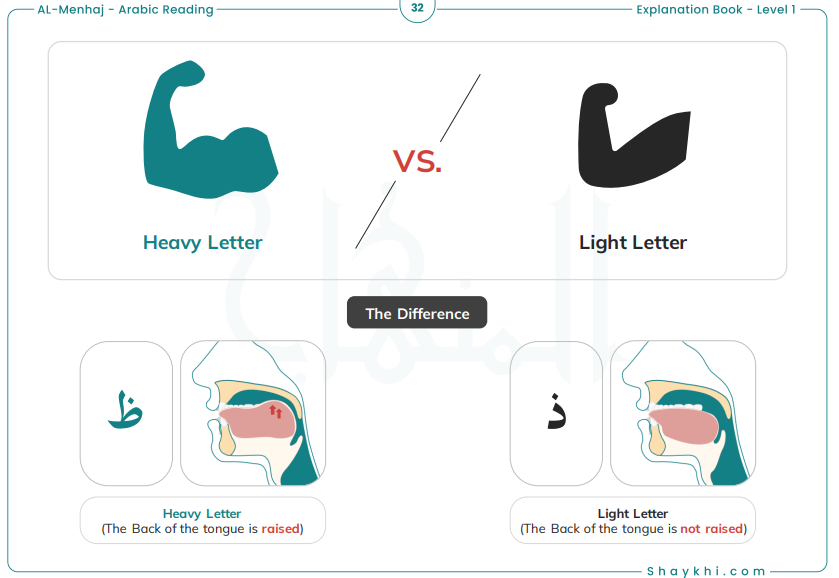
Linguistically, the word means “fattening.” In Tajweed application, it means the sound fills the mouth with a raised, back-of-mouth resonance — the opposite of a thin, forward sound.
Classical scholars use a parallel term, Taghleedh (تغليظ), which carries the same meaning. By convention, Tafkheem is used primarily when discussing the Raa’ letter, while Taghleedh is reserved for the specific cases of heavy Laam — particularly in the word “Allah.”
What Is Tarqeeq in Tajweed?
Tarqeeq (ترقيق) is the direct opposite of Tafkheem. Linguistically it means “thinning.” In Tajweed, it means producing a letter with a light, delicate quality — the sound stays forward in the mouth without the back-of-throat heaviness that characterizes Tafkheem.
Most Arabic letters carry permanent Tarqeeq. The challenge is not learning which letters are light — it is learning to maintain their lightness when they appear next to heavy letters.
Students at Learn Quran Tajweed Academy consistently report that this bleed-over effect is one of the hardest habits to correct without live instructor feedback.
Every Arabic letter falls into one of three categories: always heavy, always light, or variable depending on context.
Mastering which category each letter belongs to — and understanding the precise conditions that govern the variable letters — forms one of the core skill sets developed in Learn Quran Tajweed Academy’s Intermediate Tajweed Course, where Ijazah-certified instructors work through each rule individually with students at their own pace.
Join our Intermediate Tajweed Course and get a free trial

What Are the Three Categories of Arabic Letters Regarding Tafkheem and Tarqeeq?
Arabic letters divide into three groups based on their relationship to heaviness and lightness. Understanding this division gives every reciter a clear mental framework before working through the individual rules.
| Category | Description | Letters |
| Always Heavy | Tafkheem without exception | خ، ص، ض، غ، ط، ق، ظ (حروف الاستعلاء) |
| Always Light | Tarqeeq without exception | All remaining letters (except variable ones below) |
| Variable | Tafkheem or Tarqeeq depending on context | ر، ل |
Explore Al-Menhaj Book for FREE (Learn to Read Quran)
What Are the Tafkheem Letters in Arabic and What Are Their Levels?
The seven letters of Tafkheem are the letters of Isti’laa (حروف الاستعلاء), memorized through Ibn al-Jazari’s famous phrase: خص ضغط قظ. These are: خ، ص، ض، غ، ط، ق، ظ. They are always pronounced with heaviness — no position or context removes their Tafkheem.
Classical Tajweed scholarship organizes their heaviness into five levels, based on the vowel carried by the letter and whether an Alif follows it.
The Five Levels of Tafkheem with Examples
| Level | Condition | Example |
| Level 1 (Highest) | Letter carries Fathah followed by Alif | الطَّامَّة — الضَّالِّينَ — الظَّانِّينَ |
| Level 2 | Letter carries Fathah, no Alif follows | طَبَعَ — ضَرَبَ — قَتَلَ |
| Level 3 | Letter carries Dhammah | اضْطُرَّ — قُتِلَ — غُرْفَة |
| Level 4 | Letter is Saakin (vowel-less) | أَطْوَاراً — اضْرِب — بِمِقْدَار |
| Level 5 (Lowest) | Letter carries Kasrah | يطع — ضِيَاء — قِيلَ |
One observation worth sharing from teaching experience: Level 5 is the most commonly mispronounced. Students often over-lighten a letter like ق when it carries a Kasrah — reducing it so far toward Tarqeeq that it loses its identity entirely. The letter must remain heavy even under Kasrah; only the degree of heaviness decreases.
Shots Videos from Our Courses
Perfect Your Quran Recitation Today
Join expert-led Tajweed classes, and recite the Quran with confidence and clarity.
Start Your Free TrialWhat Are the Tarqeeq Letters and Which Letters Are Always Light?
The Tarqeeq letters are all Arabic letters except the seven letters of Isti’laa and the three variable letters (Raa’, Laam of the Majesty, and Alif al-Madd). Every letter in this group — ب، ت، ث، ج، ح، د، ذ، ر (in certain cases)، ز، س، ش، ع، ف، ك، ل، م، ن، هـ، و، ي — is always recited lightly, regardless of what surrounds it.
Maintaining Tarqeeq when a light letter immediately follows a heavy one is harder than it sounds. In a word like وَلْيَتَلَطَّفْ (Al-Kahf 18:19), the Laam must stay completely light despite the Taa’ carrying Tafkheem directly after it. This requires genuine muscular control at the articulation point — something that only develops through consistent, corrected practice.
For students building this precision systematically, Learn Quran Tajweed Academy’s Beginner Tajweed Course covers the foundational distinction between heavy and light letters before moving into the variable cases.
Begin your Tajweed journey with a free lesson

What Are the Rules of the Raa’ Letter Between Tafkheem and Tarqeeq?
The Raa’ (ر) is the most rule-intensive letter in all of Tajweed. It carries three possible states: always heavy, always light, or permissible either way — and the conditions governing each state are precise.
When Is the Raa’ Always Pronounced with Tafkheem?
The Raa’ takes Tafkheem in seven conditions:
- Raa’ carries Dhammah — e.g., رُوحِ الْقُدُسِ (Al-Baqarah 2:87)
- Raa’ carries Fathah — e.g., رَابِيَةً (Al-Haqqah 69:10)
- Raa’ is Saakin after Dhammah — e.g., زُرْتُمُ الْمَقَابِرَ (At-Takathur 102:2)
- Raa’ is Saakin after Fathah — e.g., بَرْدًا وَسَلَامًا (Al-Anbiya 21:69)
- Raa’ is Saakin after a Saakin letter (not Yaa’), and the letter before that Saakin carries Fathah or Dhammah — e.g., لَيْلَةُ الْقَدْرِ (Al-Qadr 97:2)
- Raa’ is Saakin after an incidental (Aarid) Kasrah — e.g., لِمَنِ ارْتَضَى (Al-Anbiya 21:28)
- Raa’ is Saakin after an original Kasrah, but a connected letter of Isti’laa follows it in the same word, and that Isti’laa letter is NOT kasrah-vowelled — e.g., قِرْطَاس — مِرْصَاد
When Is the Raa’ Always Pronounced with Tarqeeq?
The Raa’ takes Tarqeeq in five conditions:
- Raa’ carries Kasrah — e.g., رِزْقًا لِلْعِبَادِ (Qaaf 50:11)
- Raa’ is Saakin after an original, connected Kasrah in the same word, with no following Isti’laa letter — e.g., فِرْعَوْن — الْفِرْدَوْس
- Raa’ is Saakin at end of word, preceded by a Saakin letter (not Yaa’), and before that Saakin is a Kasrah — e.g., الذِّكْر — السِّحْر — only in Waqf (pause)
- Raa’ is Saakin at end of word, preceded by a Saakin Yaa’ — e.g., قَدِير — نَذِير — only in Waqf
- Raa’ is Saakin after an original Kasrah, and the Isti’laa letter that follows belongs to a different word — e.g., أَنْ أَنذِرْ قَوْمَكَ (Nuh 71:1)
When Are Both Tafkheem and Tarqeeq Permissible for the Raa’?
Two scenarios permit both readings:
First: When the Raa’ is Saakin after an original Kasrah, a connected Isti’laa letter follows in the same word, and that Isti’laa letter itself carries a Kasrah — this occurs in one Quranic word: فِرْقٍ in Surah Ash-Shu’ara (26:63).
Second: When stopping on a final Saakin Raa’ separated from its Kasrah by a Saakin Daad or Taa’. For مِصْر, Tafkheem is preferred. For الْقِطْر, Tarqeeq is preferred — following the principle of the connected vowel pattern.
What Are the Rules of the Laam Letter Between Tafkheem and Tarqeeq?
The Laam (ل) follows a simple foundational rule: it is always light (Tarqeeq) in every word in the Quran — except in the word “Allah” (اللَّه) and “Allahumma” (اللَّهُمَّ) when preceded by a Fathah or Dhammah.
Scholars use the term Taghleedh (تغليظ) specifically for this heavy Laam, marking it as a distinct category from general Tafkheem.
| Condition | Ruling | Example |
| Laam in any word other than اللَّه | Always Tarqeeq | لَا رَيْبَ — لِلْمُتَّقِينَ |
| اللَّه / اللَّهُمَّ preceded by Fathah | Taghleedh (Heavy) | قَالَ اللَّهُ |
| اللَّه / اللَّهُمَّ preceded by Dhammah | Taghleedh (Heavy) | عَبْدُ اللَّهِ |
| اللَّه / اللَّهُمَّ preceded by Kasrah (original or incidental) | Tarqeeq | بِاللَّهِ — قُلِ اللَّهُمَّ |
An important edge case: in قُلْ هُوَ اللَّهُ أَحَدٌ اللَّهُ الصَّمَدُ (Al-Ikhlas 112:1-2), the second اللَّه carries a light Laam. Why? Because it is preceded by an incidental Kasrah on the Tanwin of أَحَدٌ — inserted to break the meeting of two Saakin letters. That Kasrah, though temporary, still triggers Tarqeeq.
This is precisely the kind of edge case that separates a student who has memorized rules from one who has truly internalized them — and it is why live, corrected recitation practice remains irreplaceable.
The Practical Tajweed Course at Learn Quran Tajweed Academy focuses specifically on applying these distinctions within actual Quranic recitation, not just theoretical drill.
Join our Practical Tajweed Course and get a free trial

Read Also: Tarqeeq Rules in Tajweed With Examples
What Are the Rules of Alif al-Madd and Ghunnah in Tafkheem and Tarqeeq?
Alif al-Madd has no independent Tafkheem or Tarqeeq of its own. It follows the letter before it entirely. If that preceding letter is heavy, the Alif sounds heavy — as in الطَّامَّة and الضَّالِّينَ. If that letter is light, the Alif sounds light — as in الْأَنْهَار and تِجَارَة.
Ghunnah (the nasal resonance in Ikhfaa’) works in the opposite direction — it follows the letter after it. When the Ikhfaa’ letter is heavy (like ص، ض، ط، ظ، ق), the Ghunnah takes on a heavy quality, as in مِنْ طِينٍ and مِنْ قَبْلُ. When the Ikhfaa’ letter is light (like ت، ث، ج), the Ghunnah remains light, as in مِنْ تَحْتِهَا (Al-Baqarah 2:25).
For a complete understanding of how Ghunnah interacts with Ikhfaa’ letters, the detailed guide on ikhfa rules and the article on ghunnah rules provide essential supporting knowledge. Understanding qalqalah alongside these rules also deepens a student’s overall grasp of letter qualities in recitation.
Read Also: Makharij al-Huruf and Arabic Alphabet Pronunciation
Tafkheem and Tarqeeq Examples from the Quran
The clearest way to consolidate these rules is to see them working together in actual Quranic text.
وَالضُّحَى Wad-duhaa “By the morning brightness.” (Ad-Duhaa 93:1) (Daad carries Dhammah — Level 3 Tafkheem)
رِزْقًا لِلْعِبَادِ Rizqan lil-‘ibaad “As provision for the servants.” (Qaaf 50:11) (Raa’ carries Kasrah — Tarqeeq)
قَالَ اللَّهُ (Qaalal-laah) Preceded by Fathah — Laam of Majesty is heavy (Taghleedh)
Read Also: Difference Between Tafkheem and Tarqeeq With Examples
Our Students Reviews
Perfect Your Quran Recitation Today
Join expert-led Tajweed classes, and recite the Quran with confidence and clarity.
Start Your Free Trial
Begin Your Tafkheem and Tarqeeq Mastery at Learn Quran Tajweed Academy
Knowing these rules is the first step. Applying them in live recitation — where the Raa’ conditions change every few words and the Laam of Majesty appears without warning — requires guided, corrected practice under a qualified teacher.
Learn Quran Tajweed Academy offers:
- Ijazah-certified instructors specializing in Hafs ‘an ‘Asim
- Personalized 1-on-1 sessions tailored to your current recitation level
- Flexible scheduling available 24/7 for students worldwide
- Structured progression from foundational rules to full Ijazah certification
Book your FREE trial lesson today and hear the difference correct Tafkheem and Tarqeeq make in your recitation.
Check out the best tajweed course for your needs:
- Practical Tajweed Course
- Beginner Tajweed Course
- Intermediate Tajweed Course
- Advanced Tajweed Course
- Quran Tarteel Course
- Tajweed Ijazah Program
- Tajweed Course for Sisters
- Tajweed course for Kids
Book your free trial Tajweed lesson today

Conclusion
The rules of heavy and light letters sit at the heart of accurate Quranic recitation. Seven letters carry permanent Tafkheem across five measurable levels of intensity. All remaining letters default to Tarqeeq — with three critical exceptions: the Raa’, the Laam of the Divine Name, and the contextually dependent Alif al-Madd and Ghunnah.
What makes these rules genuinely challenging is not memorizing the categories — it is maintaining them under the pressure of continuous recitation, where heavy and light letters meet at almost every breath.
That challenge is exactly what makes qualified instruction so valuable. May Allah ﷻ grant us all the ability to recite His words as they deserve to be recited.
Frequently Asked Questions About Heavy and Light Letters in Tajweed
What is the difference between Tafkheem and Tarqeeq in Tajweed?
Tafkheem means pronouncing a letter with a heavy, full quality — the sound resonates at the back of the mouth. Tarqeeq means pronouncing it thinly and lightly, with the sound staying forward. The seven letters of Isti’laa always carry Tafkheem; most other letters are always light, with Raa’ and Laam being the main variable letters.
Which letters always have Tafkheem in Tajweed?
The seven letters of Isti’laa always carry Tafkheem. They are collected in the phrase خص ضغط قظ: خ، ص، ض، غ، ط، ق، ظ. Their degree of heaviness varies across five levels depending on the vowel they carry and whether an Alif follows, but the Tafkheem itself is never removed.
When does the Raa’ letter take Tarqeeq?
The Raa’ takes Tarqeeq when it carries a Kasrah, when it is Saakin after an original connected Kasrah in the same word with no following Isti’laa letter, when it is a final Saakin preceded by a Saakin Yaa’, or when the following Isti’laa letter belongs to a different word. These conditions each have specific Quranic examples that must be practiced aloud.
Is the Laam always light in Tajweed?
The Laam is light in every word in the Quran except in the word “Allah” (اللَّه) and “Allahumma” (اللَّهُمَّ) when they are preceded by a Fathah or Dhammah. When preceded by any Kasrah — whether original or incidental — even the Laam of the Divine Name reverts to Tarqeeq.
Does learning Tafkheem and Tarqeeq require a teacher?
Understanding the rules theoretically is possible from written resources. Applying them correctly in continuous recitation, however, requires a teacher who can hear your output and give immediate correction — especially for the Raa’, where conditions change rapidly mid-recitation. The Quran Recitation with Tajweed Course at Learn Quran Tajweed Academy provides exactly this kind of live, focused feedback.
Related Articles
Tajweed Rules