 Tajweed Basics

Most students who begin studying Quranic tajweed are handed the same short text before anything else: a 61-line poem called Tuhfat al-Atfal.
It is the first formal step in tajweed education across the Arab world, and it remains the standard starting point for teachers who want students to internalize the core rules before moving to longer, more technical works.
Tuhfat al-Atfal (تحفة الأطفال والغلمان في تجويد القرآن), or “The Gift of Children and Youths in the Tajweed of the Qur’an,” was written specifically to make tajweed accessible to beginners. Its author compressed the rules of noon sakinah, meem sakinah, and madd (elongation) into rhymed verse so that students could memorize them the same way they memorize a Quranic surah.
This guide explains what the poem contains, who wrote it, and how it is structured. It also explains why it still matters for anyone serious about reciting the Quran correctly.
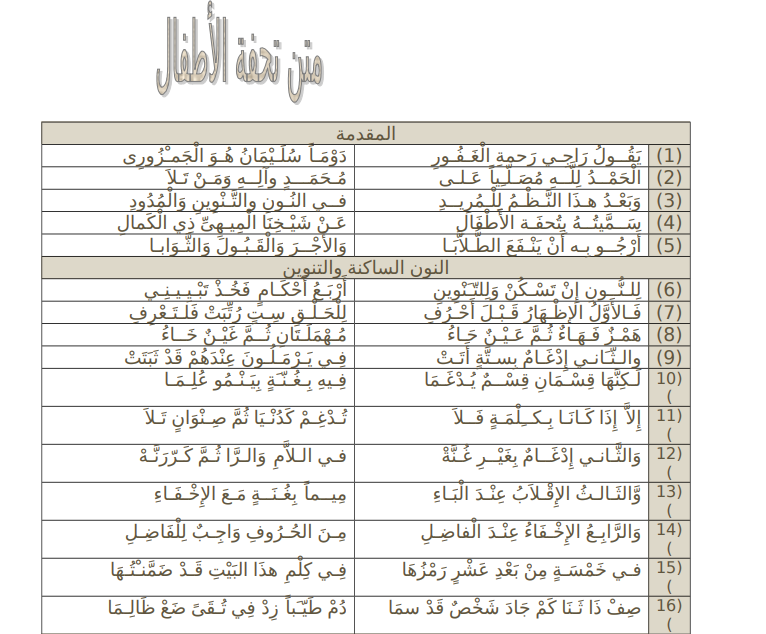
The Definition Of Tuhfat al-Atfal
Tuhfat al-Atfal is a didactic poem (manzumah) written in the rajaz meter. It is a simple, repetitive Arabic meter traditionally used for teaching texts because it is easy to memorize aloud.
The poem does not attempt to cover every rule of tajweed. It focuses mainly on three areas: the rulings of the sakinah noon and tanween, the rulings of the sakinah meem, and the categories of madd (vowel elongation).
This narrow scope is deliberate. It is meant to be a student’s first structured exposure to tajweed, not a comprehensive reference.
The Full Title And Meaning Of Tuhfat Al-Atfal
The complete title is Tuhfat al-Atfal wal-Ghilman fi Tajwid al-Qur’an, “The Gift of Children and Youths in the Tajweed of the Qur’an.” The word “tuhfah” (gift or precious offering) signals the author’s intent: a compact, valuable teaching tool designed for young or beginning students, not seasoned reciters.
Why The Text Is Called “Tuhfat Al-Atfal”
The poem is rarely referred to by its full title in daily use. Teachers and students shorten it to Tuhfat al-Atfal because the phrase “atfal” (children) captures its purpose: a first-level text, distinct from advanced works students encounter later.
Read also: How to Recite Quran with Tajweed?
Who Wrote Tuhfat Al-Atfal?
The poem was composed by Sheikh Sulayman ibn Husayn ibn Muhammad ibn Shalabi al-Jamzuri, also known as al-Afandi. He is called “al-Jamzuri” after Jamzur, the village associated with his family.
He was born in the month of Rabi’ al-Awwal, sometime in the 1160s AH, placing him among the scholars of the twelfth Islamic century.
Sheikh Sulayman Al-Jamzuri’s Life And Teacher
Al-Jamzuri composed the poem under the guidance of Sheikh Nur al-Din Ali ibn Umar ibn Hamd ibn Umar ibn Naji ibn Funaysh al-Mihi (1139–1229 AH), a scholar known by the nisbah “al-Mihi” after a village called Miyah in the Monufia governorate of Egypt.
Al-Mihi served as al-Jamzuri’s primary reference in tajweed, and the poem’s opening verses explicitly credit him.
This detail matters for students: Tuhfat al-Atfal did not emerge as an isolated composition. It sits inside an established Egyptian chain of tajweed instruction, which is part of why it was adopted so widely by teaching institutions rather than treated as one option among many.
When And Where The Poem Was Completed
Al-Jamzuri finished composing the poem in 1198 AH. Since then, it has been copied, taught, and set to memorization patterns largely unchanged, which is unusual for a teaching text of this age, a sign of how well the rajaz structure served its pedagogical purpose.
If you’re working through the poem line by line and want a teacher to walk you through the pronunciation and application in real recitation, working with a live tajweed instructor closes the gap between memorizing the verses and applying them correctly at the mus’haf.
Read also: Complete Guide to Tajweed Rules
See Our Classrooms in Action
Watch these short clips from our live, interactive Quran courses to see how our students learn and interact with our expert tutors.
Perfect Your Quran Recitation Today
Join expert-led Tajweed classes, and recite the Quran with confidence and clarity.
Start Your Free TrialWhat Does Tuhfat Al-Atfal Cover?
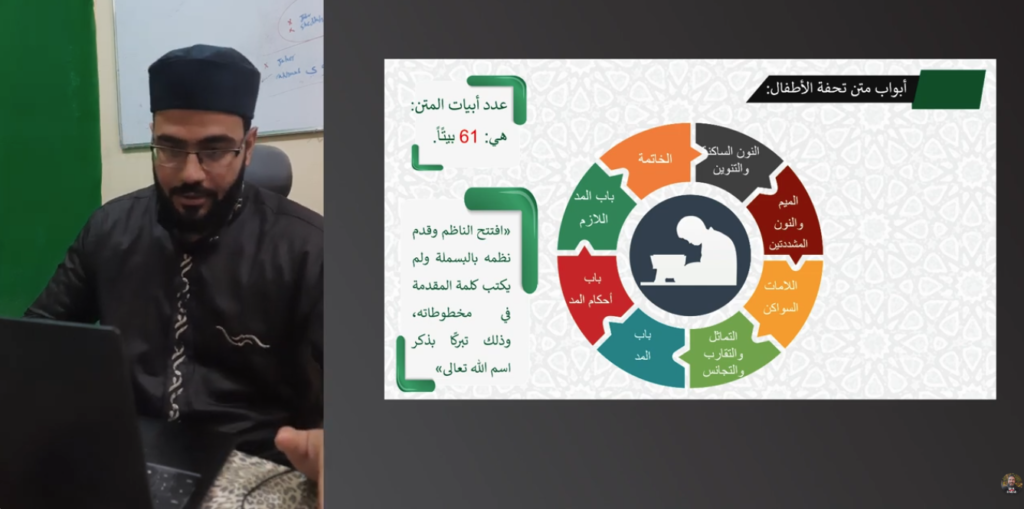
The poem’s 61 verses are organized into ten distinct sections, moving from an introduction through the technical rulings and closing with a short conclusion.
The Sections Of Tuhfat Al-Atfal
The text opens with a five-verse introduction (muqaddimah) in which al-Jamzuri names himself, credits al-Mihi, and states his intention to benefit students. From there, the poem moves through:
- Noon sakinah and tanween (verses 6–16): the four rulings, idhhar (clear pronunciation), idgham (merging, with and without ghunnah), iqlab (conversion to meem), and ikhfa (concealment), along with the specific letters that trigger each one.
- Mushaddad noon and meem (verse 17): the obligatory nasalization (ghunnah) when either letter carries a shaddah.
- Meem sakinah (verses 18–23): its three rulings, ikhfa shafawi, idgham saghir, and idhhar shafawi.
- Lam of “al” and lam of the verb (verses 24–29): the distinction between “qamariyyah” (pronounced clearly) and “shamsiyyah” (assimilated) lam.
- Similar, close, and homogeneous letters (verses 30–34): mutamathilayn, mutaqaribayn, and mutajanisayn, how adjacent letters interact when their articulation points are identical, close, or shared.
- Categories of madd (verses 35–57): the distinction between natural (asli) and branch (far’i) madd, followed by the rulings of obligatory, permissible, and necessary madd, and the four subtypes of madd lazim.
The poem closes with a four-verse conclusion (khatimah) in which al-Jamzuri offers a closing supplication and dates the completion of the work.
Read also: Principles of Tajweed
The Memorable Rajaz Meter And Mnemonic Devices
One detail that separates Tuhfat al-Atfal from a plain list of rules is its use of acrostic mnemonics. To help students recall which letters trigger idgham without ghunnah. For example, the poem groups them into the phrase “في اللام والرا” (in lam and ra), two letters, easy to retain permanently.
For the fourteen letters that require idhhar of lam al-ta’rif, the poem embeds them inside the phrase “ابغ حجك وخف عقيمه,” where each letter of the phrase is itself one of the fourteen target letters.
This is a deliberate teaching mechanism, not decoration. Turning a list of unrelated Arabic letters into a real (if unusual) Arabic phrase gives the brain a semantic hook instead of forcing rote memorization of an arbitrary sequence.
It’s the same principle modern memory techniques use, attaching abstract data to something linguistically meaningful, applied roughly 250 years before the term “mnemonic device” entered common use in tajweed pedagogy.
Read also: The Benefits of Tajweed
Why Is Tuhfat Al-Atfal Important For Tajweed Students
Tuhfat Al-Atfal is typically the first tajweed text a student memorizes in full, before progressing to longer works such as al-Muqaddimah al-Jazariyyah. Its value is that it isolates a manageable set of rules, such as noon and meem rulings, plus madd, and drills them to fluency before introducing the fuller complexity of Jazari’s text.
Common Mistakes Beginners Make When Learning Tuhfat Al-Atfal
Students commonly memorize the verses correctly but apply the rules inconsistently in live recitation. A recurrent error is treating idgham and ikhfa as interchangeable whenever a noon sakinah is followed by certain letters, instead of checking the specific letter against the correct category.
Another common mistake is forgetting that idgham without ghunnah applies only to lam and ra. Students often default to nasalizing every idgham case, which is only correct for the six letters grouped under “yarmuloon.”
A third mistake is related to madd. Students often apply a uniform elongation length regardless of whether the case is wajib (obligatory), ja’iz (permissible), or lazim (necessary), when each carries a distinct number of counts.
What Comes After Tuhfat Al-Atfal
Once a student has memorized Tuhfat al-Atfal and can apply its rules correctly in recitation, not just recite the poem itself, the standard next step is al-Muqaddimah al-Jazariyyah, a longer and more technically detailed text covering the same categories in greater depth, along with additional topics such as the articulation points (makharij) of letters in full.
Structured, teacher-guided study makes this transition considerably smoother than working through the texts alone. A qualified tajweed instructor can confirm that each rule from Tuhfat Al-Atfal has actually been internalized, not just memorized, before building on it.
Read also: How to Learn Quran with Tajweed at Home?
Free Online Resources To Learn Tuhfat Al-Atfal
Several online resources offer free explanations of Tuhfat Al-Atfal. You can follow these resources and study whenever you want. But to get the full benefit, be aware that these resources should be supplemented by guidance from a real instructor to correct any mistakes that may arise.
1. The Galal Radwan YouTube channel offers a structured English-language video series explaining Tuhfat Al-Atfal. Its visual presentations and clear explanations help non-Arabic speakers understand the poem’s verses and essential Tajweed rules while learning at their own pace for free.
2. The QTA Ahmad Noor YouTube channel supports students learning Tuhfat Al-Atfal by reciting the poem clearly and presenting its Tajweed topics verse by verse. Listening to the instructor’s repeated recitation helps learners improve pronunciation, follow the poem’s rhythm, and memorize its lines more easily.
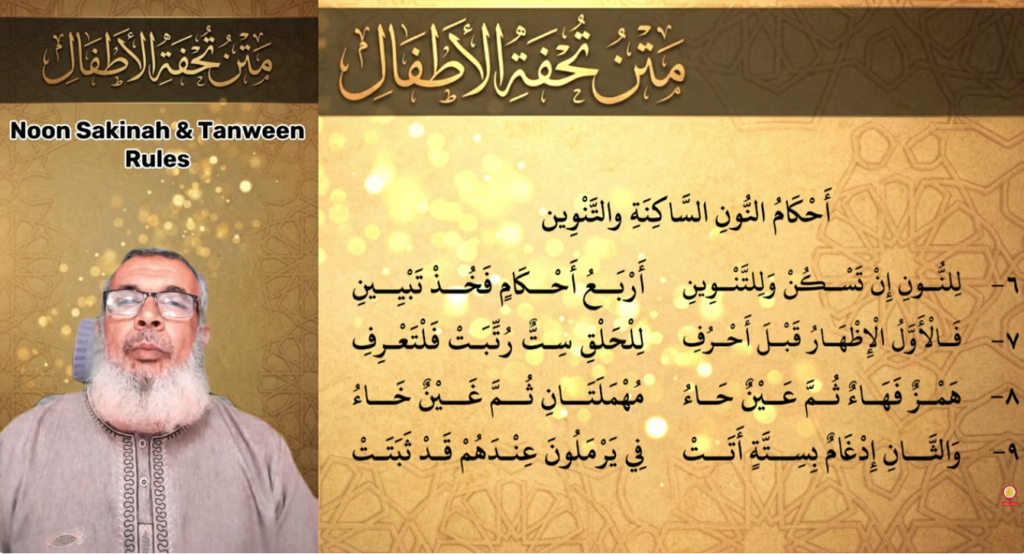
3. The Tuhfat Al-Atfal app helps English-speaking students study the poem and its essential Tajweed rules through organized chapters, Arabic verses, translations, explanations, and audio recitation. It is useful for understanding, reviewing, and memorizing the poem at a convenient pace.
Read also: How to Practice Tajweed Daily?
Inside Learn Quran Tajweed Academy
Curious about how online learning works? Peek inside our actual Quran classes and hear the beautiful recitation of our students and teachers.
Perfect Your Quran Recitation Today
Join expert-led Tajweed classes, and recite the Quran with confidence and clarity.
Start Your Free TrialStart Learning Tuhfat Al-Atfal With Guided Instruction
Memorizing 61 verses is only the first half of the work. Applying idhhar, idgham, iqlab, and ikhfa correctly inside real Quranic recitation takes a teacher listening to your pronunciation and correcting it in real time.
At Learn Quran Tajweed, you can book a live tajweed session and work through Tuhfat al-Atfal rule by rule, with direct feedback on your recitation as you go.
Courses we offer:
- Online Tajweed Classes
- Learn Quran with Tajweed Online
- Beginner Tajweed Course
- Intermediate Tajweed Course
- Advanced Tajweed Course
- Amali (Practical) Tajweed Course
Courses we offer:
- Tajweed Course for Kids
- Tajweed Course for Adults
- Tajweed Course for Ladies
- Tajweed ul Quran Course
- Quran Recitation with Tajweed Course
- Quran Tarteel Course
- Tajweed Ijazah Program
Perfect Your Quran Recitation Today
Join expert-led Tajweed classes, and recite the Quran with confidence and clarity.
Start Your Free TrialConclusion
Tuhfat al-Atfal remains the standard entry point into tajweed because it does one thing well: it takes the rules of noon sakinah, meem sakinah, and madd, and compresses them into a 61-verse poem a beginner can memorize in a matter of weeks.
Written by Sheikh Sulayman al-Jamzuri under the guidance of Sheikh al-Mihi and completed in 1198 AH, the text has outlasted almost every other beginner’s tajweed manual precisely because its structure- ten clear sections, rhymed for memory, built on acrostic mnemonics, was designed for retention, not just information.
For any student serious about reciting the Quran correctly, Tuhfat al-Atfal is not optional background reading; it is the foundation the rest of tajweed study is built on.
Frequently Asked Questions
Who Wrote Tuhfat Al-Atfal?
Tuhfat al-Atfal was written by Sheikh Sulayman ibn Husayn al-Jamzuri, an Egyptian scholar of the twelfth Islamic century, under the guidance of his teacher Sheikh Nur al-Din al-Mihi.
How Many Verses Does Tuhfat Al-Atfal Contain?
The poem contains 61 verses (bayt), composed in the rajaz meter and divided into ten sections covering the introduction, noon and meem rulings, lam rulings, letter interactions, and madd.
What Topics Does Tuhfat Al-Atfal Cover?
Tuhfat al-Atfal covers the rulings of noon sakinah and tanween, meem sakinah, mushaddad noon and meem, the lam of “al” and the lam of the verb, similar and close letters, and the categories and rulings of madd.
Why Is Tuhfat Al-Atfal Taught To Beginners First?
It is taught first because it isolates a limited, manageable set of tajweed rules and presents them in memorable rhymed form, building a foundation before students move to longer, more detailed texts like al-Muqaddimah al-Jazariyyah.
What Should I Study After Finishing Tuhfat Al-Atfal?
After memorizing and applying the rules in Tuhfat al-Atfal, the standard next step is al-Muqaddimah al-Jazariyyah, which covers the same categories in more depth along with the articulation points of Arabic letters.
When Was Tuhfat Al-Atfal Written?
Sheikh al-Jamzuri completed Tuhfat al-Atfal in 1198 AH, and it has been used as a standard beginner’s tajweed text since then.