 Tajweed Rules

Every letter in the Quran has a fixed exit point, except for two letters that break that rule in a specific way. Inhiraf in Tajweed is identified as the characteristic that makes the letters Laam (ل) and Raa (ر) sound the way they do.
Mispronouncing it is one of the most common errors reciters make without realizing it. If you’ve ever heard someone read Laam so it sounds close to Noon, or Raa sound flattened, Inhiraf is usually the missing piece.
This article illustrates what Inhiraf means and why only Laam and Raa carry it. It also explains how the deviation differs between the two letters, and how to correct your own pronunciation using the tongue positions classical Tajweed scholars describe.
What You’ll Learn In This Article
- The exact definition of Inhiraf and why it’s classified as a permanent (لازمة) characteristic
- Why Laam ل and Raa ر are the only two letters with this trait
- The physical difference between how Laam deviates and how Raa deviates
- Why mispronouncing Inhiraf causes reciters to blur Laam into Noon or Raa into Laam
- A practical way to check and correct your own articulation
What Does Inhiraf Mean In Tajweed?
Inhiraf is a Tajweed characteristic (sifah) belonging exclusively to the letters Laam ل and Raa ر. The sound deviates after leaving its designated exit point because the tongue blocks its natural path, forcing it to connect with a neighboring exit point instead.
In the linguistic definition, “Inhiraf” means “deviation” or “leaning.” In the Technical meaning, it refers to a letter’s sound bending off course rather than flowing straight out through its own makhraj (exit point).
This is important because Tajweed is built on two separate concepts that reciters often confuse: the makhraj (where a letter exits) and the sifah (how it exits). Inhiraf fits into the second category.
Laam ل and Raa ر both exit near the front-to-middle section of the tongue, but instead of the sound flowing straight out the way a letter like Baa ب does, it gets redirected around an obstruction that is created by the tongue itself.
Inhiraf is classified as a self-standing characteristic (sifah dhatiyyah) with no opposite. Unlike sifaat such as jahr/hams (voiced/unvoiced) or shiddah/rakhawah (plosive/fricative), which come in matched pairs, Inhiraf simply exists in these two letters, or it doesn’t.
It’s also counted among the sifaat of strength (sifaat al-quwwah). That means it reinforces the clarity and weight of the letter rather than weakening it.
Read also: How to Learn Tajweed?

Why Only Laam And Raa Have This Characteristic?
Laam and Raa are grouped because the sounds of both letters deviate from their original exit point before reaching full completion. Laam deviates toward the sides of the tongue, whereas Raa deviates toward the center.
Classical linguists note this shared trait is precisely why the two letters are so easily confused by beginners. Each one leans partway toward the other’s territory. There’s a well-documented practical consequence of this.
A reciter with a lisp-like speech pattern (commonly described in classical texts as al-althagh) will often read Laam as if it were Noon, and read Raa as if it were Laam.
This does not happen by coincidence. It actually happens because Laam’s deviation carries it close to Noon’s exit point at the tip of the tongue, whereas the deviation of Raa carries it toward the back of the tongue in Laam’s direction.
Recognizing this tendency is one of the fastest ways to self-diagnose a pronunciation problem before a teacher even points it out.
Read also: What is Makhraj in Tajweed?
See Our Classrooms in Action
Watch these short clips from our live, interactive Quran courses to see how our students learn and interact with our expert tutors.
Perfect Your Quran Recitation Today
Join expert-led Tajweed classes, and recite the Quran with confidence and clarity.
Start Your Free TrialHow Does Laam Deviate? – The Tongue’s Path
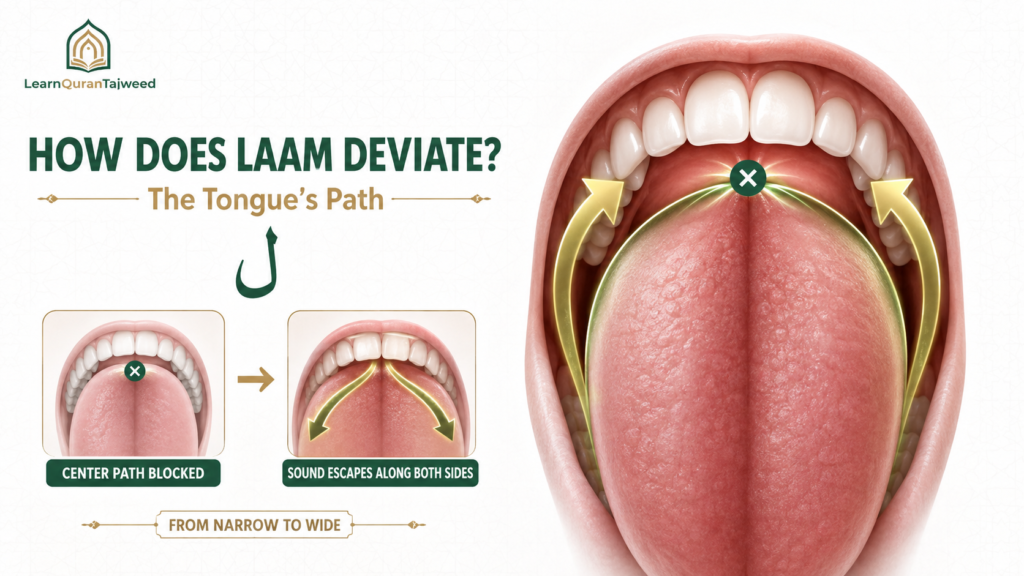
When you pronounce the letter Laam ل correctly, the front edges of the tongue press against the upper gum ridge, and the airflow that would normally pass straight through is forced to escape sideways, to deviate out to the right and left edges of the tongue instead of exiting through the center of the mouth.
The tongue essentially closes the direct path in front. As a result, the sound has nowhere to go but around the sides.
This is a wide deviation. The sound moves from a narrow point of contact at the tip of the tongue outward to the broader area along both edges. This is described in classical Tajweed sources as moving “from narrow to wide.”
Read also: Laam Rules in Tajweed
How Does Raa Deviate? – A Narrower Escape
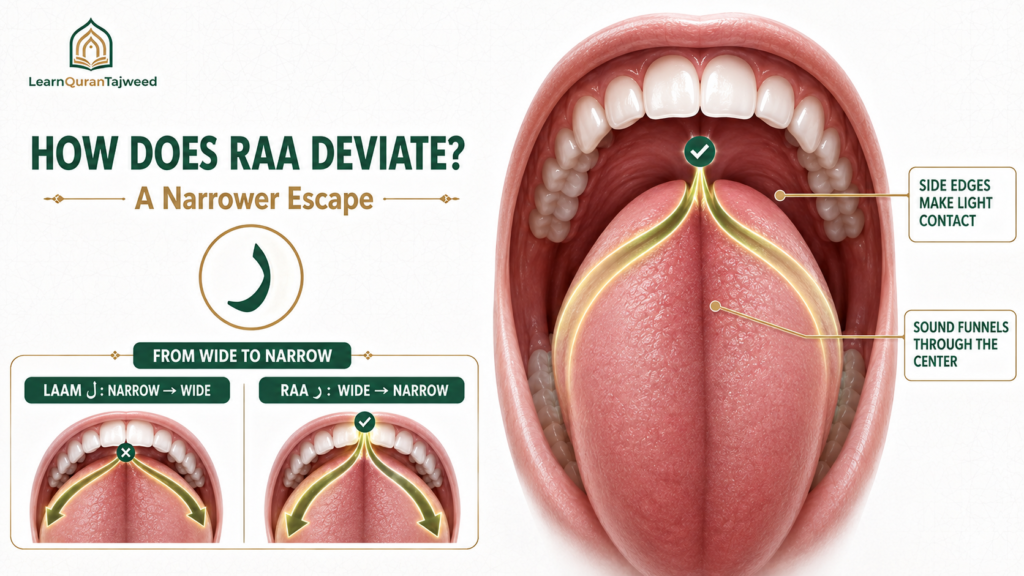
When you pronounce the letter Raa ر correctly, your tongue curves slightly, and the two side edges near the tip make light contact with the upper palate to leave only a small gap through which the sound is forced to pass, deviating from the wider sides of the tongue toward this narrow central opening.
That differs from Laam, where the sound spreads outward; the sound of Raa narrows and funnels through a tighter channel. This is the opposite direction of movement from Laam. Where Laam’s deviation goes from narrow to wide, Raa’s deviation goes from wide to narrow.
That single distinction is the core physical difference between the two letters: the direction and width of the airflow path. It’s the detail most self-taught reciters never get corrected on, as it isn’t something you can see just by watching someone’s lips.
It is difficult to learn how to feel this difference on your own tongue without live correction. This is exactly the kind of detail an instructor listens for during one-on-one Quran and Tajweed sessions instead of something you can fully absorb from a written explanation alone.
Read also: Complete Guide to Tajweed Rules
Common Mistakes Reciters Make When Applying Inhiraf
Inhiraf depends on maintaining the correct movement and positioning of the tongue while pronouncing Laam (ل) and Raa (ر).
Even when a reciter understands the basic articulation of these letters, small errors in tongue movement, tension, or recitation speed can prevent the characteristic from being produced correctly.
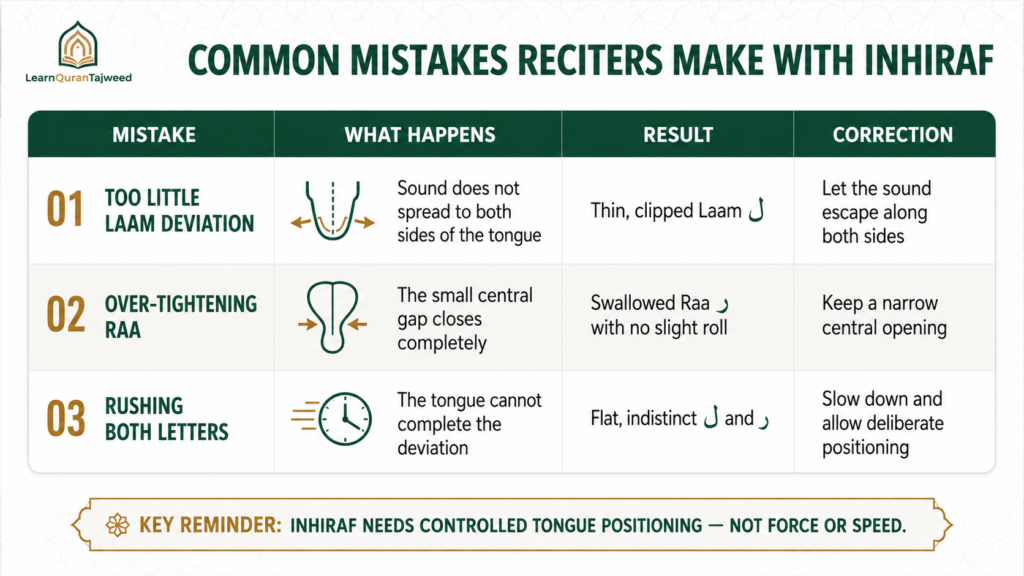
The following are three common mistakes to watch for when applying Inhiraf during Quran recitation.
1. Using Too Little Inhiraf When Pronouncing Laam
One of the most common mistakes occurs when a learner applies too little deviation to Laam (ل). This can make the letter sound thin or clipped because the sound is not given enough room to move along the sides of the tongue as it is articulated.
2. Over-Tightening the Tongue When Pronouncing Raa
Another common error is applying too much tension when pronouncing Raa (ر). When the tongue is tightened excessively, the small space needed for the sound can become restricted, causing the Raa to sound constrained or swallowed rather than clearly articulated.
3. Losing the Inhiraf of Laam and Raa During Fast Recitation
A subtler mistake appears when reciters increase their speed before the correct tongue movement has become automatic. Rushing through Laam and Raa can prevent the tongue from completing the required deviation, making both letters sound flatter and less distinct.
This is often a pacing problem rather than a lack of theoretical knowledge. Until the correct articulation becomes habitual, slowing down gives the tongue enough time to maintain the characteristic of Inhiraf consistently.
These errors can be difficult for learners to identify by listening to themselves alone. Real-time feedback from a qualified teacher can help identify whether the problem comes from insufficient deviation, excessive tension, or recitation speed.
This type of guided correction is available through Learn Quran Tajweed’s live Tajweed courses, where students can practice the letters individually and receive direct correction during recitation.
Read also: Makharij al-Huruf and Arabic Alphabet Pronunciation
The Broader Purpose Of Studying Sifaat Like Inhiraf
The importance of studying the sifaat, or characteristics of letters, emerges from three practical reasons: distinguishing letters that share the same exit point, refining the pronunciation of letters that don’t share an exit point, and identifying which letters are naturally strong or weak in articulation.
Inhiraf is a clear example of the first reason. The letters Laam and Raa sit close enough to each other and to Noon that a reciter has no reliable way to tell them apart by feel without understanding how each one deviates.
This is also where the distinction between makhraj and sifah becomes practical instead of being theoretical. The makhraj tells you where a letter exits the mouth, while the sifah tells you how it behaves once it gets there.
Two letters can share a nearly identical exit point, as Laam and Raa do, and still sound completely different once you factor in their sifaat. To master Tajweed means you should learn both layers, not just memorize exit points from a diagram.
Structured Tajweed study, the kind that walks through each sifah systematically, is exactly what separates functional recitation from precise, correctly differentiated recitation. That’s way better than leaving reciters to pick it up by imitation.
If you’ve been reciting for years without formal correction, there’s a good chance Inhiraf is one of the gaps worth addressing directly with a qualified instructor.
Read also: Sifaat Al Huroof in Tajweed
Inside Learn Quran Tajweed Academy
Curious about how online learning works? Peek inside our actual Quran classes and hear the beautiful recitation of our students and teachers.
Perfect Your Quran Recitation Today
Join expert-led Tajweed classes, and recite the Quran with confidence and clarity.
Start Your Free TrialMaster Inhiraf And Every Other Tajweed Rule With A Live Instructor
Reading about tongue placement only gets you so far. Inhiraf is a physical skill, and physical skills need real-time correction.
Learn Quran Tajweed pairs you with certified instructors who listen to your recitation letter by letter, catch deviations like these before they become habits, and walk you through every sifah step by step until your pronunciation is accurate and confident.
Courses we offer:
- Online Tajweed Classes
- Learn Quran with Tajweed Online
- Beginner Tajweed Course
- Intermediate Tajweed Course
- Advanced Tajweed Course
- Amali (Practical) Tajweed Course
- Tajweed Course for Kids
- Tajweed Course for Adults
- Tajweed Course for Ladies
- Tajweed ul Quran Course
- Quran Recitation with Tajweed Course
- Quran Tarteel Course
- Tajweed Ijazah Program
Conclusion
Inhiraf in Tajweed is the reason for the sound distinction of the letters Laam and Raa from every other letter, and from each other. The sound of Laam deviates outward to both sides of the tongue, moving from a narrow contact point to a wide release.
The sound of Raa deviates the opposite way, narrowing from the wide sides of the tongue down to a small central gap. Both deviations happen because the tongue physically blocks the sound’s direct path, forcing it to connect with a nearby exit point instead.
To get this right, you need more than memorizing a definition. You should train your tongue to find that exact position consistently, at recitation speed, without thinking about it. That requires repetition and, ideally, a certified teacher who can hear the difference between a correct and incorrect deviation in real time.
Once Inhiraf clicks, the difference between a flattened Laam or Raa and a properly articulated one becomes obvious, and it noticeably improves the overall clarity of your recitation.
Frequently Asked Questions
What Does Inhiraf Mean In Arabic?
Inhiraf literally means “deviation” or “leaning” in Arabic. In Tajweed, it refers specifically to the way the sound of Laam and Raa bends off its direct path due to the tongue blocking the airflow.
Which Letters Have The Sifah Of Inhiraf?
Only two letters carry Inhiraf: the letter Laam (ل) and the letter Raa (ر). No other letter in the Arabic alphabet is attributed to this characteristic.
Is Inhiraf A Strong Or Weak Characteristic?
Inhiraf is classified among the sifaat of strength (sifaat al-quwwah). It reinforces the letter’s clarity rather than weakening its pronunciation.
Why Do Some People Read Laam Like Noon?
This happens because Laam’s deviation carries its sound toward the tip of the tongue, close to Noon’s exit point. Without correct tongue placement, the two letters can blur together, which is a known pattern described in classical Tajweed texts.
Can I Learn Inhiraf Without A Teacher?
You can understand the definition and mechanics on your own, but correcting your actual pronunciation is difficult without live feedback. A tongue position that feels right to you may still be off, which is why guided practice with an instructor is the most reliable way to fix it.
Does Inhiraf Affect The Meter Or Timing Of A Letter?
No, Inhiraf is about the direction and pathway of the sound, not its duration. It’s distinct from characteristics like madd (elongation), which govern timing.