 Tajweed Resources
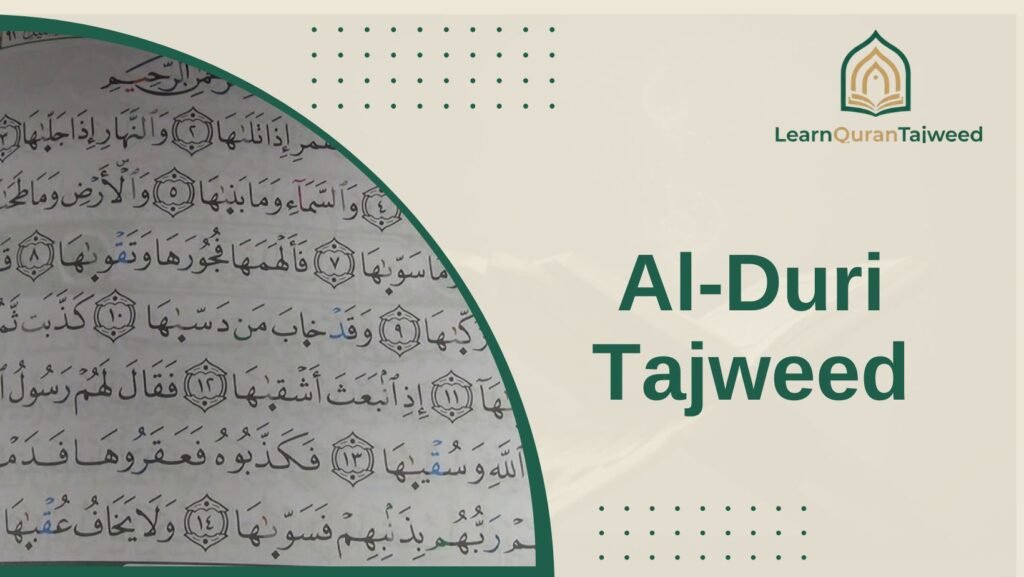
Al-Duri Tajweed refers to the transmission of Quranic recitation attributed to Imam Abu Amr al-Basri through his narrator Hafs al-Duri, preserved precisely along the chain of the Shatibiyya path. This recitation carries distinct phonetic rules — in imala, idgham, madd, and hamz — that differ measurably from the more widely known Hafs an Asim recitation. It is the standard recitation used across Sudan and East Africa today.
Mastering the al-Duri recitation connects a student to one of the oldest and most authenticated chains in Quranic transmission. Imam al-Duri was recognized by scholars of his era as the foremost authority in the science of Quranic readings, and his riwaaya preserves linguistic features of the earliest Arabic dialects of the Hijaz and Basra.
What You’ll Learn in This Article
- Who Imam Abu Amr al-Basri and Imam al-Duri were and why their chain matters
- The five Basmala options unique to al-Duri between Quranic chapters
- How al-Duri’s imala system works and which words it applies to
- The idgham rules that distinguish al-Duri recitation from other narrations
- How al-Duri handles hamz, madd, and haa al-kinaya
- How to study al-Duri Tajweed with a certified teacher online
Imam Abu Amr al-Basri and Imam al-Duri
The al-Duri recitation descends from two foundational figures: the imam whose reading is transmitted, and the narrator who preserved and spread it. Their biographies are not background detail — they are part of the isnad, the authenticated chain that gives the recitation its scholarly authority.
Abu Amr al-Basri at a Glance
Abu Amr al-Basri was Zubban ibn al-Ala al-Mazini, born in Mecca in 68 AH and raised in Basra. He is counted among the Seven Canonical Reciters (al-Qurra al-Sabaa) and holds a distinction no other reciter shares: he had more teachers than any of the other six. He studied in Mecca, Medina, Kufa, and Basra, reading under figures including al-Hasan al-Basri, Sa’id ibn Jubayr, Mujahid ibn Jabr, and Abd Allah ibn Kathir al-Makki. He passed away in Kufa in 154 AH.
Hafs al-Duri and His Transmission
Hafs al-Duri was Hafs ibn Umar ibn Abd al-Aziz al-Azdi, born in 150 AH in a district near Baghdad called al-Dawr — from which his title al-Duri derives. He was the first scholar in Islamic history to systematically compile and record Quranic readings. Imam Ahmad ibn Hanbal was reported to have personally written from al-Duri, a fact that signals the level of credibility his transmission carried among the hadith scholars. Al-Duri passed away in 246 AH.
His transmission of Abu Amr’s recitation passed through an intermediate link: Yahya al-Yazidi, the linguist and grammarian who had studied directly under Abu Amr and served as the bridge between the imam and al-Duri.
Al-Duri Basmala Rules Between Surahs
The rules governing the Basmala in al-Duri recitation are among the first distinctions a student must learn. Between any two consecutive surahs, al-Duri has five permissible options, not the single default familiar to Hafs readers.
Five Basmala Options Between Surahs
The five options are:
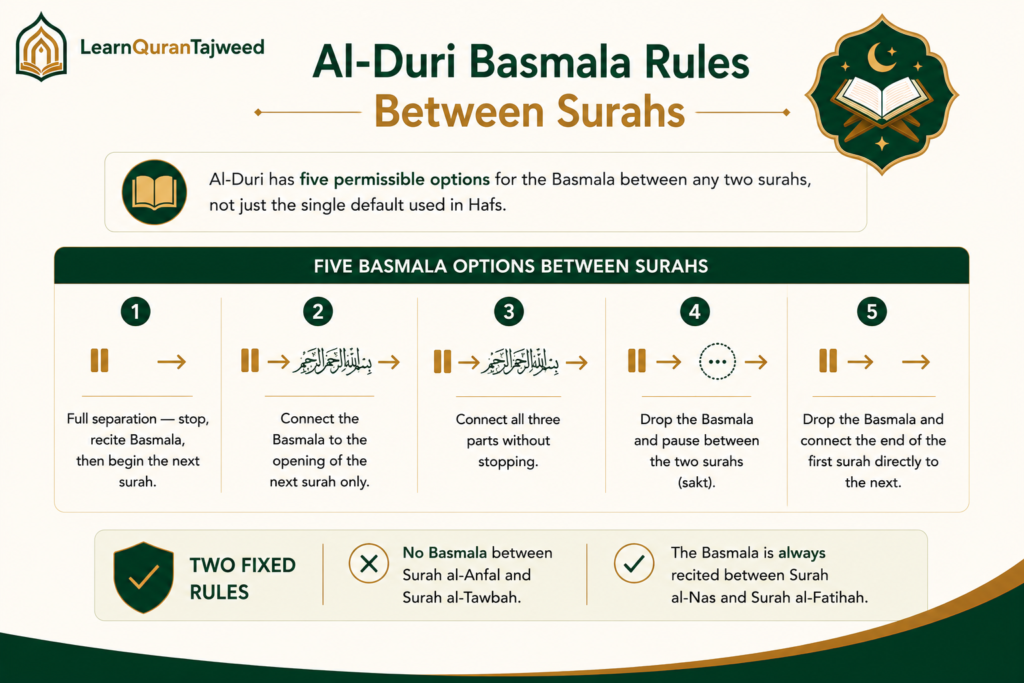
- Full separation — stopping at the end of the first surah, reciting the Basmala, then beginning the second
- Connecting the Basmala to the opening of the second surah only
- Connecting all three parts without stopping
- Dropping the Basmala and pausing between the two surahs with a sakt (a brief soundless pause)
- Dropping the Basmala and connecting the end of the first surah directly to the beginning of the second
Two fixed rules apply regardless of which option is chosen: there is no Basmala between Surah al-Anfal and Surah al-Tawbah, and the Basmala is always recited between Surah al-Nas and Surah al-Fatihah.
Basmala Between al-Anfal and al-Tawbah
Between these two surahs specifically, al-Duri has only three options: full stop (waqf), the sakt, or direct connection (wasl). The Basmala is entirely absent in this position for all canonical reciters, a rule grounded in the scholarly consensus about the ambiguous boundary between these two surahs.
Al-Zuhr Four Surahs Basmala Rule
Al-Duri recites the Basmala between four specific short surah pairs known as al-Zuhr al-Arbaa (the Four Famous Pairs): between al-Muddaththir and al-Qiyamah, between al-Infitar and al-Mutaffifin, between al-Fajr and al-Balad, and between al-Asr and al-Humazah. This naming convention reflects a practitioner-level detail that distinguishes a trained al-Duri reciter from a general reader.
Al-Duri Madd Rules and Lengths
Madd — the prolongation of a vowel sound — follows specific length rules in al-Duri recitation that differ at a practical level from the standard Hafs approach. Getting these lengths right is what separates technically correct recitation from approximate recitation.
The madd al-muttasil (connected prolongation, where the madd letter and hamza occur within the same word) is recited at three counts — equivalent to pressing three fingers together sequentially as a tactile reference used in traditional pedagogy. The madd al-munfasil (separated prolongation, where the madd letter is in one word and the hamza is in the next) offers the student two permitted options: the short form (qasr, two counts) which is the default and starting position, and the medium form (tawsit, three counts) which is a valid secondary choice.
Critically, the long form (four to six counts) for al-munfasil does not apply in al-Duri recitation from the Shatibiyya path. Students transitioning from Hafs recitation frequently apply an extended madd al-munfasil out of habit — this is a known correction point in al-Duri tuition.
Learn Quran Tajweed offers the Intermediate Tajweed Course specifically designed to correct madd lengths and applied rules for students moving beyond the basics.

Start correcting your madd today
Al-Duri Idgham Rules in Recitation
Idgham — the merging of one letter into another — is more extensive in al-Duri recitation than in Hafs. Al-Duri applies idgham in categories that Hafs reads with full pronunciation, making this one of the most practically significant differences a student will encounter.
Idgham of Idh Into Six Letters
Al-Duri merges the dhaal of إذ into six following letters: ta, jim, zay, sad, dal, and sin. A full Quranic example of this idgham:
وَإِذۡ قَالَ رَبُّكَ لِلۡمَلَـٰٓئِكَةِ إِنِّي جَاعِلٌ فِي الۡأَرۡضِ خَلِيفَةً
(Wa-idh qāla rabbuka lil-malā’ikati innī jāʿilun fī l-arḍi khalīfah)
(“And when your Lord said to the angels: I am placing a successor on the earth”)
Surah Al-Baqarah 2:30
Here the dhaal of إذ merges into the jim of جاعل — a textbook idgham position in al-Duri recitation.
Idgham of Qad Into Eight Letters
The dal of قد merges into eight letters in al-Duri recitation: sin, dhal, dad, dha, zay, jim, sad, and shin. This is the largest idgham category in the narration and one that requires deliberate memorization of the trigger letters rather than relying on the feel of the word.
Read also: Levels Of Recitation In The Quran
Idgham of Ta al-Tanith Into Six Letters
The feminine marker ta — when silent at the end of a word — merges into sin, tha, sad, zay, dha, and jim. This rule applies to phrases like كَذَّبَتْ ثَمُودُ (Thamud denied), where the ta merges into the following tha without any audible separation.
Idgham of Lam Hal Into Ta
Al-Duri merges the lam of هل specifically before ta, in the two Quranic positions هَلْ تَرَى in Surah al-Mulk and Surah al-Haqqah. This is a localized rule with two fixed positions — not a general lam-idgham rule.
Read also: Qaloon Tajweed Rules, Recitation Principles and How to Learn Them Online
See Our Classrooms in Action
Watch these short clips from our live, interactive Quran courses to see how our students learn and interact with our expert tutors.
Perfect Your Quran Recitation Today
Join expert-led Tajweed classes, and recite the Quran with confidence and clarity.
Start Your Free TrialAl-Duri Imala Rules and Applications
Imala is the defining phonetic feature of al-Duri recitation. It means tilting a fatha (a) vowel toward kasra (i), and an alif toward ya — producing a sound between the two extremes. Taqiil (slight imala) is a reduced version of the same tilt, applied in different positions.
Al-Duri applies full imala to the ra and ha letters in certain surah openers: the letter ر in the five surahs with the opener الر, and the opener المر, and the letter ه in كهيعص and طه. He also applies full imala to every alif that is written as a ya in the Uthmanic script and falls after a ra — such as in اشترى، النصارى، and التوراة (in all seventeen positions where it occurs).
A critical operational rule governs the word رَأَى: al-Duri applies imala to the hamza and alif when a voweled letter follows, in fifteen Quranic positions. When a sukun follows in connected recitation, the imala disappears in wasl and returns in waqf. This context-sensitive imala is one of the most common error points for students, and it requires direct correction from a trained teacher rather than self-study alone.
The word النَّاسِ in its genitive case (majrur) is imaled wherever it appears in the Quran — both in wasl and waqf. This applies only to the genitive form; the nominative النَّاسُ is not imaled.
Taqiil applies to: the ha in the حم surah openers (seven surahs), raa al-taan at end positions (fawasil) in eleven specific surahs including Taha, al-Najm, al-Qiyamah, and al-Aala, and alf al-tanith al-maqsura on the pattern of فَعْلى in all three vowel forms of the prefix.
Learn Quran Tajweed designed the Tajweed ul Quran Course to cover imala, taqiil, and all advanced phonetic distinctions with practical recitation correction built into every session.

Enroll in Tajweed ul Quran today
Al-Duri Hamz Rules and Substitutions
Hamz — the glottal stop — receives detailed treatment in al-Duri recitation, with specific substitution and softening rules that must be applied precisely.
Hamzatan Min Kalima Wahida (Two Hamzas in One Word)
When two hamzas appear in a single word and the first is fatha, al-Duri softens (yusahhil) the second and inserts an alif separator (idkhal) between them. The word أَأَنذَرْتَهُمْ becomes phonetically أَآنذَرْتَهُمْ — the alif extends to two counts and the second hamza is pronounced softly rather than with a full stop. When the second hamza carries a damma rather than fatha or kasra, al-Duri has two options: with idkhal or without, and the version without is given priority.
Three words are exceptions where idkhal does not apply even though the structure would normally trigger it: أَأَمَنتُمْ in Taha and the two surahs, أَآلِهَتُنَا, and أَئِمَّةً — where tashil applies but without the alif separator.
Hamzatan Min Kalimatayn (Two Hamzas from Two Words)
When two hamzas from adjacent words share the same vowel, al-Duri drops the first and extends the vowel. The phrase جَاءَ أَحَدٌ becomes جَا أَحَدٌ, with the reader having the option of qasr or tawsit in the resulting madd position.
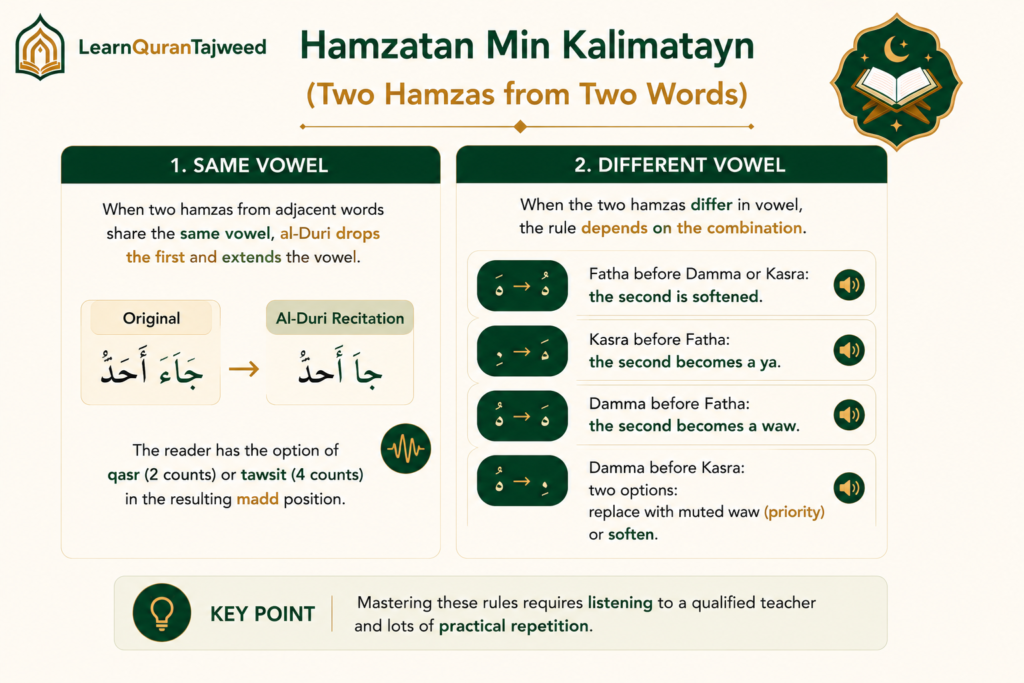
When the two hamzas differ in vowel, the rule depends on the combination. A fatha before a damma or kasra: the second is softened. A kasra before a fatha: the second becomes a ya. A damma before a fatha: the second becomes a waw. A damma before a kasra: two options exist — replacing with a muted waw (the priority reading) or softening.
Notable Hamz Substitutions
Al-Duri reads كُفُؤًا and هُزُؤًا with a full hamza rather than the substituted waw used by Hafs. He reads يَأْجُوجَ وَمَأْجُوجَ with the hamza converted to alif: يَاجُوجَ وَمَاجُوجَ. He reads زَكَرِيَّاءُ with a pronounced hamza and full madd — a reading distinct from the hamza-free form used in other narrations.
Read also: Al-Kisai Tajweed Rules, Recitation Style, and How to Learn It
Al-Duri Waqf and Specific Word Forms
Al-Duri applies the rule of stopping according to the Uthmanic script (al-waqf ala marsum al-khatt). Any ta marbuta written as an open ta in the mushaf is pronounced as ha in waqf. So رَحْمَتَ becomes رَحْمَه when stopping, and شَجَرَتَ becomes شَجَرَه.
Six words are excluded from this rule and retain their ta in waqf: مَرْضَات، يَا أَبَت، هَيْهَات، ذَات بَهْجَة، وَلَات، اللَّات.
Al-Duri also differs from Hafs in a set of individual word forms. He reads يَحْسِبُ with kasra on the sin wherever it occurs. He reads الْمَيِّت and مَيِّت with the ya sukun: الْمَيْت. He reads مُتُّمْ and مُتُّنَا with a damma on the mim. He lightens the zay in يُنَزِّلُ to produce يُنزِلُ. He reads بُشْراً as نُشْراً with a nun. These are not variant interpretations — they are fixed readings within the authenticated transmission.
Learn Quran Tajweed delivers the Quran Recitation with Tajweed Course with focused drilling on waqf, word-level differences, and applied correction for students of all backgrounds.
Start your recitation course today
Read also: Imam Khalaf Tajweed Rules, Narrators, and How It Differs From Hafs
Inside Learn Quran Tajweed Academy
Curious about how online learning works? Peek inside our actual Quran classes and hear the beautiful recitation of our students and teachers.
Free Trial Session at Learn Quran Tajweed Academy
Studying al-Duri Tajweed requires more than reading rules — it requires a trained teacher who can hear your recitation, identify where imala is missing, where idgham is applied incorrectly, and where your madd lengths are off. No written guide replaces that corrective feedback.
Learn Quran Tajweed offers a free trial session with a certified instructor so you can experience live correction before committing to a course. The session is structured, one-to-one, and focused entirely on your current recitation level.

Book your free trial session now
Courses we offer:
- Tajweed Course for Kids
- Tajweed Course for Adults
- Tajweed Course for Ladies
- Tajweed ul Quran Course
- Quran Recitation with Tajweed Course
- Quran Tarteel Course
- Tajweed Ijazah Program
Perfect Your Quran Recitation Today
Join expert-led Tajweed classes, and recite the Quran with confidence and clarity.
Start Your Free TrialConclusion
Al-Duri Tajweed is a complete and technically rich recitation system that demands precise knowledge of imala positions, idgham categories, Basmala options, madd lengths, and hamz rules — all authenticated through a direct chain reaching back to the Prophet ﷺ. It is not a simplified variant of Hafs recitation; it is a fully independent narration with its own rules, its own exceptions, and its own practitioner knowledge built through centuries of oral transmission.
The most effective path to al-Duri recitation is structured learning under a teacher who specializes in this narration. Written rules provide the framework; a qualified instructor provides the correction that makes the rules stick.
Read also: Riwayat vs Qira’at Every Student Must Know
Frequently Asked Questions
What is al-Duri Tajweed?
Al-Duri Tajweed is the system of Quranic recitation rules belonging to the narration of Hafs al-Duri from Imam Abu Amr al-Basri. It is one of the ten canonical narrations and is the standard recitation in Sudan and East Africa.
How does al-Duri recitation differ from Hafs an Asim?
Al-Duri recitation differs in imala (vowel tilting), a more extensive idgham system, shorter madd al-munfasil, five Basmala options between surahs, and dozens of individual word-level differences. Hafs has none of these imala rules and reads madd al-munfasil at four to six counts.
Is al-Duri recitation valid for all Muslims?
Yes. Al-Duri recitation is a fully authenticated narration among the ten canonical Quranic readings. It is equally valid for prayer, recitation, and memorization for any Muslim anywhere in the world.
How long does it take to learn al-Duri Tajweed?
A student with prior Hafs recitation background typically needs six to twelve months of structured study to apply al-Duri rules reliably. A beginner starting from scratch may need longer depending on lesson frequency and practice consistency.
Can I learn al-Duri recitation online?
Yes. Al-Duri recitation is taught online through live one-to-one sessions with certified instructors. Learn Quran Tajweed Academy offers structured courses for all levels with teachers who specialize in this narration.
What is imala in al-Duri recitation?
Imala is the tilting of a fatha vowel toward kasra and an alif sound toward ya. In al-Duri recitation, imala applies to specific surah openers, the word النَّاسِ in its genitive form, the word التَّوْرَاةَ, all alf al-raaiy positions, and the verb رَأَى under specific conditions.
Related Articles
Tajweed Resources