 Quran
Quran
| Key Takeaways |
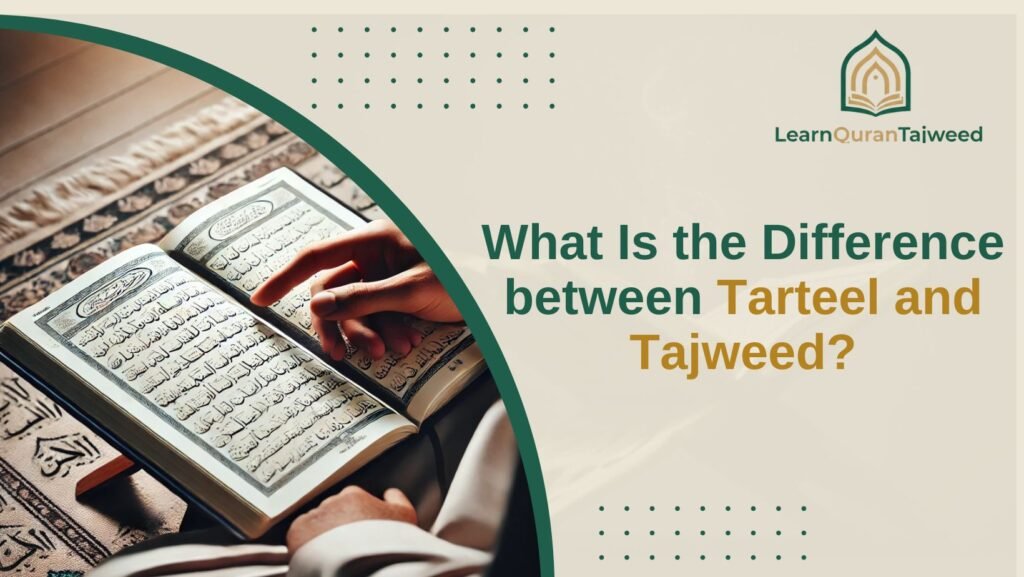
| Tajweed is the science of correct letter articulation and rule application; Tarteel is the practice of measured, contemplative Quranic recitation. |
| Applying Tajweed rules is a prerequisite for Tarteel — you cannot achieve true Tarteel without correct pronunciation and rule accuracy. |
| Allah commands Tarteel explicitly in Surah Al-Muzzammil, making it a Quranic obligation, while Tajweed is the scholarly instrument that fulfills that command. |
Both the terms “Tarteel” and “Tajweed” appear in Quranic learning contexts, both relate to reading the Quran correctly, and both are praised in Islamic tradition. Understanding the difference between Tarteel and Tajweed — and the precise relationship between them — removes this confusion permanently.
What is Tajweed?
Tajweed is the science: the body of rules governing how every letter is articulated, how long vowels are extended, and how adjacent letters interact.
What is Tarteel?
Tarteel is the application in worship: slow, measured, melodious recitation that allows meaning to reach the heart. One is the instrument; the other is the music it makes.
What is the Core Difference Between Tajweed and Tarteel?
Tajweed differs from Tarteel in function: Tajweed is a prescriptive science with codified rules, while Tarteel is a mode of recitation characterized by deliberateness, measured pace, and spiritual presence. Every rule of Tajweed — from Ikhfa to Idgham to Madd — is a tool. Tarteel is what happens when all those tools are used together, in the right tempo, with conscious engagement.
The word Tajweed (تجويد) derives from the Arabic root meaning “to make excellent” or “to bring something to its finest state.” Technically, it refers to giving every letter its Makhraj (articulation point) and its full Sifat (inherent attributes), and applying the situational rules that govern how letters behave in combination.
Tarteel (ترتيل), by contrast, comes from a root conveying arrangement, order, and measured flow. In Quranic recitation, it means reading slowly and distinctly, pausing at appropriate stopping points, and absorbing the meaning of what is being recited.
Shots Videos from Our Courses
Perfect Your Quran Recitation Today
Join expert-led Tajweed classes, and recite the Quran with confidence and clarity.
Start Your Free TrialWhat Does the Quran Say About Tarteel?
Allah ﷻ commands Tarteel directly in the Quran. This command is not advisory — it is a divine instruction to every reciter.
وَرَتِّلِ ٱلْقُرْءَانَ تَرْتِيلًا
Wa rattilil-Qur’āna tartīlā
“And recite the Quran with measured recitation.” (Al-Muzzammil 73:4)
The emphasis on both verb and cognate noun (rattil + tartīlā) in Arabic grammar signals the highest degree of importance. Classical scholars interpreted this as commanding both correct letter pronunciation and deliberate, unhurried pacing.
How Tajweed Rules Function as the Foundation of Tarteel
Tajweed is the structural foundation without which Tarteel cannot exist in its complete form. A student reading slowly and deliberately but mispronouncing letters or misapplying Ghunnah is not performing Tarteel — they are performing slow, incorrect recitation.
The rules that form Tajweed’s core are:
- Noon Sakinah and Tanween rules — covering Idhaar, Idgham, Iqlab, and Ikhfa
- Meem Sakinah rules — Idgham Shafawi, Ikhfa Shafawi, and Idhaar Shafawi
- Madd (elongation) rules — governing when and how long to extend vowel sounds
- Qalqalah — the echo-like bounce applied to specific letters in sukoon
- Tafkheem and Tarqeeq — heaviness and lightness of letter pronunciation
Each of these rules must be applied correctly before Tarteel can reflect the Quran’s true sound.
At Learn Quran Tajweed Academy, our Beginner Tajweed Course systematically builds this foundation rule by rule, giving students the technical precision they need before advancing into recitation practice.
Begin your Tajweed journey with a free lesson

What Are the Three Speeds of Quranic Recitation
Classical Tajweed scholarship identifies three recognized speeds of Quranic recitation. Understanding these clarifies exactly where Tarteel sits among them.
| Speed | Arabic Term | Description | Tajweed Application |
| Slow and measured | Tarteel | Deliberate, letter-perfect, contemplative | Full and detailed |
| Moderate pace | Tadweer | Between slow and fast | Full application |
| Rapid (but correct) | Hadr | Swift recitation without error | Full application |
Tarteel is not simply “slow recitation.” It is the combination of measured pace, correct articulation at every letter, proper elongation of Madd letters, and conscious engagement with meaning.
Hadr — the fastest speed — still requires every Tajweed rule to be applied. Speed does not exempt a reciter from Tajweed rules.
Perfect Your Quran Recitation Today
Join expert-led Tajweed classes, and recite the Quran with confidence and clarity.
Start Your Free TrialDoes Tajweed Apply Only to Tarteel or to All Forms of Recitation?
Tajweed rules apply to every speed and style of Quranic recitation — Tarteel, Tadweer, and Hadr alike. This is a point many students misunderstand. Some assume Tajweed is only for slow, formal recitation.
Scholars unanimously agree that Tajweed is obligatory (واجب) to the extent that its absence causes clear error, regardless of recitation speed.
Ibn Al-Jazari — one of the foremost authorities in Tajweed scholarship — stated in his famous Muqaddimah: applying Tajweed is obligatory upon every Muslim who recites the Quran, and leaving it is a sin. The Sifat of every letter must be honored whether reciting in Tarteel or Hadr.
Read also: The Ruling of Istiaadhah and Basmalah
Which Comes First in Learning Tajweed or Tarteel?
Tajweed knowledge must precede Tarteel practice — not the other way around. A student cannot develop the spiritual quality of Tarteel without first building the technical accuracy of Tajweed. This is the precise learning sequence used in Learn Quran Tajweed Academy’s structured programs.
| Learning Stage | Focus | Outcome |
| Stage 1 — Foundational Rules | Noon Sakinah, Tanween, Meem rules, basic Madd | Technical accuracy |
| Stage 2 — Advanced Rules | Sifat al-Huruf, Tafkheem/Tarqeeq, Ghunnah | Phonetic precision |
| Stage 3 — Applied Recitation | Makharij correction, Wuquf knowledge, Tarteel pace | Tarteel in practice |
| Stage 4 — Tarteel Mastery | Pacing, melody, breath control, spiritual presence | Authentic Tarteel |
Our Quran Tarteel Course at Learn Quran Tajweed Academy specializes in Stage 3 and Stage 4 — helping students who have completed foundational Tajweed study develop the measured, melodious recitation that reflects true Tarteel.
Students who arrive without Tajweed foundations are guided through our Beginner Tajweed Course first.
Join our Quran Tarteel Course and get a free trial
Is Tajweed Obligatory or Recommended?
Avoiding Lahn Jali (major error) is obligatory (fard) upon every Muslim. Applying the full rules of Tajweed at the level of advanced rule interactions is obligatory upon those who are capable of learning and have access to instruction.
Scholars confirm that Tajweed rules must be observed during Salah and Quranic recitation, and deliberate violation of rules that alter meaning is sinful. Tarteel, as commanded in the Quran, carries its own obligation — making both interconnected duties, not optional refinements.
Our Students Reviews
Perfect Your Quran Recitation Today
Join expert-led Tajweed classes, and recite the Quran with confidence and clarity.
Start Your Free TrialRead also: Learn Surah Yaseen with Tajweed
Develop Your Tarteel Through Certified Instruction at Learn Quran Tajweed Academy
Understanding the difference between Tajweed and Tarteel is only the beginning. The real transformation happens through consistent, corrected practice with qualified guidance.
Learn Quran Tajweed Academy offers:
- Ijazah-certified instructors specializing in Hafs ‘an ‘Asim
- Personalized 1-on-1 sessions tailored to your current recitation level
- Structured progression from foundational rules to full Tarteel application
- Flexible scheduling available 24/7 for students worldwide
- A dedicated Quran Tarteel Course and a clear path to Tajweed Ijazah
Book your free trial lesson today and begin reciting with the precision and presence the Quran deserves.
Perfect Your Quran Recitation Today
Join expert-led Tajweed classes, and recite the Quran with confidence and clarity.
Start Your Free TrialCheck out the best tajweed course for your needs:
- Practical Tajweed Course
- Beginner Tajweed Course
- Intermediate Tajweed Course
- Advanced Tajweed Course
- Quran Tarteel Course
- Tajweed Ijazah Program
- Tajweed Course for Sisters
- Tajweed course for Kids
Book your free trial Tajweed lesson today

Read also: Best Tajweed Classes in Toronto
Conclusion
Tajweed and Tarteel are not competing approaches to the Quran — they are two dimensions of a single, sacred act. Tajweed provides the technical precision that protects the words of Allah from distortion. Tarteel provides the pace, presence, and intention that allows those words to settle in the heart.
The student who masters both does not merely recite correctly. They recite as the Quran was revealed to be recited — with measured clarity, unwavering accuracy, and genuine contemplation. That standard is achievable, Insha’Allah, with the right sequence of learning and qualified instruction.
Frequently Asked Questions About the Difference Between Tajweed and Tarteel
Is Tarteel possible without learning Tajweed rules first?
Tarteel without Tajweed is incomplete by definition. Imam Ali ibn Abi Talib defined Tarteel as beautifying the letters and knowing the stopping points — both of which require Tajweed knowledge. Slow recitation that contains letter errors or missing rules is not authentic Tarteel, regardless of pace or intention.
Are Tajweed rules obligatory during daily Salah?
Yes. Scholars unanimously agree that avoiding clear recitation errors (Lahn Jali) that alter meaning is obligatory during Salah. Advanced Tajweed application, to the degree one is capable, is also considered obligatory. A Muslim who has access to Tajweed instruction and neglects it without excuse is blameworthy according to mainstream scholarly opinion.
How long does it take to develop genuine Tarteel recitation?
Most non-Arabic speaking adult students who study consistently require six to twelve months of structured Tajweed learning before their recitation reflects genuine Tarteel. The timeline depends on prior Arabic reading fluency, lesson frequency, and daily practice. Students who practice even fifteen minutes daily progress noticeably within the first three months, in most instructors’ experience.