 Quran
Quran
| Key Takeaways |
| Istiaadhah means seeking Allah’s protection from Shaytan before recitation; its ruling is recommended according to the majority of scholars. |
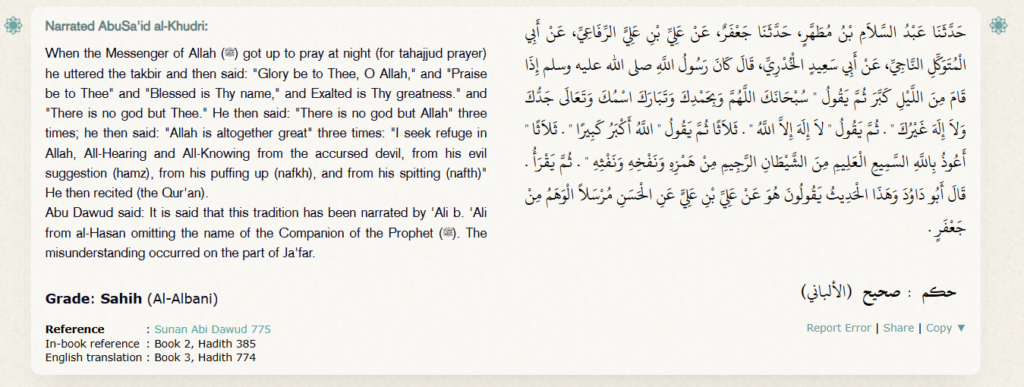
| Four Quranic formulas exist for Istiaadhah, all authenticated through Prophetic practice narrated by Abu Sa’eed al-Khudri. |
| The Basmalah has one fixed wording and is obligatory between every two surahs in Hafs ‘an ‘Asim except between Al-Anfal and At-Tawbah. |
| Four permissible connection modes exist when combining Istiaadhah and Basmalah before a surah; only three modes apply between surahs. |
Every time you open the Mushaf and prepare to recite, two acts precede the first word of the Quran itself: the Istiaadhah and the Basmalah. These are not mere rituals. They are carefully governed acts of recitation with defined rulings, precise wording, and specific modes of connection — and mastering them is foundational to correct Tajweed application.
The Istiaadhah is your declaration of refuge with Allah before His words enter your tongue. The Basmalah is your opening in His name. Together, they frame every recitation session with meaning and method. Both carry scholarly rulings, authenticated narrations, and recitation modes that every student — from beginner to Ijazah candidate — must know with precision.
What Is Istiaadhah?
Istiaadhah (الاستعاذة) means seeking refuge with Allah and fortifying oneself against the harm, whispers, and interference of Shaytan al-Rajeem.
Istiaadhah in Arabic
Istiaadhah in Arabic is derived from the Arabic root ع-و-ذ, meaning to take shelter or seek protection. In recitation contexts, it refers specifically to the verbal act performed before beginning Quranic recitation.
Allah commands this act directly in the Quran:
فَإِذَا قَرَأْتَ الْقُرْآنَ فَاسْتَعِذْ بِاللّهِ مِنَ الشَّيْطَانِ الرَّجِيمِ
Fa-idhā qara’tal-Qur’āna fasta’idh billāhi minash-Shaytānir-Rajeem
“So when you recite the Quran, seek refuge in Allah from Shaytan, the expelled.” (An-Nahl 16:98)
The scholars of Tajweed define its meaning as: al-iltijā’ ilallāh wal-tahassun bihi — complete reliance upon and fortification through Allah against Shaytan’s whispers, promptings, and distractions during recitation.
At Learn Quran Tajweed Academy, our Beginner Tajweed Course covers the Istiaadhah and Basmalah as the very first applied lesson — because every rule of Tajweed builds on getting this opening correctly.
Begin your Tajweed journey with a free lesson

What Are the Types and Transliterations of Istiaadhah?
The Istiaadhah has four authenticated formulas, all grounded in Prophetic narration. Students often assume only one formula exists — in practice, all four are valid and used by reciters across the established chains of transmission.
| # | Arabic Formula | Transliteration |
| 1 | أَعُوذُ بِاللهِ مِنَ الشَّيْطَانِ الرَّجِيمِ | A’ūdhu billāhi minash-Shaytānir-Rajeem |
| 2 | أَعُوذُ بِاللهِ السَّمِيعِ الْعَلِيمِ مِنَ الشَّيْطَانِ الرَّجِيمِ | A’ūdhu billāhis-Samī’il-‘Alīmi minash-Shaytānir-Rajeem |
| 3 | أَعُوذُ بِاللهِ مِنَ الشَّيْطَانِ الرَّجِيمِ مِنْ هَمْزِهِ وَنَفْخِهِ وَنَفْثِهِ | A’ūdhu billāhi minash-Shaytānir-Rajeem min hamzihi wa nafkhihi wa nafthihi |
| 4 | أَعُوذُ بِاللهِ السَّمِيعِ الْعَلِيمِ مِنَ الشَّيْطَانِ الرَّجِيمِ مِنْ هَمْزِهِ وَنَفْخِهِ وَنَفْثِهِ | A’ūdhu billāhis-Samī’il-‘Alīmi minash-Shaytānir-Rajeem min hamzihi wa nafkhihi wa nafthihi |
The longer formulas (3 and 4) include a request for protection from Shaytan’s hamz (evil promptings), naf kh (arrogance), and nafth (poetry used to distort).
The second and fourth formulas are authenticated through the narration of Abu Sa’eed al-Khudri, reported in Sunan Abi Dawud and confirmed as authentic by Al-Albani.
Shots Videos from Our Courses
Perfect Your Quran Recitation Today
Join expert-led Tajweed classes, and recite the Quran with confidence and clarity.
Start Your Free TrialWhat Is the Ruling of Istiaadhah Before Quranic Recitation?
The ruling of Istiaadhah is mandub (recommended) according to the overwhelming majority of scholars, including the four major schools of Islamic jurisprudence. A minority position holds it obligatory based on the apparent command in Surah An-Nahl 16:98.
The majority interpret the imperative fasta’idh as indicating strong recommendation rather than strict obligation, noting that no authentic narration records anyone being corrected for omitting it.
Omitting it does not invalidate recitation, but performing it is a preserved Sunnah and a mark of complete recitation etiquette.
When Is Istiaadhah Recited Aloud and When Is It Silent?
The question of jahr (aloud) versus sirr (silent) for Istiaadhah is governed by clear scholarly guidelines — not personal preference.
Cases Requiring Jahr in Isti’adhah (Reciting Aloud)
- When reciting aloud and others are listening
- At the beginning of a lesson or teaching session
Cases Requiring Sirr in Istiaadhah (Silent Recitation)
- When reciting within the prayer (salah)
- When reciting in a group study and you are not the one opening the session
- When reciting alone, regardless of whether your recitation itself is loud or silent
There is an important practical note: if recitation is involuntarily interrupted — by a cough, sneeze, or an explanation of a verse — the Istiaadhah does not need to be repeated. However, if the interruption is voluntary — such as engaging in unrelated speech or leaving the session — the Istiaadhah must be renewed before resuming.
Students at Learn Quran Tajweed Academy find this distinction especially useful in group Quran circles, where knowing when to recite Istiaadhah aloud vs. silently reflects genuine mastery — not just rule memorization.
Our Practical Tajweed Course applies exactly these real-session scenarios in live recitation practice.
Join our Practical Tajweed Course and get a free trial

What Is the Istiaadhah Meaning in the Context of Recitation Preparation?
The istiaadhah meaning goes beyond its literal translation. It is a conscious act of spiritual and cognitive reset before engaging with Divine speech. Recitation is an act of worship, and Shaytan’s interference — subtle distractions, mispronunciation, loss of focus — is real. The Istiaadhah activates mindfulness, signals intentionality, and frames the recitation as an act directed entirely toward Allah.
Understanding this meaning transforms how students approach it. Rather than rushing through it as a formality, they recite it with awareness — and that awareness produces noticeably more focused, deliberate recitation in every session I have observed across years of teaching.
Read also: What Is the Difference between Tarteel and Tajweed?
What Is the Basmalah?
The Basmalah is the phrase بِسْمِ اللهِ الرَّحْمَنِ الرَّحِيمِ — Bismillāhir-Rahmānir-Raheem — and it has exactly one wording in Tajweed. Unlike the Istiaadhah, which has multiple valid formulas, the Basmalah admits no variation in its text.
Basmalah’s position is before the recitation begins — after the Istiaadhah and before the first word of the surah. Scholars unanimously agree it is part of verse 30 of Surah An-Naml:
إِنَّهُ مِن سُلَيْمَانَ وَإِنَّهُ بِسْمِ اللَّهِ الرَّحْمَنِ الرَّحِيمِ
Innahu min Sulaymāna wa innahu Bismillāhir-Rahmānir-Raheem
“Indeed, it is from Solomon, and indeed, it reads: In the name of Allah, the Most Gracious, the Most Merciful.” (An-Naml 27:30)
Beyond that verse, scholars differ on its status at the opening of other surahs — a disagreement that directly shapes its ruling.
Perfect Your Quran Recitation Today
Join expert-led Tajweed classes, and recite the Quran with confidence and clarity.
Start Your Free TrialWhat Is the Ruling of Basmalah?
The ruling of Basmalah depends on one’s position regarding its Quranic status — a question with genuine scholarly disagreement.
| Position | Ruling on Basmalah |
| Basmalah is a verse of every surah (except At-Tawbah) | Obligatory before each surah |
| Basmalah is an independent verse revealed for blessing and separation | Recommended (mustahabb) |
| Basmalah is a verse of Al-Fatihah only | Obligatory in Al-Fatihah; debated elsewhere |
| Basmalah is not a Quranic verse at all | Optional or omitted |
For students of Hafs ‘an ‘Asim — the most widely studied recitation worldwide — the ruling is clear: the Basmalah must be recited between every two surahs, with the sole exception of between Surah Al-Anfal and Surah At-Tawbah (Al-Bara’ah).
If a reciter begins from the middle of a surah, they have a choice: they may recite the Basmalah or omit it.
However, Al-Ja’bari held that reciting Basmalah when beginning from within Surah At-Tawbah (Bara’ah) is prohibited, following the principle that its absence at the surah’s opening sets the ruling for the entire surah.
This is one of those edge cases that distinguishes intermediate from advanced students.
Our Intermediate Tajweed Course at Learn Quran Tajweed Academy addresses exactly these position-specific distinctions systematically. Understanding the complete guide to Tajweed rules also helps contextualize where Basmalah rulings sit within the broader Tajweed framework.
Join our Intermediate Tajweed Course and get a free trial

What Are the Permissible Connection Modes for Istiaadhah and Basmalah Before a Surah?
When beginning any surah other than At-Tawbah — or beginning from the middle of a surah while choosing to recite the Basmalah — four permissible modes of connection exist between the Istiaadhah, Basmalah, and the surah opening.
| Mode | Description |
| 1. Qat’ al-Jamee’ | Full pause: Stop after Istiaadhah → Stop after Basmalah → Begin surah |
| 2. Wasl al-Jamee’ | Full connection: Istiaadhah flows into Basmalah → Basmalah flows into surah |
| 3. Wasl al-Awwal, Qat’ al-Thani | Connect Istiaadhah to Basmalah → Pause → Begin surah |
| 4. Qat’ al-Awwal, Wasl al-Thani | Pause after Istiaadhah → Connect Basmalah to surah opening |
All four modes are valid and transmitted. The choice between them is a matter of recitation style and teacher guidance — not personal preference without basis.
When beginning Surah At-Tawbah or beginning from the middle of a surah without Basmalah, only two modes apply:
- Wasl: Connect Istiaadhah directly to what follows
- Qat’: Pause after Istiaadhah, then begin
What Are the Correct Modes for Basmalah Between Two Surahs?
Between two consecutive surahs — excluding the Al-Anfal/At-Tawbah transition — three modes are valid for handling the Basmalah.
| Mode | Method |
| 1. Qat’ al-Jamee’ | Pause on last word of surah → Pause on Basmalah → Begin next surah |
| 2. Qat’ al-Awwal, Wasl al-Thani | Pause on last word of surah → Connect Basmalah to opening of next surah |
| 3. Wasl al-Jamee’ | Connect last word of surah to Basmalah → Connect Basmalah to next surah |
A fourth mode is explicitly forbidden: connecting the end of the previous surah to the Basmalah, then pausing before the next surah.
This is impermissible because the Basmalah belongs at the opening of surahs — not at their endings. Placing it at the tail of a surah without connecting it forward distorts its position and its meaning.
This is a rule I have seen misapplied repeatedly — students who connect the ending of one surah into the Basmalah and then pause, thinking all connection modes are symmetric. They are not. The directionality matters.
For a deeper understanding of how stopping and pausing rules interact with recitation flow, see our guide on Makharij al-Huruf and the broader Tajweed rules framework.
Read also: Best Tajweed Classes in Toronto
Our Students Reviews
Perfect Your Quran Recitation Today
Join expert-led Tajweed classes, and recite the Quran with confidence and clarity.
Start Your Free TrialWhat Are the Three Modes Between Surah Al-Anfal and Surah At-Tawbah?
Between Al-Anfal and At-Tawbah, the Basmalah is never recited — this is the unanimous position in the Hafs transmission and one of the most well-known rules in Quranic recitation. Three modes govern this unique transition:
| Mode | Method |
| 1. Wasl | Connect the last verse of Al-Anfal directly to the opening of At-Tawbah |
| 2. Waqf | Pause fully with breath on the last verse of Al-Anfal, then begin At-Tawbah |
| 3. Sakt | Brief silent pause without breathing on the last verse of Al-Anfal, then begin At-Tawbah |
The Sakt here is a specialized Tajweed technique — a momentary cessation of sound without inhalation. It signals to the listener that a surah boundary has been crossed without the marker of Basmalah, maintaining both textual clarity and transmission accuracy.
Understanding Sakt and Waqf at this level connects directly to Madd rules and proper breath management taught in our Quran Tarteel Course.
Join our Quran Tarteel Course and get a free trial

Begin Your Mastery of Istiaadhah and Basmalah with Certified Instruction at Learn Quran Tajweed Academy
These rulings are foundational — and they deserve to be taught correctly from day one.
Learn Quran Tajweed Academy offers:
- Ijazah-certified instructors specializing exclusively in Hafs ‘an ‘Asim recitation
- Personalized 1-on-1 sessions tailored to your current recitation level
- Flexible scheduling available 24/7 for students worldwide
- Structured progression from foundational rules to full Ijazah certification
- A FREE trial lesson with no commitment
Book your free trial today and start your recitation with the precision it deserves.
Perfect Your Quran Recitation Today
Join expert-led Tajweed classes, and recite the Quran with confidence and clarity.
Start Your Free TrialCheck out the best tajweed course for your needs:
- Practical Tajweed Course
- Beginner Tajweed Course
- Intermediate Tajweed Course
- Advanced Tajweed Course
- Quran Tarteel Course
- Tajweed Ijazah Program
- Tajweed Course for Sisters
- Tajweed course for Kids
Book your free trial Tajweed lesson today

Read also: How to Practice Tajweed Daily?
Conclusion
The ruling of Istiaadhah and Basmalah is not a minor preliminary — it is the opening gate of every correct recitation. Getting these two acts right means understanding their definitions, authenticating their formulas, applying their rulings accurately, and knowing which connection modes are valid in each context.
Hafs ‘an ‘Asim students carry a specific responsibility here: the Basmalah rules between surahs, the prohibition between Al-Anfal and At-Tawbah, and the four permissible opening modes are all transmission-specific obligations — not general guidelines. Precision at this level is what separates memorization from mastery.
May Allah grant every student of His Book the tawfiq to recite it as it deserves to be recited. Ameen.
Frequently Asked Questions About the Ruling of Istiaadhah and Basmalah
Is the Istiaadhah Considered Part of the Quran?
No. The Istiaadhah is not part of the Quran. It is a verbal act of protection recited before recitation begins. Scholars are unanimous that it is external to the Quranic text itself, regardless of which formula is used.
What Is the Difference Between Istiaadhah and Basmalah in Tajweed Application?
The Istiaadhah precedes the Basmalah and is never considered Quranic text. The Basmalah, by contrast, is a Quranic phrase whose status as a standalone verse is debated — but its inclusion between surahs in Hafs ‘an ‘Asim is obligatory except between Al-Anfal and At-Tawbah.
Does Reciting the Wrong Istiaadhah Formula Invalidate Recitation?
No. All four authenticated formulas are valid for recitation. Choosing any of them is permissible. What matters is that the Istiaadhah is recited sincerely before beginning — not which specific wording is selected.
Can a Student Skip the Basmalah When Starting from the Middle of a Surah?
Yes. When beginning from the middle of a surah, the reciter has a choice between reciting or omitting the Basmalah — with the notable exception of Surah At-Tawbah, where scholars like Al-Ja’bari consider the Basmalah impermissible given its absence from the surah’s opening in the Mushaf.