 Tajweed Basics

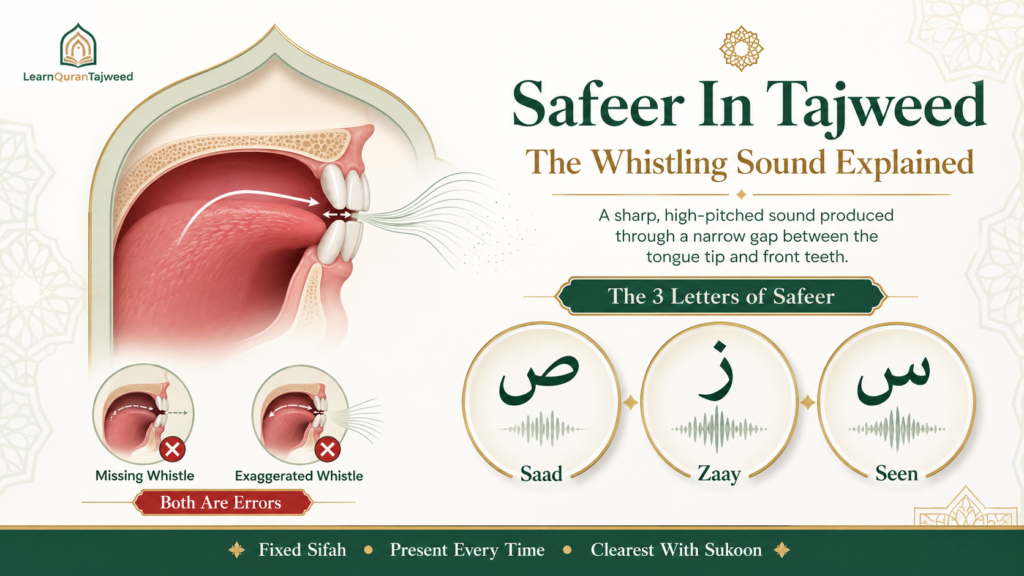
Safeer in Tajweed is identified as the sharp, whistling sound that escapes through a narrow gap in the mouth when you pronounce the letters Saad (ص), Zaay (ز), and Seen (س).
Many beginners learn to identify these letters by their makhraj alone and miss the acoustic signature that actually separates a correct recitation from a flat one.
This whistling quality is not optional. It is a fixed characteristic (sifah) of these three letters. That means it must be present every time they are pronounced, regardless of vowel or position in the word. If it is skipped or exaggerated, then both count as recitation errors.
This guide explains what safeer is and why it happens physically. It also illustrates how the three letters differ in strength, and the mistakes students make most often when trying to produce it correctly.
What You’ll Learn In This Article
- What safeer means linguistically and technically in Tajweed
- Which three letters carry safeer and why no other letters do
- The physical mechanism that produces the whistling sound
- Why safeer is most noticeable when the letter is sakin (unvoweled)
- How Saad, Zaay, and Seen differ in the strength of their whistle
- The two most common mistakes students make with safeer letters
What Is Safeer In Tajweed?
To understand safeer, you should start with separating its linguistic meaning from its technical definition in the science of Tajweed. That’s because the two are connected but not identical.
The Linguistic And Technical Definition
The linguistic definition of safeer (الصفير) means sharpness or shrillness in sound. For the technical definition in Tajweed, safeer is an extra, high-pitched sound that escapes from between the front teeth and the tip of the tongue while pronouncing a specific letter, a sound reciters have long compared to a bird’s chirp.
Safeer is one of seven sifaat (characteristics) in Tajweed that have no opposite. It differs from traits such as jahr and hams, which come in paired opposites; a letter either has safeer or it doesn’t. Classical Tajweed theory has no partial or reduced version of it.
Read also: Complete Guide to Tajweed Rules
The Three Letters Of Safeer
There are only three letters in the Arabic alphabet that carry this characteristic: Saad (ص), Zaay (ز), and Seen (س). They are known as huroof al-safeer, or the letters of the whistle.
There is no other letter in the alphabet that produces this hissing quality. That’s why safeer is used as a diagnostic tool by Tajweed teachers. If the whistle is missing on one of these three letters, the letter is not being pronounced correctly, regardless of how accurate the makhraj otherwise sounds.
See Our Classrooms in Action
Watch these short clips from our live, interactive Quran courses to see how our students learn and interact with our expert tutors.
Perfect Your Quran Recitation Today
Join expert-led Tajweed classes, and recite the Quran with confidence and clarity.
Start Your Free TrialHow Is The Safeer Sound Produced?
If you know which letters carry safeer, that is only half the picture. The whistle itself is produced from a specific mechanical bottleneck in how the sound is shaped in the mouth.
The Narrow Channel Behind The Tongue
The Safeer sound comes when the tip of the tongue rests against the lower front teeth. That forms a narrow channel between the tongue and the inner surface of the upper and lower incisors. When air is forced through this constricted space, that constriction generates the sharp, hissing tone.
This mechanism is worth understanding rather than memorizing, as it explains why Safeer is so sensitive to tongue placement.
Even a small shift in where the tongue sits against the teeth widens or narrows the channel, which directly weakens or strengthens the whistle.
Why Is Safeer Clearest On Sakin Letters?
Safeer is present whenever Saad, Zaay, or Seen occurs. It becomes most audible and most exposed when the letter is sakin (carries no vowel).
For example, notice the pronunciation of the Saad in اصْبِروا (be patient), the Zaay in مُزْجاةٌ (of little value, Surah Yusuf 88), and the Seen in يُوَسْوِسُ (whispers, Surah An-Nas 5).
You can follow this practical rule: if you want to check whether a student is producing genuine safeer, listen to their recitation on a sakin instance of one of these letters, rather than a voweled one. The vowel sound in a voweled letter can mask a weak whistle. A sakin letter has nothing to hide behind.
At Learn Quran Tajweed, this sakin-focused listening check is one of the first diagnostic habits we build into every student’s ear training. It isolates the exact sound a reciter needs to correct.
Read also: What is Makhraj in Tajweed?
How Saad, Zaay, and Seen Differ in the Strength of Safeer
Although all three letters share the same underlying mechanism, they do not produce a whistle of equal strength. The difference is produced by the other sifaat each letter carries alongside safeer.
Ranking Saad, Zaay, and Seen From Strongest to Weakest Safeer
Saad ص produces the strongest whistle, as it also carries isti’laa (elevation of the back of the tongue) and itbaq (a fuller seal against the palate). Both characteristics reinforce the sound.
Zaay ز comes next, as it is a jahr (voiced) letter, giving it more vocal resonance than a voiceless one. Seen س is the weakest of the three because it is a hams (voiceless, breath-carrying) letter. It produces a lighter, airier whistle.
| Letter | Strength | Contributing Sifah | Traditional Sound Comparison |
| Saad (ص) | Strongest | Isti’laa + Itbaq | Goose |
| Zaay (ز) | Middle | Jahr (voiced) | Bees |
| Seen (س) | Weakest | Hams (voiceless) | Locust |
Traditional Sound Comparisons for Recognizing the Safeer of Saad, Zaay, and Seen
Classical Tajweed teachers describe each letter’s whistle using a natural sound comparison that students can actually hear in their minds. Saad ص resembles the sound of a goose, Zaay ز resembles the buzzing of bees, and Seen س resembles the sound of a locust.
These comparisons are not decorative ones. They are a genuinely useful diagnostic tool. If a learner’s Saad ص sounds closer to a flat “s” than to that sharper, fuller tone, the isti’laa and itbaq that should be reinforcing the whistle are likely missing as well. The fix usually needs to address both issues together rather than the whistle alone.
Read also: The Benefits of Tajweed
Common Mistakes When Pronouncing Safeer Letters
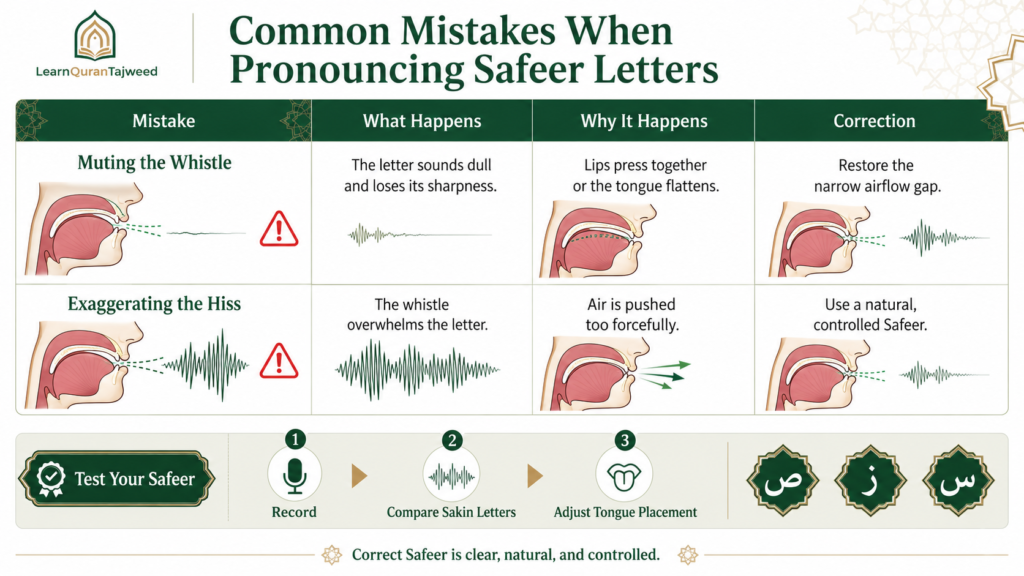
There are two opposite errors that appear repeatedly in recitation. Both errors come from not understanding what the whistle is supposed to sound like.
Muting the Safeer Whistle by Incorrectly Flattening the Tongue or Tensing the Lips
The most recurrent mistake is pressing the lips together or flattening the tongue in a way that kills the whistle entirely. In this case, the letter loses its sharpness and comes out sounding dull or generic. This usually happens when a learner focuses only on the makhraj location and forgets that a sifah has to be produced on top of it.
If this error is left uncorrected, this habit spreads across all three safeer letters at once, since the underlying tongue placement is the same for each.
Exaggerating the Safeer Hiss Until the Letter Sounds Unnatural
The opposite mistake happens when the learner pushes the whistle so hard that it exceeds correct Quranic pronunciation. In this case, the Quran learner turns a subtle hissing quality into an exaggerated, almost theatrical hiss.
This is less common than muting but equally incorrect, because Tajweed calls for a natural, controlled degree of safeer, not a performance of it.
To test both errors, the first step is to record a short passage containing all three letters. The next step is to compare the sakin instances against the sound comparisons above. If the whistle disappears or overwhelms the letter, the tongue placement needs adjustment, not just more practice at speed.
Our trained instructors at Learn Quran Tajweed correct this pattern early, because it is far easier to fix tongue placement before a student has built months of muscle memory around it.
Read also: Sifaat Al Huroof in Tajweed
Safeer Among The Sifaat With No Opposite
Safeer sits alongside six other sifaat (characteristics) that share a common trait. None of them has an opposite.
If you understand where safeer fits among these seven, that will help you place it correctly within the wider structure of Tajweed rather than treating it as an isolated rule.
Where Does Safeer Fit Among The Seven Sifaat?
The seven sifaat with no opposite are safeer, qalqalah, leen, inhiraf, takreer, tafashi, and istitala. Each protects a different acoustic feature of a specific set of letters. Qalqalah produces an echo on sukoon; leen softens the Waaw and Yaa preceding a fathah. Safeer produces the whistle discussed here.
Recognizing safeer as part of this group matters practically. A student who has already studied qalqalah’s echo mechanism will find safeer’s logic familiar, since both are about a letter producing an audible signature beyond its basic pronunciation.
Read also: Makharij al-Huruf and Arabic Alphabet Pronunciation
Inside Learn Quran Tajweed Academy
Curious about how online learning works? Peek inside our actual Quran classes and hear the beautiful recitation of our students and teachers.
Perfect Your Quran Recitation Today
Join expert-led Tajweed classes, and recite the Quran with confidence and clarity.
Start Your Free TrialPerfect Your Safeer Pronunciation With Learn Quran Tajweed
Reading about tongue placement only goes so far. Safeer is a sound you correct by ear, with live feedback on your own recitation. Small placement errors that are invisible in writing are immediately obvious the moment a qualified teacher hears them.
Learn Quran Tajweed offers one-on-one online sessions where an instructor listens to your recitation of safeer letters in real Quranic context, identifies whether your whistle is muted, exaggerated, or correct, and corrects it on the spot rather than leaving you to guess.
Book Your Free Trial Lesson Today
Courses we offer:
- Online Tajweed Classes
- Learn Quran with Tajweed Online
- Beginner Tajweed Course
- Intermediate Tajweed Course
- Advanced Tajweed Course
- Amali (Practical) Tajweed Course
- Tajweed Course for Kids
- Tajweed Course for Adults
- Tajweed Course for Ladies
- Tajweed ul Quran Course
- Quran Recitation with Tajweed Course
- Quran Tarteel Course
- Tajweed Ijazah Program
Conclusion
Safeer in Tajweed is the whistling sound produced when Saad, Zaa, and Seen pass through the narrow channel between the tongue tip and the front teeth. It is one of the seven fixed sifaat with no opposite, meaning it must be present on every occurrence of these three letters — most audibly when they are sakin.
Saad carries the strongest whistle because of its isti’la and itbaq, Zaa sits in the middle because of jahr, and Seen is the lightest because it is a hams letter. The two errors to watch for are muting the whistle entirely and exaggerating it beyond correct recitation.
Getting safeer right is a small detail, but it is exactly the kind of detail that separates technically accurate recitation from truly polished Tajweed.
Frequently Asked Questions About Safeer In Tajweed
What Does Safeer Mean In Tajweed?
Safeer means a sharp, whistling sound that accompanies the pronunciation of the letters Saad, Zaa, and Seen. It results from air passing through a narrow channel formed between the tip of the tongue and the front teeth, and it is one of the seven Tajweed characteristics that have no opposite.
Which Letters Have The Sifah Of Safeer?
Only three letters carry safeer: Saad (ص), Zaa (ز), and Seen (س). These are known collectively as huroof al-safeer, and no other letter in the Arabic alphabet produces this same whistling quality.
Why Is Safeer Stronger On The Letter Saad Than On Seen?
Saad’s whistle is stronger because it also carries isti’la and itbaq, two additional characteristics that reinforce the sound. Seen, by contrast, is a hams (voiceless) letter, which naturally produces a lighter, airier whistle than either Saad or Zaa.
When Is Safeer Most Noticeable In Recitation?
Safeer is present in every occurrence of Saad, Zaa, and Seen, but it becomes most noticeable when the letter is sakin, as in اصْبِروا or يُوَسْوِسُ. A sakin letter has no vowel sound to mask the whistle, which makes it the clearest point to check pronunciation.
Is Safeer The Same As Qalqalah?
No. Safeer and qalqalah are two separate sifaat that both belong to the group of seven characteristics with no opposite. Safeer is a whistling sound tied specifically to Saad, Zaa, and Seen, while qalqalah is an echoing sound tied to the five letters Qaf, Taa, Ba, Jeem, and Dal when they carry sukoon.