 Tajweed Rules

Ikhfa examples in the Quran are the fastest way to learn this tajweed rule because you see it in real words and verses, not just in a definition. Have you ever read kuntum and heard yourself say koontum? That small slip is one of the most common ikhfa mistakes, and examples are what help you catch it.
This guide walks through ikhfa examples for all 15 letters. Each letter includes examples within one word, across two words, and with tanween, all from the Quran. You will also learn how to pronounce ikhfa correctly, how to recognize it in the Mushaf, and which mistakes to avoid.

Ikhfa Examples In The Quran Start With The Definition
Ikhfa (الإخفاء) is a tajweed rule in which a noon saakinah or tanween is pronounced in a way between izhar (clear pronunciation) and idgham (merging), without shaddah, while keeping the ghunnah (nasal sound) for two counts. In Arabic, ikhfa literally means “concealment,” because the noon sound is hidden rather than fully pronounced.
Before looking at examples of ikhfa, it helps to know the rule’s place among its neighbours. Noon saakinah and tanween have four rules: izhar, idgham, iqlab, and ikhfa. Ikhfa covers every letter left over after the other three.
Why It Is Called Ikhfa Haqiqi (True Ikhfa)
This rule is called ikhfa haqiqi (true concealment) because it is not limited to throat letters or lip letters. It applies to 15 letters spread across the mouth. That separates it from ikhfa shafawi, which happens only when a meem saakinah is followed by ب, as in تَرْمِيهِم بِحِجَارَةٍ (Al-Fil 4).
The 15 Ikhfa Letters And How To Memorise Them
The 15 ikhfa letters are: ص، ذ، ث، ك، ج، ش، ق، س، د، ط، ز، ف، ت، ض، ظ. Imam al-Jamzuri gathered them in the first letters of the words in this line:
صِفْ ذَا ثَنَا كَمْ جَادَ شَخْصٌ قَدْ سَمَا … دُمْ طَيِّبًا زِدْ فِي تُقًى ضَعْ ظَالِمَا
Memorizing this poetic line is an easy way to remember all 15 ikhfa letters in the correct order. Reciting it regularly will help you recognize the letters quickly whenever you read the Quran and apply the ikhfa rule correctly during recitation.
You can also practice by identifying examples of ikhfa in different surahs to strengthen your understanding and improve your fluency over time.
See Our Classrooms in Action
Watch these short clips from our live, interactive Quran courses to see how our students learn and interact with our expert tutors.
Perfect Your Quran Recitation Today
Join expert-led Tajweed classes, and recite the Quran with confidence and clarity.
Start Your Free TrialIkhfa Examples For All 15 Letters (One Word, Two Words, Tanween)
Ikhfa can happen in three settings, and seeing all three side by side makes the rule easy to recognise. With noon saakinah, the noon and the ikhfa letter can be inside one word or across two words. With tanween, ikhfa always happens across two words, because tanween only comes at the end of a word.
The table below gives one Quranic example for each setting for every letter.
| Letter | In one word (noon) | Across two words (noon) | With tanween |
| ص | مَنصُورًا (manṣūrā) | أَن صَدُّوكُمْ (an ṣaddūkum) | رِيحًا صَرْصَرًا (rīḥan ṣarṣarā) |
| ذ | وَأَنذِرْهُمْ (wa andhirhum) | مَن ذَا الَّذِي (man dhā alladhī) | ظِلٍّ ذِي ثَلَاثٍ (ẓillin dhī thalāth) |
| ث | وَالْأُنثَىٰ (wal-unthā) | فَمَن ثَقُلَتْ (faman thaqulat) | مَاءً ثَجَّاجًا (mā’an thajjājā) |
| ك | أَنكَالًا (ankālā) | مَن كَانَ (man kāna) | كِتَابٌ كَرِيمٌ (kitābun karīm) |
| ج | فَأَنجَيْنَاهُ (fa anjaynāhu) | مِن جِبَالٍ (min jibāl) | فَصَبْرٌ جَمِيلٌ (faṣabrun jamīl) |
| ش | مَنشُورًا (manshūrā) | إِن شَاءَ (in shā’a) | غَفُورٌ شَكُورٌ (ghafūrun shakūr) |
| ق | فَأَنقَذَكُم (fa anqadhakum) | مِن قَبْلُ (min qabl) | سَمِيعٌ قَرِيبٌ (samī’un qarīb) |
| س | مِنسَأَتَهُ (minsa’atahu) | عَن سُوءٍ (ʿan sū’) | قَوْلًا سَدِيدًا (qawlan sadīdā) |
| د | عِندَ (ʿinda) | وَمَن دَخَلَهُ (wa man dakhalahu) | قِنْوَانٌ دَانِيَةٌ (qinwānun dāniyah) |
| ط | يَنطِقُونَ (yanṭiqūn) | وَإِن طَائِفَتَانِ (wa in ṭā’ifatān) | قَوْمًا طَاغِينَ (qawman ṭāghīn) |
| ز | مُنزِلِينَ (munzilīn) | فَإِن زَلَلْتُم (fa in zalaltum) | مُبَارَكَةٍ زَيْتُونَةٍ (mubārakatin zaytūnah) |
| ف | فَانفَلَقَ (fanfalaq) | وَإِن فَاتَكُمْ (wa in fātakum) | عُمْيٌ فَهُمْ (ʿumyun fahum) |
| ت | مُنتَهُونَ (muntahūn) | مِن تُرَابٍ (min turāb) | جَنَّاتٍ تَجْرِي (jannātin tajrī) |
| ض | مَنضُودٍ (manḍūd) | مَن ضَلَّ (man ḍalla) | قَوْمًا ضَالِّينَ (qawman ḍāllīn) |
| ظ | يَنظُرُونَ (yanẓurūn) | مَن ظَلَمَ (man ẓalama) | ظِلًّا ظَلِيلًا (ẓillan ẓalīlā) |
A practical tip from tajweed teaching: read each row out loud three times before moving on. Linking each letter to one familiar word, such as مِن قَبْلُ for ق, makes recognition automatic during recitation.
If you’d like a teacher to check each row with you, the tajweed courses at Learn Quran Tajweed are built around this kind of letter-by-letter correction.
Read also: Ikhfa Letters – The 15 Letters Of Ikhfa, How To Pronounce Them, And Examples From The Quran
Examples Of Ikhfa In Quran Verses
Single words are a good start, but ikhfa sounds different inside a full verse, where it sits next to madd, qalqalah, and other rules. The verses below show ikhfa examples in their real context. Practicing these examples will help you understand how ikhfa is applied naturally during Quranic recitation.
Pay attention to the sound of noon sakinah or tanween as you read each verse, noticing how it blends smoothly with the following letter. Listening to a qualified Quran teacher can also help you recognize the correct pronunciation and avoid common mistakes.
Ikhfa With Noon Saakinah In Verses
These verses show noon saakinah followed by an ikhfa letter, inside one word or across two:
- مَّن ذَا الَّذِي يُقْرِضُ اللَّهَ قَرْضًا حَسَنًا (Al-Baqarah 245): noon before ذ.
- فَلَا تَجْعَلُوا لِلَّهِ أَندَادًا وَأَنتُمْ تَعْلَمُونَ (Al-Baqarah 22): noon before د and ت in one word.
- وَإِذْ فَرَقْنَا بِكُمُ الْبَحْرَ فَأَنجَيْنَاكُمْ (Al-Baqarah 50): noon before ج.
- هَٰذَا يَوْمُ لَا يَنطِقُونَ (Al-Mursalat 35): noon before ط.
- لَن تَنَالُوا الْبِرَّ حَتَّىٰ تُنفِقُوا (Al Imran 92): noon before ت and ف.
- أَفَإِن مَّاتَ أَوْ قُتِلَ انقَلَبْتُمْ (Al Imran 144): noon before ق in انقَلَبْتُمْ.
- اللَّهُ الَّذِي خَلَقَكُم مِّن ضَعْفٍ (Ar-Rum 54): noon before ض.
Ikhfa Tanween Examples In Verses
These verses show tanween followed by an ikhfa letter, which always happens across two words:
- بِرِيحٍ صَرْصَرٍ عَاتِيَةٍ (Al-Haqqah 6): tanween before ص.
- قَرْضًا حَسَنًا فَيُضَاعِفَهُ (Al-Baqarah 245): tanween before ف.
- إِنَّهُ لَيَئُوسٌ كَفُورٌ (Hud 9): tanween before ك.
- وَلَوْ أَنزَلْنَا مَلَكًا لَّقُضِيَ الْأَمْرُ ثُمَّ لَا يُنظَرُونَ (Al-An’am 8): noon before ز and ظ in one word.
More Quick Examples Of Ikhfa For Daily Practice
These short phrases appear often in recitation, which makes them ideal for drilling:
| Letter | Example | Where it appears |
| ص | مِن صَلْصَالٍ | Ar-Rahman 14 |
| ذ | مِّن ذَكَرٍ | Al-Hujurat 13 |
| ث | مِن ثَمَرَةٍ | Al-Baqarah 25 |
| ج | إِن جَاءَكُمْ | Al-Hujurat 6 |
| ش | مِن شَرِّ | Al-Falaq 2 |
| ط | مِن طَيِّبَاتِ | Al-Baqarah 57 |
| ز | مَن زَكَّاهَا | Ash-Shams 9 |
| ف | مِن فَضْلِ اللَّهِ | Al-Jumu’ah 10 |
| ظ | مِن ظَهِيرٍ | Saba 22 |
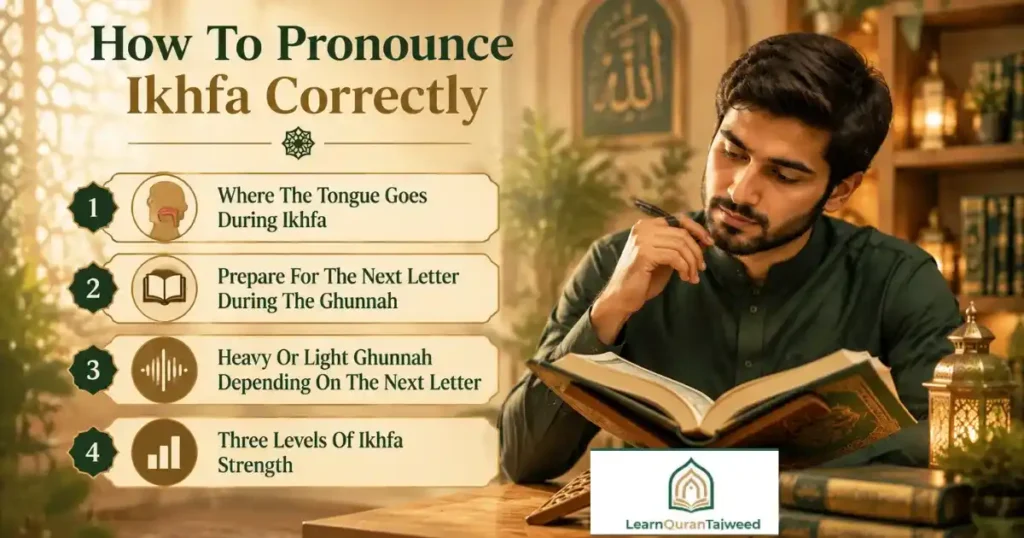
How To Pronounce Ikhfa Correctly
Knowing that a word contains ikhfa is only half the work. The other half is producing the right sound, which sits between clear pronunciation and full merging. The sound of noon sakinah or tanween should be concealed while maintaining a natural nasal sound (ghunnah) for approximately two counts.
To achieve this, the tongue should prepare for the following letter without fully pronouncing the noon sound or merging it completely into that letter.
Regular listening and practice with a qualified Quran teacher will help you master the correct pronunciation and apply ikhfa smoothly during recitation.
1. Position Your Tongue Correctly During Ikhfa
In ikhfa, the noon’s articulation point moves from the tip of the tongue on the upper gum toward the articulation point of the next letter. In practice, the tip of the tongue pulls slightly away from the gum instead of pressing firmly as it does in izhar.
The simple sequence is: noon saakinah or tanween → hidden ghunnah for two counts → the next letter. The noon is not fully pronounced, and it is not merged into the next letter either.
2. Prepare For The Next Letter During The Ghunnah
A detail many beginners miss is that your mouth should already be getting ready for the next letter while the ghunnah lasts. In مِن قَبْلُ, the back of the tongue moves toward the qaf position during the nasal sound. That preparation is what gives ikhfa its smooth, “hidden” quality.
3. Adjust The Ghunnah Between Heavy And Light Depending On The Next Letter
The ghunnah in ikhfa follows the heaviness of the letter after it. Before the five heavy (isti’la) letters among the ikhfa letters, ص ض ط ظ ق, the ghunnah is heavy (tafkheem), as in إِنَّهُ كَانَ مَنصُورًا (Al-Isra 33). Before the other ten letters, it is light (tarqeeq), as in إِنَّ لَدَيْنَا أَنكَالًا (Al-Muzzammil 12).
A quick check: if your ghunnah in مَنصُورًا sounds the same as in أَنكَالًا, one of them is wrong.
4. Three Levels Of Ikhfa Strength
Classical tajweed scholars describe ikhfa as having three levels, based on how close the next letter’s articulation point is to the noon:
- Strongest: before ت، د، ط, because they are closest to the noon.
- Weakest: before ق and ك, because they are furthest away.
- Middle: before the remaining ten letters.
This is why the noon in مُنتَهُونَ almost disappears, while in مِن قَبْلُ a trace of it is still felt.
Inside Learn Quran Tajweed Academy
Curious about how online learning works? Peek inside our actual Quran classes and hear the beautiful recitation of our students and teachers.
Perfect Your Quran Recitation Today
Join expert-led Tajweed classes, and recite the Quran with confidence and clarity.
Start Your Free TrialHow Ikhfa Is Marked In The Mushaf
The Mushaf shows ikhfa through specific diacritic marks, so you can spot it before you pronounce it. In most modern Mushafs, including the Madinah print, the marks are consistent:
- Noon saakinah: the noon has no sukoon sign on it (أَنتُمْ, not أَنْتُمْ). A visible sukoon usually means izhar.
- Tanween: the two vowel marks are written staggered (consecutive), one slightly after the other, as in جَنَّاتٍ تَجْرِي. In izhar, the two marks are stacked directly on top of each other.
Learning to read these marks lets you predict the rule in advance instead of stopping mid-verse to think.
Read also: Idgham Letters – The 6 Letters Of Idghaam, 2 Types, And Examples From The Quran
Common Ikhfa Mistakes And How To Fix Them
Most ikhfa errors come from pushing the sound too far toward one of the neighbouring rules, such as izhar or idgham, instead of maintaining the correct balance between them.
Some learners pronounce the noon sakinah too clearly, while others merge it too completely into the following letter or produce an incorrect ghunnah. These mistakes can affect the accuracy and smoothness of Quranic recitation, especially when ikhfa occurs between different letters.
Here are the most common mistakes that Tajweed teachers correct and how to avoid them through proper practice.
1. Turning The Ghunnah Into A Madd Letter
Students sometimes stretch the ghunnah into a vowel, so كُنتُمْ becomes “koontum” or مِن قَبْلُ becomes “meen qabl.” The ghunnah is a nasal sound from the nose, not a long vowel from the mouth. Fix it by keeping the vowel before the noon short and moving the sound into the nose.
2. Pronouncing The Noon Clearly (Izhar)
Pressing the tongue firmly on the gum produces a full “n,” which turns ikhfa into izhar. Fix it by letting the tongue hover near the gum without full contact.
Practice this movement slowly to maintain the concealed sound while keeping the ghunnah clear and natural.
3. Merging The Noon Completely (Idgham)
Some readers skip the noon and jump straight into the next letter with a shaddah-like sound. Ikhfa has no shaddah, so the ghunnah must be heard for two counts before the next letter.
Focus on maintaining the nasal sound without fully merging the noon into the following letter.
4. Cutting The Ghunnah Short Or Using One Heaviness For All Letters
A ghunnah shorter than two counts loses the rule, and a ghunnah that is always light or always heavy ignores the next letter. These are hard to self-diagnose, which is why reciting to a qualified teacher who can hear and correct you makes such a difference.
At Learn Quran Tajweed, students recite live and get corrected on exactly these points.

A Three-Step Practice Method For Ikhfa
Reading examples of ikhfa helps, but steady practice is what makes the rule natural. A simple routine you can use with any page of the Quran will help you recognize ikhfa letters and apply the correct pronunciation consistently.
Start by reading slowly and identifying every noon sakinah or tanween followed by an ikhfa letter before attempting the full verse. Repeat each example several times, paying attention to the ghunnah, tongue position, and smooth transition into the next letter.
- Spot: before reciting, scan the page for noon without sukoon and staggered tanween, and underline each case.
- Shape: for each case, name the next letter and decide whether the ghunnah is heavy or light.
- Sustain: recite the word, hold the ghunnah for two counts, and keep the tongue moving toward the next letter.

Start Your Tajweed Journey With A Qualified Teacher Today
You can memorise every ikhfa example in this article and still pronounce them incorrectly. Ghunnah length, tongue position, and heavy or light nasalisation are learned by listening, imitating, and being corrected, not from text alone.
With Learn Quran Tajweed, you study one-to-one online with teachers who listen to your recitation and correct each rule as you read. Learn from home, at a time that fits your schedule, and build recitation you can be confident in.
Book your tajweed class now and recite every ikhfa correctly.
- Tajweed Course for Kids
- Tajweed Course for Adults
- Tajweed Course for Ladies
- Tajweed ul Quran Course
- Quran Recitation with Tajweed Course
- Quran Tarteel Course
- Tajweed Ijazah Program
Take the first step today, enroll now and experience the difference that proper Tajweed makes.
Perfect Your Quran Recitation Today
Join expert-led Tajweed classes, and recite the Quran with confidence and clarity.
Start Your Free TrialConclusion
Ikhfa is the rule of hiding a noon saakinah or tanween before one of 15 letters, with a two-count ghunnah and no shaddah. The ikhfa examples in the Quran covered here show the rule inside one word, across two words, and with tanween for every letter, from مَنصُورًا to ظِلًّا ظَلِيلًا.
These examples make it easier to understand how the rule changes slightly depending on the following letter while maintaining the same basic principle. Practicing different examples will also help you recognize ikhfa more quickly during everyday recitation.
To recite it well, move the tongue toward the next letter, keep the ghunnah heavy before ص ض ط ظ ق and light before the rest, and avoid turning it into a vowel.
Regular revision and careful listening to skilled Quran reciters will strengthen your pronunciation and help you avoid common mistakes.
Frequently Asked Questions
How Many Ikhfa Letters Are There?
There are 15 ikhfa letters: ص، ذ، ث، ك، ج، ش، ق، س، د، ط، ز، ف، ت، ض، ظ. They are collected in the first letters of each word in al-Jamzuri’s line “صِفْ ذَا ثَنَا كَمْ جَادَ شَخْصٌ قَدْ سَمَا…”.
What Is An Example Of Ikhfa In The Quran?
A clear example of ikhfa in the Quran is مِن قَبْلُ, where a noon saakinah comes before ق. Others include جَنَّاتٍ تَجْرِي (tanween before ت) and يَنطِقُونَ (Al-Mursalat 35), where the noon and ط are in one word.
Can Ikhfa Tanween Happen Inside One Word?
No, ikhfa with tanween always happens across two words. Tanween only appears at the end of a word, so the ikhfa letter must be at the start of the next word, as in كِتَابٌ كَرِيمٌ.
How Long Is The Ghunnah In Ikhfa?
The ghunnah in ikhfa lasts two counts (two harakat). It is held through the nose and should never be stretched into a vowel or cut shorter.
What Is The Difference Between Ikhfa Haqiqi And Ikhfa Shafawi?
Ikhfa haqiqi applies to noon saakinah and tanween before 15 letters, while ikhfa shafawi applies only to meem saakinah before ب. An example of ikhfa shafawi is تَرْمِيهِم بِحِجَارَةٍ (Al-Fil 4).
How Do I Recognise Ikhfa In The Mushaf?
You recognise ikhfa in the Mushaf when the noon has no sukoon sign, and the next letter is an ikhfa letter. For tanween, ikhfa is shown by two vowel marks written staggered rather than stacked directly on top of each other.
Related Articles
Tajweed Rules