 Tajweed Rules

The levels of ghunnah in Tajweed explain why the nasal sound in إِنَّ lasts noticeably longer than the one in أَنْعَمْتَ. That difference is not random. It follows a fixed system, and applying it correctly is one of the clearest signs of whether a reciter has truly mastered tajweed.
The levels of ghunnah (also called the ranks of ghunnah) arrange the nasal sound of noon and meem from strongest to weakest. Each level depends on the state of the letter: whether it carries a shaddah, is merged, is hidden, is pronounced clearly, or carries a vowel.
This guide walks you through all five levels, shows you exactly where each one appears in the Quran, explains how long to hold each one, and clears up why some teachers count five levels while others count four.

What Ghunnah Is And Where It Comes From
Ghunnah is a pleasant nasal sound that comes from the nose with no involvement of the tongue. In tajweed terminology, it is a permanent quality built into the body of the noon (including tanween) and the meem.
This means ghunnah never disappears from these two letters. It is present whether the noon or meem is voweled or silent, shown clearly, merged, or hidden. What changes is only its strength and length, and that change is exactly what the levels of ghunnah measure. The noon also carries a stronger ghunnah than the meem.
Ghunnah comes from the khayshoom, the nasal cavity at the back of the nose where it opens toward the mouth.
You can test this yourself. Pinch your nose closed and try to say أَنْ or ثُمَّ. The sound cuts off completely, even in the weakest levels where the noon or meem is voweled. That simple test, mentioned by classical tajweed scholars, proves the ghunnah exists in every state of these letters.
The 5 Ranks Of Ghunnah From Strongest To Weakest
The levels of ghunnah are the ranks that describe how strong and how long the nasal sound of noon (ن), tanween, and meem (م) should be, depending on the letter’s state. Before learning the ranks themselves, you need a clear picture of the sound being ranked.
Understanding these differences helps learners recognize when ghunnah requires a full two-count duration and when it is pronounced more briefly.
The majority of tajweed scholars, as recorded by Sheikh Abdul Fattah al-Marsafi in Hidayat al-Qari, divide ghunnah into five ranks. The first three are held for two full counts; the last two carry only the basic ghunnah with no extra length. Each rank has a specific application, and learning them in order makes it easier to maintain consistent nasalization throughout Quran recitation.
Level 1 – The Doubled Letter (Al-Mushaddad)
The strongest ghunnah occurs in a noon or meem carrying a shaddah. A doubled letter is really two letters: a silent one followed by a voweled one, which is why the ghunnah is at its fullest here.
It appears within one word, as in إِنَّ (inna), ثُمَّ (thumma), and يَمُنُّونَ (yamunnoona). It also appears across two words in four cases of complete merging:
- Noon sakinah or tanween merged into noon or meem: إِن نَّشَأْ, مِّن مَّالِ ٱللَّهِ
- Meem sakinah merged into meem: كَم مِّن فِئَةٍ
- Baa merged into meem in ٱرْكَب مَّعَنَا, in Hafs via ash-Shatibiyyah
- Lam shamsiyyah merged into noon: إِلَى ٱلنُّورِ
Level 2 – The Incompletely Merged Letter (Al-Mudgham)
The second level is incomplete merging with ghunnah (idgham naqis). It happens when noon sakinah or tanween meets و or ي, as in مَن يَعْمَلْ (man ya’mal), مِن وَالٍ (min waal), وُجُوهٌ يَوْمَئِذٍ (wujoohun yawma’idhin), and مِن وَلِيٍّ (min waliyy).
Here, the noon as a letter disappears, but its nasal quality stays and blends into the و or ي. That remaining ghunnah is held for two counts. The merging is called “incomplete” because the noon’s quality survives, not because the ghunnah is shorter.
This rule only applies across two words. When noon sakinah meets و or ي inside one word, as in دُنْيَا, بُنْيَانٌ, صِنْوَانٌ, and قِنْوَانٌ, the noon is pronounced clearly to keep the word’s meaning intact. In Hafs, يسٓ وَٱلْقُرْءَانِ and نٓ وَٱلْقَلَمِ are also read with the noon shown clearly.
Level 3 – The Hidden Letter (Al-Mukhfa)
The third level covers every case where noon or meem is hidden rather than pronounced clearly or merged. The letter sits halfway between the two: the tongue or lips do not fully form it, but its two-count ghunnah remains. It includes three rules:
- Ikhfa haqiqi: noon sakinah or tanween before one of the 15 ikhfa letters (ص ذ ث ك ج ش ق س د ط ز ف ت ض ظ), as in مِن صَلْصَالٍ, أَنتُمْ, مَن ذَا, and عَنكُمْ
- Iqlab: noon sakinah or tanween turned into a hidden meem before baa, as in يُنۢبِتُ and عَلِيمٌۢ بِذَاتِ
- Ikhfa shafawi: meem sakinah before baa, as in فَٱحْكُم بَيْنَهُم and تَرْمِيهِم بِحِجَارَةٍ
In ikhfa haqiqi, the tongue does not press on the noon’s point of articulation; instead, the mouth prepares for the next letter while the ghunnah flows through the nose.
Level 4 – The Silent, Clearly Pronounced Letter (As-Sakin Al-Muzhar)
The fourth level is a silent noon or meem pronounced clearly. This includes noon sakinah or tanween before a throat letter (ء هـ ع ح غ خ), as in مَنْ آمَنَ, مِنْ خَيْرٍ, and عَذَابٌ أَلِيمٌ, and meem sakinah before any letter except baa and meem, as in أَنْعَمْتَ and عَلَيْهِمْ.
The ghunnah here is the basic built-in sound only. It is not stretched, and the reciter moves directly to the next letter without a pause or a nasal tail.
Teachers pay extra attention to meem sakinah before ف and و, as in هُمْ فِيهَا and عَلَيْهِمْ وَلَا. Because these letters share or neighbor the lips, students often hide the meem by mistake. The meem must be closed and released clearly, with no added ghunnah.
Level 5 – The Voweled Letter (Al-Mutaharrik Al-Mukhaffaf)
The weakest level is a noon or meem without shaddah that carries a fathah, dammah, or kasrah, as in نَعْبُدُ (na’budu), مَالِكِ (maaliki), نَسْتَعِينُ (nasta’eenu), and ٱلْمُسْتَقِيمَ (al-mustaqeema).
The ghunnah still exists, as the nose test proves, but it is the shortest and lightest of all the ranks. The vowel carries the letter forward immediately, so any holding of the nasal sound before it is an error that makes the recitation sound heavy.
One practical detail: the level can change when you stop. When you pause on نَسْتَعِينُ or ٱلْعَٰلَمِينَ, the voweled noon becomes silent and clearly pronounced, so it moves to level 4 and keeps only its basic ghunnah, without being stretched.

Quick Reference – The Levels Of Ghunnah At A Glance
The table below brings all five levels of ghunnah together in one place, so you can review them quickly before reciting or revising. Read it from top to bottom to see how the nasal sound weakens as the noon or meem moves from doubled, to merged, to hidden, to clearly pronounced, and finally to voweled.
Notice the clear dividing line between the first three levels, which share the same two-count length, and the last two, which carry only the basic built-in ghunnah.
| Level | Arabic name | Where it occurs | Length |
| 1 | Al-Mushaddad | Noon/meem with shaddah; complete merging | 2 counts |
| 2 | Al-Mudgham | Incomplete merging into و / ي | 2 counts |
| 3 | Al-Mukhfa | Ikhfa haqiqi, iqlab, ikhfa shafawi | 2 counts |
| 4 | As-Sakin Al-Muzhar | Clearly pronounced silent noon/meem | Basic ghunnah only |
| 5 | Al-Mutaharrik | Voweled noon/meem without shaddah | Basic ghunnah only |
Reading a table is one thing; hearing the difference between two counts and a basic ghunnah in your own voice is another. This is where a one-on-one session with a Learn Quran Tajweed teacher helps, because a teacher can catch a level 3 ghunnah that you are cutting short before it becomes a habit.
See Our Classrooms in Action
Watch these short clips from our live, interactive Quran courses to see how our students learn and interact with our expert tutors.
Perfect Your Quran Recitation Today
Join expert-led Tajweed classes, and recite the Quran with confidence and clarity.
Start Your Free TrialHow Long Is Each Level Of Ghunnah?
The first three levels of ghunnah are held for two counts (harakatain), the same length as a natural madd. The last two levels are not held beyond the basic sound. Two practical points make this easier to apply. First, focus on maintaining an even nasal sound without stretching it longer than required.
Second, practice each level within complete Quranic verses to recognize how its duration changes according to the letter’s state. Listening to a skilled reciter can also help you distinguish the different levels and develop better control over the timing of ghunnah.
1. How Do You Measure Two Counts?
One count is roughly the time it takes to fold or open a finger at a steady pace. Two counts of ghunnah means holding the nasal sound for two of those beats.
Teachers often use the natural madd as a reference point: if your ghunnah in ثُمَّ matches the length of the “aa” in قَالَ, you are close to the right length. Using your own madd as the measuring stick keeps your ghunnah and your madd in balance across the whole recitation.
A simple drill helps lock this in. Recite إِنَّ, مِن صَلْصَالٍ, and مَن يَعْمَلْ one after another while folding two fingers for each ghunnah. All three should come out equal in length, because levels 1, 2, and 3 share the same two counts.
2. Does Recitation Speed Change Ghunnah Length?
Yes. The length of ghunnah stays proportional to your reciting pace. In slow recitation (tahqeeq), the two counts take more time; in medium pace (tadweer) and fast pace (hadr), they take less.
What must stay constant is the ratio between levels. If you recite quickly, level 1 still needs to sound clearly longer than level 4; otherwise, the ranks collapse into one. This is one of the most common weaknesses in fast recitation, where every noon and meem starts to sound the same.
Consistency matters just as much as the ratio. Once you choose a pace, keep your two counts the same length throughout that recitation, rather than holding ghunnah longer in one verse and shorter in the next. Ghunnah length also stays the same whether you are continuing (wasl) or stopping (waqf), so a pause does not license extra stretching.
Read also: Ikhfa Letters – The 15 Letters Of Ikhfa, How To Pronounce Them And Examples From The Quran
Five Levels Or Four? Why The Types Of Ghunnah Differ Between Teachers
If you have searched for this topic, you have probably seen lists of four levels as well as five. Both are taught by respected scholars, and the difference is mostly in how the categories are grouped, not in how you actually recite.
The four-level classification, taught by Dr. Ayman Suwaid among others, uses descriptive names:
- Most complete (akmal ma takun): doubled and merged letters
- Complete (kamilah): hidden letters (ikhfa and iqlab)
- Incomplete (naqisah): silent, clearly pronounced letters
- Most incomplete (anqas ma takun): voweled letters
The key difference is where idgham naqis (merging into و and ي) is placed. The five-level view gives it its own rank. The four-level view groups it with the merged letters at the top.
Read also: How To Recite Surah Al-Mulk With Tajweed?
The 3-Question Ghunnah Check For Reciting
Students often know the five ranks on paper but freeze when they meet a noon or meem mid-verse. Recitation moves continuously, so there is no time to recall Arabic level names or scan a table before deciding how long to hold a sound.
This simple three-question check, built on the classification above, turns the theory into a quick decision while reciting. Instead of asking “which of the five levels is this?”, it asks only what you need to know in the moment: is there a ghunnah, and should it be held or released?
Each question relies on what you can see on the page, such as a shaddah, a sukoon, or the letter that comes next, so the check works even before the levels feel natural to you. With practice, the three questions shrink into a single glance.
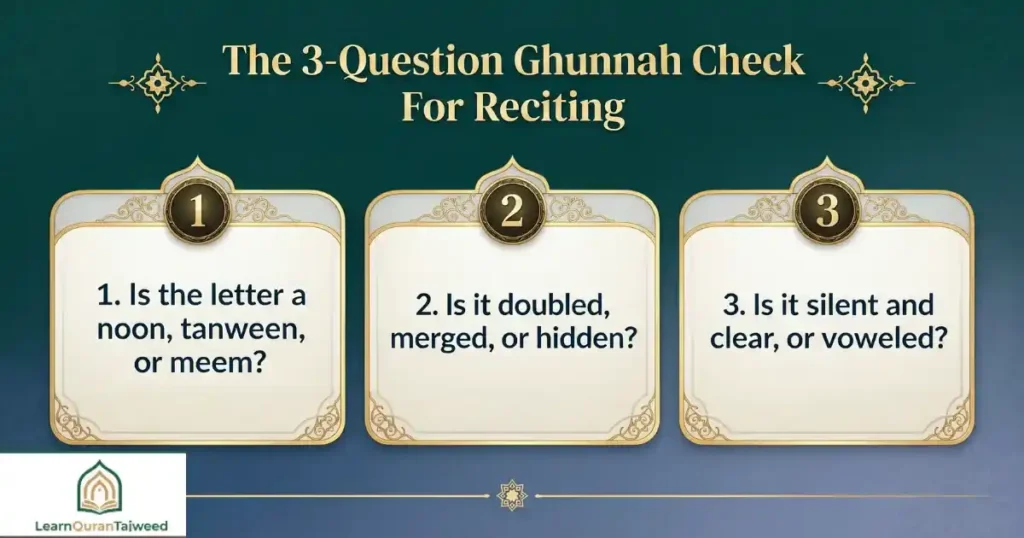
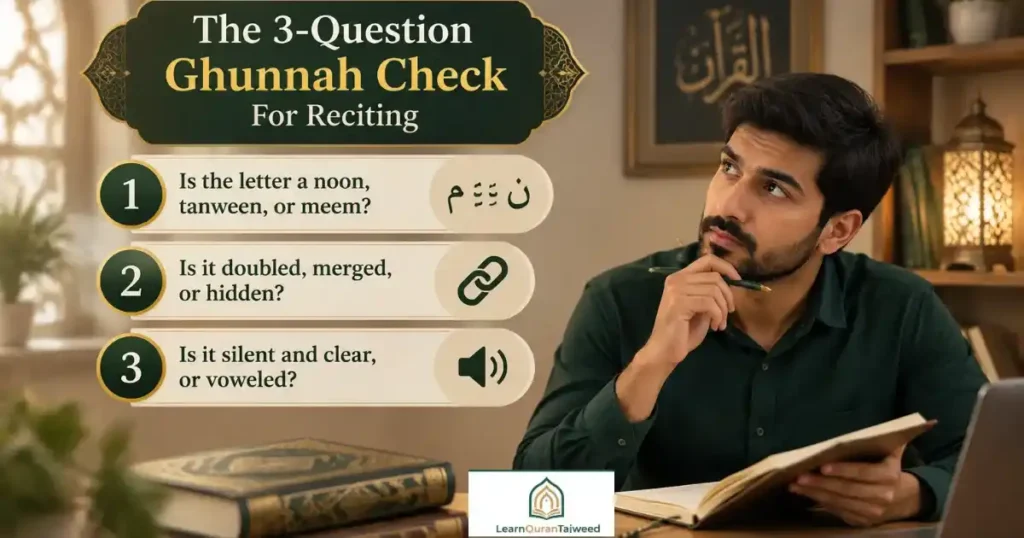
1. Is the letter a noon, tanween, or meem? If not, there is no ghunnah to rank. Remember that tanween counts even though no ن is written; it is a noon sound at the end of the word.
2. Is it doubled, merged, or hidden? If yes, it belongs to levels 1 to 3. Hold the ghunnah for two counts. A quick visual clue: a shaddah on the noon or meem itself, or on the letter right after a silent noon or meem, usually signals merging.
3. Is it silent and clear, or voweled? If yes, it belongs to levels 4 or 5. Give only the basic ghunnah and move on without lingering.
Here is the check applied to Surah An-Nas (verses 4–6):
- مِن شَرِّ: silent noon before ش, which is hidden. Level 3, two counts.
- ٱلْخَنَّاسِ and ٱلنَّاسِ: noon with shaddah. Level 1, two counts.
- مِنَ ٱلْجِنَّةِ: the noon in مِنَ is voweled (level 5, basic ghunnah), while the noon in ٱلْجِنَّةِ is doubled (level 1, two counts).
Read also: Idgham Letters – The 6 Letters Of Idghaam, 2 Types, And Examples From The Quran
Common Mistakes When Applying The Levels Of Ghunnah
Knowing the ranks of ghunnah is only half the work. Applying them correctly during Quran recitation requires consistent practice, careful listening, and an understanding of how each rank changes according to the letter’s characteristics. These are the errors teachers correct most often, and each one breaks a specific rule from the system above.
Recognizing these mistakes early helps learners avoid developing incorrect pronunciation habits and makes it easier to improve their recitation with guidance from a qualified Tajweed teacher.
1. Stretching Ghunnah Into A Madd
In words like إِنَّآ أَعْطَيْنَٰكَ (Al-Kawthar, 1) and فَإِمَّا تَثْقَفَنَّهُمْ (Al-Anfal, 57), students often lengthen the short vowel before the doubled letter, saying “iinnaa” instead of “innaa” or “fa-iimmaa” instead of “fa-immaa.” The two counts belong to the nasal sound in noon or meem, not to any surrounding vowel.
The cause is usually trying to “feel” the two counts before reaching the letter. The fix is to keep the vowel before the shaddah short, arrive at the letter quickly, and hold the ghunnah there.
A physical check helps: during a doubled noon, the tip of the tongue rests on the gum ridge; during a doubled meem, the lips are closed. If your mouth is open while you are holding the sound, you are stretching a vowel, not a ghunnah.
2. Over-Nasalizing (Tamteet And Tanteen)
Exaggerating ghunnah, either by stretching it past two counts or by adding a buzzing, whining tone, is a recognized error. A correct ghunnah is smooth and controlled, not forced through the nose.
Over-nasalizing usually comes from pushing too much air or raising the pitch during the ghunnah. It also shows up as nasal sound leaking into the neighboring vowels, so the “aa” in ٱلنَّاسِ comes out through the nose instead of the mouth.
You can test this with the nose pinch. Pinching your nose should cut off the ghunnah itself, but the vowel after it should sound the same whether your nose is open or closed. If the vowel changes, the ghunnah has spread beyond its letter.
3. Holding Levels 4 And 5
A common beginner habit is adding length to أَنْعَمْتَ or نَعْبُدُ because “noon always has ghunnah.” That is true, but in these levels the ghunnah is only the built-in sound. Holding it makes the recitation sound heavy and slows the flow.
This mistake does more than add time. Holding a silent noon before a throat letter, as in مِنْ خَيْرٍ, tends to blur the noon so that it starts to sound hidden. The recitation then shifts from izhar toward ikhfa, a change of rule, not just length.
The fix is to articulate the noon or meem fully and release it straight onto the next letter. In level 5, let the vowel move you forward at once, especially before a madd letter, as in نُوحِيهَا, where the madd is lengthened but the noon before it is not.
4. Ignoring Heavy And Light Ghunnah
Ghunnah follows the letter after it in heaviness (tafkheem) and lightness (tarqeeq). In مِن صَلْصَالٍ the hidden noon is heavy because saad is heavy; in مِن تَحْتِهَا it is light because taa is light. Getting the length right but the tone wrong is still a mistake.
Most of these errors are invisible to the person making them, because we rarely hear our own recitation objectively. Learn Quran Tajweed’s live online classes are built around exactly this kind of correction: you recite, a qualified teacher listens, and you fix each ghunnah level in real time from home.

Inside Learn Quran Tajweed Academy
Curious about how online learning works? Peek inside our actual Quran classes and hear the beautiful recitation of our students and teachers.
Perfect Your Quran Recitation Today
Join expert-led Tajweed classes, and recite the Quran with confidence and clarity.
Start Your Free TrialStart Mastering Ghunnah With A Qualified Tajweed Teacher Today
You now understand the five levels of ghunnah. The next step is making them automatic in your recitation, so that every إِنَّ gets its full two counts and every أَنْعَمْتَ stays light, without you having to stop and think.
With Learn Quran Tajweed, you study one-on-one with qualified teachers who listen to your recitation, point out exactly which ghunnah level needs work, and give you focused drills on it. Classes are online and scheduled around your time, so you can practice consistently without traveling anywhere.
Book your first lesson now and hear the difference in your recitation.
Courses we offer:
- Tajweed Course for Kids
- Tajweed Course for Adults
- Tajweed Course for Ladies
- Tajweed ul Quran Course
- Quran Recitation with Tajweed Course
- Quran Tarteel Course
- Tajweed Ijazah Program
Perfect Your Quran Recitation Today
Join expert-led Tajweed classes, and recite the Quran with confidence and clarity.
Start Your Free TrialConclusion
The levels of ghunnah rank the nasal sound of noon, tanween, and meem from strongest to weakest: the doubled letter, the incompletely merged letter, the hidden letter, the silent clearly pronounced letter, and the voweled letter. The first three take two full counts; the last two carry only the basic ghunnah.
Whether your teacher calls them five levels or four, the recitation rule is the same. Check whether the letter is doubled, merged, or hidden, and give it two counts; otherwise, keep the ghunnah light. Avoid stretching the vowel after a doubled letter, over-nasalizing, and ignoring heavy and light tones.
Mastering the ranks of ghunnah takes listening and correction more than memorization, and that is where steady practice with a teacher makes the biggest difference.
Frequently Asked Questions
How Many Levels Of Ghunnah Are There?
There are five levels of ghunnah according to the majority of tajweed scholars: the doubled, the merged, the hidden, the silent clearly pronounced, and the voweled letter. Some teachers, such as Dr. Ayman Suwaid, group them into four levels instead.
Which Level Of Ghunnah Is The Strongest?
The strongest level of ghunnah is the doubled noon or meem (al-mushaddad), as in إِنَّ and ثُمَّ. It also includes complete merging into noon or meem, such as مِن مَّاءٍ.
How Many Counts Is Ghunnah Held For?
Ghunnah is held for two counts in the first three levels: doubled, merged, and hidden letters. In the last two levels, silent, clearly pronounced, and voweled letters, only the basic ghunnah is pronounced with no extra length.
Does A Voweled Noon Or Meem Have Ghunnah?
Yes, a voweled noon or meem still has ghunnah, but it is the weakest level. You can confirm it by pinching your nose while saying نَعْبُدُ: the sound is blocked, proving the ghunnah is present.
Is Ghunnah Heavy Or Light?
Ghunnah is heavy or light depending on the letter after it. Before a heavy letter, as in مِن صَلْصَالٍ, the ghunnah is heavy; before a light letter, as in مِن تَحْتِهَا, it is light.