 Tajweed Rules

These qalqalah examples start with a sound you’ve probably heard already: the slight echo after the dāl when a reciter stops on أَحَدْ. That echo is qalqalah, and the fastest way to master it is to study real words from the Quran, one letter and one level at a time.
This guide gives you clear qalqalah examples for each of the five letters. It also covers the three strength levels, the cases where qalqalah does not apply, and the mistakes that make recitation sound wrong.
Each example includes the Arabic word, its transliteration, and its surah and verse, so you can open your mushaf and practice right away.
Qalqalah Examples Begin With The Five Letters – قُطْبُ جَدٍّ
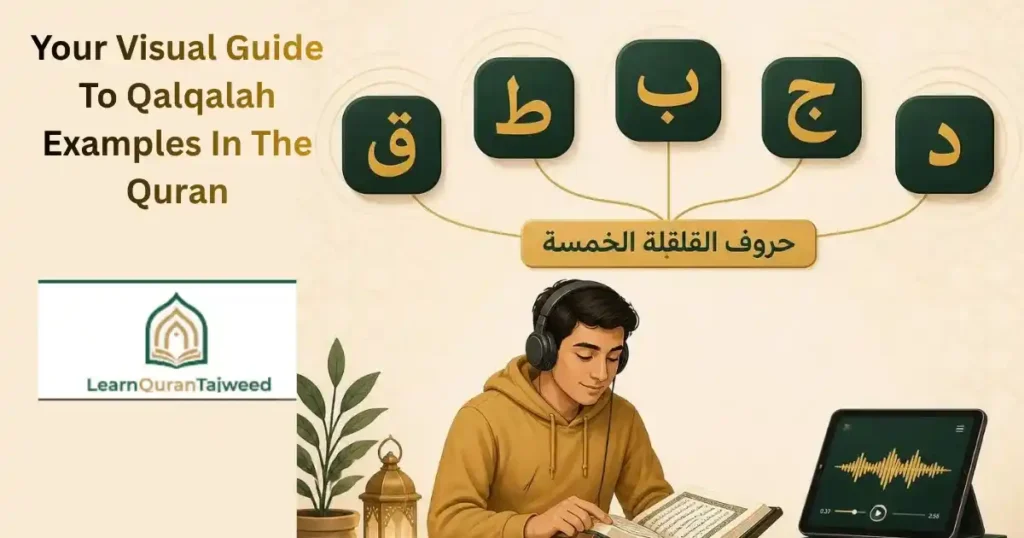
Before exploring different Qalqalah examples in the Quran, it is important to understand which letters carry this rule, where each letter is pronounced, and why they require a slight bouncing sound when they have a sukoon. Qalqalah applies to five specific letters, known as Qutb Jad (قُطْبُ جَدٍّ): ق، ط، ب، ج، د.
Each letter has a distinct articulation point, and producing the correct echo depends on releasing the sound clearly without adding a vowel.
Once you understand these basic mechanics, you will find it much easier to recognize Qalqalah in Quranic verses, distinguish its levels, and pronounce every example accurately during recitation.
What Is Qalqalah In Tajweed?
Qalqalah is a slight bounce or echo produced when one of five letters (ق ط ب ج د) carries a sukoon. It makes a letter that would otherwise be trapped and unclear fully audible.
This sound is created by briefly releasing the articulation point without adding an extra vowel or changing the original letter. Learning to control this bounce helps you recite Quranic words more clearly and maintain the correct pronunciation of each letter.
- Linguistically, qalqalah means shaking, stirring, or disturbance. Arabs say taqalqala ash-shay’ when something moves and wobbles in place, which describes the small movement at the letter’s articulation point.
- Technically, tajweed scholars define it as pronouncing a sākin qalqalah letter by separating the two parts of its articulation point, without the sound taking on any trace of a fatḥah, ḍammah, or kasrah.
Which Letters Are The Qalqalah Letters?
There are five qalqalah letters: qāf (ق), ṭā’ (ط), bā’ (ب), jīm (ج), and dāl (د). Scholars gathered them in the mnemonic phrase قُطْبُ جَدٍّ (quṭbu jadd), which roughly means “the axis of greatness.”
The phrase is only a memory aid, but it is worth memorizing exactly. Most students who forget a qalqalah letter forget the bā’ or the dāl, and reciting the phrase once brings all five back.
Where Is Each Qalqalah Letter Pronounced?
Each qalqalah letter has its own articulation point (makhraj), so the bounce happens in a different part of the mouth for each one. Knowing the location helps you feel where the release should happen.
- ق (qāf): the back of the tongue against the soft palate, the deepest of the five.
- ج (jīm): the middle of the tongue against the hard palate.
- ط (ṭā’): the tip of the tongue against the roots of the upper front teeth, with the back of the tongue raised.
- د (dāl): the tip of the tongue against the roots of the upper front teeth, without raising the back of the tongue.
- ب (bā’): the two lips pressed together.
Notice that ط and د share the same articulation point. The difference is that ط is heavy, with the tongue raised toward the palate, while د is light. Their qalqalah should sound different for that reason.
Why Do Only These Five Letters Bounce?
These five letters share two qualities: jahr (voicing, where breath is held back) and shiddah (strength, where the sound is fully blocked). A sākin letter with both qualities traps both breath and sound completely.
Without the small release that qalqalah provides, the letter would be nearly inaudible. A sākin ب in أَبْصَارِهِمْ, for example, would simply disappear between the alif and the ṣād.
Think of it like a sealed balloon. Shiddah closes the opening, and jahr stops air from leaking out. The only way to make a sound is a quick, controlled release, and that release is the qalqalah.
See Our Classrooms in Action
Watch these short clips from our live, interactive Quran courses to see how our students learn and interact with our expert tutors.
Perfect Your Quran Recitation Today
Join expert-led Tajweed classes, and recite the Quran with confidence and clarity.
Start Your Free TrialQalqalah Letters Examples In The Quran, One Letter At A Time
Each qalqalah letter sounds different because it is released from a different point in the mouth, so the best way to train your ear is to practice one letter at a time. The table below gives two qalqalah words in the Quran for each of the five letters, all taken from well-known surahs you can find quickly in your mushaf.
For most letters, one example has the sākin letter in the middle of a word and the other has it at the end of a word, either connected to the next word or stopped on. Read each pair aloud and compare: the middle-of-word bounce should feel light and quick, while stopping on the final letter produces a clearer, fuller echo.
Before you read the examples, keep one rule in mind: a qalqalah letter bounces only when it carries a sukoon. If the same letter appears with a vowel in the same word, that letter is read normally.
| Letter | Qalqalah word | Transliteration | Reference |
| ق (qāf) | اقْرَأْ | iqra’ | Al-‘Alaq, 1 |
| ق (qāf) | الْفَلَقْ (on stopping) | al-falaq | Al-Falaq, 1 |
| ط (ṭā’) | أَطْعَمَهُم | aṭ’amahum | Quraysh, 4 |
| ط (ṭā’) | مَطْلَعِ | maṭla’i | Al-Qadr, 5 |
| ب (bā’) | الْأَبْتَرُ | al-abtar | Al-Kawthar, 3 |
| ب (bā’) | أَبْصَارِهِمْ | abṣārihim | Al-Baqarah, 7 |
| ج (jīm) | يَجْعَلُونَ | yaj’alūn | Al-Baqarah, 19 |
| ج (jīm) | وَالْفَجْرِ | wal-fajr | Al-Fajr, 1 |
| د (dāl) | قَدْ أَفْلَحَ | qad aflaḥa | Al-Mu’minūn, 1 |
| د (dāl) | لَمْ يَلِدْ وَلَمْ يُولَدْ | lam yalid wa lam yūlad | Al-Ikhlāṣ, 3 |
Which Qalqalah Letter Is The Strongest?
The ṭā’ (ط) carries the strongest qalqalah, the jīm (ج) is in the middle, and the dāl, bā’, and qāf carry the lightest. The ṭā’ is strongest because it also has itbāq (the tongue rising to the palate), which adds weight to its release.
If you are learning these sounds on your own, it is hard to tell whether your bounce is too heavy or too faint. A short session where a Learn Quran Tajweed tutor listens to you read the table above can settle that in minutes.
Read also: Ikhfa Letters – The 15 Letters Of Ikhfa, How To Pronounce Them And Examples From The Quran
The Three Levels Of Qalqalah With Examples Of Qalqalah From The Quran
Qalqalah does not always sound the same. Its strength depends on two factors: where the qalqalah letter falls in the word, and whether you continue reading or stop on it.
These two factors create three levels, from a light tap in the middle of a word to a full, clear echo at the end of a verse. A skilled reciter moves between these levels naturally, and a trained listener can hear the difference immediately.
Learning the levels also prevents the most common qalqalah error: giving every bounce the same weight. Once you know which level applies, you know how much force each word needs.
1. The Minor Qalqalah (Qalqalah Ṣughrā)
Minor qalqalah happens when a qalqalah letter carries an original sukoon, one written in the mushaf, and you keep reading past it. The letter can sit in the middle of a word or at the end of a word that connects to the next one. It is the lightest level of qalqalah.
It sounds like a quick, crisp tap: the articulation point closes fully, then releases just enough to make the letter audible. You don’t pause on the letter. Your voice moves straight into the next sound.
- Examples in the middle of a word: the qāf in يَقْطَعُونَ (Al-Baqarah, 27), the ṭā’ in مَطْلَعِ (Al-Qadr, 5), the bā’ in أَبْصَارِهِمْ (Al-Baqarah, 7), the jīm in يَجْعَلُونَ (Al-Baqarah, 19), and the dāl in يَدْعُونَ (Yūnus, 66).
- Examples at the end of a connected word: in قَدْ أَفْلَحَ (Al-Mu’minūn, 1), the dāl of قَدْ is minor because you move straight into أَفْلَحَ. In لَمْ يَلِدْ وَلَمْ يُولَدْ (Al-Ikhlāṣ, 3), the dāl of يَلِدْ is minor for the same reason.
2. The Major Qalqalah (Qalqalah Kubrā)
Major qalqalah happens when you stop on a word that ends in a qalqalah letter. The sukoon is not written in the mushaf. It is created by the stop itself, which is why scholars call it an incidental sukoon.
It is stronger and clearer than minor qalqalah because two causes combine: the letter’s qalqalah quality and the pause. With no following word to absorb the sound, the echo is fully exposed, so it must be clean, firm, and audible.
Examples on stopping: the qāf in الْفَلَقْ (Al-Falaq, 1) and الطَّارِقْ (Aṭ-Ṭāriq, 1), the ṭā’ in مُّحِيطْ (Al-Burūj, 20), the bā’ in لَهَبْ (Al-Masad, 3), the jīm in الْبُرُوجْ (Al-Burūj, 1), and the dāl in أَحَدْ (Al-Ikhlāṣ, 1 and 4) and الصَّمَدْ (Al-Ikhlāṣ, 2).
The same word can change level depending on how you read. يُولَدْ at the end of Al-Ikhlāṣ (3) carries minor qalqalah if you connect it to verse 4, and major qalqalah if you stop at the verse end, which is the usual practice.
3. The Strongest Qalqalah (Qalqalah Akbar)
The strongest qalqalah happens when you stop on a word whose final qalqalah letter carries a shaddah. The shaddah means the letter is doubled: the first half is sākin and the second carries a vowel, which becomes a sukoon when you stop.
It is the fullest qalqalah in recitation because three factors combine at once: the doubled letter, the qalqalah quality, and the pause. The extra pressure from the shaddah makes the release noticeably heavier than major qalqalah.
Examples of stopping: the clearest example is the bā’ in وَتَبّْ at the end of Al-Masad (1). The same level applies when you stop on words such as الْحَقّْ or الْحَجّْ at a pause sign, or when you run out of breath and must stop on them mid-verse.

Why Do Some Books List Only Two Levels?
Some tajweed books list only minor and major qalqalah, and treat the shaddah case as the top of the major level. Others name three levels, as above. The sound you produce is the same either way. Only the labels differ, so follow the system your teacher uses.
Read also: Huroof Saktah In Quran – Meaning, The 4 Places And How To Recite Them Correctly
The Letter–Sukoon–Stop Check – A 3-Step Method To Spot Qalqalah Words
Most learners memorize the five Qalqalah letters but still miss the rule while reading the Quran, or apply the bouncing sound where it does not belong. This often happens because recognizing the letters alone is not enough; you must also check their vowel status and position in the word.
The Letter–Sukoon–Stop check turns the rule into three quick questions you can ask about any word, in order. This simple method helps you identify when Qalqalah is required and avoid unnecessary bouncing during recitation. With regular practice, you will become more confident in applying the rule correctly in different Quranic examples.
- Letter: Is the letter one of ق ط ب ج د? If not, there is no qalqalah.
- Sukoon: Does it carry a sukoon, either written or caused by stopping? If it has a fatḥah, ḍammah, or kasrah, there is no qalqalah.
- Stop: Are you stopping on it? If no, apply minor qalqalah. If yes, apply major qalqalah, or the strongest qalqalah if the letter has a shaddah.

How The Check Works On A Real Verse
Take قُلْ أَعُوذُ بِرَبِّ الْفَلَقِ (Al-Falaq, 1). The qāf in قُلْ passes step 1 but fails step 2, because it carries a ḍammah. The bā’ in بِرَبِّ has a shaddah, but you continue reading past it, so there is no qalqalah.
The qāf in الْفَلَقِ passes all three steps once you stop at the verse end: it is a qalqalah letter, the stop gives it a sukoon, and you are pausing on it. The result is major qalqalah.
Run this check on one short surah a day, such as Al-Ikhlāṣ or Al-Falaq, marking each qalqalah word in pencil before you recite. With regular practice, you will start hearing qalqalah before you consciously look for it.
Inside Learn Quran Tajweed Academy
Curious about how online learning works? Peek inside our actual Quran classes and hear the beautiful recitation of our students and teachers.
Perfect Your Quran Recitation Today
Join expert-led Tajweed classes, and recite the Quran with confidence and clarity.
Start Your Free TrialWhen Qalqalah Letters Do Not Bounce – Edge Cases Most Guides Skip
Applying qalqalah everywhere a sākin ق ط ب ج د appears is a common overcorrection. In a few situations, other Tajweed rules take priority, and the bounce disappears. Recognizing these exceptions helps you avoid adding an unnecessary echo and maintain accurate Quranic pronunciation.
These cases are easy to miss because the letter looks like it should bounce on the page. Knowing them is what separates a reader who memorized the rule from one who understands it.
Does Merging (Idghām) Cancel Qalqalah?
Yes, when a sākin qalqalah letter fully merges into the next letter, there is no qalqalah. Qalqalah needs the articulation point to open and release, but in merging, the tongue stays closed and moves directly into the following letter.
- Identical letters (idghām mithlayn): in وَقَد دَّخَلُوا (Al-Mā’idah, 61), the first dāl merges into the second, so you read one doubled dāl with no echo. The same applies to the bā’ in اضْرِب بِّعَصَاكَ (Al-Baqarah, 60), read as one doubled bā’.
- Letters sharing an articulation point (idghām mutajānisayn): in قَد تَّبَيَّنَ (Al-Baqarah, 256), the sākin dāl merges fully into the tā’, so the dāl is not pronounced at all and has nothing to bounce.
The qāf before kāf: in أَلَمْ نَخْلُقكُّم (Al-Mursalāt, 20), the qāf merges into the kāf. Most readers in the Ḥafṣ narration merge it completely, while some keep a trace of the qāf’s heaviness. In both ways of reading, the qāf takes no qalqalah, and bouncing it is a frequent error among intermediate students.

Do Voweled Qalqalah Letters Ever Bounce?
No, a qalqalah letter with a fatḥah, ḍammah, or kasrah never takes qalqalah. The vowel already releases the sound, so there is nothing trapped that needs a bounce. For example, the ق in قُلْ has a ḍammah, so it is read normally.
Watch for vowels added in connected reading. When a sākin qalqalah letter meets a hamzat al-waṣl, it takes a vowel to avoid two sukoons in a row. In وَلَقَدِ اسْتُهْزِئَ (Al-An’ām, 10), the dāl of قَدِ carries a kasrah, so it is read smoothly without qalqalah.
A shaddah in the middle of reading does not bounce. In بِرَبِّ inside قُلْ أَعُوذُ بِرَبِّ الْفَلَقِ (Al-Falaq, 1), the doubled bā’ is followed by a kasrah as you continue, so there is no qalqalah. A shaddah only produces the strongest qalqalah when you stop on it.
Fatḥatain on stopping does not bounce. When you stop on a word ending in a qalqalah letter with fatḥatain, the tanween turns into a long alif. The letter is then followed by a vowel sound, so there is no qalqalah, as in stopping on تُرَابًا (An-Naba’, 40) as “turābā.”
Read also: Idgham Letters – The 6 Letters Of Idghaam, 2 Types, And Examples From The Quran
Common Mistakes When Reading Qalqalah Words In The Quran
Most Qalqalah errors come from doing too much rather than too little. These are the mistakes Tajweed teachers correct most often when helping students improve their Quran recitation. Learners may exaggerate the bouncing sound, add an unintended vowel, or apply Qalqalah to letters that do not require it.
Others may overlook the rule when a Qalqalah letter carries a sukoon, especially when stopping at the end of a verse. Understanding these common mistakes will help you recognize incorrect pronunciation, develop better control over the sound, and recite Quranic words more accurately.
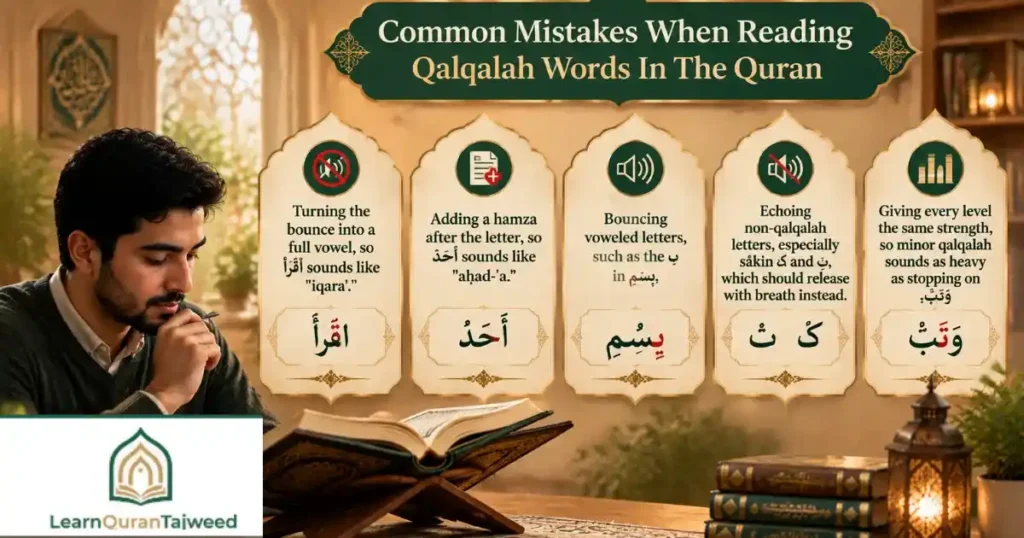
- Turning the bounce into a full vowel, so اقْرَأْ sounds like “iqara’.”
- Adding a hamza after the letter, so أَحَدْ sounds like “aḥad-‘a.”
- Bouncing voweled letters, such as the ب in بِسْمِ.
- Echoing non-qalqalah letters, especially sākin ك and ت, which should release with breath instead.
- Giving every level the same strength, so minor qalqalah sounds as heavy as stopping on وَتَبّْ.
Scholars historically differed on the bounce’s color: following the vowel before it, following the vowel after it, or leaning slightly toward a fatḥah. What matters in practice is consistency with one sound teacher’s method.
Book Your Tajweed Class And Get Your Qalqalah Corrected Live
Reading lists of qalqalah examples teaches you the rule. Hearing a qualified teacher correct your recitation in real time teaches you the sound. Learn Quran Tajweed offers online tajweed classes where you read aloud and get immediate, specific feedback on qalqalah and every other rule.
Learn from home on a schedule that fits your week, at your own level, whether you are just starting or polishing your recitation.
Courses we offer:
- Online Tajweed Classes
- Learn Quran with Tajweed Online
- Beginner Tajweed Course
- Intermediate Tajweed Course
- Advanced Tajweed Course
- Amali (Practical) Tajweed Course
Take the first step today, enroll now, and experience the difference that proper Tajweed makes.
Perfect Your Quran Recitation Today
Join expert-led Tajweed classes, and recite the Quran with confidence and clarity.
Start Your Free TrialConclusion
Qalqalah applies to five letters, قُطْبُ جَدٍّ, when they carry a sukoon. It grows from minor in the middle of a word, to major when you stop, to strongest when you stop on a doubled letter.
It does not apply to voweled letters or to letters that merge into the next one. Overdoing the bounce is a more common error than missing it.
The best way to make this automatic is to read real qalqalah examples aloud every day using the Letter–Sukoon–Stop check, and to have a teacher confirm that what you hear matches what you say.
Frequently Asked Questions
What Are 5 Examples Of Qalqalah In The Quran?
Five clear qalqalah examples in the Quran are اقْرَأْ ,أَطْعَمَهُم ,الْأَبْتَرُ ,وَالْفَجْرِ ,قَدْ أَفْلَحَ.
What Are Qalqalah Words?
Qalqalah words are Quran words containing one of the letters ق ط ب ج د with a sukoon. The sukoon can be written in the word or caused by stopping at its end.
Is There Qalqalah In Surah Al-Ikhlāṣ?
Yes, Surah Al-Ikhlāṣ contains several qalqalah words. Stopping on أَحَدْ (verses 1 and 4) and الصَّمَدْ (verse 2) gives major qalqalah, while يَلِدْ in verse 3 gives minor qalqalah.
Which Qalqalah Is Strongest?
The strongest qalqalah happens when you stop on a qalqalah letter with a shaddah, as in وَتَبّْ (Al-Masad, 1). Among the letters, ط has the strongest qalqalah.
Does Qalqalah Apply When The Letter Has A Vowel?
No, qalqalah never applies to a letter with a fatḥah, ḍammah, or kasrah. It applies only when the qalqalah letter carries a sukoon.
Can I Learn Qalqalah Without A Teacher?
Yes, You can learn the qalqalah rule from examples on your own, but a teacher is needed to confirm your sound. Most qalqalah errors, such as adding a vowel or a hamza, are hard to hear in your own recitation.