 Tajweed Basics
Have you ever seen a tiny letter س floating above a word in your Mushaf and wondered whether you should stop, breathe, or keep going? That small mark is one of the most misunderstood signs in the whole Quran — and getting it wrong can actually change the meaning of the verse.
Huroof Saktah in Quran refers to the words and letters that carry this saktah mark: places where the reciter pauses very briefly without taking a breath, then continues immediately.
There are only four agreed places in the recitation of Hafs ‘an ‘Asim, which makes this one of the easiest advanced tajweed rules to master.
In this guide, you will learn what saktah means, exactly where the four places are, why each one exists, how saktah differs from a normal stop, and how it fits into the wider family of Quranic stop signs. Every example is written out in Arabic with its surah and verse reference, so you can open your Mushaf and follow along.
What You Will Learn
- The precise meaning of saktah in tajweed and how long the pause should last
- The 4 sakta in Quran with their exact verses and the reason behind each one
- The difference between saktah, waqf, and qat’ — three pauses that look similar but are not
- How to read the main Quran stop signs with examples so you never guess again.
- A simple practice method to apply saktah correctly in your daily recitation
Huroof Saktah in Quran: What the Term Actually Means
The phrase “huroof saktah” is how many learners search for this rule, but it needs one clarification: saktah is not a category of letters like the letters of ikhfaa or qalqalah. It is a pause, and the “huroof” are simply the letters and words that carry its mark.
In practice, then, huroof saktah in Quran means the specific letters — the alif of عِوَجَا, the alif of مَرْقَدِنَا, the noon of مَنْ, and the laam of بَلْ — where the reciter must cut the sound briefly and resume without breathing.
Understanding it this way removes a lot of confusion. You are not memorising a letter group; you are memorising four locations in the Mushaf.
Why Learners Mix It Up
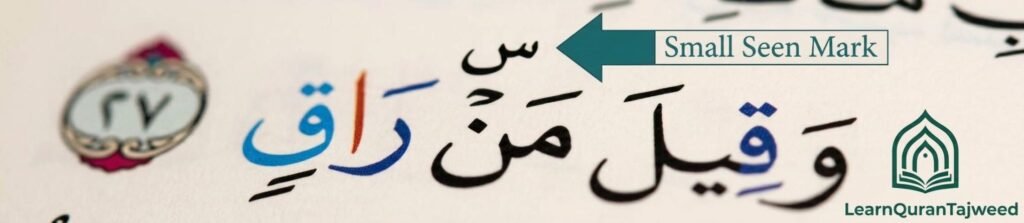
Most Mushaf prints mark saktah with a small seen (س) or the word سكتة above the line. Because the mark sits above a letter, learners assume the letter itself is the rule.
The reality is simpler: the mark tells you what to do at that letter. The letter is just the address.
What Is Saktah in Quran?
Saktah in Quran is a brief interruption of the sound — roughly the length of two harakat, or one alif — made without taking a new breath, after which the reciter continues the recitation immediately.
That last part is the whole point of the rule. If you breathe, it is no longer a saktah; it has become a stop (waqf). The breath is the dividing line between the two.
Scholars of tajweed describe it as “cutting the voice without cutting the breath.” The lungs stay engaged; the mouth simply goes silent for an instant.
Saktah vs Waqf vs Qat’
These three terms are often used loosely in conversation, but tajweed treats them as clearly distinct actions:
| Term | What you do | Breath? | Do you continue? |
| Saktah (سكتة) | Silence for about 2 harakat | No breath | Yes, immediately |
| Waqf (وقف) | Stop at the end of a word | Yes, you breathe | Yes, after breathing |
| Qat’ (قطع) | End the recitation session | Yes | No, you leave off |
A helpful mental image: waqf is a comma you can rest on, saktah is a hesitation mid-sentence, and qat’ is closing the book.
How Long Should the Pause Be?
Aim for the duration of a natural short vowel doubled — about two counts. Too short and the listener hears nothing; too long and it sounds like a full stop.
This is exactly the kind of detail that is difficult to judge from text alone. Most students only feel confident once a qualified teacher listens and corrects the timing, which is why Shaykhi Academy’s online Tajweed classes dedicate live practice time to these four verses specifically.
See Our Classrooms in Action
Watch these short clips from our live, interactive Quran courses to see how our students learn and interact with our expert tutors.
Perfect Your Quran Recitation Today
Join expert-led Tajweed classes, and recite the Quran with confidence and clarity.
Start Your Free TrialThe 4 Sakta in Quran With Their Exact Verses
In the recitation of Hafs ‘an ‘Asim by the way of ash-Shatibiyyah, the reading used in the vast majority of printed Mushafs worldwide, there are four agreed places of saktah. Here they are in order of the Quran, each with the reason behind it.
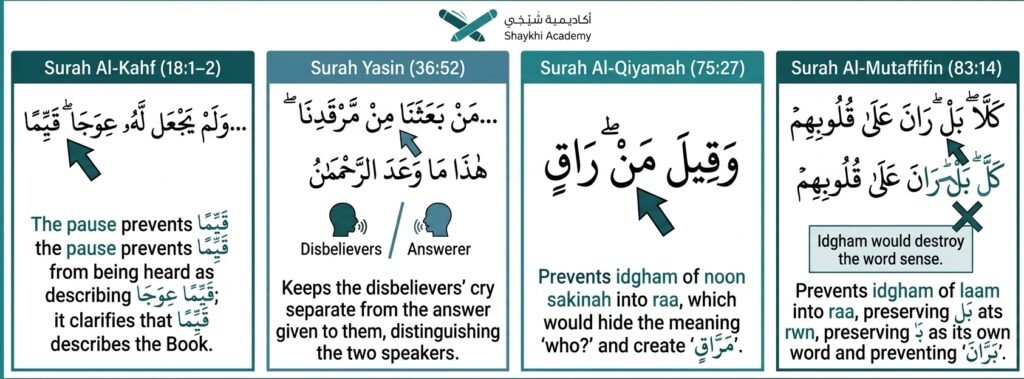
1. Surah Al-Kahf (18:1–2)
The first example of saktah appears in these words:
…وَلَمْ يَجْعَل لَّهُۥ عِوَجَا ۜ قَيِّمًا
The saktah falls on the final alif of عِوَجَا before قَيِّمًا.
The reason: without the pause, قَيِّمًا could be heard as describing عِوَجَا — as though the crookedness were “straight.” The saktah makes clear that قَيِّمًا describes the Book itself.
2. Surah Yasin (36:52)
The second example appears in this part of the verse:
…مَن بَعَثَنَا مِن مَّرْقَدِنَا ۜ هَٰذَا مَا وَعَدَ ٱلرَّحْمَٰنُ
The saktah falls on the alif of مَرْقَدِنَا.
The reason: the first half is the cry of the disbelievers rising from their graves; the second half is the answer given to them. The pause keeps two different speakers from blending into one sentence.
3. Surah Al-Qiyamah (75:27)
The third example is found in these words:
وَقِيلَ مَنْ ۜ رَاقٍ
The saktah falls on the noon of مَنْ.
The reason: noon sakinah followed by raa would normally require idgham, producing “مَرَّاقٍ” — a single word in which the meaning “who?” disappears entirely. The saktah blocks the merge.
4. Surah Al-Mutaffifin (83:14)
The fourth example occurs in this part of the verse:
كَلَّا ۖ بَلْ ۜ رَانَ عَلَىٰ قُلُوبِهِم
The saktah falls on the laam of بَلْ.
The reason: laam followed by raa would merge into “بَرَّانَ,” again destroying the sense of the verse. The pause preserves بَلْ as its own word.
A Simple Way to Remember All Four
Memorise the four carrier words in Quranic order:
عِوَجَا — مَرْقَدِنَا — مَنْ — بَلْ
Recite that short chain a few times, and the locations stay with you. Notice the pattern too: the first two saktahs protect meaning, while the last two prevent an unwanted idgham.
How Many Saktah in Quran Are There?
There are four agreed places of saktah in the Quran in the recitation of Hafs ‘an ‘Asim: Al-Kahf 18:1, Yasin 36:52, Al-Qiyamah 75:27, and Al-Mutaffifin 83:14.
So when learners ask how many sakta in the Quran exist, four is the answer to memorise for everyday recitation. Two further pauses, however, are discussed by the scholars and appear in some prints.
The Additional Pauses Scholars Mention
These are two other pauses that are the most important to recognize in the Qur’an, each serving a specific role in preserving the correct pronunciation and meaning of the verse.
- Surah Al-Haqqah (69:28–29):
In مَالِيَهْ ۜ هَلَكَ, Hafs allows either a saktah on the haa or an idgham of the two haa letters. Many Mushafs carry the saktah mark here, which is why some references count five.
- Between Al-Anfal and At-Tawbah:
Since At-Tawbah has no Basmalah, the reciter joining the two surahs may stop with a breath, make a saktah, or connect them outright — all three are permitted.
Does the Count Change Between Recitations?
Yes, and this is worth knowing. Saktah placement belongs to the riwayah you recite, so a student of Warsh ‘an Nafi’ or another route will find a different set of pauses.
If your goal is a certified sanad, these differences matter a great deal — they are studied in depth in an Ijazah programme, where the chain of transmission itself defines which pauses you apply.
Inside Learn Quran Tajweed Academy
Curious about how online learning works? Peek inside our actual Quran classes and hear the beautiful recitation of our students and teachers.
Perfect Your Quran Recitation Today
Join expert-led Tajweed classes, and recite the Quran with confidence and clarity.
Start Your Free TrialQuran Stop Signs With Examples
Saktah is one member of a larger family of pause marks that Mushaf editors placed above the line to guide the reciter. Reading them confidently is what separates hesitant recitation from smooth, meaningful recitation.
Here are the signs you will meet most often, with verified examples.
The Core Waqf Symbols
The Mushaf uses specific waqf symbols to guide readers on where to stop, continue, or briefly pause during recitation.
Learning these signs helps preserve the intended meaning of the verses and makes Quran recitation more accurate.
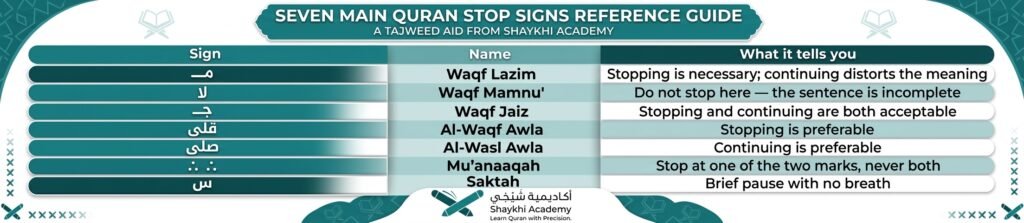
| Sign | Name | What it tells you |
| مـ | Waqf Lazim | Stopping is necessary; continuing distorts the meaning |
| لا | Waqf Mamnu’ | Do not stop here — the sentence is incomplete |
| جـ | Waqf Jaiz | Stopping and continuing are both acceptable |
| قلى | Al-Waqf Awla | Stopping is preferable |
| صلى | Al-Wasl Awla | Continuing is preferable |
| ∴ ∴ | Mu’anaqah | Stop at one of the two marks, never both |
| س | Saktah | Brief pause with no breath |
Worked Examples From the Mushaf
Seeing waqf symbols inside Quranic verses makes their function much easier to understand. The following examples show how several important stopping signs guide the reader during actual recitation.
- Waqf Lazim (مـ) — Surah Yasin 36:76:
فَلَا يَحْزُنكَ قَوْلُهُمْ ۘ إِنَّا نَعْلَمُ…
- Mu’anaqah (∴ ∴) — Surah Al-Baqarah 2:2:
ذَٰلِكَ ٱلْكِتَٰبُ لَا رَيْبَ ۛ فِيهِ ۛ هُدًى لِّلْمُتَّقِينَ
Here you choose one of the two dotted marks. Stop after رَيْبَ or after فِيهِ — but never at both.
- Saktah (س) — Surah Al-Qiyamah 75:27:
وَقِيلَ مَنْ ۜ رَاقٍ
Teaching Stop Signs to Children
Children absorb these marks remarkably well when the signs are turned into visual cues rather than terminology.
A red mark for “must stop,” a green one for “keep going,” and a hand gesture for the silent saktah work better than definitions.
That visual, gamified approach is how tajweed and recitation classes for kids at Shaykhi Academy introduce waqf signs — one sign per session, reinforced through recitation rather than memorised from a chart.
Read more about our tajweed and recitation classes for kids
How to Practise Saktah Correctly in 4 Steps
Reading about a pause and producing it are two different skills. This short routine builds the habit within a week.
- Locate: Open each of the four verses and mark the saktah word in pencil. Seeing them in your own Mushaf fixes the locations in memory.
- Split: Recite the phrase before the saktah, count two beats silently, then recite the phrase after. Do this slowly, without joining them yet.
- Join without breathing: Now run the whole verse. Place one hand on your chest to confirm you are not inhaling at the pause.
- Record and compare: Record yourself, then listen beside a trusted reciter. Your ear will catch what your mouth missed.
The fourth step is where most self-learners plateau, because you cannot correct what you cannot hear. A teacher hears it instantly.
Perfect Your Recitation With Live Tajweed Lessons at Shaykhi Academy
Book your free trial lesson with a certified Al-Azhar teacher and recite the four saktah verses out loud today — with immediate, personal correction.
Learn Quran Tajweed programmes are one-to-one, flexible around your timetable, and available for both children and adults from complete beginner to Ijazah level. Your teacher listens to every letter, times every pause, and builds a plan around the exact rules you find difficult.
Courses we offer:
- Tajweed Course for Kids
- Tajweed Course for Adults
- Tajweed Course for Ladies
- Tajweed ul Quran Course
- Quran Recitation with Tajweed Course
- Quran Tarteel Course
- Tajweed Ijazah Program
- Online Tajweed Classes
- Learn Quran with Tajweed Online
- Beginner Tajweed Course
- Intermediate Tajweed Course
- Advanced Tajweed Course
- Amali (Practical) Tajweed Course
Thousands of students across the UK, US, Canada, and the Gulf recite with confidence because someone qualified was listening. Let that be you.
Book your first tajweed lesson now.
Perfect Your Quran Recitation Today
Join expert-led Tajweed classes, and recite the Quran with confidence and clarity.
Start Your Free TrialConclusion
Saktah is a small rule with a large effect. A pause of two beats, taken without a breath, is what keeps مَنْ رَاقٍ from collapsing into a single meaningless word and what separates the cry of the disbelievers from the answer they receive in Surah Yasin.
We covered the meaning of huroof saktah in Quran, the four agreed places in Hafs ‘an ‘Asim — عِوَجَا, مَرْقَدِنَا, مَنْ, and بَلْ — the two additional pauses scholars mention, the clear line between saktah and waqf, and the main Quran stop signs with worked examples from the Mushaf.
Takeaway message: the Quran’s pause marks are not decoration; they are instructions that protect meaning. Learn the four saktah places, practise them out loud, and have a qualified teacher confirm your timing — that is how careful recitation becomes natural recitation.
FAQs
Is saktah obligatory in Quran recitation?
Yes. In the recitation of Hafs ‘an ‘Asim via ash-Shatibiyyah, the four saktah places are the established practice and should be observed. Two of them, in Al-Qiyamah and Al-Mutaffifin, are especially important because skipping the pause creates an idgham that changes the wording.
What is the difference between saktah and waqf?
Saktah is a short silence of about two harakat with no breath, followed immediately by continuing. Waqf is a genuine stop at the end of a word where you do take a breath before resuming.
Do I take a breath during saktah?
No. Taking a breath converts the saktah into a waqf. Keep the breath held and simply stop the sound for two counts.
Why is there a saktah in Surah Al-Mutaffifin?
Because بَلْ ends in laam and the next word رَانَ begins with raa. Joined normally, the laam would merge into the raa and produce “بَرَّانَ,” erasing the word بَلْ. The saktah keeps both words distinct.
How many stop signs are there in the Quran?
Mushaf prints commonly use around seven to ten waqf symbols, though the exact set varies slightly between editions. The most frequent are مـ, لا, جـ, قلى, صلى, the mu’anaqah dots, and س for saktah.
Can children learn saktah and stop signs easily?
Yes. Children usually learn the four saktah verses faster than adults because there are only four to memorise.