 Tajweed Resources

Qaloon tajweed refers to the precise set of recitation rules transmitted by Imam Qaloon from Imam Nafi al-Madani, one of the seven canonical Quranic readers. This narration is widely practiced across Libya, Tunisia, and Mauritania, and it carries a fully authenticated chain of transmission reaching back to the Prophet Muhammad ﷺ through seventy Successors.
If you want to recite the Quran correctly according to Qaloon recitation, you need to understand the rules that distinguish this narration from others like Hafs or Warsh. This article breaks those rules down clearly, so you know exactly what to study and where to begin.
What You’ll Learn in This Article?
- Who Imam Qaloon was and where his narration is practiced today
- The core Qaloon recitation rules covering madd, hamzah, meem al-jama, and imala
- How Qaloon differs from Hafs in practical, audible ways
- Common mistakes students make when switching to Qaloon recitation
- Which courses at Learn Quran Tajweed will help you master this narration with a qualified teacher
Who Is Imam Qaloon and Where Is His Recitation Used?
Imam Qaloon is one of the most authoritative transmitters in the science of Quranic recitation. Understanding who he was explains why his narration carries such scholarly weight across North Africa and beyond.
His full name is Abu Musa Isa ibn Mina al-Zarqi, born in Medina in 120 AH. He studied directly under Imam Nafi al-Madani and remained with him for over twenty years until Imam Nafi himself told him: “Sit at a pillar so students may read to you.” This marks the formal handover of scholarly authority.
Imam Nafi had received the recitation from seventy Successors, among them Abu Jafar ibn al-Qaqa, Shayba ibn Nassah, and Abd al-Rahman ibn Hurmuz al-Araj. That chain runs back through the Companions to the Prophet ﷺ, who received it from Jibril عليه السلام from the Preserved Tablet. The transmission is classified as mutawatir — authenticated at every generational level.
Where Qaloon Recitation Is Practiced Today?
Qaloon recitation remains the dominant reading in Libya, Tunisia, and Mauritania. It is also found across parts of West Africa where oral transmission from teacher to student preserved it intact across centuries.
Libya in particular relied entirely on oral transmission rather than printed manuscripts for much of its history. Despite this, scholars confirm that the narration reached modern readers in its original form, uncorrupted in both its foundational rules (usul) and its verse-specific details (farsh).
Core Qaloon Tajweed Rules Every Student Must Know
Qaloon recitation rules differ from the Hafs recitation that most English-speaking students first encounter. These differences are systematic, not random — and mastering them requires a qualified teacher who can demonstrate the sounds live.
The rules below cover the main categories where Qaloon diverges. Each one is non-negotiable for anyone seeking an authentic Qaloon recitation.
Madd Rules in Qaloon Recitation
Qaloon tajweed assigns specific elongation lengths that differ from Hafs. Madd al-muttasil (connected elongation) is recited at four vowel counts. Madd al-munfasil (separated elongation) is recited at either two or four counts — both are valid transmitted options.
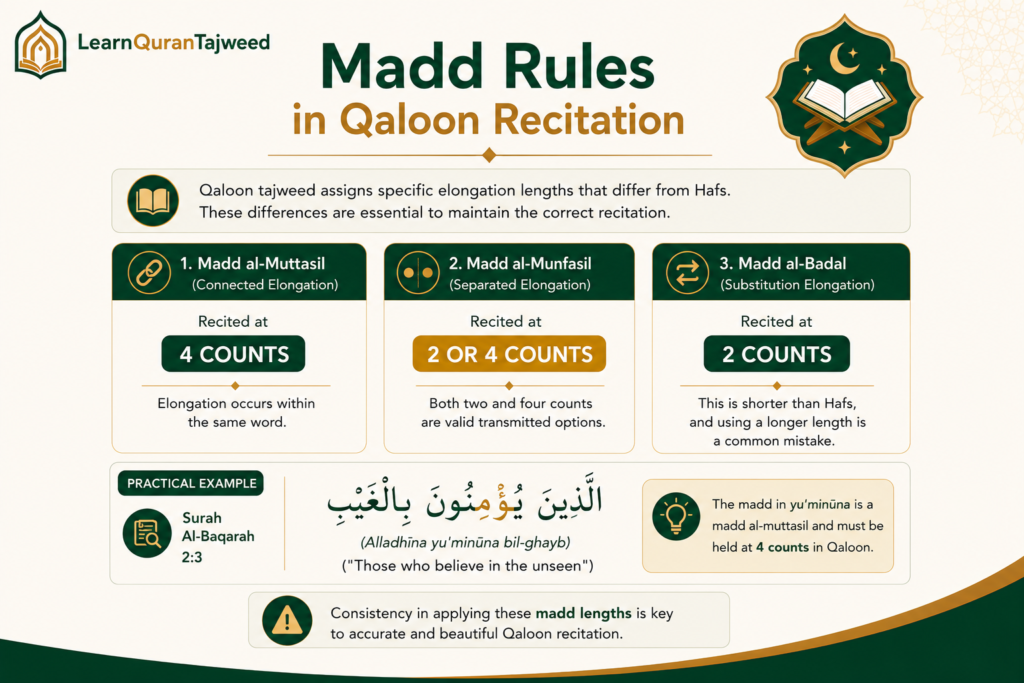
Madd al-badal (substitution elongation) is held at two counts. This is shorter than what many Hafs students are accustomed to, and applying the wrong length is one of the most common errors when transitioning to Qaloon.
A practical example is in Surah Al-Baqarah:
الَّذِينَ يُؤْمِنُونَ بِالْغَيْبِ
(Alladhīna yu’minūna bil-ghayb)
(“Those who believe in the unseen”)
Surah Al-Baqarah 2:3
The madd in يُؤْمِنُونَ is a madd al-muttasil and must be held at four counts in Qaloon.
Meem al-Jama Rules
Qaloon has two valid options for the plural pronoun suffix (meem al-jama) when followed by a moving letter. The first option is connecting it with a vowel sound (ضم الميم وصلتها). The second is leaving it silent (إسكان الميم).
Both options are authentic. A student must commit to one consistently within a recitation session rather than alternating arbitrarily. This rule does not exist in Hafs, where meem al-jama is always silent before a consonant.
Hamzah Rules in Qaloon Recitation
This is the most technically complex area of Qaloon tajweed. Qaloon applies facilitation (tasheel) to the second of two hamzahs appearing in one word, and inserts a separating alef between them.
For two hamzahs in separate words, the approach depends on their vowel pattern. If both are fatha (open), Qaloon drops the first hamzah entirely. If both are kasra (lowered), he facilitates the first between a hamzah and a ya. If both are damma (raised), he facilitates the first between a hamzah and a waw.
An important exception is the phrase بِالسُّوءِ إِلَّا in Surah Yusuf (12:53):
بِالسُّوءِ إِلَّا مَا رَحِمَ رَبِّي
(Bil-sū’i illā mā raḥima rabbī)
(“…with evil, except what my Lord has mercy upon”)
Surah Yusuf 12:53
Here Qaloon has two options: replace the first hamzah with a waw and merge it into the preceding waw, or facilitate the first hamzah with a shortened madd before it.
Imala in Qaloon Recitation
Imala means tilting the fatha vowel toward kasra and the alef toward ya. Qaloon applies full imala (al-kubra) to only one word in the entire Quran: هَارٍ in Surah At-Tawbah (9:109).
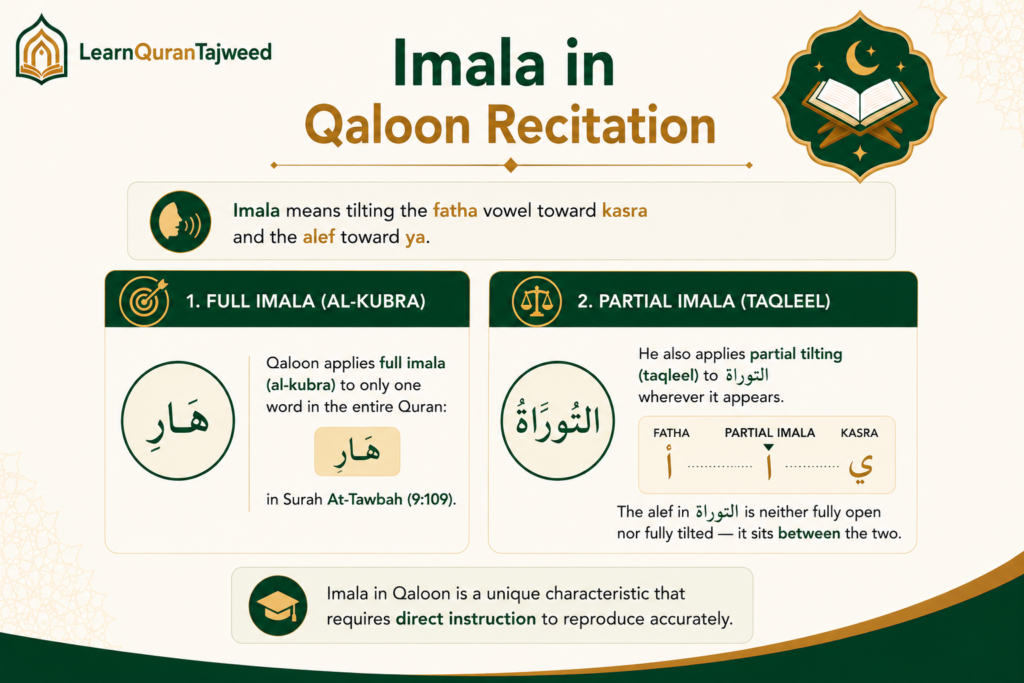
He also applies partial tilting (taqleel) to التوراة wherever it appears. This means the alef in التوراة is neither fully open nor fully tilted — it sits between the two. This is a unique characteristic that requires direct instruction to reproduce accurately.
Practical Comparison of Qaloon and Hafs Recitation Rules
Most students come to Qaloon after years of Hafs. Knowing the differences in advance prevents deep-seated errors from forming.
| Rule | Hafs | Qaloon |
| Madd al-munfasil | 4–5 counts (typical) | 2 or 4 counts |
| Meem al-jama before consonant | Silent | Silent or with vowel (two options) |
| Second hamzah in one word | Fully pronounced | Facilitated with separating alef |
| Imala (full tilt) | None | One word only: هَارٍ |
| Imala (partial tilt) | None | التوراة wherever it appears |
| Haa al-kinayah (pronoun haa) | Elongated with vowel | Shortened with kasra in specific positions |
Switching from Hafs to Qaloon is not simply a matter of learning a few exceptions. It requires recalibrating the madd lengths, retraining the hamzah approach, and adjusting the meem al-jama habit. A structured course with a specialized teacher is the fastest and safest path.
The Intermediate Tajweed Course at Learn Quran Tajweed targets students who have mastered the basics and are ready to apply rigorous rules like these Qaloon-specific distinctions at a high level.

Elevate your recitation now with the Intermediate Tajweed Course
Haa al-Kinayah and Yaaat al-Idafa in Qaloon Recitation
These two categories are where precision separates an acceptable recitation from an accurate one. Both involve short connecting sounds that disappear when applied incorrectly.
Haa al-kinayah refers to the pronoun suffix “he/it” (هاء الضمير). Qaloon’s rule is to shorten the haa with kasra — without elongation — in specific positions. For example:
يُؤَدِّهِ إِلَيْكَ
(Yu’addihi ilayk)
(“He will return it to you”)
Surah Aal Imran 3:75
Here Qaloon reads with a short, lowered haa. Elongating it in the style of Hafs is a tajweed error in this narration.
Read also: Imam Khalaf Tajweed Rules, Narrators, and How It Differs From Hafs
Al-Duri Tajweed Rules and Recitation
See Our Classrooms in Action
Watch these short clips from our live, interactive Quran courses to see how our students learn and interact with our expert tutors.
Perfect Your Quran Recitation Today
Join expert-led Tajweed classes, and recite the Quran with confidence and clarity.
Start Your Free TrialYaaat al-Idafa in Qaloon Recitation
Iya al-idafa are the first-person singular pronoun suffixes (my, I). Qaloon opens these with a fatha when the following word begins with a hamzah al-qat — whether that hamzah is open, lowered, or raised.
However, he keeps specific positions silent. Among them are:
- بَيْتِيَ (My house) in Surah Nuh
- مَعِيَ (With me) not followed by a hamzah al-qat
- وَمَحْيَايَ (And my life) in Surah Al-An’am 6:162
These positions require memorization with a teacher because the pattern is not entirely predictable from the general rule alone. This is exactly the kind of detail the Quran Recitation with Tajweed Course at Learn Quran Tajweed is designed to address through direct practice.
Perfect your recitation rule by rule at the Quran Recitation with Tajweed Course
Common Mistakes Students Make in Qaloon Recitation
Even motivated students repeat the same errors. Knowing them in advance shortens the correction process significantly.
The first and most frequent mistake is applying Hafs madd lengths to Qaloon. Students trained in Hafs default to four or five counts for madd al-munfasil. In Qaloon, two counts is the primary transmitted option. Applying the longer count without an authentic chain behind it makes the recitation inauthentic.
Applying Hamzah Rules Inconsistently
The second mistake is inconsistent hamzah treatment. Students who understand the rule in isolation often apply tasheel (facilitation) in some positions and forget it in others within the same passage. This inconsistency signals that the rule has been memorized theoretically but not internalized through repetition.
The correct approach is to practice specific suwar that contain multiple hamzah clusters until the rule applies automatically. Surah Al-Baqarah, Surah Al-Araf, and Surah Ash-Shuara contain dense clusters that make them ideal practice material.
Skipping Meem al-Jama Altogether
The third mistake is ignoring the meem al-jama rule entirely and treating it the same as in Hafs. Students who do this lose one of Qaloon’s most distinctive phonetic features. Whether a student chooses the connected or silent option, that choice must be applied consistently throughout each recitation session.
All three of these mistakes can be corrected rapidly under a teacher who specializes in Qaloon recitation. The Tajweed ul Quran Course at Learn Quran Tajweed provides direct oral correction from certified instructors trained in classical pronunciation standards.

Fix your recitation errors now with the Tajweed ul Quran Course
How to Learn Qaloon Recitation Rules Systematically?
Learning Qaloon tajweed requires a sequenced approach — not random exposure to rules. The following framework moves from phonetic foundation to full recitation competency.
First, confirm your makhaarij (articulation points) are correct before touching narration-specific rules. A student who mispronounces the letters will apply Qaloon’s hamzah rules incorrectly regardless of how well they understand them theoretically.
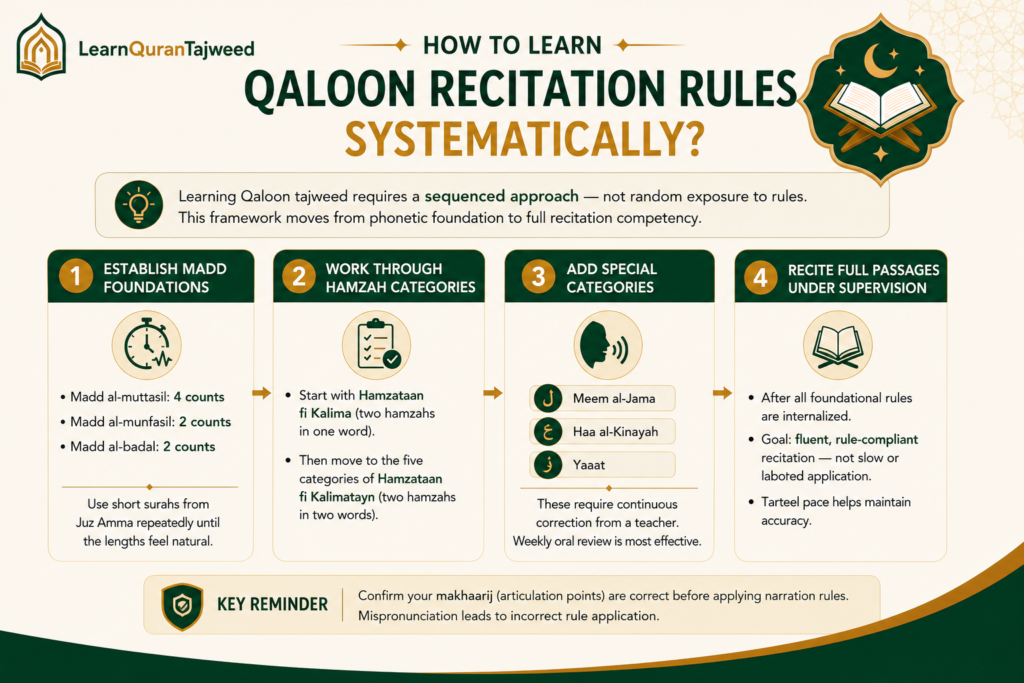
Step One: Establish Madd Foundations
Once articulation is stable, begin with the madd rules. Drill madd al-muttasil at four counts, madd al-munfasil at two counts, and madd al-badal at two counts. Use short surahs from Juz Amma repeatedly until the lengths feel natural rather than counted.
Step Two: Work Through Hamzah Categories One at a Time
Do not attempt all hamzah rules simultaneously. Start with hamzataan fi kalima (two hamzahs in one word) and practice it until it is automatic. Then move to the five categories of hamzataan fi kalimatayn (two hamzahs in two words) with specific Quranic examples for each.
Read also: Riwayat Hamzah and its Tajweed Rules Principles
Step Three: Add Meem al-Jama, Haa al-Kinayah and Yaaat
These three categories require continuous correction from a teacher because errors in them are subtle and not easily self-detected. Weekly oral review sessions are more effective than independent study for these categories.
Step Four: Recite Full Passages Under Supervision
Only after all foundational rules are internalized should a student recite extended passages under a teacher’s supervision. The goal is fluent, rule-compliant recitation — not slow, labored application. Tarteel pace helps maintain accuracy during this phase.
Inside Learn Quran Tajweed Academy
Curious about how online learning works? Peek inside our actual Quran classes and hear the beautiful recitation of our students and teachers.
Start Reciting Quran with Qaloon Tajweed at Learn Quran Tajweed
Learn Quran Tajweed offers structured, expert-led courses that take you from foundational Tajweed basics through to full Qaloon recitation mastery. Every session is taught by certified instructors trained in classical pronunciation and narration-specific rules.
Whether you are switching from Hafs, learning Qaloon recitation for the first time, or correcting long-standing errors, the right teacher makes all the difference. Oral transmission remains the only reliable path to an authentic Quranic recitation — and that is exactly what Learn Quran Tajweed provides.

Courses we offer:
- Tajweed Course for Kids
- Tajweed Course for Adults
- Tajweed Course for Ladies
- Tajweed ul Quran Course
- Quran Recitation with Tajweed Course
- Quran Tarteel Course
- Tajweed Ijazah Program
Perfect Your Quran Recitation Today
Join expert-led Tajweed classes, and recite the Quran with confidence and clarity.
Start Your Free TrialConclusion
Qaloon tajweed is a complete, internally consistent system of recitation rules transmitted from Imam Qaloon through an unbroken chain to the Prophet ﷺ. Its core rules — madd lengths, hamzah facilitation, meem al-jama options, and imala — differ from Hafs in systematic ways that require deliberate study, not casual adjustment.
The fastest path to accurate Qaloon recitation is working with a qualified teacher who can demonstrate and correct these rules live. Independent study fills in the knowledge gaps, but vocal precision comes only through direct oral transmission. Learn Quran Tajweed provides exactly that environment through its certified instructors and structured curriculum.
Frequently Asked Questions
What is Qaloon tajweed and where does it come from?
Qaloon tajweed refers to the rules of Quranic recitation transmitted by Imam Qaloon from Imam Nafi al-Madani. The chain goes back through seventy Successors to the Companions to the Prophet ﷺ, making it one of the most authenticated narrations in Islamic scholarship.
What are the main Qaloon recitation rules that differ from Hafs?
Qaloon recitation rules differ from Hafs in four main areas: madd al-munfasil is shorter at two or four counts, the second hamzah in one word is facilitated with a separating alef, meem al-jama has two valid options before a consonant, and imala applies to one word fully and التوراة partially.
Can I learn Qaloon recitation online with a qualified teacher?
Yes. Learn Quran Tajweed provides live online sessions with certified instructors who specialize in Tajweed recitation. The Quran Recitation with Tajweed Course and the Intermediate Tajweed Course are both suited to students pursuing Qaloon narration.
How long does it take to learn Qaloon recitation rules?
The time depends on your baseline. A student who already recites Hafs fluently can realistically master the foundational Qaloon recitation rules in four to six months of consistent weekly sessions. Students starting from scratch will need longer to establish both articulation and narration-specific rules simultaneously.
Why is imala restricted to only one word in Qaloon?
Full imala in Qaloon applies only to the word هَارٍ in Surah At-Tawbah 9:109 because that is the only position transmitted with certainty in this narration. Adding imala to other words would mean introducing a reading not authenticated through Qaloon’s chain, which violates the strict transmission standards of Quranic recitation science.
Is Qaloon recitation used in formal Quran memorization programs?
Yes. In Libya, Tunisia, and Mauritania, Qaloon recitation is the standard narration in formal hifz programs. Many students outside those regions now also choose to memorize by Qaloon as a second narration after completing Hafs, widening their recitation competence.
What is the difference between Qaloon and Warsh recitation?
Both Qaloon and Warsh are narrations from Imam Nafi al-Madani, but they differ significantly. Warsh applies extensive imala and lengthens madd al-munfasil to six counts. Qaloon applies minimal imala and allows madd al-munfasil at two counts. Warsh is dominant in Morocco and Algeria, while Qaloon is dominant in Libya and Tunisia.
Related Articles
Tajweed Resources