 Tajweed Resources
Khalaf Tajweed refers to the recitation narration transmitted by Khalaf ibn Hisham al-Baghdadi from Imam Hamzah al-Kufi — one of the ten authenticated Qira’at of the Quran. It differs from the globally dominant Hafs narration in over a dozen technical areas, including Madd lengths, Imala, Idgham patterns, and Hamzah treatment.
If you’ve heard a reciter whose vowels sound tilted toward the “ee” sound, who pauses briefly before Hamzah, or who merges letters that Hafs pronounces clearly — you’ve likely heard the Khalaf narration in action.
What You’ll Learn in This Article
- Who Khalaf ibn Hisham was and how he transmitted Hamzah’s recitation
- How Khalaf Tajweed differs from Hafs in Madd, Imala, Idgham, and Hamzah rules
- The specific Quranic examples where Khalaf’s rules produce audible differences
- Common mistakes students make when first studying the Khalaf narration
- How to begin learning Khalaf Tajweed with structured guidance
Imam Khalaf Tajweed and Its Place Among the Ten Qira’at
Khalaf Tajweed is one of the twenty narrations derived from the ten authenticated Qira’at (Qira’at al-‘Ashr). The ten Qira’at each carry two narrators — Khalaf is one of the two narrators of Imam Hamzah’s recitation, alongside Khallad.
This narration chain is fully Mutawatir — transmitted by reliable scholars across every generation back to the Prophet ﷺ. Students who study Khalaf Tajweed are not learning a regional variation or a minority opinion; they are studying one of the ten divinely preserved modes of Quranic recitation.
Who Was Imam Khalaf ibn Hisham?
Khalaf ibn Hisham al-Baghdadi (155–229 AH) memorized the Quran at age ten and became one of the most trusted transmitters in Quranic sciences. He is described in classical sources as a worshipper, an ascetic, and a scholar of high standing.
Imam Muslim ibn al-Hajjaj narrated hadith from him in Sahih Muslim. Imam Abu Dawud cited him in the Sunan. Scholars including Yahya ibn Ma’in and al-Nasa’i affirmed his reliability (thiqah). His teacher in recitation was Sulaym ibn ‘Isa, the chief narrator of Hamzah’s reading.
Who Was Imam Hamzah al-Kufi?
Imam Hamzah ibn Habib al-Zayyat al-Kufi (80–156 AH) was one of the Seven Imams of Qira’at. He was the leading recitation authority in Kufa after Imam ‘Asim. Abu Hanifah said of him: “You have surpassed us in two things we do not contest — the Quran and the laws of inheritance.”
Sufyan al-Thawri stated: “Hamzah did not recite a single letter from the Book of Allah except with a transmitted basis.” His recitation chain passes through prominent Companions including Ali ibn Abi Talib through multiple verified routes.
The Beginner Tajweed Course at Learn Quran Tajweed builds the foundational recitation knowledge every student needs before advancing to narration-level study like the Khalaf reading.

Enroll in the Beginner Tajweed Course today at Learn Quran Tajweed
Core Rules That Define Imam Khalaf Tajweed
Khalaf Tajweed is distinguished from Hafs ‘an ‘Asim by a set of consistent, rule-based differences that apply throughout the Quran. These are not random variations — each rule reflects a documented transmission from Imam Hamzah.
A practical decision rule for students: when studying Khalaf Tajweed, treat every Hamzah at rest or at the end of a word as a candidate for modification, and treat every eligible Alif as a candidate for Imala. These two principles alone cover the majority of audible differences.
Madd (Elongation) in Imam Khalaf Tajweed
Khalaf recites both Madd al-Muttasil (connected elongation) and Madd al-Munfasil (separated elongation) at six counts — the maximum level. This is longer than the typical four to five counts used in Hafs.
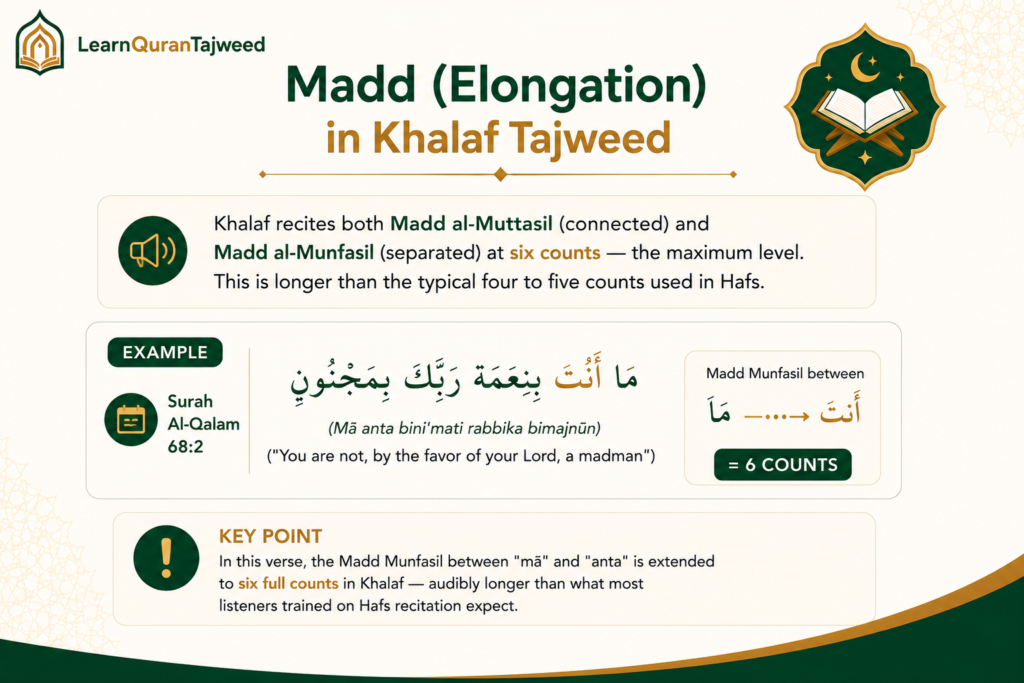
مَا أَنتَ بِنِعْمَةِ رَبِّكَ بِمَجْنُونٍ
(Mā anta bini’mati rabbika bimajnūn)
(“You are not, by the favor of your Lord, a madman”)
In this verse, the Madd Munfasil between “مَا” and “أَنتَ” is extended to six full counts in Khalaf — audibly longer than what most listeners trained on Hafs recitation expect.
Imala (Vowel Tilting) in Imam Khalaf Tajweed
Imala is the most audible characteristic of Imam Khalaf Tajweed for new listeners. Khalaf tilts eligible Alifs toward the “ee” sound — a feature largely absent in Hafs. The rule applies to every original Alif derived from a Ya’, words following specific patterns (fa’la, fu’la, fi’la), and the closing vowels of eleven specific Surahs.
هُدًى لِّلْمُتَّقِينَ
(Hudan lil-muttaqīn)
(“Guidance for the God-conscious”)
The word “هُدًى” — with an Alif derived from Ya’ — is recited with Imala in Khalaf. It sounds closer to “hudee” rather than the flat “huda” heard in Hafs. Khalaf also applies Imala to the closing verses of Surah Taha, Surah Al-Najm, Surah Al-Qiyamah, and eight other Surahs.
The Intermediate Tajweed Course at Learn Quran Tajweed covers advanced Ahkam including Imala, equipping students moving beyond the basics of Hafs recitation.

Enroll in the Intermediate Tajweed Course today at Learn Quran Tajweed
How Khalaf Handles Hamzah Differently From Hafs?
One of the most technically demanding aspects of Imam Khalaf Tajweed is its treatment of Hamzah, particularly during Waqf (stopping). Khalaf applies a systematic softening of Hamzah at the end of a word or syllable — following two recognized schools: the grammatical (tasrifiyy) approach and the script-based (rasmiyy) approach.
When two Hamzahs appear in one word — as in the interrogative form — Khalaf verifies both rather than simplifying one. This differs from how some other narrations handle double Hamzah.
Hamzah at the End of a Word
When stopping on a word ending in Hamzah, Khalaf modifies it rather than pronouncing it with full glottal stop. The method depends on whether the Hamzah follows a long vowel, a short vowel, or a Sukoon.
Sakt (Brief Pause Without Breath) in Imam Khalaf Tajweed
Khalaf applies Sakt — a deliberate momentary stop without taking a new breath — in two consistent positions: before the definite article “أل” when followed by Hamzah (e.g., الْأَرْضِ, وَبِالْآخِرَةِ), and on “شَيْءٍ” to allow the Hamzah after the Sakt letter to be pronounced clearly.
الْحَمْدُ لِلَّهِ رَبِّ الْعَالَمِينَ
(Al-ḥamdu lillāhi rabbil-‘ālamīn)
(“All praise is due to Allah, Lord of all worlds”)
In the phrase “رَبِّ الْعَالَمِينَ,” Khalaf applies Sakt on the Lam of “الْ” before the Hamzah of “الْعَالَمِينَ” — a brief, breathless pause that makes the Hamzah audibly distinct rather than elided.
Read also: Qaloon Tajweed Rules, Recitation Principles and How to Learn Them Online
See Our Classrooms in Action
Watch these short clips from our live, interactive Quran courses to see how our students learn and interact with our expert tutors.
Perfect Your Quran Recitation Today
Join expert-led Tajweed classes, and recite the Quran with confidence and clarity.
Start Your Free TrialIdgham Patterns Unique to Khalaf Tajweed
Khalaf merges (Idgham) a broader set of letter combinations than Hafs. Three specific patterns are notable for students transitioning from Hafs-based study.
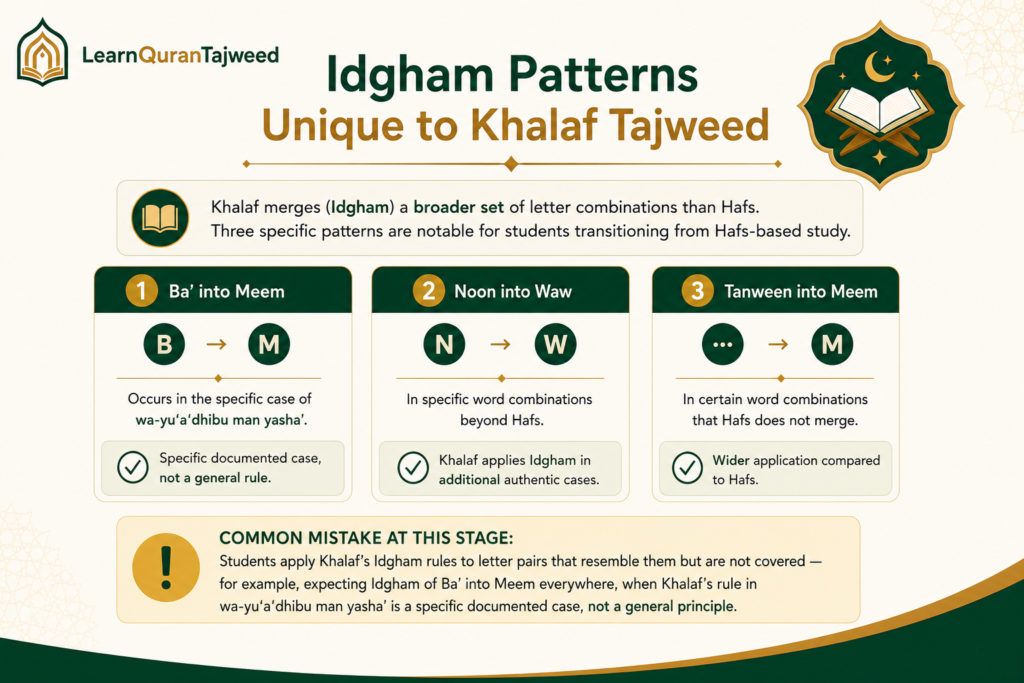
A common mistake at this stage: students apply Khalaf’s Idgham rules to letter pairs that resemble them but are not covered — for example, expecting Idgham of Ba’ into Meem everywhere, when Khalaf’s rule in وَيُعَذِّبُ مَنْ يَشَاءُ is a specific documented case, not a general principle.
Idgham of “Idh” Into Dal and Ta’
Khalaf merges the Dhal of “إِذْ” into both Dal and Ta’ whenever they appear next in the text.
إِذْ تَلَقَّوْنَهُ بِأَلْسِنَتِكُمْ
(Idh talaqawnahū bi’alsinatikum)
(“When you received it with your tongues”)
The “إِذْ” merges entirely into the Ta’ — no Dhal sound is produced. In Hafs, the Dhal is clearly pronounced.
Idgham of “Qad” Into Eight Letters
Khalaf merges the Dal of “قَدْ” into Dhad, Dha’, Seen, Dhal, Zayn, Jeem, Sad, and Sheen — a significantly wider set than Hafs allows.
وَلَقَدْ صَرَّفْنَا فِي هَذَا الْقُرْآنِ
(Walaqad ṣarrafnā fī hādhā al-Qur’ān)
(“We have certainly diversified in this Quran”)
The Dal of “لَقَدْ” merges into the Sad of “صَرَّفْنَا” — producing a doubled Sad rather than a distinct Dal followed by Sad.
The Tajweed ul Quran Course at Learn Quran Tajweed trains students in applied Idgham rules with direct practice on Quranic text under certified instructor supervision.

Register for the Tajweed ul Quran Course at Learn Quran Tajweed
Imam Khalaf vs Imam Hafs Side-by-Side
Hafs ‘an ‘Asim and Khalaf ‘an Hamzah are both authenticated Mutawatir narrations, but their recitation rules diverge in ways that are immediately audible. The table below maps the most significant technical differences across six categories — useful as a quick reference when you encounter an unfamiliar recitation or begin comparing the two narrations side by side.
| Feature | Hafs ‘an ‘Asim | Khalaf ‘an Hamzah |
| Madd Muttasil | 4–5 counts | 6 counts |
| Madd Munfasil | 4–5 counts | 6 counts |
| Imala | Absent (full Fath) | Extensive — Alifs from Ya’, pattern words, 11 Surah endings |
| Sakt | Not applied | Applied before “أل” + Hamzah and on “شَيْءٍ” |
| Hamzah at Waqf | Fully pronounced | Softened (tasrifiyy or rasmiyy method) |
| Idgham of “إِذْ” | Into Dal and Ta’ only | Into Dal and Ta’ (Khalaf); wider set with Khallad |
| Idgham of “قَدْ” | Limited | Into 8 letters |
| Joining Surahs | With or without Basmala | Without Basmala |
| “عَلَيْهُمْ / إِلَيْهُمْ / لَدَيْهُمْ” | Kasrah on Ha’ | Dammah on Ha’ in all positions |
| Basmala between Surahs | Standard practice | Omitted |
Read also: Al-Duri Tajweed Rules and Recitation
Inside Learn Quran Tajweed Academy
Curious about how online learning works? Peek inside our actual Quran classes and hear the beautiful recitation of our students and teachers.
Start Learning Khalaf Tajweed with Expert Instruction
Khalaf Tajweed rewards precision. Every rule covered in this article — Imala, Sakt, extended Madd, Idgham of Idh and Qad — requires a qualified teacher who can hear your application in real time and correct it before errors become habits.
Learn Quran Tajweed connects students with certified instructors who specialize in narration-level Tajweed training. Whether you are beginning with foundations or advancing to narration study, every session is one-on-one, structured, and adapted to your level.

Book your free trial session now at Learn Quran Tajweed
Courses we offer:
- Online Tajweed Classes
- Learn Quran with Tajweed Online
- Beginner Tajweed Course
- Intermediate Tajweed Course
- Advanced Tajweed Course
- Amali (Practical) Tajweed Course
Perfect Your Quran Recitation Today
Join expert-led Tajweed classes, and recite the Quran with confidence and clarity.
Start Your Free TrialConclusion
Khalaf Tajweed is a complete, authenticated narration of the Quran transmitted by Khalaf ibn Hisham from Imam Hamzah al-Kufi — one of ten Mutawatir Qira’at reaching back to the Prophet ﷺ. Its defining features are extended Madd at six counts, widespread Imala of eligible Alifs, systematic Sakt before Hamzah following “أل,” and broader Idgham patterns than those in Hafs.
Students who learn Khalaf Tajweed are not learning a harder version of Hafs — they are learning a distinct transmission with its own consistent, learnable system. The key is studying it with a teacher certified in the Hamzah narration, applying the rules directly in Quranic text from the first lesson.
Frequently Asked Questions
What Is Khalaf Tajweed?
Khalaf Tajweed is the recitation narration transmitted by Khalaf ibn Hisham al-Baghdadi from Imam Hamzah al-Kufi — one of the ten authenticated Quranic Qira’at. It is characterized by extended Madd, Imala of eligible Alifs, Sakt before certain Hamzahs, and specific Idgham merges not found in the Hafs narration.
How Does Khalaf Tajweed Differ From Hafs?
Khalaf differs from Hafs in six major areas: Madd length (six counts vs four to five), extensive Imala vs no Imala, Sakt application before Hamzah following “أل,” Hamzah softening at Waqf, broader Idgham merges, and Dammah on the Ha’ of “عَلَيْهُمْ / إِلَيْهُمْ / لَدَيْهُمْ” vs the standard Kasrah in Hafs.
Is Khalaf Tajweed Valid to Recite?
Yes. Khalaf Tajweed is fully Mutawatir — transmitted through continuous, verified chains of reliable scholars in every generation back to the Prophet ﷺ. All ten Qira’at, including the Khalaf narration, are equally valid and equally the word of Allah. Scholarly consensus (Ijma’) confirms this without exception.
What Is Imala in Imam Khalaf Tajweed?
Imala is the tilting of an eligible Alif vowel toward the “ee” sound instead of the full open “ah.” in Imam Khalaf Tajweed, Imala applies to every Alif derived from a Ya’, words on specific morphological patterns (fa’la, fu’la, fi’la), and the closing verses of eleven Surahs including Taha, Al-Najm, and Al-Qiyamah.
What Is Sakt in Imam Khalaf Tajweed?
Sakt is a brief, deliberate pause without taking a new breath — applied in Khalaf before “أل” when followed by a Hamzah (e.g., الْأَرْضِ) and on “شَيْءٍ.” Its purpose is to allow the Hamzah to be articulated distinctly rather than elided into the preceding sound.
Can a Beginner Start With Khalaf Tajweed?
A beginner can study Khalaf Tajweed, but a foundation in Arabic reading and basic Tajweed is necessary first — specifically Makharij al-Huruf and the core rules of Noon Sakinah, Meem Sakinah, and Madd. Students without this foundation should complete a Beginner Tajweed course before advancing to narration-level study.
Where Can I Learn Khalaf Tajweed Online?
Learn Quran Tajweed offers structured one-on-one online courses taught by certified instructors trained in Tajweed at the narration level. You can begin with a free trial session to assess your current level and receive a personalized learning path.
Related Articles
Tajweed Resources