 Tajweed Rules

If you’ve ever heard a reciter from Morocco, Algeria, or West Africa and noticed their elongations sound richer and their letters carry a different weight than what you’re used to — you were likely listening to Warsh Tajweed. Warsh ‘an Nafi’ (transmitted via the route of Al-Azraq) is one of the two most widely recited Qira’at outside the Arab East, and its Tajweed rules differ from Hafs ‘an Asim in specific, learnable ways.
This guide covers every major rule of Warsh Tajweed directly from its classical sources — Madd, Naql, Hamzah, Imala, Lam tafkheem, and Ra’ — with the conditions, exceptions, and practical notes that most articles leave out.
What You’ll Learn in This Article
- Who Is Imam Warsh ‘an Nafi’?
- How Warsh handles Madd (elongation) differently from Hafs — including the three Madd al-Badal options
- The four tools Warsh uses to modify Hamzah and how to tell which applies
- The unique Lam tafkheem rule found only in Warsh
- Warsh’s Ra’ thinning (tarqeeq) rules and their conditions
- Imala and Taqeel — what they mean and where they occur
- A practical switching checklist for students transitioning from Hafs to Warsh.
Who Is Imam Warsh ‘an Nafi’?
Imam Warsh, whose full name was Uthman ibn Sa’id al-Misri, was one of the greatest Quran reciters and a leading authority in the science of Quranic recitation. He was born in Egypt in 110 AH (728 CE). His teacher, Imam Nafi’, gave him the nickname “Warsh” because of his exceptionally fair complexion, and the name became widely associated with him.
Warsh traveled from Egypt to Madinah to study under Imam Nafi’, from whom he recited the Quran multiple times until he mastered the reading. He was renowned for his beautiful voice, precise recitation, and exceptional skill in Quranic performance.
After returning to Egypt, Warsh became the foremost authority in Quran recitation, and students traveled from across the Muslim world to learn from him. He passed away in 197 AH (812 CE) at the age of 87, leaving behind one of the most widely transmitted Quranic recitations, which remains the dominant reading in many parts of North and West Africa.
Warsh Tajweed Rules for Madd مد(Elongation)
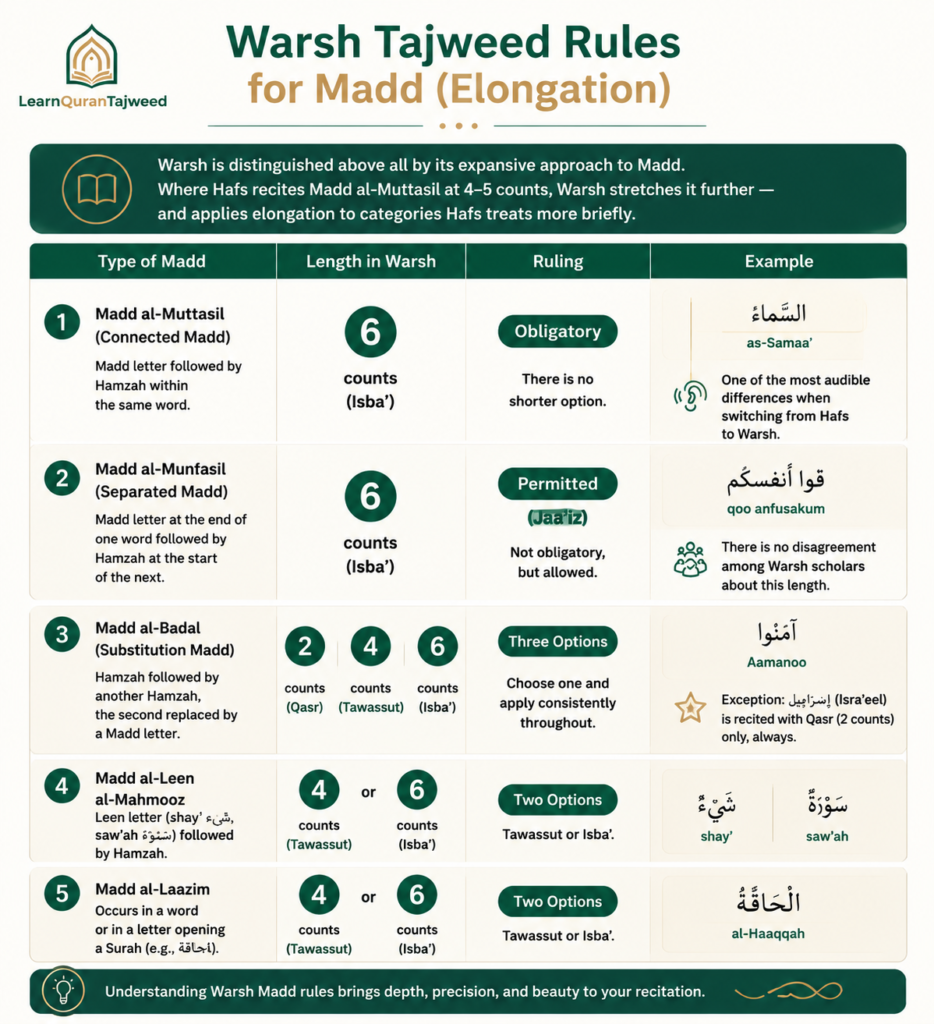
Warsh is distinguished above all by its expansive approach to Madd. Where Hafs recites Madd al-Muttasil at 4–5 counts, Warsh stretches it further — and applies elongation to categories Hafs treats more briefly.
Madd al-Muttasil( مد متصل) (Connected Madd)
Madd al-Muttasil — a Madd letter followed by a Hamzah within the same word, as in as-Samaa’ (السماء) — is recited at 6 counts (Isba’) obligatorily in Warsh. There is no shorter option. This is one of the most audible differences a listener notices immediately when switching from Hafs to Warsh.
Madd al-Munfasil( مد منفصل) (Separated Madd)
Madd al-Munfasil — a Madd letter at the end of one word followed by Hamzah at the start of the next, as in qoo anfusakum (قوا أنفسكم) — is also recited at 6 counts in Warsh, though here it is permitted (Jaa’iz) rather than obligatory. There is no disagreement among Warsh scholars about this length.
Madd al-Badal( مد البدل) (Substitution Madd)
Madd al-Badal occurs when a Hamzah is followed by another Hamzah, and the second is replaced by a Madd letter — as in Aamanoo (آمنوا). This is the one Madd category where Warsh offers three valid options: Qasr (2 counts), Tawassut (4 counts), or Isba’ (6 counts). Practitioners studying Warsh need to select one option and apply it consistently throughout their recitation.
One frequently misunderstood exception: the word Isra’eel (إسرائيل) is recited with Qasr (2 counts) only, regardless of which Madd al-Badal option the reciter has chosen elsewhere. This exception is fixed.
Madd al-Leen al-Mahmooz and Madd al-Laazim
Madd al-Leen al-Mahmooz — a Leen letter (shay’ شيء, saw’ah سوءة) followed by Hamzah — carries either 4 or 6 counts in Warsh (Tawassut or Isba’). Madd al-Laazim, whether in a word or a letter opening a Surah (al-Haaqqah
الحاقة), is always 6 counts without exception.
Naql (Transfer of the Hamzah’s Vowel) in Warsh
Naql is a distinctive rule found in the narration of Warsh and is not applied in the other major canonical recitations. It involves removing a Hamzah al-Qaṭʿ (همزة القطع) and transferring its vowel (Fatḥah, Ḍammah, or Kasrah) to the preceding sound consonant carrying Sukoon at the end of the previous word.
As a result, the Hamzah is no longer pronounced, and the two words are recited smoothly as one continuous sound.
Examples:
- الأرض (al-arḍ) → aaLARD
- قد أفلح (qad aflaḥa) → qadaflaḥa
The Three Contexts Where Naql Applies
Naql is applied in three main situations:
1. After the Definite Article (الـ)
When a word beginning with Hamzah follows the definite article al-, the Hamzah’s vowel is transferred to the preceding Lam.
Examples:
- الأرض → aaLARD
- الأنهار → aaLANHAAR
2. After a Written Sukoon
When the first word ends with a consonant carrying a written Sukoon and the following word begins with Hamzah, the Hamzah’s vowel is transferred to that consonant.
Example:
- قد أفلح → qadaflaḥa
3. After Tanween (Phonetic Sukoon)
When the first word ends with Tanween, the Hamzah’s vowel is transferred to the hidden Noon of the Tanween during connected recitation.
Example:عذابٌ أليم (ʿadhābun alīm) → ʿadhābanaLeem
Exceptions to Naql
Although Naql is a regular feature of Warsh, there are three important exceptions where the rule is not applied.
1. رِدْءًا (Rid’an) — Surah Al-Qasas
In the word رِدْءًا, Warsh does not transfer the Hamzah’s vowel. Instead, it is recited as Ridā, with Idghām of the Tanween and without Naql.
2. Meem al-Jamāʿ (مـ الجمع)
When Meem al-Jamāʿ (the plural suffix م) is followed by a Hamzah, Warsh does not apply Naql. Instead:
- the Meem is read with a Ḍammah,
- followed by a connecting Madd Wāw,
- which is prolonged six counts.
- Example: ﴿عَلَيْهِمْ أَأَنذَرْتَهُمْ﴾ (2:6) ʿalayhimuuu ā-andhartahum→ Rather than applying Naql, Warsh reads the plural Meem with a ḍammah, adds a connecting Wāw (Madd al-Ṣilah), and prolongs it six counts before the following Hamzah.
3. كتابيه (Kitābiyah) — Surah Al-Haqqah
For كتابيه in Surah Al-Haqqah, Warsh allows two accepted readings:
- Complete Sukoon on the final Hāʾ, followed by the Hamzah without Naql.
- Sakt (a brief pause) on the Hāʾ before continuing with the Hamzah, also without applying Naql.
Hamzah Rules in Warsh Tajweed
Among the ten canonical Qira’at, Warsh ‘an Nafi’ (via Al-Azraq) has one of the most detailed systems for pronouncing Hamzah (ء). Because Hamzah is considered a phonetically heavy letter, Warsh employs several methods to make its pronunciation smoother while preserving the correct recitation.
The Four Hamzah Rules in Warsh
The Warsh narration uses four primary techniques for handling Hamzah, depending on its position and surrounding letters.
| Rule | Arabic Term | When It Applies | What Happens | Example |
| Naql (Transfer) | نقل | A Hamzah al-Qat’ begins the second word after a word ending with a consonant in sukoon | The Hamzah is omitted, and its vowel is transferred to the preceding consonant | قد أفلح → قَدَفْلَح (qadaflaha) |
| Ibdal (Substitution | إبدال | A resting Hamzah (Hamzah Sakinah) follows a vowel | The Hamzah is replaced with a Madd letter matching the preceding vowel (Alif, Waw, or Ya) | يؤمنون → Yoominoon, بئر → Beer, ذئب → Dheeb |
| Tasheel (Facilitation) | تسهيل | Two Hamzahs occur within the same word | The second Hamzah is softened to a sound between a full Hamzah and the corresponding Madd letter | أأنذرتهم |
| Isqaat (Dropping) | إسقاط | Two Hamzahs occur in adjacent words with compatible vowels | The second Hamzah is omitted and replaced with the appropriate Madd letter | جاء أمة → Jaa-oo ummatan |
Two Hamzahs in One Word (الهمزتان في كلمة)
When two Hamzahs appear within the same word, the treatment of the second Hamzah depends on its vowel.
| Vowel Pattern | First Hamzah | Second Hamzah | Result | Example |
|---|---|---|---|---|
| Fatha + Fatha | Fully pronounced | Softened (Tasheel) or replaced with Alif | Softening or Ibdal | أأنذرتهم |
| Fatha + Kasra | Fully pronounced | Replaced with Ya | Ibdal | أإذا |
| Fatha + Damma | Fully pronounced | Replaced with Waw | Ibdal | أأنبئكم |
Note: When the resulting Alif meets a permanent sukoon, a Madd Lazim (6 counts) may occur.
Read also: Shu’bah Tajweed Rules and Differences from Hafs
Two Hamzahs in Two Consecutive Words (الهمزتان من كلمتين)
When one word ends with a Hamzah and the following word begins with another Hamzah, the ruling depends on the relationship between their vowels.
| Vowel Relationship | Rule | Example |
| Both Fatha | Second Hamzah is softened or replaced with Alif | جاء أمرنا |
| Both Kasra | Second Hamzah is softened or replaced with Ya | من دونه أولياء |
| Both Damma | Second Hamzah is softened or replaced with Waw | أولياء أولئك |
| First Fatha, Second Damma | Second becomes Waw | جاء أمة |
| First Fatha, Second Kasra | Second becomes Ya | النساء إلى |
| First Kasra, Second Fatha | Second becomes an open Ya | السماء أو |
| First Damma, Second Fatha | Second becomes an open Waw | هؤلاء أضل |
Summary
Warsh applies four distinct methods to simplify the pronunciation of Hamzah while preserving the integrity of the Qur’anic recitation:
- Naql (Transfer): Moves the Hamzah’s vowel to the preceding consonant and omits the Hamzah.
- Ibdal (Substitution): Replaces a resting Hamzah with a corresponding Madd letter.
- Tasheel (Facilitation): Softens the second Hamzah when two Hamzahs occur together.
- Isqaat (Dropping): Omits the second Hamzah in specific cases where two Hamzahs occur in consecutive words.
These rules are among the defining characteristics of Warsh ‘an Nafi’ via Al-Azraq, giving the recitation its distinctive rhythm and phonetic ease while remaining faithful to the transmitted tradition.
See Our Classrooms in Action
Watch these short clips from our live, interactive Quran courses to see how our students learn and interact with our expert tutors.
Perfect Your Quran Recitation Today
Join expert-led Tajweed classes, and recite the Quran with confidence and clarity.
Start Your Free TrialImala and Taqleel(الإماله والتقليل) – Warsh’s Vowel Inclination Rules
Imala in Warsh is called Taqleel or Bayna bayna — a vowel between full Fatha and full Imala (inclination toward the “i” sound). Warsh does not use full Imala Kubra except in a single position.
Imala Kubra اماله كبرى (Full Inclination)
There is exactly one position of Imala Kubra in Warsh: the letter Ha at the opening of Surah Ta-Ha (طه). The Ha is fully inclined toward the “i” sound in this position only.
Dhawat al-Ya’ذوات الياء (Alifs Derived from Ya’)
Alifs that originate from Ya’ — such as al-hudaa (الهدى) and hawaa (هوى) — or are written as Ya’ in the Mushaf — such as annaa (أنى) and mataa (متى) — carry two valid options in Warsh: full Fatha, or Taqleel. Both are transmitted.
Dhawat al-Ra’ ذوات الراء(Alifs Before Kasra Ra’)
Alifs at the end of a word that are followed by a Ra’ with Kasra — such as al-Kubraa (الكبرى), al-Bushraa (البشرى) — are read with Taqleel as the only option (Qawlan Waahidan). No Fatha option exists here.
Ru’oos al-Aayرؤوس الآي (End-of-Verse Alifs in Eleven Surahs)
Warsh applies Taqleel to the final Alifs of verses in eleven Surahs: Ta-Haطه, An-Najmالنجم, Al-Ma’aarijالمعارج , Al-Qiyaamahالقيامة , An-Naazi’aat النازعات , ‘Abasaعبس , Al-A’laaالأعلى, Ash-Shamsالشمس , Al-Laylالليل, Ad-Duhaaالضحى, and Al-‘Alaqالعلق.
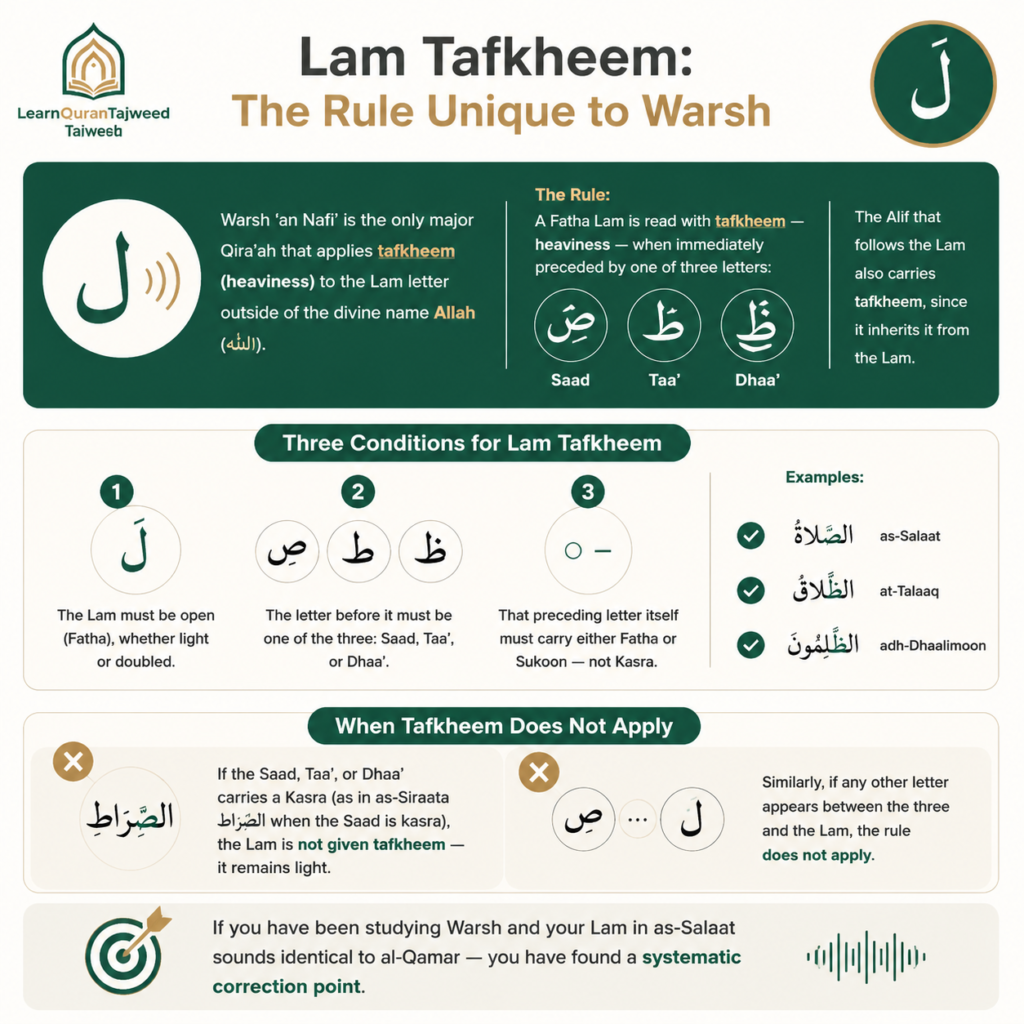
Lam Tafkheem( لام تفخيم)- The Rule Unique to Warsh
Warsh ‘an Nafi’ is the only major Qira’ah that applies tafkheemتفخيم (heaviness) to the Lam letter outside of the divine name Allah (الله). The rule- a Fatha Lam is read with tafkheem — heaviness — when immediately preceded by one of three letters: Saad (ص), Taa’ (ط), or Dhaa’ (ظ). The Alif that follows the Lam also carries tafkheem, since it inherits it from the Lam.
Three Conditions for Lam Tafkheem
The Lam must be open (Fatha), whether light or doubled. The letter before it must be one of the three: Saad, Taa’, or Dhaa’. That preceding letter itself must carry either Fatha or Sukoon — not Kasra. Examples: as-Salaat (الصلاة), at-Talaaq (الطلاق), adh-Dhaalimoon (الظالمون).
When Tafkheem Does Not Apply
If the Saad, Taa’, or Dhaa’ carries a Kasra (as in as-Siraata الصراط when the Saad is kasra), the Lam is not given tafkheem — it remains light. Similarly, if any other letter appears between the three and the Lam, the rule does not apply.
If you have been studying Warsh and your Lam in as-Salaat sounds identical to al-Qamar — you have found a systematic correction point.
Ra’ Rules(احكام الراء )-in Warsh Tajweed (Tafkheem and Tarqeeq)
Warsh ‘an Nafi’ applies a detailed, condition-based system to the pronunciation of Ra’ (ر). Compared to Hafs, Warsh pronounces Ra’ with Tafkheem (heaviness) in additional situations while also preserving several cases where Tarqeeq (thinning) is required. The rulings fall into three categories:
- Cases where Tafkheem is obligatory.
- Cases where Tarqeeq is obligatory.
- Cases where both Tafkheem and Tarqeeq are permissible.
1. Tafkheem( تفخيم )(Heaviness) of Ra’ — Obligatory
Ra’ must be pronounced with Tafkheem in the following situations:
| Condition | Examples | |
| The Ra’ has an incidental (non-original) Kasra. | ارْجِعِي · ارْجِعُونِ | |
| The Ra’ occurs in a foreign proper noun. | إبراهيم · إسرائيل · عمران | |
| The letter Ra’ is repeated within the same word. | ضِرَاراً لَّتَعْتَدُواْ | |
| A Saad (ص), Taa’ (ط), or Qaaf (ق)—letters of Isti’laa’—comes between the Kasra and the Ra’. | صِرَاطَ · إعْرَاضاً · فِرَاقُ · الإشْرَاقِ | |
| During Waqf (pause), the word ends with a silent Ra’ preceded by a Fatha, Damma, or Sukoon. | الْكُبَرِ · الزُّبُرِ |
2. Tarqeeq ترقيق (Thinning) of Ra’ — Obligatory
Ra’ must be pronounced with Tarqeeq in the following situations:
| Condition | Examples |
| A Fatha or Damma on Ra’ is immediately preceded by a Kasra in the same word. | ناضرة · وَتُعَزِّرُوهُ · الْكَافِرُونَ · سَاحِرٌ |
| A non-Isti’laa’ letter with Sukoon separates the Kasra from the Ra’. (Khaa’ خ is excluded from this rule.) | وِزْرَكَ · إِخْرَاجٍ |
| Ra’ (regardless of its vowel) is preceded by a silent Ya’ (ياء ساكنة). | وَنَذِيراً · ضَيْرَ |
| The final Ra’ is repeated within the same word. | فِرَاراً |
3. Cases Where Both Tafkheem and Tarqeeq Are Permitted
Both pronunciations are acceptable in a limited number of words.
A. Mansub Munawwan Nouns
When a noun is mansub with Tanween Fatha and follows the فِعْل (fi’l) pattern, both Tafkheem and Tarqeeq are permissible.
Examples:
- ذِكْراً
- سِتْراً
- إِمْراً
- وِزْراً
- وَصِهْراً
- حِجْراً
B. Specific Words During Waqf
The following words also allow both pronunciations only when stopping (Waqf):
Examples: وَنُذُرِ (Al-Qamar) • يَسْرِ (Al-Fajr) • حَيْرَانَ (Al-An’am).
Read also: What Is the Difference Between Hafs and Warsh Quran?
Inside Learn Quran Tajweed Academy
Curious about how online learning works? Peek inside our actual Quran classes and hear the beautiful recitation of our students and teachers.
Start Learning Warsh Tajweed with a Certified Teacher
Warsh Tajweed is not self-study material — its rules interact with each other, and applying one rule incorrectly in Hamzah or Madd can create systematic errors throughout your recitation. A certified instructor who holds Ijazah in Warsh ‘an Nafi’ will hear what you cannot hear yourself.
learnqurantajweed.com connects students worldwide with Ijazah-certified Quran teachers for live, one-on-one Warsh Tajweed instruction — structured from your current level to full proficiency.
- Practical Tajweed Course
- Beginner Tajweed Course
- Intermediate Tajweed Course
- Advanced Tajweed Course
- Quran Tarteel Course
- Tajweed Ijazah Program
- Tajweed Course for Sisters
Perfect Your Quran Recitation Today
Join expert-led Tajweed classes, and recite the Quran with confidence and clarity.
Start Your Free Trial
Conclusion
Warsh Tajweed is a complete, internally consistent recitation system — not simply “Hafs with longer vowels.” Its distinctive features — 6-count Madd al-Muttasil and Munfasil, the three-option Madd al-Badal, the four-tool Hamzah system, the unique Lam tafkheem, the nuanced Ra’ tarqeeq, and the Taqleel Imala positions — work together to produce a recitation style that is phonologically distinctive from every other Qira’ah.
The most common mistake students make when first approaching Warsh is treating its rules as additions to Hafs, adjusting one feature at a time. Warsh is better learned as its own phonological system: the Hafs-to-Warsh transition is most efficient when the learner works through Madd first, then Naql, then Hamzah — in that order — because each layer builds on the previous one.
Mastering Warsh Tajweed is accessible with a structured approach and a qualified teacher. The rules are precise, they are learnable, and they are preserved intact through unbroken chains of transmission to this day.
Frequently Asked Questions
What is Warsh Tajweed?
Warsh Tajweed is the set of recitation rules specific to the Qira’ah of Warsh ‘an Nafi’ via the route of Al-Azraq — one of the ten canonical Quranic readings. It governs pronunciation, elongation, Hamzah modification, and vowel inclination in ways that differ systematically from Hafs ‘an Asim.
How is Warsh different from Hafs in Madd?
The most immediate difference is Madd length. Warsh reads Madd al-Muttasil at 6 counts obligatorily and Madd al-Munfasil at 6 counts permissibly, where Hafs reads both at 4–5 counts. Warsh also adds three options for Madd al-Badal — a category that Hafs reads only at 2 counts.
What is Naql in Warsh, and does Hafs have it?
Naql is a rule in which Warsh transfers the vowel of a Hamzah al-Qat’ to the preceding sukoon letter, then drops the Hamzah. It does not exist in Hafs. The result is that words like al-ard and qad aflaha sound distinctly different between the two readings.
Where is Warsh used today?
Warsh ‘an Nafi’ is the dominant recitation in Morocco, Algeria, Tunisia, West Africa (including Senegal, Mali, Mauritania, and Niger), and parts of Sudan and Libya. It is the standard Mushaf text in these regions.
Can someone who knows Hafs learn Warsh Tajweed?
Yes, and the knowledge of Hafs Tajweed is a valid foundation. However, Hafs habits in Madd length, Hamzah pronunciation, and Ra’ quality will surface as systematic errors in Warsh recitation. Students learn most efficiently by identifying the rule categories that differ — Madd, Naql, Hamzah, Lam — and drilling each one under a certified Warsh instructor before attempting full Surah recitation.
Is Ijazah available in Warsh ‘an Nafi’ online?
Yes. Ijazah in Warsh ‘an Nafi’ (via Al-Azraq) is available through online instruction with certified teachers who hold their own chains of transmission back to the Imam. The student recites the complete Quran in Warsh under supervision, and the instructor verifies mastery before granting the Ijazah.
Related Articles
Tajweed Rules