 Quran
Quran
If you’ve ever picked up a Quran in North Africa and noticed the recitation sounds different from what you learned, you’ve already encountered the answer. What is the difference between Hafs and Warsh Quran is one of the most searched questions in Quranic studies — and for good reason.
These are two of the most widely used narrations (riwayat) of the Quran globally, both fully authentic and traceable to the Prophet ﷺ. The differences are real, specific, and governed by precise rules — not arbitrary variation.
What You’ll Learn in This Article
- What Hafs and Warsh actually are, and why both exist
- The exact phonetic differences: Madd, Hamzah, Ra’, Imala, and more
- Side-by-side Quranic verse examples where the two narrations diverge
- Which narration is used in which region — and why it matters for students
- How to transition from one narration to the other without mixing them
What Is the Difference Between Hafs and Warsh Quran?
The main difference between Hafs and Warsh Quran is that they are two authentic narrations (riwayat) of the same Quran, transmitted through different chains of reciters back to the Prophet ﷺ. They do not differ in the Quran’s message or authenticity.
Instead, their differences lie in specific rules of pronunciation, vowelization, and Tajweed—such as the length of Madd, the treatment of Hamzah, the pronunciation of Ra’, Imala, and Meem al-Jam’—all of which follow well-established recitation rules.
Another key difference is where each narration is commonly used. Hafs ‘an ‘Asim is the dominant narration across most of the Muslim world, including the Middle East, South Asia, and Southeast Asia, while Warsh ‘an Nafi’ is primarily recited in North and West Africa.
Both narrations are equally authentic and complementary, so the important rule for students is to learn one narration consistently and avoid mixing the recitation rules of Hafs and Warsh in the same recitation.
The Origin of the Hafs and Warsh narrations
Hafs ‘an ‘Asim traces through Hafs ibn Sulayman (d. 180 AH), a student of Imam ‘Asim ibn Abi al-Najud of Kufa. Hafs is the dominant narration globally — used across the Middle East, South Asia, Southeast Asia, Turkey, and most of sub-Saharan Africa.
Warsh ‘an Nafi’ traces through ‘Uthman ibn Sa’id, known as Warsh (d. 197 AH), a student of Imam Nafi’ al-Madani of Madinah. Warsh is the primary narration of North and West Africa — Morocco, Algeria, Tunisia, Mauritania, and parts of West Africa including Mali, Niger, and Senegal.
Both narrations meet all three classical conditions for authentic Qira’ah: grammatical agreement with Arabic, conformity with the Uthmani Mushaf skeleton (rasm), and unbroken transmission to the Prophet ﷺ.
The Core Phonetic Differences Between Hafs and Warsh
The differences between Hafs and Warsh are systematic, not random. They fall into identifiable categories — each governed by specific rules that must be applied consistently. Mixing rules from both narrations within a single recitation is a recognized error called tarkib al-riwayat, and it is prohibited in classical Tajweed scholarship.
Applying Madd Rules In Hafs and Warsh
Madd — the elongation of long vowels — is where the two narrations diverge most noticeably in practice.
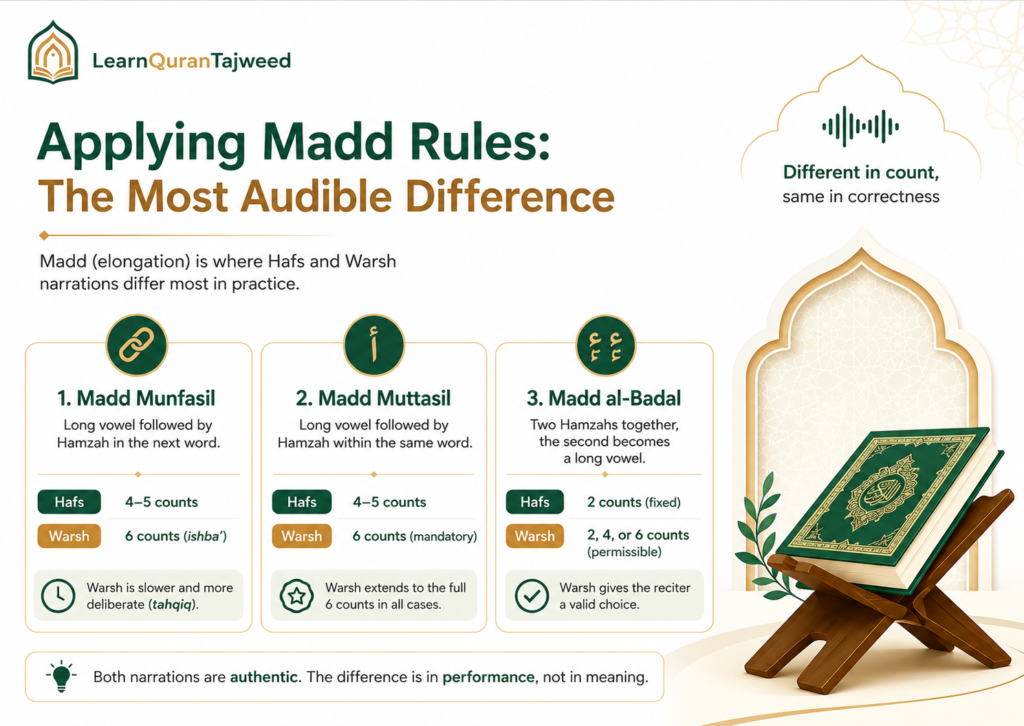
Madd Munfasil (separated elongation, where a long vowel is followed by a Hamzah in the next word) is treated differently in each narration. Hafs reads it at 4–5 counts. Warsh reads it at a full 6 counts (ishba’), giving his recitation a slower, more deliberate quality often described as tahqiq.
Madd Muttasil (connected elongation, where a long vowel is followed by a Hamzah within the same word) is read at 4–5 counts in Hafs and at a mandatory 6 counts in Warsh.
Madd al-Badal — elongation that occurs when two Hamzahs appear together and the second becomes a long vowel — is read at a fixed 2 counts in Hafs and Qalon, but Warsh permits 2, 4, or 6 counts, giving the reciter a valid choice in each occurrence.
Handling Hamzah: Tashil, Naql, and Ibdal in Warsh
Hafs consistently pronounces all Hamzahs with full articulation (tahqiq). Warsh applies several specialized rules that ease the Hamzah in specific grammatical positions.
Naql (transfer): When a word-final Hamzah is preceded by a sukoon, Warsh transfers the Hamzah’s vowel onto the preceding consonant and drops the Hamzah entirely from pronunciation. For example: وَمِنْ أَهْلِ is pronounced وَمِنَهْلِ in Warsh. Hafs has no naql.
Tashil (easing): When two Hamzahs appear in sequence within one word, Warsh eases the second by pronouncing it between a Hamzah and the long vowel that follows it, without adding the alif separator. Hafs pronounces both Hamzahs fully.
Ibdal (substitution): Warsh substitutes certain Hamzahs with the corresponding long vowel letter — turning هَاء into ها, for example — in specific conditions Hafs does not apply.
Learn Quran Tajweed‘s Quran Recitation with Tajweed Course trains students in the precise articulation rules behind Hamzah pronunciation, with live correction from certified instructors
.
Start mastering your recitation today with Learn Quran Tajweed
Applying Ra’ Pronunciation – Tarqiq and Tafkhim In Hafs and Warsh
Both narrations apply the rule that Ra’ (ر) may be read with tafkhim (heavy pronunciation) or tarqiq (light pronunciation) depending on context — but Warsh applies tarqiq in significantly more positions.
In Warsh, Ra’ following a kasrah or a sukoon preceded by a kasra is read lightly (tarqiq), even when the kasra is separated from the Ra’ by a sukoon. This includes words like خَبِيرٌ (khabir) and سِرَاجًا (sirajan), where the Ra’ is lightened in Warsh due to the preceding kasra — a rule Hafs does not apply.
Hafs applies tarqiq to Ra’ only when it directly follows a kasra or a sukoon that itself follows a kasra, in a more restricted set of conditions.
Imala In Warsh
Imala (inclination) refers to pronouncing an alif sound with a tilt toward the “ee” vowel — somewhere between a full “a” and a full “ee.” This gives the word a distinctive melodic quality.
Hafs applies imala in exactly one place in the entire Quran: the word مَجْرَاهَا in Surah Hud (11:41), read with full imala kubra (major inclination).
Warsh applies imala extensively across ذوات الياء — words whose alif derives from an original ya’ — and across many verse-final alifs in specific surahs. This creates the characteristic flowing sound of Warsh recitation that listeners often describe as melodically distinct from Hafs.
Applying Meem al-Jam’ Voweling in Warsh and Qalon
Meem al-jam’ is the plural suffix مْ (e.g., عَلَيْهِمْ). In Hafs, this meem is always read with sukoon (no vowel). Warsh adds a connected vowel — a waaw — when meem al-jam’ is followed by a voweled letter, extending it as عَلَيْهِمُو (with a 6-count sila). This sila is a distinctive marker of Warsh recitation and one of the first differences students transitioning from Hafs notice.
See Our Classrooms in Action
Watch these short clips from our live, interactive Quran courses to see how our students learn and interact with our expert tutors.
Perfect Your Quran Recitation Today
Join expert-led Tajweed classes, and recite the Quran with confidence and clarity.
Start Your Free TrialComparing Hafs and Warsh in Specific Quranic Verses
The clearest way to understand what is the difference between Hafs and Warsh Quran is to see the narrations side by side in actual verses. These are not theoretical — they are real divergences in recitation practice.
| Verse | Hafs Reads | Warsh Reads | Category of Difference |
| Al-Fatiha 1:4 | مَالِكِ يَوْمِ الدِّينِ (Malik — Owner) | مَلِكِ يَوْمِ الدِّينِ (Malik — King) | Farsh (word-level variant) |
| Al-Baqarah 2:214 | حَتَّىٰ يَقُولَ الرَّسُولُ (nasb — future) | حَتَّىٰ يَقُولُ الرَّسُولُ (raf’ — present state) | Haraka / grammatical case |
| Al-Baqarah 2:6 | أَأَنذَرْتَهُمْ (two clear Hamzahs) | أَانذَرْتَهُمْ (tashil of second Hamzah) | Hamzah rule |
| Al-Imran 3:133 | وَسَارِعُوا (with waaw) | سَارِعُوا (without waaw) | Farsh — conforms to Madani Mushaf |
| Al-Nisa’ 4:11 | يُوصِيكُمُ (with damma) | يُوصِّيكُمُ (with shaddah) | Farsh — verb form |
The Al-Fatiha difference is particularly important for students to understand. Both مَالِكِ (Owner) and مَلِكِ (King) are theologically true descriptions of Allah on the Day of Judgment. The narrations are not contradicting each other — they are conveying complementary aspects of divine sovereignty. This is the hermeneutic principle scholars call ikhtilaaf al-tanawwu’ (variation of complement, not contradiction).
Read also: Shu’bah Tajweed Rules and Differences from Hafs
Learn Quran Tajweed‘s Tajweed ul Quran Course teaches students to understand and correctly apply the Tajweed rules that govern these narration-level differences, building from makharij through applied recitation.

Book your first lesson at Learn Quran Tajweed and recite with precision
Recognizing Where Hafs and Warsh Recited Globally
Recognizing Where Hafs and Warsh Are Recited Globally helps students know which narration to expect when studying with teachers from different Muslim communities.
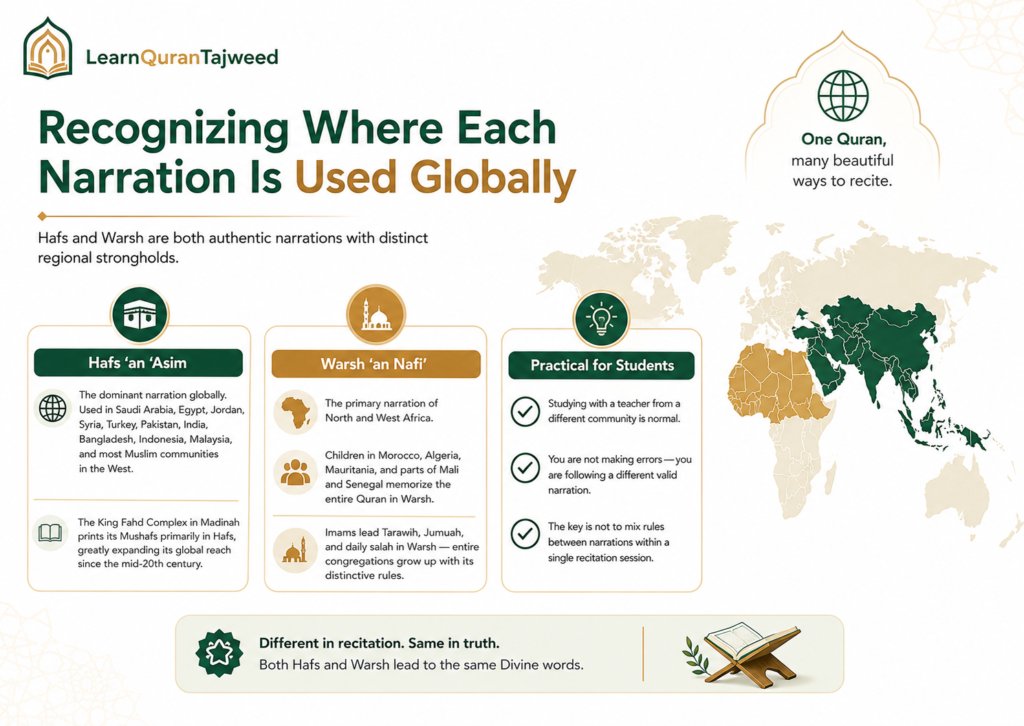
Hafs ‘an ‘Asim is the dominant narration globally. It is used in Saudi Arabia, Egypt, Jordan, Syria, Turkey, Pakistan, India, Bangladesh, Indonesia, Malaysia, and the majority of immigrant Muslim communities in the West. The King Fahd Complex in Madinah prints its Mushafs primarily in Hafs, which has accelerated its global reach significantly since the mid-20th century.
Warsh ‘an Nafi’ is the primary narration of North and West Africa. Children in Morocco, Algeria, Mauritania, and large parts of Mali and Senegal memorize the entire Quran in Warsh. In these countries, mosque imams lead Tarawih prayers, Jumuah, and daily salah reciting Warsh — which means entire congregations grow up distinguishing Madd ishba’, sila, and naql as normal features of Quranic recitation.
A practical implication for students: if you learned Quran in a Warsh-dominant community and are now studying with a Hafs-trained teacher (or vice versa), you are not making errors — you are applying a different valid narration. The key is not to mix rules between narrations within a single recitation session.
The Common Mistake When Switching Between Hafs and Warsh
The most widespread error students make when they encounter what is the difference between Hafs and Warsh Quran is attempting to apply both simultaneously. This is called tarkib al-riwayat — blending narrations — and classical scholars classify it as impermissible in recitation.
A student trained in Hafs who tries to add Warsh’s imala or naql without formal study of Warsh from a certified teacher will produce a hybrid recitation that belongs to neither tradition. The rules of each narration form an internally consistent system. Pulling isolated features from Warsh and inserting them into a Hafs recitation breaks that system.
The correct method is: master one narration completely before studying a second, and always do so under a teacher who holds an authorized sanad (chain of transmission) in that specific narration.
Learn Quran Tajweed‘s Intermediate Tajweed Course is designed for students who have a Hafs foundation and are ready to deepen their Tajweed precision — building the advanced sifat and ahkam awareness needed before studying a second narration.

Deepen your Tajweed foundation with Learn Quran Tajweed
Inside Learn Quran Tajweed Academy
Curious about how online learning works? Peek inside our actual Quran classes and hear the beautiful recitation of our students and teachers.
Start Reciting the Quran Correctly with Learn Quran Tajweed
Knowing the theory is one step. Reciting accurately under a certified teacher is where the knowledge becomes practice — and worship.
Learn Quran Tajweed connects you with Ijazah-certified instructors who teach Tajweed in structured, live 1-on-1 sessions — correcting your recitation in real time, from makharij through advanced applied rules. Whether you’re a beginner establishing your first foundation or an experienced reciter ready to refine your narration, there is a course built for your exact level.

Book your free trial lesson with Learn Quran Tajweed today
Courses we offer:
- Online Tajweed Classes
- Learn Quran with Tajweed Online
- Beginner Tajweed Course
- Intermediate Tajweed Course
- Advanced Tajweed Course
- Amali (Practical) Tajweed Course
Perfect Your Quran Recitation Today
Join expert-led Tajweed classes, and recite the Quran with confidence and clarity.
Start Your Free TrialConclusion
Understanding what is the difference between Hafs and Warsh Quran comes down to recognizing that both are fully authenticated narrations of the same divine text — transmitted through verified chains from the Prophet ﷺ to this day. Their differences are systematic and rule-governed: Warsh elongates Madd further, applies naql and tashil to Hamzah, extends imala across more positions, adds sila to meem al-jam’, and lightens Ra’ in more conditions than Hafs. Neither narration is more correct than the other — they are complementary expressions of a single preserved revelation. The practical takeaway: study one narration completely and consistently, learn it from a certified teacher who holds sanad in that tradition, and never blend rules between narrations in a single recitation.
Read also: Warsh Tajweed -The Complete Guide to Warsh ‘an Nafi’ Rules
Frequently Asked Questions
Do Hafs and Warsh recite a different Quran?
No. Both Hafs and Warsh recite the same Quran. The Arabic consonantal text (rasm ‘Uthmani) is identical in both narrations. The differences are in pronunciation, vowelization, and Tajweed application — not in any word, verse, or meaning of the Quran itself.
Why does Surah Al-Fatiha sound different in Warsh?
In Warsh, verse four reads مَلِكِ يَوْمِ الدِّينِ (King of the Day of Judgment), while Hafs reads مَالِكِ يَوْمِ الدِّينِ (Owner of the Day of Judgment). Both are authentic Mutawatir readings transmitted from the Prophet ﷺ, and both attributes — King and Owner — are simultaneously true of Allah. This is one of the clearest examples of how Quranic narrations complement rather than contradict each other.
What is naql in Warsh and does Hafs have it?
Naql is a rule in Warsh where the vowel of a Hamzah is transferred to the preceding sukoon-bearing consonant, and the Hamzah is dropped in pronunciation. For example, مَنْ أَمَنَ is pronounced مَنَاْمَنَ in Warsh. Hafs does not apply naql at all — it pronounces Hamzah fully in all positions.
Can I learn Warsh if I already know Hafs?
Yes, and your Hafs foundation helps significantly. You already know the Arabic text and basic Tajweed rules. Transitioning to Warsh requires formal study of Warsh’s specific rules — naql, tashil, extended Madd, imala positions, and sila — with a teacher who holds an authorized Warsh sanad. Plan for several months of consistent practice before your recitation in Warsh becomes stable.
Which narration should a beginner start with?
Most beginners start with Hafs because it is the most widely available narration globally — used in most printed Mushafs, apps, and online courses. Students from North or West African backgrounds often start with Warsh, which is what their community uses. Either is a valid starting point; the important thing is to learn one narration properly and completely before attempting a second.
Is mixing Hafs and Warsh rules allowed?
No. Classical scholars of Qira’at consider tarkib al-riwayat — blending rules from different narrations in one recitation — impermissible. Each narration is an internally consistent system of rules, and selectively applying features from Warsh inside a Hafs recitation (or vice versa) produces a hybrid that belongs to neither authenticated tradition.