 Tajweed Rules
Shu’bah Tajweed refers to the recitation rules narrated by Abu Bakr Shu’bah ibn Ayyash from Imam Asim ibn Abi al-Najud — one of the ten mutawatir (mass-transmitted) Quranic readings. It differs from the more widely known Hafs recitation in over 500 positions across the Quran, with distinctive rules in imala, idgham, hamza, and ha al-kinaya.
What you’ll learn in this article:
- Who Shu’bah ibn Ayyash was and his chain of transmission
- The core Tajweed principles unique to Shu’bah’s narration
- How Shu’bah differs from Hafs in madd, imala, and hamza
- Practical Quranic examples for each major rule
- How to start learning Shu’bah Tajweed with certified instruction
How Shu’bah Tajweed Was Transmitted
Shu’bah Tajweed traces back through a dual chain rooted in two Companions of the Prophet ﷺ. Imam Asim ibn Abi al-Najud told his student Hafs: “I taught you what Abu Abd al-Rahman al-Sulami taught me from Ali ibn Abi Talib, and I taught Abu Bakr [Shu’bah] what Zirr ibn Hubaysh taught me from Abd Allah ibn Mas’ud.”
This explains why the two narrations from the same imam — Hafs and Shu’bah — carry different readings: they preserve two separate Prophetic recitation chains.
Who Was Shu’bah ibn Ayyash
Abu Bakr Shu’bah ibn Ayyash al-Asadi al-Kufi was born in 95 AH and died in 193 AH. He studied directly under Imam Asim and was considered the more prominent of Asim’s two famous students — the Shatibiyya poem presents Shu’bah’s narration before Hafs.
Among those who received the recitation from him were Imam al-Kisa’i and Yahya al-Ulami. His narration as transmitted via Yahya al-Ulami forms the standard Shu’bah path studied through the Shatibiyya.
Madd Rules in Shu’bah Tajweed
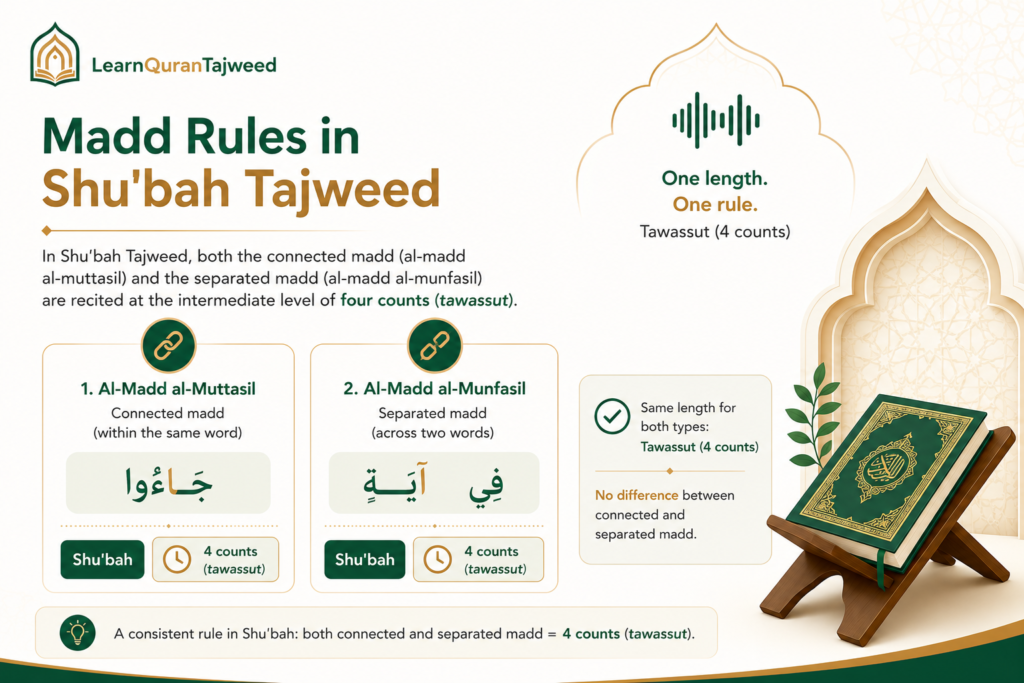
In Shu’bah Tajweed, both the connected madd (al-madd al-muttasil) and the separated madd (al-madd al-munfasil) are recited at the intermediate level of four counts (tawassut). This is a consistent rule with no variation between the two types — unlike some other narrations where the two lengths differ.
How Shu’bah Reads the Word Ra’uf
One of the most recognizable differences between Shu’bah and Hafs is the word رَءُوفٌ (Ra’uf — “Compassionate”). In Hafs, the hamza is followed by a lengthened waaw, producing a madd. In Shu’bah Tajweed, the hamza is shortened with no madd extension, wherever the word appears in the Quran.
The word رَءُوفٌ appears, for example, in the verse:
إِنَّ اللَّهَ بِالنَّاسِ لَرَءُوفٌ رَّحِيمٌ
(Inna Allaha bil-nasi la-Ra’oofun Raheem)
(“Indeed, Allah is, to the people, Kind and Merciful”)
Surah Al-Baqarah 2:143
Hafs reads رَءُوفٌ with a lengthened waaw; Shu’bah reads رَءُفٌ with a shortened hamza and no madd — a subtle but consistent distinction.
The Beginner Tajweed Course at Learn Quran Tajweed builds this kind of foundational precision from the first lesson, training students to distinguish Shu’bah-specific letter properties before advancing.

Start your Shu’bah recitation training with Learn Quran Tajweed today
Imala in Shu’bah Tajweed
Imala — tilting a fatha vowel toward a kasra sound, and its corresponding alif toward a ya — is one of the most audible features of Shu’bah Tajweed. Hafs uses almost no imala; Shu’bah applies it consistently across specific categories.
Imala in the Disconnected Opening Letters of Surahs
Shu’bah applies full imala (al-imala al-kubra) to the letters from the group حي طهر when they appear as disconnected opening letters (huruf al-muqatta’at). This means:
- The ح in حمٓ (Ha-Meem) openings is imaled
- The ط in طسٓ (Ta-Seen) and طسٓمٓ (Ta-Seen-Meem) is imaled
- The هـ and ي in كٓهيعٓصٓ (Kaf-Ha-Ya-‘Ain-Sad) are both imaled
For example, the opening of Surah Maryam:
كٓهيعٓصٓ
(Kaf-Ha-Ya-‘Ain-Sad)
Surah Maryam 19:1
Hafs recites this with full fatha on every letter. Shu’bah tilts the ها and ي toward kasra — a distinction immediately noticeable to the ear.
Imala in Specific Quranic Verbs and Nouns
Beyond the opening letters, Shu’bah applies imala to a defined set of words throughout the Quran:
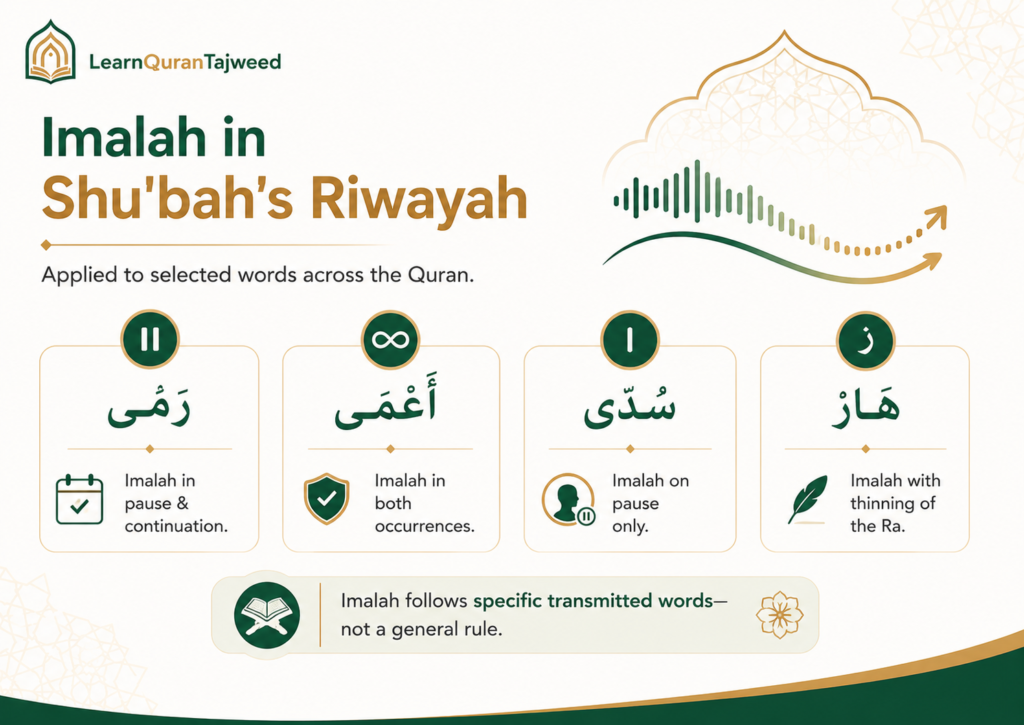
- كلمة رَمَىٰ (ramaa — “he threw”) in Surah Al-Anfal — imaled in both pause and continuation
- كلمة أَعۡمَىٰ (a’maa — “blind”) in both positions in Surah Al-Isra — imaled in both states
- كلمة سُدًى (sudan — “aimlessly”) in Surah Al-Qiyamah — imaled on pause only
- كلمة هَارٖ (haar — “crumbling”) in Surah Al-Tawbah — imaled with thinning of the ra
The word رَمَىٰ appears in the verse:
وَمَا رَمَيۡتَ إِذۡ رَمَيۡتَ وَلَٰكِنَّ ٱللَّهَ رَمَىٰ
(Wa ma ramayta idh ramayta wa laakinna Allaha ramaa)
(“And you did not throw, when you threw, but it was Allah who threw”)
Surah Al-Anfal 8:17
Idgham Rules Specific to Shu’bah
Shu’bah has two idgham (assimilation) rules that distinguish him from Hafs.
The first is the assimilation of dhaal into taa in all words from the root اتخاذ (ittikhadh — “to take/adopt”). Wherever the pattern occurs — such as اتَّخَذۡتُمُ, اتَّخَذۡتُمُوهُ, and similar forms — Shu’bah merges the dhaal fully into the taa. Hafs, by contrast, pronounces the dhaal clearly.
The second is the assimilation of nuun into waaw in two specific Quranic positions:
- يٓسٓ وَٱلۡقُرۡءَانِ — the noon of Yaa-Seen merges into the following waaw
- نٓ وَٱلۡقَلَمِ — the noon of Nun merges into the following waaw
The Intermediate Tajweed Course at Learn Quran Tajweed covers these assimilation distinctions in full, with direct application across Shu’bah Tajweed positions.

Refine your Shu’bah idgham with the Intermediate Tajweed Course at Learn Quran Tajweed
Read also: What Is the Difference Between Hafs and Warsh Quran?
See Our Classrooms in Action
Watch these short clips from our live, interactive Quran courses to see how our students learn and interact with our expert tutors.
Perfect Your Quran Recitation Today
Join expert-led Tajweed classes, and recite the Quran with confidence and clarity.
Start Your Free TrialHamza and Substitution Rules in Shu’bah Tajweed
Shu’bah’s approach to hamza differs from Hafs in several consistent patterns across the Quran.
How Shu’bah Reads Kufuan and Huzuwan
Both كُفُوًا (kufuwan — “equal”) in Surah Al-Ikhlas and هُزُوًا (huzuwan — “mockery”) wherever they appear are read by Hafs without hamza — using a plain waaw. Shu’bah reads both with a clear hamza: كُفُؤًا and هُزُؤًا.
The word كُفُؤًا appears in the verse:
وَلَمۡ يَكُن لَّهُۥ كُفُوًا أَحَدٌ
(Wa lam yakun lahu kufuwan ahad)
(“Nor is there to Him any equivalent”)
Surah Al-Ikhlas 112:4
How Shu’bah Reads the Name Jibreel
Wherever the name جِبۡرِيلَ (Jibreel — Gabriel) appears, Shu’bah reads it as جَبۡرَئِلَ — with fatha on the jeem and ra, followed by a hamza with kasra. Hafs reads جِبۡرِيلَ with kasra on the jeem and ra.
Similarly, the name مِيكَىٰلَ (Mikal — Michael) is read by Shu’bah as مِيكَائِيلَ, with a hamza and extended ya, producing both a madd muttasil and a madd badal.
The name وَجِبۡرِيلَ appears in:
وَجِبۡرِيلُ وَصَٰلِحُ ٱلۡمُؤۡمِنِينَ
(Wa Jibreelu wa salihu al-mu’mineen)
(“And Gabriel and the righteous among the believers”)
Surah Al-Tahrim 66:4
Shu’bah’s Substitution in the Word Lu’lu’
Wherever the word لُؤۡلُؤًا (lu’lu’an — “pearl”) appears, Shu’bah substitutes the first hamza with a plain madd waaw, reading it as لُولُؤًا. The second hamza is retained. Hafs reads both hamzas normally.
Ha al-Kinaya in Shu’bah Tajweed
Ha al-kinaya refers to the pronoun ه (him/it) when it appears between two voweled letters. The default rule is to extend it with a madd (called silat sughra). Shu’bah preserves this rule in most positions but silences the ha — reciting it without extension — in six specific words:
- يُؤَدِّهۡ (yu’addihi) — Surah Ali Imran
- نُؤۡتِهۡ (nu’tihi) — Surah Ali Imran and Surah Al-Shura
- نُوَلِّهۡ (nuwallih) and نُصۡلِهۡ (nuslih) — Surah Al-Nisa
- وَيَتَّقِهۡ (wa yattaqih) — Surah Al-Nur
Additionally, Shu’bah shortens the ha in فِيهِ مُهَانًا (feehi muhanan) in Surah Al-Furqan — eliminating the silat entirely — while Hafs extends it.
The Quran Recitation with Tajweed Course at Learn Quran Tajweed applies these ha al-kinaya distinctions in live recitation sessions with certified instructors.
Master Shu’bah ha al-kinaya rules with Learn Quran Tajweed’s recitation course
Shu’bah and the Sakt Positions
While Hafs observes a brief sakt (voiceless pause without breath) at four famous positions in the Quran, Shu’bah does not observe sakt at any of them. He reads continuously without pause at:
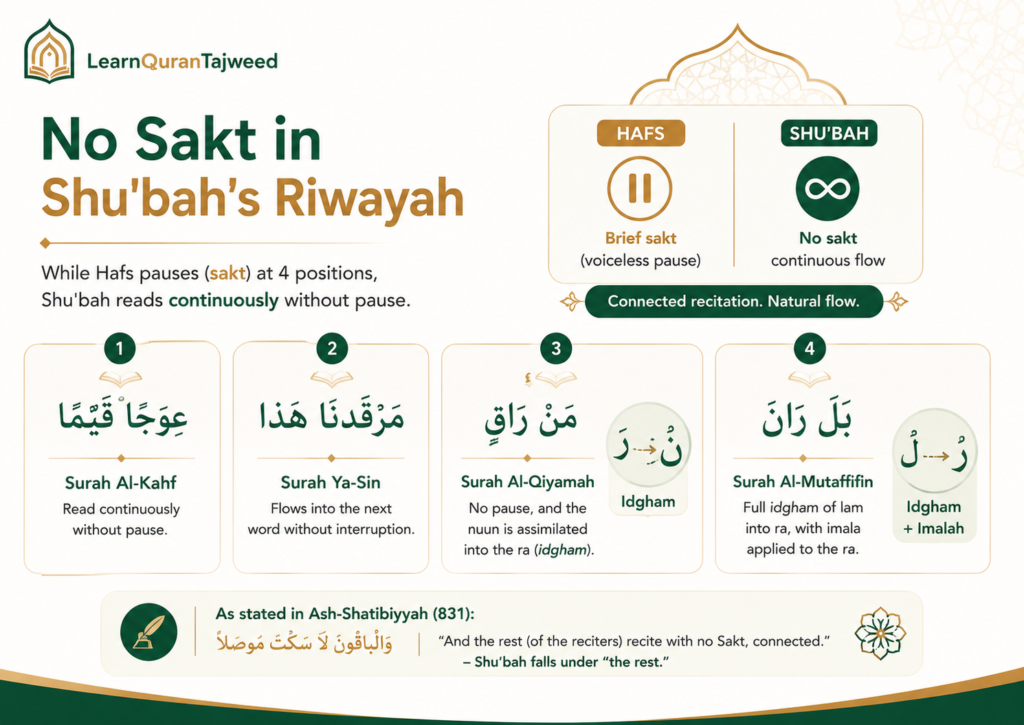
- عِوَجًا قَيِّمًا in Surah Al-Kahf
- مَرۡقَدِنَا هَٰذَا in Surah Ya-Sin
- مَنۡ رَاقٖ in Surah Al-Qiyamah — where he also assimilates the nuun into the ra
- بَلۡ رَانَ in Surah Al-Mutaffifin — where he also applies imala to the ra with full idgham
This is a practical point often tested in Tajweed exams: a student applying Hafs sakt rules to a Shu’bah recitation has made a transmitted error, not a minor pronunciation mistake.
Shu’bah Tajweed Versus Hafs at a Glance
| Feature | Hafs | Shu’bah |
| Madd al-munfasil | 4–5 counts (tawassut or tul) | 4 counts (tawassut only) |
| Word رَءُوفٌ | Madd on waaw | No madd (shortened hamza) |
| Imala in fawatih | None | Full imala on حي طهر letters |
| كُفُوًا / هُزُوًا | No hamza | With hamza |
| جِبۡرِيلَ | Kasra on jeem and ra | Fatha on jeem and ra + hamza |
| Sakt positions | Four positions | None |
| Idgham in اتخذتم | Dhaal is clear (izhaar) | Dhaal merges into taa |
| Ha al-kinaya in يُؤَدِّهۡ | Extended (silat) | Silent (saakin) |
| Zikraa / Zikrya | زَكَرِيَّا — no hamza | زَكَرِيَّاءَ — with hamza after alif |
Read also: Warsh Tajweed -The Complete Guide to Warsh ‘an Nafi’ Rules
Inside Learn Quran Tajweed Academy
Curious about how online learning works? Peek inside our actual Quran classes and hear the beautiful recitation of our students and teachers.
Start Learning Shu’bah Tajweed with Certified Instructors
Learn Quran Tajweed connects students with qualified instructors trained in Shu’bah Tajweed from authenticated chains. Whether you are beginning with the basics or transitioning from Hafs, the structured curriculum moves you through every distinction — madd, imala, idgham, hamza — with direct recitation correction in every session.

Book your free Shu’bah Tajweed trial lesson at Learn Quran Tajweed
Courses we offer:
- Tajweed Course for Kids
- Tajweed Course for Adults
- Tajweed Course for Ladies
- Tajweed ul Quran Course
- Quran Recitation with Tajweed Course
- Quran Tarteel Course
- Tajweed Ijazah Program
Perfect Your Quran Recitation Today
Join expert-led Tajweed classes, and recite the Quran with confidence and clarity.
Start Your Free TrialConclusion
Shu’bah Tajweed is a complete, mass-transmitted recitation narration from Imam Asim via two distinct Prophetic chains. Its most defining features — full imala on huruf al-muqatta’at, hamza in كُفُؤًا and هُزُؤًا, idgham of dhaal into taa, unique ha al-kinaya positions, and the absence of sakt — set it apart from Hafs at the level of transmitted rule, not stylistic preference. Every difference in Shu’bah Tajweed has a documented basis and must be applied consistently. For students already grounded in Hafs, learning Shu’bah is a disciplined process of replacing specific habits with authenticated alternatives — best done under live instruction from a certified teacher.
Frequently Asked Questions
Is Shu’bah Tajweed the same as Hafs with different pronunciation habits?
No. Shu’bah Tajweed is a separate transmitted narration (riwaya) from Imam Asim with over 500 documented differences from Hafs. These differences are fixed rules — not accent variations — and include distinct madd lengths, imala positions, hamza forms, and idgham rules.
Where does the imala in Shu’bah Tajweed apply?
Shu’bah applies full imala to the huruf al-muqatta’at from the group حي طهر, and to specific words including رَمَىٰ in Surah Al-Anfal, أَعۡمَىٰ in both positions in Surah Al-Isra, سُدًى in Surah Al-Qiyamah on pause, and هَارٖ in Surah Al-Tawbah.
Does Shu’bah read with sakt like Hafs?
No. All four positions where Hafs observes sakt — عِوَجًا قَيِّمًا, مَرۡقَدِنَا, مَنۡ رَاقٖ, and بَلۡ رَانَ — are read by Shu’bah with idraj (continuous flow) and without any pause.
What is the difference between Shu’bah and Hafs in reading كُفُوًا?
Hafs reads كُفُوًا without hamza, using a plain waaw. Shu’bah reads it as كُفُؤًا with a clear hamza. The same rule applies to هُزُوًا, which Shu’bah reads as هُزُؤًا wherever it appears.
Can I learn Shu’bah Tajweed online from scratch?
Yes. Learn Quran Tajweed offers structured online courses for Shu’bah Tajweed with certified instructors. Students typically begin with the Beginner Tajweed Course to establish foundational articulation, then advance to Shu’bah-specific rules with a dedicated instructor.
Related Articles
Tajweed Rules