 Tajweed Rules
Every verse of the Quran contains sounds that must be recited with the exact length prescribed by the rules of Tajweed. Among the most fundamental of these rules are Madd (elongation) and Qasr (shortening). Whether you are reading a single word or completing an entire surah, you are constantly making a Madd vs Qasr decision.
Holding a vowel longer than required or shortening a sound that should be extended changes the rhythm of the recitation and may affect the accuracy and beauty of the Quranic pronunciation.
Understanding the difference between Madd and Qasr is essential for every Quran learner, from complete beginners to advanced students studying the science of Tajweed. Madd governs when a vowel must be prolonged because of specific letters or conditions, while Qasr refers to maintaining the original, natural vowel length without any additional extension. Mastering these two principles helps preserve the authentic recitation passed down from the Prophet ﷺ and ensures that every letter receives its proper right.
In this guide, you will learn the classical definitions of Madd and Qasr, understand how they differ, explore the various types of Madd recognized in Tajweed, and discover when Qasr is required instead of elongation.
You’ll also find clear Quranic examples, practical pronunciation tips, and simple rules that will help you confidently determine whether a word should be recited with Madd or Qasr in any passage of the Quran.
What You’ll Learn in This Article
- The exact definitions of Madd and Qasr in both language and Tajweed terminology.
- Why Qasr is the default state and Madd always needs a cause.
- The three letters that trigger Madd — and when they don’t.
- Every type of Madd, its cause, its length, and whether it is obligatory or permitted.
- A decision framework for choosing between Madd and Qasr in real recitation.
- The most common mistakes reciters make — and how to avoid them.
What Is Madd and Qasr?
In Tajweed, Madd and Qasr are two essential concepts that determine how long a vowel sound should be pronounced during Quran recitation.
Madd literally means “extension” or “increase,” while in Tajweed it refers to prolonging the sound of one of the three letters of Madd (Alif, Waw, or Ya) when it is followed by a Hamzah or a Sukoon.
Qasr, on the other hand, literally means “restriction” or “confinement,” and in Tajweed it means pronouncing the Madd letter without any additional elongation, limiting it to its natural length. In practice, Qasr equals two counts (harakat), whereas Madd refers to any elongation beyond two counts, depending on the applicable Tajweed rule.
The Three Madd Letters (Huroof al-Madd حروف المد)
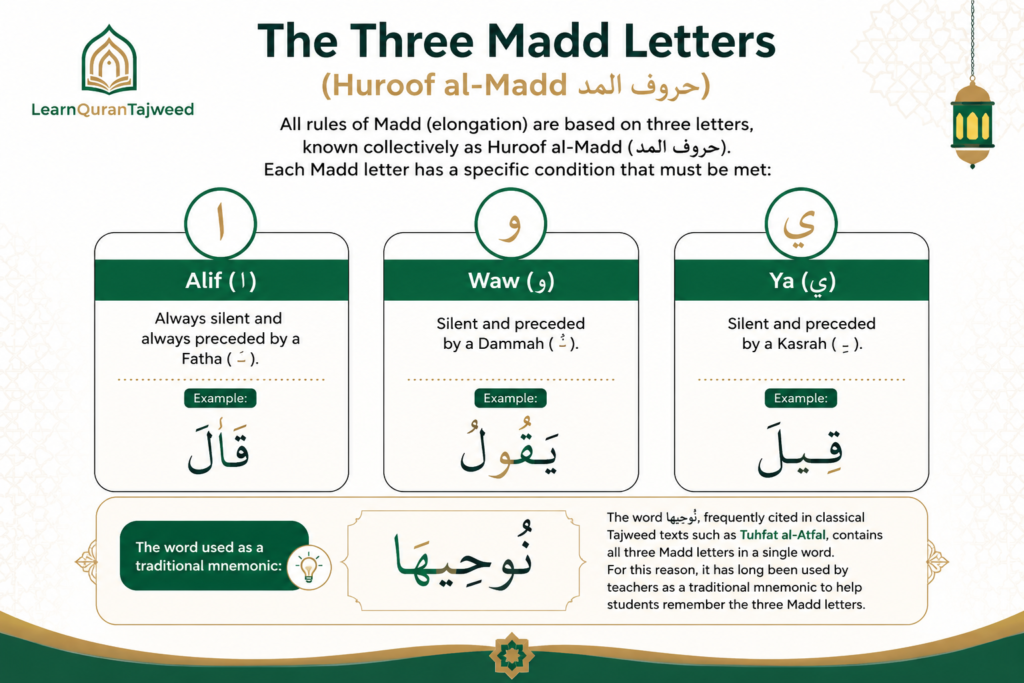
All rules of Madd (elongation) are based on three letters, known collectively as Huroof al-Madd (حروف المد). Each Madd letter has a specific condition that must be met:
- Alif (ا): Always silent and always preceded by a Fatha (ـَ).
Example: قَالَ - Waw (و): Silent and preceded by a Dammah (ـُ).
Example: يَقُولُ - Ya (ي): Silent and preceded by a Kasrah (ـِ).
Example: قِيلَ
The word نُوحِيهَا, frequently cited in classical Tajweed texts such as Tuhfat al-Atfal, contains all three Madd letters in a single word. For this reason, it has long been used by teachers as a traditional mnemonic to help students remember the three Madd letters.
Madd Letters vs. Leen Letters
A key point to remember is that Waw (و) and Ya (ي) do not always function as Madd letters. They can also serve as Leen (soft) letters, depending on the vowel that comes before them.
- When Waw is silent and preceded by a Dammah, or Ya is silent and preceded by a Kasrah, they are Madd letters.
- When either Waw or Ya is silent and preceded by a Fatha, they become Leen letters, not Madd letters.
Compare:
- خَوْفٌ → Leen (silent Waw preceded by a Fatha)
- يَقُولُ → Madd (silent Waw preceded by a Dammah)
This distinction is essential because Madd and Leen follow different Tajweed rules, particularly when stopping (waqf) on a word.
Read also: Madd Letters in Tajweed
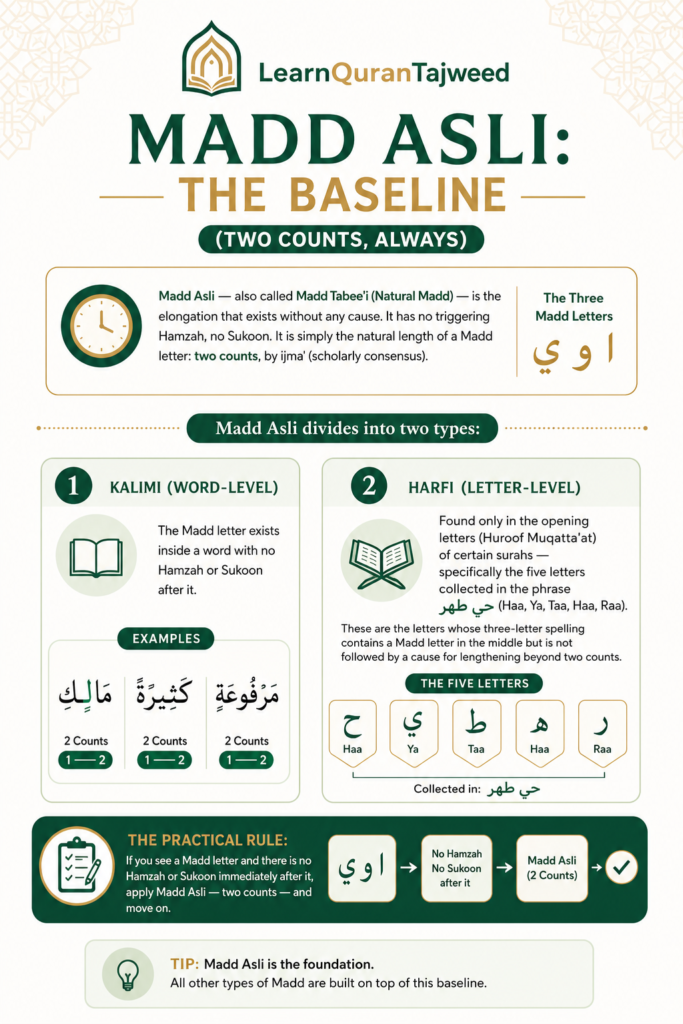
Madd Asli مد أصلي – Natural Madd (Two Counts, Always)
Madd Asli (المد الأصلي), also known as Madd Tabi’i (Natural Madd), is the basic form of elongation in Tajweed. It is called “natural” because the Madd letter cannot be pronounced correctly without extending its sound. This type of Madd does not depend on the presence of a Hamzah (ء) or a Sukoon (ْ) after the Madd letter. Instead, it occurs whenever one of the three Madd letters—Alif (ا), Waw (و), or Ya (ي)—appears with its required conditions. The elongation is always two counts (two harakat), with no increase or decrease.
Madd Asli is divided into two main categories:
1. Madd Tabi’i Kalimi مد طبيعي كلمي(Natural Madd in Words):
This occurs within regular words of the Qur’an when a Madd letter appears under its normal conditions. It also includes several related forms that are treated as natural Madd, namely:
a. Madd Al-Tamkeen (مد التمكين):
Madd Al-Tamkeen is the elongation of a Waw (و) or Ya (ي) madd letter for two counts when it is followed by a similar letter. This elongation prevents the madd letter from being omitted or merged into the following letter, ensuring a clear and correct pronunciation.
It occurs in three main situations:
- Two Ya’s meet – the first Ya is stressed (mushaddad) and the second is a silent madd letter.
Examples: ﴿النَّبِيِّينَ﴾, ﴿الْأُمِّيِّينَ﴾ - Two Waws meet – a silent Waw (preceded by a Dammah) is followed by a moving Waw.
Examples: ﴿آمَنُوا وَعَمِلُوا﴾, ﴿اصْبِرُوا وَصَابِرُوا﴾ - Two Ya’s meet – a silent Ya (preceded by a Kasrah) is followed by a moving Ya.
Examples: ﴿فِي يَوْمَيْنِ﴾, ﴿الَّذِي يُوَسْوِسُ﴾
b. Madd Al-‘Iwad (مد العوض):
Madd Al-‘Iwad occurs when stopping (waqf) on a noun ending with Fatḥatayn (ــً). The tanween is replaced with a madd Alif (ا) and is prolonged for two counts. It is considered a form of Natural Madd (Madd Ṭabīʿī) and is applied only when stopping; it is not applied when continuing the recitation.
Examples:
- ﴿حَكِيمًا﴾ → حَكِيمَا (when stopping)
- ﴿أَثَاثًا﴾ → أَثَاثَا (when stopping)
Exceptions:
- Words ending with Tāʾ Marbūṭah (ةً): When stopping, the Tāʾ Marbūṭah is pronounced as a silent Hāʾ (هْ), with no Madd Al-‘Iwad.
Example: ﴿شَجَرَةً﴾ → شَجَرَهْ - Maqṣūr nouns (ending with Alif Maqṣūrah ى): The final natural madd is maintained, and Madd Al-‘Iwad is not applied.
Example: ﴿هُدًى﴾ → هُدَى (when stopping)
c. Madd As-Silah As-Sughra (مد الصلة الصغرى):
Minor Silah Madd occurs when the pronoun Hāʾ (هاء الضمير) referring to a third-person singular masculine is followed by a vowel sound that produces a Waw (و) if the Hāʾ has a Dammah (ـُ) or a Ya (ي) if it has a Kasrah (ـِ). It is prolonged for two counts and is considered a form of Natural Madd (Madd Ṭabīʿī).
Conditions:
- The Hāʾ pronoun must be between two vowelled (moving) letters.
- The letter following the Hāʾ must not be a Hamzat Al-Qaṭʿ (ء). If a Hamzah follows, the rule becomes Major Silah Madd (Madd As-Silah Al-Kubra) instead.
Examples:
- Hāʾ with Kasrah (extended with a Ya):
﴿فَأَمَّا مَنْ أُوتِيَ كِتَابَهُۥ بِيَمِينِهِۦ﴾ - Hāʾ with Dammah (extended with a Waw):
﴿إِنَّهُۥ كَانَ بِعِبَادِهِۦ خَبِيرًۢا بَصِيرًا﴾
2. Madd Tabi’i Harfi مد طبيعي حرفي (Natural Madd in Isolated Letters):
This type occurs in certain disconnected letters (Al-Huruf Al-Muqatta’ah) that appear at the beginning of 29 surahs of the Qur’an. Among these are the letters grouped in the phrase “حي طهر”. They are considered natural Madd because the pronunciation of each letter consists of two sounds, with the second sound being a Madd letter, such as حا، يا، طا، ها، را, and each is prolonged for two harakat.
Madd Far’i When Elongation Extends Beyond Two Counts
Madd Far’i is any Madd that goes beyond the natural two counts. It is called “secondary” because it branches from Madd Asli. Two causes trigger it: a Hamzah or a Sukoon.
1. Madd Caused by Hamzah
In the science of Tajweed, prolongation due to the hamza is the lengthening of the sound of the vowel letter (alif, waw, ya) when the hamza comes with it, and it is divided into three main types:
A. Madd Muttasil (Obligatory Connected Madd)
The Hamzah falls inside the same word as the Madd letter. This Madd is Wajib (obligatory) — every school of Qira’at extends it beyond two counts, even if they disagree on the exact measure.
For Hafs ‘an ‘Asim (the most widely read narration), the length is four or five counts in both connection and pause. No scholar permits Qasr (two counts) in Madd Muttasil — Ibn al-Jazari searched every narration and found no precedent for it.
Examples: السَّمَاءَ، الْمَلَائِكَةَ، السُّوءَ، تَفِيءَ
The cause of the extension is phonetic: the Hamzah is a heavy stop-consonant. The Madd before it gives the reciter the breath and space to produce the Hamzah cleanly and with its full quality.
B. Madd Munfasil (Permitted Separated Madd)
The Madd letter ends one word and the Hamzah opens the next word. This Madd is Ja’iz (permitted) — meaning it may be elongated beyond two counts, but Qasr (two counts) is also valid.
For Hafs ‘an ‘Asim via the Shatibiyya path, the standard recited length is four or five counts during connection. At a pause, the second word is not reached, so the Madd collapses to its natural two counts.
Examples: قَالُوا آمَنَّا،
وَفِي أَنفُسِكُمْ،
يَا أَيُّهَا
The critical rule for both Madd Muttasil and Madd Munfasil: you must be consistent within a single recitation session. You cannot read one Munfasil at four counts and the next at two. Ibn al-Jazari’s principle — “the pronunciation of a word is the same as its equivalent” — makes inconsistency a Tajweed error, not merely a stylistic choice.
C. Madd Badal (Substitution Madd)
A Hamzah precedes the Madd letter — the opposite of Muttasil. The Madd letter itself was originally a second Hamzah, which was softened into a Madd letter for ease of pronunciation.
Examples:
- آمَنَ ← originally أَأْمَنَ (two Hamzahs became one long Ā)
- إِيمَانًا ← originally إِئْمَانًا (the second Hamzah changed to Yāʼ Madd (ي))
- أُوتُوا ← originally أُؤْتُوا (the second Hamzah changed to Wāw Madd (و)
For Hafs, Madd Badal is always two counts (Qasr). It behaves exactly like Madd Asli. Some other narrations (notably Warsh ‘an Nafi’) permit lengthening it further, but for Hafs students, Badal = Qasr.
Read also: Idgham Saghir in Tajweed With Examples
See Our Classrooms in Action
Watch these short clips from our live, interactive Quran courses to see how our students learn and interact with our expert tutors.
Perfect Your Quran Recitation Today
Join expert-led Tajweed classes, and recite the Quran with confidence and clarity.
Start Your Free Trial2. Madd Caused by Sukoon:
Madd due to sukoon is the lengthening of the sound of a madd letter when it is followed by a sukoon letter. It is divided into two main types in Tajweed.
A. Madd Laazimمد لازم (Necessary Madd)
A Sukoon that is permanent — present in both connection and pause — follows the Madd letter. The length is fixed at six counts by the consensus of all Qira’at scholars.
Madd Laazim has four subtypes:
Kalimi Muthaqqal كلمي مثقل (Heavy Word-Level):
The Madd letter is followed by a shaddah (doubled consonant) in the same word. The shaddah means the following letter has a built-in Sukoon that is absorbed into the following consonant — permanent and immovable.
Examples: الضَّالِّينَ، الْحَاقَّةُ، دَابَّةٍ
Kalimi Mukhaffaf كلمي مخفف(Light Word-Level):
A permanent Sukoon follows the Madd letter with no shaddah. This occurs in exactly two places in the Quran — both in Surah Yunus (verses 51 and 91): آلْآنَ
Harfi Muthaqqalحرفي مثقل (Heavy Letter-Level):
Mad lazim harfi Muthaqqal Found in the opening letters of surahs whose spelling contains a Madd letter followed by a Sukoon that merges into the next letter.
Examples: الم، طسم
Harfi Mukhaffafحرفي مخفف (Light Letter-Level):
Madd Lazim Harfi Mukhafaf occurs when a Madd letter is followed by an original (permanent) Sukoon that is neither doubled (non-Mushaddad) nor assimilated (non-Idgham)
Examples: الر، ق، يس، حم
The eight letters that carry Madd Laazim in their spelling are collected in the phrase نقص عسلكم (Nun ن, Qaf ق, Sad ص, ‘Ayn ع, Sin س, Lam ل , Kaf ك, Mim م ). Any opening letter outside this group is either Madd Asli (two counts) or not a Madd letter at all.
B. Madd ‘Aarid Lissukoonمد عارض للسكون (Pause-Induced Madd)
The Sukoon here is temporary — created only because you stop at the end of a word. The Madd letter or Leen letter precedes the final letter of a word, and that final letter receives a temporary Sukoon when you pause.
Length options: two, four, or six counts at pause. All three are valid. During connection (without stopping), the Sukoon disappears and the Madd returns to its natural two counts.
Examples during pause: اللَّهِ، الرَّحْمَٰنِ، الرَّحِيمِ، مُخْتَلِفُونَ، يُؤْمِنُونَ
When Leen letters (خَوْفٌ، الْبَيْتِ) precede the pause, the same three options apply — but only at the pause. During connection: two counts only.
A common recitation error: reading Madd ‘Aarid at six counts during connection (as if it were Madd Laazim), then switching to two counts right before bowing in salah. The classical scholars explicitly warn against this inconsistency — the chosen length for ‘Aarid must be held throughout the surah.
Read also: Shiddah, Tawassut, and Rakhawah: Comparing Letter Characteristics in Tajweed
The Madd Types at a Glance
Not all Madd rules are the same. Some occur naturally as part of normal pronunciation, while others are triggered by specific letters or stopping at the end of a verse. Each type has its own cause, recitation length, and ruling in Tajweed. The table below provides a quick reference to the seven main types of Madd you’ll encounter when reading the Quran, making it easier to compare them at a glance before studying each one in detail.
| Madd Type | Cause | Length (Harakaat) | Ruling |
| Asli (Natural) | No cause | 2 | Required baseline |
| Muttasil | Hamzah in same word | 4–5 | Wajib (obligatory) |
| Munfasil | Hamzah in next word | 2–5 (4–5 for Hafs) | Ja’iz (permitted) |
| Badal | Hamzah before Madd letter | 2 (for Hafs) | Qasr only |
| Laazim | Permanent Sukoon | 6 | Wajib (obligatory) |
| ‘Aarid Lissukoon | Temporary pause Sukoon | 2, 4, or 6 | Ja’iz at pause |
| Leen | Leen letter at pause | 2, 4, or 6 | Ja’iz at pause |
Read also: Understanding At-Tafashi in Tajweed: The Rule of Letter Shin
The Madd vs Qasr Decision Framework
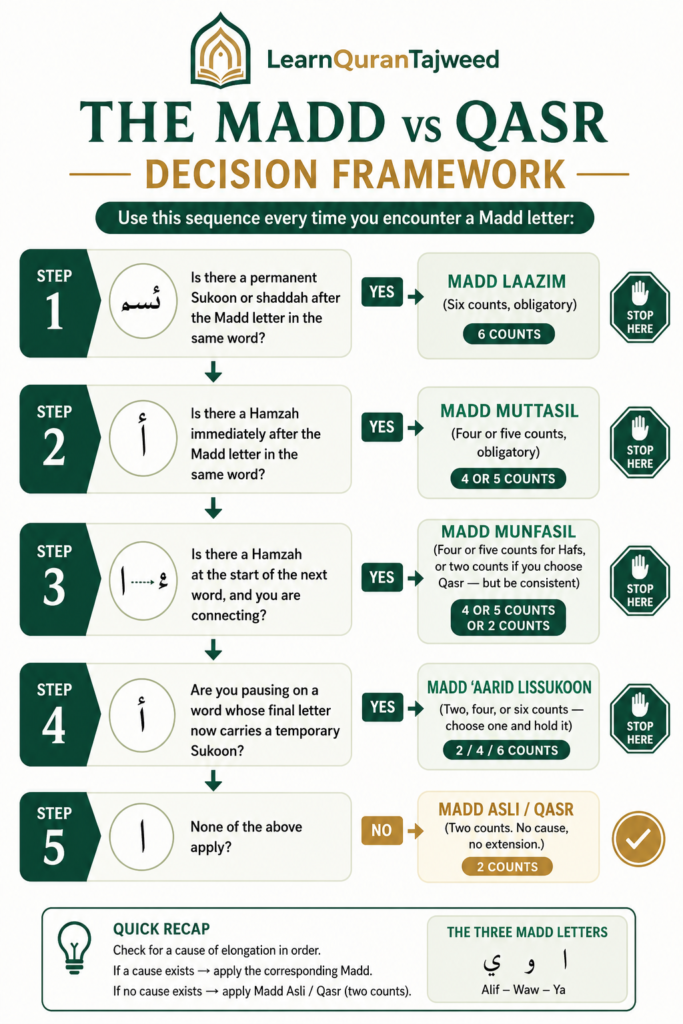
Use this sequence every time you encounter a Madd letter:
Step 1 — Is there a permanent Sukoon or shaddah after the Madd letter in the same word? Yes → Madd Laazim (six counts, obligatory). Stop here.
Step 2 — Is there a Hamzah immediately after the Madd letter in the same word? Yes → Madd Muttasil (four or five counts, obligatory). Stop here.
Step 3 — Is there a Hamzah at the start of the next word, and you are connecting? Yes → Madd Munfasil (four or five counts for Hafs, or two counts if you choose Qasr — but be consistent). Stop here.
Step 4 — Are you pausing on a word whose final letter now carries a temporary Sukoon? Yes → Madd ‘Aarid Lissukoon (two, four, or six counts — choose one and hold it).
Step 5 — None of the above apply. → Madd Asli / Qasr: two counts. No cause, no extension.
Common Mistakes to Avoid
Even after understanding the rules of Madd, many learners make small mistakes that affect the accuracy and rhythm of their recitation. Most of these errors come from confusing similar types of Madd or applying the correct rule in the wrong situation. Recognizing these common mistakes will help you recite with greater confidence and avoid habits that can be difficult to correct later.
Confusing Madd Asli with Madd ‘Aarid
During connection, الرَّحِيمِ has a two-count Ya (Madd Asli). At a pause on الرَّحِيمِ, the Madd letter is still there but now a temporary Sukoon follows it — making it Madd ‘Aarid, which can be two, four, or six counts. Many students hold six counts in connection and two counts at a pause, reversing the logic.
Treating Madd Munfasil as optional in the sense of being inconsistent
Munfasil is “Ja’iz” meaning you may choose Qasr or a longer measure — but whichever you choose becomes binding for that entire recitation session.
Shortening Madd Muttasil to two counts.
This has no precedent in any valid Qira’at and is a clear error.
Reading the Ya or Waw as a Madd letter when it is actually a Leen letter.
When the letter before the silent Waw or Ya is a Fatha (not a Dammah or Kasrah), the rules change.
خَوْفٌ is Leen, not Madd — during connection there is no extension; at a pause, Madd ‘Aarid rules apply.
Read also: Idgham Kabir – Full Guide With Examples
Inside Learn Quran Tajweed Academy
Curious about how online learning works? Peek inside our actual Quran classes and hear the beautiful recitation of our students and teachers.
Start Reciting with Precision — Join learnQuranTajweed
Knowing the rules of Madd and Qasr on paper is the first step. Applying them accurately across a full surah — while managing breath, pronunciation, and focus — requires trained ears and real-time feedback.
At learnQuranTajweed, our Ijazah-certified instructors correct your Madd lengths in live sessions, not after the fact. Whether you are working through Surah Al-Fatiha or preparing for an Ijazah chain, we meet you at your level and move at your pace.
Book your free trial lesson today and give every vowel the length it is owed.
Courses we offer:
- Online Tajweed Classes
- Learn Quran with Tajweed Online
- Beginner Tajweed Course
- Intermediate Tajweed Course
- Advanced Tajweed Course
- Amali (Practical) Tajweed Course
Perfect Your Quran Recitation Today
Join expert-led Tajweed classes, and recite the Quran with confidence and clarity.
Start Your Free Trial
Conclusion
Madd and Qasr are not two competing options — they are two precise states governed by clearly defined rules. Qasr is the natural resting state of a Madd letter: two counts, no cause required. Madd beyond two counts always has a cause — a Hamzah or a Sukoon — and the nature of that cause determines the length and whether elongation is obligatory or merely permitted.
The five-step decision framework above gives you a reliable method for handling any Madd letter you encounter. Master the cause, identify the type, apply the correct length, and hold that length consistently throughout your recitation. That consistency — more than any single correct count — is what separates a precise recitation from a good-faith approximation.
Frequently Asked Questions
What is the difference between Madd and Qasr?
Madd is the prolongation of a vowel sound beyond the natural two-count baseline when a specific cause — a Hamzah or Sukoon — is present after a Madd letter. Qasr is holding that same Madd letter at exactly two counts with no additional extension. Qasr is the default; Madd beyond two counts always requires a cause.
Is Qasr ever wrong?
Qasr (two counts) is wrong in Madd Muttasil and Madd Laazim, where all Qira’at scholars agree that the length must exceed two counts. In Madd Munfasil and Madd ‘Aarid, Qasr is a valid recitation choice. In Madd Asli, two counts is not “Qasr” at all — it is the correct and only length.
What is the minimum length for Madd Muttasil?
No authenticated narration permits fewer than three counts in Madd Muttasil. For Hafs ‘an ‘Asim via the Shatibiyya path, the standard is four or five counts. Ibn al-Jazari reviewed every narration and found no precedent for two-count Muttasil.
How is a harakah measured?
A harakah (count) is the time it takes to say one short vowel — Fatha, Kasrah, or Dammah — at your natural recitation pace. Practically, it is the time to open or close one finger. At any pace (fast or slow), the ratio between your counts must remain constant.
Can I mix different Madd lengths in one recitation?
No. Once you choose a length for a variable Madd (Munfasil or ‘Aarid), that length must be applied consistently to every equivalent instance in that recitation session. Ibn al-Jazari’s rule — “the pronunciation of a word is the same as its equivalent” — makes inconsistency a Tajweed error, not a stylistic variation.
What are the three letters of Madd?
The three Madd letters are Alif (ا) preceded by Fatha, Waw (و) preceded by Dammah, and Ya (ي) preceded by Kasrah. All three appear together in the word نُوحِيهَا, which classical Tajweed scholars use as the standard mnemonic.
Related Articles
Tajweed Rules